

Bicyclist fatalities in the US peaked at 1,105 in 2022, yet only 18% of victims were wearing helmets at the time of the crash. That single number tells you everything about the gap between what riders know and what they actually do. But 2026 is not just about reminding people to wear helmets. It is about a new generation of gear, from radar-enabled tail lights to AI-powered crash detection, that is fundamentally changing what it means to ride safely. This article breaks down the most important safety trends, technologies, and habits every urban and road cyclist needs to know right now.
Table of Contents
- Cyclist safety in 2026: Key data and urban risk factors
- Next-generation helmets: MIPS, airbag systems, and smart features
- Radar tail lights and advanced visibility tech
- 2026 cycling safety checklist: Tech, habits, and expert advice
- Where to find the latest cycling safety gear
- Frequently asked questions
Key Takeaways
| Point | Details |
|---|---|
| Urban cycling risks rising | Most cyclist fatalities now occur in urban areas and at dusk or night, highlighting the danger of low visibility. |
| Smart helmets are essential | Helmets with MIPS or advanced rotational protection drastically reduce head injury risk. |
| Radar tail lights boost safety | Radar-enabled tail lights give real-time vehicle alerts for greater awareness, especially on busy roads. |
| Behavior still matters | Combining tech upgrades with smart riding habits offers the best defense against accidents. |
Cyclist safety in 2026: Key data and urban risk factors
Before we talk gear, the numbers deserve your attention. Cycling fatalities are not evenly distributed. They cluster in specific environments, at specific times, and among specific rider types. Understanding where the risk is highest helps you prioritize the right upgrades.
In the US, urban areas account for 75% of bike fatalities, with 33% of those crashes happening at dusk or night. In Europe, 70% of urban deaths involve vulnerable road users, including cyclists and pedestrians. Meanwhile, European cyclists represent roughly 1,800 fatalities per year, making up 9% of total road deaths, and progress toward the EU’s 2030 reduction goals is already off track.
Here is a quick breakdown of where the risk concentrates:
| Risk factor | US impact | European impact |
|---|---|---|
| Urban riding | 75% of fatalities | 70% of urban deaths are vulnerable users |
| Dusk or night riding | 33% of crashes | Major contributor to fatality spikes |
| E-bike adoption | Rising crash rates | Faster speeds, same infrastructure |
| Helmet non-use | 82% of fatalities | Varies by country and regulation |
The e-bike factor is worth calling out separately. As more commuters switch to e-bikes for speed and convenience, they are riding faster on infrastructure designed for slower cyclists. That speed gap creates new blind spots, both literally and in terms of how other road users perceive them.
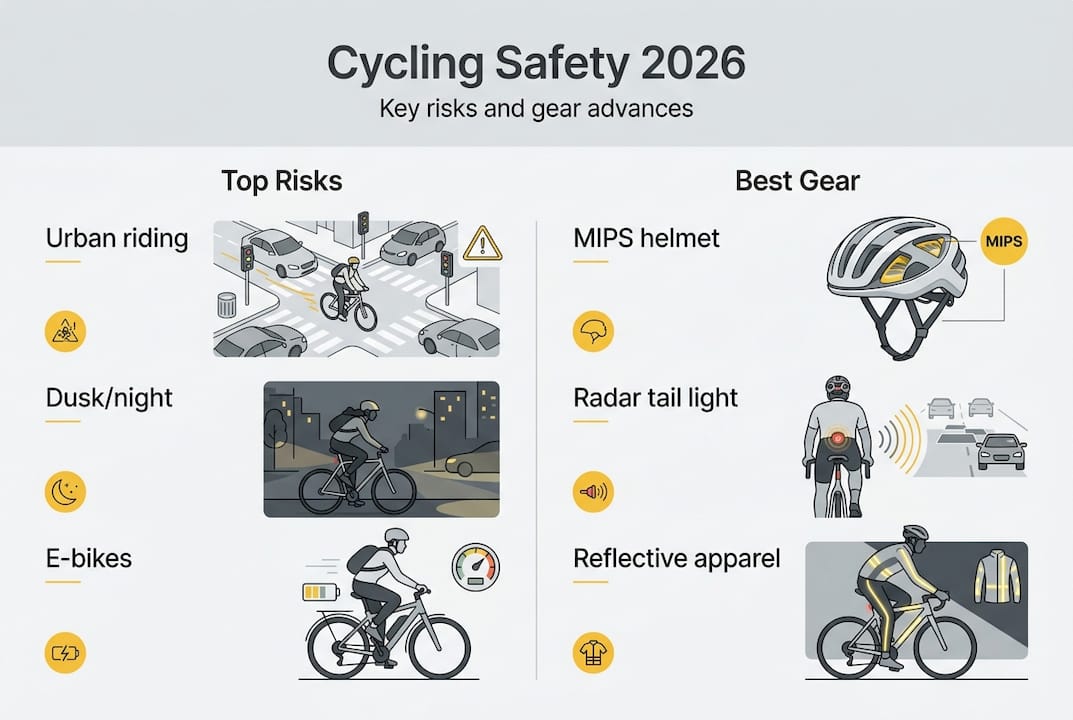
Key takeaway: If you ride in a city, at night, or on an e-bike, you are in the highest-risk categories. The gear you choose needs to reflect that reality.
Next-generation helmets: MIPS, airbag systems, and smart features
A basic foam helmet is not enough anymore. Not because it offers zero protection, but because the science of head injury has moved well beyond what a simple EPS shell can address. Rotational force, the kind generated when your head hits the ground at an angle, is now understood to be a primary driver of traumatic brain injury. That is exactly what MIPS helmet technology is designed to counteract.
Helmets with MIPS or similar systems (like SLID) add a low-friction layer inside the shell that allows the helmet to rotate slightly on impact, redirecting rotational energy away from the brain. Studies confirm that helmets reduce head injury risk by 48 to 60%, but that figure climbs significantly when rotational protection is included. If you are still wondering whether MIPS is worth it, the short answer is yes, especially for urban and road riders who face angled impacts in traffic.
For 2026, helmet innovation has accelerated into territory that would have seemed futuristic just a few years ago:
- Advanced MIPS and SLID systems now appear across price points, not just premium models.
- Airbag helmets (like the Hövding collar) offer a different form factor for urban commuters who resist traditional helmets.
- AI crash detection can sense an impact and automatically alert emergency contacts via a paired smartphone.
- Smart material integration uses energy-absorbing foams that respond differently to low-speed vs. high-speed impacts.
Here is how the main helmet categories compare:
| Helmet type | Rotational protection | Smart features | Best for |
|---|---|---|---|
| Basic EPS helmet | None | None | Casual, low-risk riding |
| MIPS or SLID helmet | Yes | Optional | Urban, road, e-bike |
| Airbag helmet | High | Limited | Urban commuters |
| Smart helmet with AI | Yes | Crash detection, alerts | All serious cyclists |
On certification: Europe uses EN1078, which is generally considered stricter than the US CPSC standard. Virginia Tech’s 5-star rating system is the most rigorous independent benchmark available in both markets. If you are shopping for a European helmet selection, look for EN1078 plus a Virginia Tech rating for the strongest combination.
Pro Tip: Do not just check the certification sticker. Look up your helmet model on the Virginia Tech Helmet Ratings database before you buy. A certified helmet and a top-rated helmet are not always the same thing.
Radar tail lights and advanced visibility tech
If helmets protect you after a crash, radar tail lights work to prevent the crash from happening at all. The concept is straightforward: a radar unit mounted to your seatpost or rack continuously scans the road behind you, detecting approaching vehicles and alerting you through a handlebar display or a connected cycling computer.
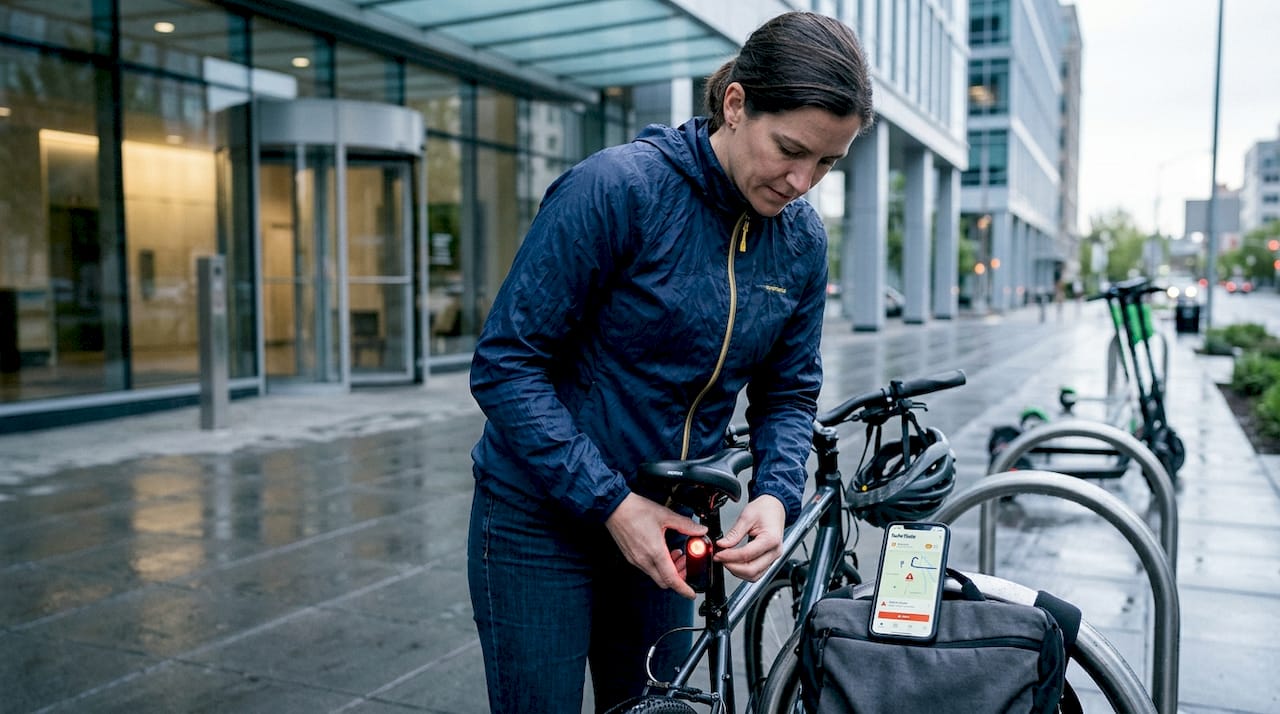
Die Garmin RearVue 820 sets the current benchmark for 2026. It delivers 100 lumens of visibility, detects vehicles up to 175 meters behind you, covers a 60-degree field of view, tracks lane position and vehicle speed, activates a brake light when you decelerate, and runs for up to 24 hours on a single charge. That is a serious package for any road or urban rider.
Here is how the leading radar tail lights compare:
| Feature | Garmin RearVue 820 | Wahoo Radar | Lezyne Radar |
|---|---|---|---|
| Detection range | 175m | 140m | 130m |
| Brake light | Yes | Yes | No |
| Battery life | 24h | 15h | 12h |
| GPS integration | Yes | Yes | Limited |
| Lumens | 100 | 90 | 75 |
For urban riders, the brake light function alone is worth the investment. Drivers in city traffic are not always watching for cyclists, and a light that flares brighter when you slow down gives them a critical extra second of reaction time.
“Situational awareness is the single biggest gap in urban cycling safety. Radar tail lights close that gap by giving you eyes in the back of your head.”
Beyond radar, protection technology innovations in 2026 also include smarter reflective systems, integrated turn signals in helmets, and connected accessories that sync with cycling computers. The Urbanproof radar rear light is a solid entry-level option for riders who want radar awareness without the premium price tag.
Pro Tip: Pair your radar tail light with a front light that has a daytime flash mode. Studies consistently show that being visible from the front reduces intersection crashes, which are among the most deadly for urban cyclists.
2026 cycling safety checklist: Tech, habits, and expert advice
Gear matters, but gear without good habits is only half the equation. Urban and road cyclists should prioritize MIPS helmets and radar lights as their baseline, but infrastructure still lags behind technology. That means your behavior on the road has to compensate for gaps that no gadget can fully fix.
Here is a practical checklist for 2026:
- Helmet with MIPS or SLID: Non-negotiable for any road, urban, or e-bike rider. Check EN1078 (Europe) or CPSC (US) certification, then cross-reference with Virginia Tech ratings.
- Radar tail light: Essential for road cycling and strongly recommended for urban commuting, especially in mixed-traffic or multi-lane environments.
- Front light with daytime mode: Run it during the day. Visibility is not just a night issue.
- High-visibility reflectors or vest: Particularly important at dusk, which accounts for a disproportionate share of fatalities.
- Route planning: Use cycling-specific apps to identify safer corridors, avoid high-speed roads, and plan for lighting conditions.
For behavior, focus on these high-impact habits:
- Avoid riding in drivers’ blind spots, especially near trucks and buses.
- Slow down at intersections even when you have the right of way.
- Increase following distance on e-bikes, since your stopping distance is longer than on a standard bike.
- Ride predictably. Sudden lane changes are a leading cause of cyclist-vehicle collisions.
Pro Tip: Check your local regulations before buying lights or helmets. Some European countries have specific lumen requirements for front and rear lights, and certain helmet standards are legally mandated for e-bike riders above a set speed threshold.
For a deeper look at how cyclist safety technologies are evolving across all these categories, it is worth staying current as new products and standards roll out through 2026.
Where to find the latest cycling safety gear
Knowing what to buy is one thing. Finding it in one place is another. At THE BEAM, we have built our entire product line around the safety priorities this article covers: rotational impact protection, visibility, and connected safety features for real-world riding conditions.
Our men’s helmets collection includes models with MIPS and SLID technology, designed for road, urban, and e-bike use, and certified to both EN1078 and CPSC standards. Our flagship VIRGO integral helmet brings full-face protection with MIPS to riders who want maximum coverage without sacrificing aerodynamics or style. Beyond helmets, our cycling accessories range covers radar-compatible lights, high-visibility reflectors, rear-view mirrors, and connected safety tools, all available for delivery across Europe and the United States. If you are ready to upgrade your setup for 2026, this is where to start.
Frequently asked questions
What is the most important cycling safety trend for 2026?
Radar tail lights and MIPS helmets lead the 2026 safety gear trends, offering vehicle detection and rotational impact protection that standard equipment simply cannot match for urban and road cyclists.
How much can a helmet reduce head injury risk?
Modern helmets reduce head injury risk by 48 to 60%, with that figure increasing when rotational protection systems like MIPS or SLID are included and the helmet fits correctly.
Do European and US safety standards differ for helmets?
Yes. Europe applies the EN1078 standard, which is generally stricter, while the US uses CPSC certification. Both markets increasingly recommend MIPS or equivalent rotational protection as a baseline.
Are radar tail lights worth it for city or road cyclists?
Absolutely. Radar tail lights provide real-time vehicle detection and brake light alerts that significantly reduce crash risk in high-traffic and low-visibility conditions, making them one of the highest-value safety upgrades available in 2026.


