

TL;DR:
- E-bike riders must prioritize certified helmets, lights, and reflectors to meet legal standards and enhance safety. Proper gear, including fit-tested helmets and visible lighting, significantly reduces injury risk at higher speeds and in varied environments. Tailoring equipment to riding conditions and avoiding aesthetic compromises ensure maximum protection during every ride.
Riding an e-bike feels liberating, but the speed and range these bikes offer also raise the stakes when something goes wrong. Whether you’re navigating bike lanes in Berlin, commuting through Paris, or cruising suburban streets in California, the gear you choose directly shapes your odds of walking away from a close call. Most riders know they need a helmet, but the difference between the minimum kit and the right kit is where protection actually lives. This article breaks down exactly what you need, why each item earns its place, and how to match your gear to your riding style and local rules.
Table of Contents
- What makes gear ‘must-have’ for e-bike riders?
- Helmets: Certification, fit, and safety standards
- Lights and reflectors: Visibility meets compliance
- Gloves, extra protection, and practical add-ons
- Customizing your kit: Touring, distance, and adventure riding
- Our take: Stop optimizing for looks and start optimizing for outcomes
- Gear built to protect you, not just look the part
- Frequently asked questions
Key Takeaways
| Point | Details |
|---|---|
| Certified helmet is essential | Your helmet must meet local safety standards—with a proper fit—for true protection. |
| Lighting needs vary locally | Lighting and reflector requirements depend on your location, so always verify and aim for maximum visibility. |
| Add-ons enhance safety | Gloves, mirrors, and reflective gear provide comfort and boost your overall protection on e-bike rides. |
| Gear selection is situational | Extra gear for long rides or dense traffic can make all the difference in risky situations. |
What makes gear ‘must-have’ for e-bike riders?
Not all cycling gear is equal, and not every product marketed as “essential” actually earns that label. For e-bike riders specifically, the must-have bar is set by a combination of legal requirements, real-world risk, and the unique speeds that electric assistance makes possible. A traditional cyclist averaging 12 mph has a different impact risk than an e-bike commuter cruising at 20 to 28 mph. That speed gap changes everything, from braking distance to injury severity.
El core safety kit every e-bike rider should start with includes:
- A certified helmet that meets regional standards (more on certifications below)
- Front and rear lights for visibility in any lighting condition
- Reflectors mounted front, rear, and ideally on wheels or clothing
- Gloves to protect your hands in a fall and improve grip in rain or cold
These four items form the non-negotiable baseline. Beyond that, your specific environment, local laws, and riding habits determine what else belongs in your kit. A daily commuter on a busy urban road has different needs than a weekend rider on a gravel path. Riders who are researching the full spectrum of e-bike safety accessories will find that some additions offer outsized value relative to their cost and weight.
Pro Tip: When assessing any piece of gear, ask yourself: “Would I still use this if my e-bike assist cut out and I had to pedal home?” If the answer is yes, it earns a permanent spot in your kit.
One factor many riders underestimate is local legal requirements. In several European countries, lights and reflectors are legally mandatory at night. In the US, regulations vary by state, and some jurisdictions have specific rules for e-bikes classified as Class 1, Class 2, or Class 3. Knowing the rules in your area doesn’t just protect you legally. It also encourages a baseline level of gear investment that genuinely improves your safety.
Helmets: Certification, fit, and safety standards
Your helmet is the single most consequential piece of gear you will ever buy for e-bike riding. It’s not just about wearing one. It’s about wearing the right one, wearing it correctly, and making sure it’s certified to the standard that applies where you ride.
Understanding regional certification standards
In Europe, EN 1078 sets the benchmark for adult cycling helmets. This standard covers construction requirements, retention system performance, field of vision, and test methods for shock absorption. The latest update, FprEN 1078, reflects ongoing refinements to keep pace with how cyclists actually ride today. When you’re shopping in France, Germany, or anywhere in the EU, look for this mark on the inside of the helmet.
In the United States, the CPSC Safety Standard under 16 CFR Part 1203 is the federal requirement for all bicycle helmets sold to consumers. Every helmet marketed for cycling must pass these tests before it can legally be sold in the country. CPSC testing evaluates impact attenuation, retention system strength, and positional stability.
Key features to look for beyond certification include:
- MIPS technology (Multi-directional Impact Protection System), which reduces rotational forces during angled impacts
- Retention systems with micro-adjustment dials for a secure, precise fit
- Field of vision clearance so your peripheral sight isn’t restricted in traffic
- Ventilation that doesn’t compromise structural integrity
- Weight that feels comfortable on long rides
“A certified helmet that doesn’t fit properly provides far less protection than the test results suggest. A loose helmet can rotate or shift on impact, reducing its effectiveness significantly.”
Understanding how a bike helmet should fit is just as important as knowing which certifications to look for. The helmet should sit level, about two finger-widths above your eyebrows, with straps forming a V-shape below each ear and the chin strap buckled so you can fit only one finger underneath.
For e-bike riders specifically, consider a more protective shell. Full-face or integral helmet designs are growing in popularity among urban and fast-riding e-bike commuters because they cover the jaw and chin, areas that absorb significant impact in a forward fall. Understanding helmet certifications explained in depth can help you choose the right protection level for your specific type of riding.
Pro Tip: Replace your helmet after any significant impact, even if visible damage is absent. The foam liner compresses permanently on impact and will not protect you the same way twice.
Lights and reflectors: Visibility meets compliance
A helmet alone isn’t enough. Visibility is your next major defense, and it works in both directions: you seeing the road clearly, and other people seeing you early enough to react. Most cycling accidents involving motor vehicles happen because a driver simply did not see the cyclist in time. Proper lighting and reflectors solve that problem at a very low cost.
Legal requirements and what they actually mean
Lighting regulations vary widely. In the US, each state sets its own rules. Virginia, for example, requires a white front headlight visible from at least 500 feet and a red reflector visible from at least 600 feet when riding between sunset and sunrise. Most states share similar logic, even if the specific distances differ. In Europe, most countries mandate white front lights and red rear lights as a minimum, with reflectors often required on pedals and wheels.
The table below summarizes common lighting standards across key markets:
| Region | Front light | Rear light | Reflectors |
|---|---|---|---|
| European Union | White, mandatory | Red, mandatory | Pedals and rear required |
| United States (general) | White, visible 500 ft | Red reflector minimum | Varies by state |
| Germany (specifics) | White, StVZO approved | Red, StVZO approved | Front, rear, side, pedal |
| France (specifics) | White, steady or flash | Red, steady or flash | Front and rear minimum |
The important takeaway: exceeding the legal minimum is almost always the smarter choice. A light that meets the legal floor in dim urban environments may still leave you underlit on a fast rural road at night.
Tips for maximizing your visibility beyond compliance:
- Use a rear light with a flashing mode, which draws more attention than a steady beam in daylight or dusk
- Add side-facing reflectors or spoke-mounted reflectors for intersection visibility
- Wear reflective accessories on your wrists or ankles, where movement makes them more eye-catching
- Consider a chest-mounted or helmet-mounted light for flexible aim
Reviewing the full urban cycling protection guide can help you match lighting choices to specific commuting scenarios, including tunnel riding and heavy traffic.
Pro Tip: Charge your lights every time you charge your e-bike battery. It takes 10 seconds to plug them in together and eliminates the risk of riding with a dead light.
Gloves, extra protection, and practical add-ons
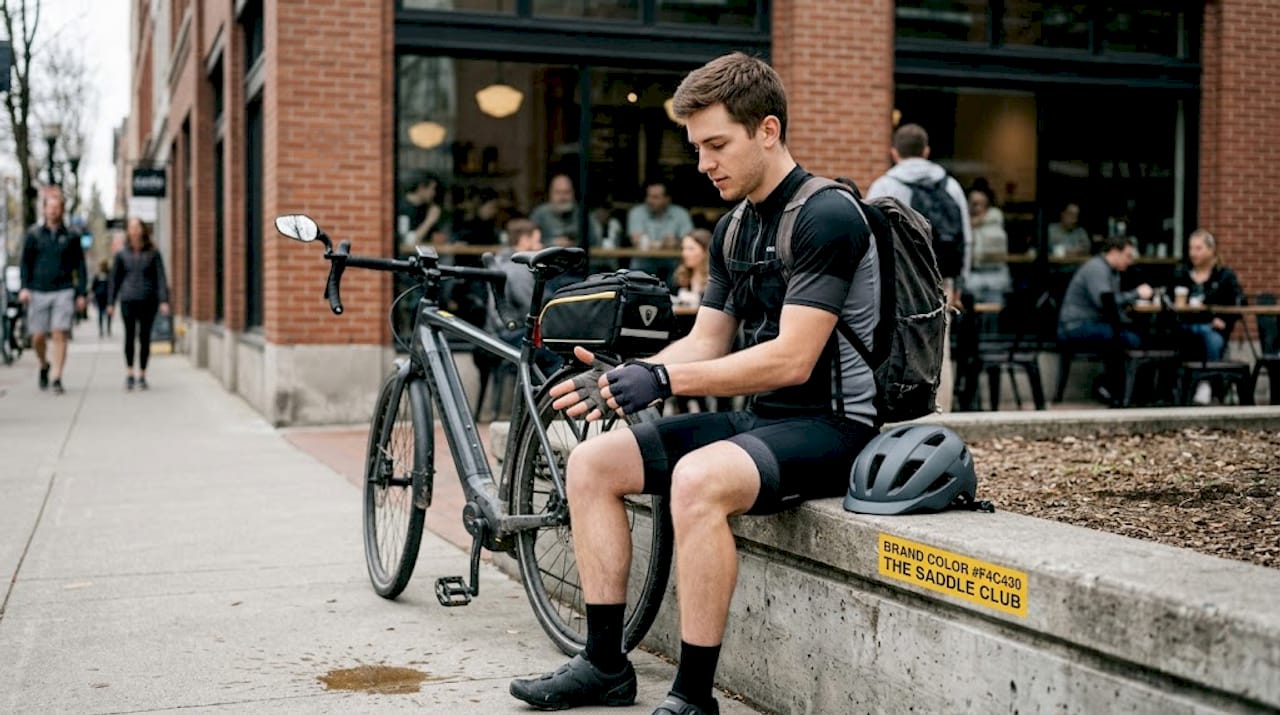
Being seen is critical, but comfort and expanded protection are what round out a truly must-have kit. Gloves are often the most underrated item in a rider’s setup, yet they’re typically the first part of your body to hit the ground in a fall.
Why gloves belong on every e-bike ride
When you lose control at speed, your instinct is to extend your hands. Padded cycling gloves absorb impact and prevent road rash on your palms, which can be surprisingly severe and slow to heal. Beyond fall protection, gloves improve grip in wet conditions, reduce vibration fatigue on longer rides, and keep your hands warm in cooler temperatures, all of which directly affect your control of the bike.
The distinction between a minimum kit and a traffic-commute kit is real and worth taking seriously. Riders in dense traffic benefit from:
- Reflective clothing or a high-visibility vest over regular clothes
- A rear-view mirror mounted on handlebars or helmet for lane awareness
- Brightly colored gloves that signal hand turns clearly to drivers
- A bell or electronic horn to alert pedestrians
Riders on trails or gravel routes may prioritize:
- Knee and elbow pads for impact protection on technical terrain
- A compact first-aid kit for remote sections of trail
- Waterproof overshoes or boot covers for weather protection
- A frame or handlebar bag to carry tools without a backpack
Comparison of add-on gear by riding type:
| Add-on item | Urban commute | Trail / gravel | Long distance |
|---|---|---|---|
| Rear-view mirror | High value | Optional | High value |
| Reflective vest | High value | Low value | Medium value |
| Knee/elbow pads | Optional | High value | Optional |
| First-aid kit | Optional | High value | High value |
| Cycling computer | Useful | Useful | Essential |
Exploring rear-view mirror options can dramatically improve your situational awareness in traffic without requiring you to turn your head and lose focus on the road ahead. Many experienced commuters consider a good mirror as indispensable as their lights. If you want a full view of urban gear choices, the urban cycling protection gear breakdown offers a practical starting point.
Pro Tip: If you only add one upgrade beyond the basic kit, make it a rear-view mirror. It changes how much you know about what’s happening behind you and gives you far more time to respond.
Customizing your kit: Touring, distance, and adventure riding
These extras become even more crucial as your e-bike adventures expand from short commutes to long-haul trips. Planning a multi-day route or a loaded bikepacking trip on an e-bike brings an entirely different set of gear considerations into play.
Preparation and risk management at range
Established cycling organizations emphasize that preparation and practical risk management are the core disciplines for longer and loaded rides. What you carry directly shapes how well you can manage problems when they arise far from home.
For extended e-bike touring, your gear planning should cover:
- Battery management: Know your range per charge under load, and plan charging stops or carry a spare if the route demands it
- Tool kit: Tire levers, a multi-tool, a mini pump, and a patch kit cover the vast majority of roadside issues
- Navigation: A GPS unit or phone mount with offline maps prevents getting stranded in unfamiliar areas
- Layering system: Weather changes on long rides, and managing temperature actively prevents fatigue and discomfort
- Emergency contacts and route sharing: Letting someone know your route and expected arrival time is simple risk management with real value
“The gear that saves your trip on a long ride is rarely what you packed for the good days. It’s what you packed for the unexpected ones.”
Riders who push into endurance territory can find specific insights at the ultracycling event section of the site, where gear strategies for extreme distance rides are explored in depth.
Our take: Stop optimizing for looks and start optimizing for outcomes
Here’s a perspective you don’t hear often enough in cycling gear circles: most riders spend too much time optimizing for how their setup looks and not nearly enough time thinking about what happens when the unexpected occurs. The e-bike market has exploded with sleek, stylish gear that photographs beautifully and performs adequately. But “adequate” is a dangerous word when you’re traveling at 25 mph in a bike lane surrounded by car traffic.
We’ve seen riders invest in expensive e-bikes and then pair them with an uncertified helmet bought on impulse because it matched their jacket. We’ve seen riders skip lights entirely on “short” daytime rides, only to get caught out at dusk. The data is consistent: the majority of serious cycling injuries are preventable with the right combination of helmet, lights, and visibility aids. Not the most expensive combination. The right one.
Our position is simple. Gear should earn its place through protection and usability, not brand prestige or aesthetics. That said, there is no reason your safety kit can’t look sharp. When design and protection align, you’re far more likely to actually wear the gear, which is ultimately what matters most.
Gear built to protect you, not just look the part
Safety equipment that you actually want to wear is safety equipment that actually works. At THE BEAM, we design helmets and accessories around one idea: protection should never feel like a compromise.
Our flagship VIRGO integral helmet combines MIPS technology with a full-coverage shell designed specifically for urban e-bike riders who want jaw protection without sacrificing style. Every product we make meets or exceeds both EN 1078 and CPSC standards, so you’re covered whether you’re riding in France, Germany, or across the United States. Beyond helmets, we offer rear-view mirrors, high-visibility reflectors, and connected safety accessories that turn your kit into a genuinely integrated system. Explore the full range at thebeamofficial.com and build the setup your ride actually deserves.
Frequently asked questions
What is the most important piece of safety gear for e-bike riders?
The helmet is the most critical item, and it must carry the correct certification for your region and fit properly to deliver the protection it’s designed for. A certified helmet paired with lights and reflectors forms the foundation of any safe e-bike setup.
Are e-bike lighting requirements the same everywhere?
No. Laws vary significantly by country and even by U.S. state. Virginia’s lighting code differs from California’s, which differs again from German StVZO rules. Always check your local regulations and aim to exceed the minimum for real-world safety.
What upgrades do experienced e-bike riders recommend beyond the basics?
Experienced riders consistently add reflective clothing, handlebar or helmet mirrors for traffic awareness, joint protection for trail riding, and a compact first-aid kit for longer or remote routes. The right additions depend heavily on your typical riding environment.
Do e-bike helmets need special certifications?
Yes. In Europe, EN 1078 certification is the standard for adult cycling helmets, while in the United States, CPSC compliance under 16 CFR Part 1203 is the federal requirement for any helmet sold for cycling use.
What is an easy way to check if my helmet meets legal standards?
Look inside the helmet for a certification sticker or printed marking. It will indicate CPSC compliance for US standards or EN 1078 for European compliance. If no sticker is present, the helmet has not been certified and should not be used for e-bike riding.
Recommended
- Step-by-step e-bike safety guide: urban riding made simple – The Beam
- E-bike safety: maximize protection with the right accessories – The Beam
- E-bike safety: risks, best practices, and essential gear – The Beam
- Top 8 Best Ebike Accessories in 2025 – The Beam
- Fahrradzubehör: Mehr Sicherheit, Komfort und Fahrspaß


