

TL;DR:
- Helmet impact and visible damage are the primary factors requiring replacement, not age alone.
- Regular inspection before each ride is crucial to identify cracks, soft spots, or retention issues.
- After any crash, helmets should be replaced immediately due to unseen damage to the EPS foam.
Your cycling helmet might look perfectly fine from the outside while quietly failing at its only job: protecting your head. Most cyclists never think about helmet condition until something goes wrong, and that’s a dangerous gap. The truth is that replace after any impact is the rule that matters most, yet it’s the one most riders ignore. In this guide, we’ll walk you through exactly what to look for, what the science actually says about helmet aging, and how to make smarter, safer decisions every time you clip in.
Table of Contents
- How helmet materials wear down over time
- Key signs your helmet needs replacing
- After a crash: What to do with your helmet
- Visual guide: Comparing safe and worn helmets
- Why the ‘replace every 5 years’ rule misses the point
- Upgrade your safety: Find the right helmet and accessories
- Frequently asked questions
Key Takeaways
| Point | Details |
|---|---|
| Inspect beyond surface | Invisible damage can weaken helmets even if the outside looks fine. |
| Impact matters most | Replace your helmet immediately after any significant crash or impact. |
| Material condition is key | Sun damage, cracks, and worn straps mean it’s time for a new helmet. |
| Ignore myths about age | Scientific studies prove age alone is a poor reason to replace a helmet. |
How helmet materials wear down over time
Before detailing what to check on your helmet, it’s crucial to understand how its materials degrade with use and exposure. A helmet isn’t a single material. It’s a system of components working together, and each one ages differently.
The most important component is the EPS foam liner, or expanded polystyrene. This is the white, rigid foam you see inside the shell. EPS is engineered to crush on impact, absorbing the energy that would otherwise travel into your skull. The problem? It only works once. After a significant impact, the foam cells are permanently compressed and can no longer absorb energy effectively. There’s no recovery, no reset.
The outer shell, usually made from polycarbonate or fiberglass, faces a different set of threats. UV radiation from sunlight slowly breaks down the polymer structure, making it brittle over time. Sweat, particularly the salts and acids it contains, can degrade adhesives and interior padding. Heat, like leaving your helmet in a hot car, can warp the shell geometry and compromise fit. These are the real cycling safety gear basics that most guides skip over.
Here are the primary material stressors every cyclist should know:
- Direct impacts, even minor ones, can permanently damage EPS foam
- UV exposure weakens the outer shell and fades protective coatings
- Sweat and heat degrade adhesives, padding, and retention system components
- Time and storage conditions affect shell flexibility and foam density
Here’s the part that surprises most riders. A 2015 MEA Forensic study crash-tested 675 used bicycle helmets up to 26 years old and found no significant impact performance degradation from age alone, with only a 0.7g per year increase at high drop heights. Age by itself is not the enemy.
Crash, impact, and visible condition matter far more than age. A 10-year-old helmet that has never been dropped may outperform a 2-year-old helmet that took a hard hit last summer.
When you understand this, the way you evaluate your helmet changes completely. Knowing how to choose cycling helmets starts with understanding what you’re actually buying and how it behaves over time.
Key signs your helmet needs replacing
Now that you know what can go wrong inside and out, let’s break down the clearest signs that tell you it’s time for a new helmet. Some of these are obvious. Others require a closer look.
- Visible cracks in the outer shell. Any crack, no matter how small, means structural integrity is compromised. Run your fingers along the surface and around every vent opening.
- Indentations or soft spots in the EPS foam. Press gently on the interior foam. It should feel uniformly firm. Any soft zone or depression signals crushed foam cells.
- Shell distortion or warping. Hold the helmet at eye level and look across the surface. Any uneven curves or buckled areas indicate heat or impact damage.
- Fading, peeling, or bubbling of the outer shell. These are signs that UV inhibitors have broken down, leaving the shell brittle and prone to cracking, especially around vent edges.
- Broken or loose retention system. The dial or strap system at the back keeps the helmet seated correctly. If it slips, clicks loosely, or won’t tighten, your helmet won’t stay in position during a crash.
- Interior foam separation. If the EPS liner is pulling away from the outer shell, the two-part protection system is no longer working as designed.
- Missing or compressed comfort pads. While pads don’t affect impact protection directly, missing pads can shift the helmet’s fit and change how it sits on your head during a fall.
Pro Tip: After any minor drop, even off a handlebar or a shelf, press firmly on the interior foam in several spots. Hidden compression is nearly invisible but can drastically reduce protection. If you’re unsure, contact the manufacturer directly.
One more thing worth addressing: the idea that sweat accelerates helmet failure. Sweat does not degrade EPS foam according to current standards testing. The routine advice to replace every five years regardless of condition may be more about marketing than safety science. Replace based on what you see and what happened to your helmet, not based on a calendar date.
For a deeper look at condition-based inspection routines, the urban helmet safety checks guide is a practical starting point.
After a crash: What to do with your helmet
Physical impacts change everything. Here’s what you need to know if you’ve just had a fall or crash.
The moment your helmet contacts the ground during a crash, the EPS foam does its job. It crushes. That’s the design. But that also means it’s done. The foam cannot return to its original structure, and no visual inspection will reliably tell you how much protection remains.
Replace your helmet immediately after any crash where your head or the helmet contacts the ground, even if there is no visible exterior damage. This is not overcautious advice. It’s the direct result of how EPS foam works at a material level.
Here’s what to do right after a crash:
- Remove the helmet from use immediately. Don’t finish the ride with it, even if it looks fine.
- Inspect the shell carefully for cracks, dents, or any distortion, especially near the vents.
- Check the retention system to see if the impact bent or cracked any components.
- Contact the manufacturer if you’re uncertain. Many brands offer crash replacement programs at a discount.
- Never take post-impact risks. A helmet that absorbed one crash has done its job. It is not ready for another.
Microscopic internal cracks in EPS foam are invisible to the naked eye. The shell may look completely intact while the foam underneath has lost the ability to absorb energy. This is why the visual check alone isn’t enough after a real impact.
Err on the side of caution. Your head is irreplaceable.
For context on how much protection a properly functioning helmet provides, the cycling helmet injury stats data is striking and worth reviewing before you decide to keep riding with a compromised helmet.
Visual guide: Comparing safe and worn helmets
Sometimes, the difference between safe and unsafe is subtle. Here’s how to spot the clues side by side.
| Feature | Healthy helmet | Worn or compromised helmet |
|---|---|---|
| Outer shell color | Bright, consistent finish | Faded, chalky, or uneven |
| Shell surface | Smooth, no cracks | Cracks near vents, bubbling |
| EPS foam | Firm, uniform density | Soft spots, visible indentations |
| Retention system | Clicks firmly, holds position | Slips, rattles, or won’t adjust |
| Interior padding | Intact, evenly placed | Missing, compressed, or peeling |
| Vent edges | Clean, sharp | Cracked or chipped |
| Liner bond | Shell and foam attached | Separation visible at edges |
Subtle degradation is the real danger here. A helmet that scores poorly on two or three of these points may still look wearable at a glance. That’s exactly why close inspection matters. UV-related cracking often starts near vent openings, where the shell is thinnest and most exposed. It can look like a hairline scratch until it doesn’t.
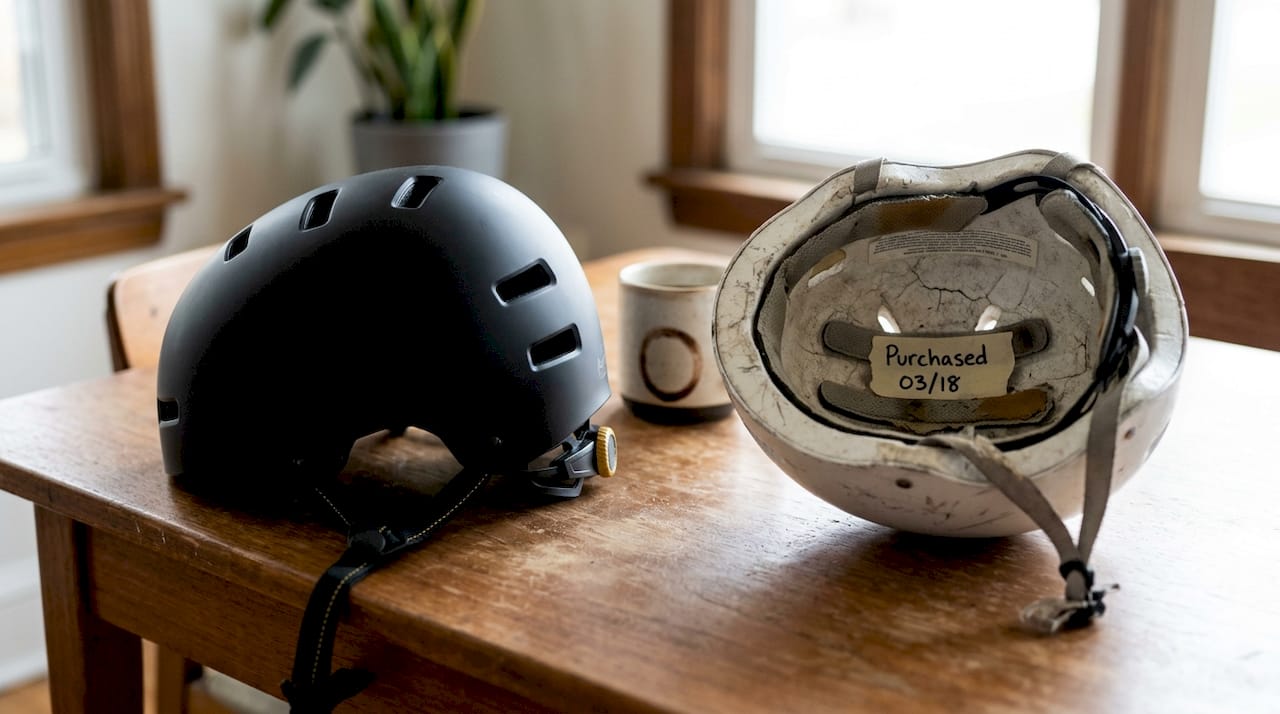
Pro Tip: Write your purchase date on a small piece of tape and stick it inside the helmet near the foam. It takes five seconds and gives you an instant reference point every time you inspect it.
Don’t limit your inspection to once a year. Check your helmet before every ride. It takes less than 60 seconds to run through the key points in the table above. For families riding together, the family cycling helmet tips guide covers how to apply these checks across different helmet sizes and age groups.
Why the ‘replace every 5 years’ rule misses the point
All of these details add up to a responsible helmet replacement strategy. But what about the five-year rule you hear everywhere?
Here’s our honest take: the five-year rule is not grounded in strong evidence. The MEA Forensic study tested helmets up to 26 years old and found minimal age-related performance loss. The primary driver of helmet failure is impact, not time. A helmet stored carefully in a cool, dark space for seven years may be safer than one that survived two crashes in three years.
The five-year guideline likely has marketing origins. Helmet manufacturers benefit from regular replacement cycles, and without clear evidence that age alone causes failure, the rule functions more as a sales prompt than a safety standard. We’re not saying ignore it entirely. We’re saying don’t use it as your only metric.
Trust your inspection. Learn the signs. Check after every ride and after every incident. As we see it, why helmet safety is critical is not a question of following a schedule. It’s a question of knowing what you’re looking at.
A helmet’s real expiry is in its wear, not its birthday.
Upgrade your safety: Find the right helmet and accessories
When your inspection reveals cracks, soft spots, or a compromised retention system, there’s only one right move: replace it. Riding on a worn helmet is not a calculated risk. It’s an unnecessary one.

At THE BEAM, we design safety-certified helmets built for road, gravel, urban, and e-bike cyclists who take protection seriously. Our VIRGO integral helmet with MIPS technology is engineered to absorb rotational impact forces, not just direct hits. Beyond helmets, our range of helmet add-ons including rear-view mirrors, high-visibility reflectors, and connected safety accessories gives you everything you need to ride with real confidence. Your safety is worth the upgrade.
Frequently asked questions
How often should I check my cycling helmet for wear?
You should inspect your helmet before every ride. A quick 60-second check catches new cracks, soft spots, or retention issues before they become a real problem on the road.
Is it safe to use a helmet after a minor fall?
No. Even minor drops can cause hidden foam cracks that are invisible from the outside. Inspect closely after any impact, or contact the manufacturer before riding again.
Does sweat make a helmet wear out faster?
Sweat does not degrade EPS foam according to current standards testing. Shell condition and impact history matter far more than how much you sweat during your rides.
Are age-based helmet replacement guidelines reliable?
Not on their own. A 675-helmet study found no significant performance loss from age alone. Condition and crash history are far more reliable indicators than the date on your receipt.


