

TL;DR:
- Proper helmet fit ensures safety by maintaining correct positioning during impacts.
- Common errors like tilting or loose straps significantly reduce helmet protection.
- Ensuring snug, level fit and frequent rechecks are essential for optimal safety.
A cycling helmet sitting on your head does not automatically protect you. Countless riders pull on a helmet, buckle the chin strap loosely, and assume they are covered because the foam touches their skull and nothing feels painful. That assumption is wrong, and it could cost you in a crash. Proper helmet fit is one of the most important and least understood elements of cycling safety. It determines whether your helmet actually does its job when you hit the ground. This guide breaks down exactly what fit means, where most riders go wrong, what the science says about protection, and how to dial in your fit step by step.
Table of Contents
- What does ‘helmet fit’ actually mean?
- Common helmet fit mistakes every cyclist should avoid
- How helmet fit impacts actual safety and lab results
- How to achieve and check the perfect helmet fit
- Why helmet fit is more important than features and price tags
- Find your perfect helmet fit with The Beam
- Frequently asked questions
Key Takeaways
| Point | Details |
|---|---|
| Fit means protection | A helmet can only offer true protection if it fits snugly and stays secure in a crash. |
| Avoid common mistakes | Loose straps, bad positioning, and not rechecking fit weaken even the best helmet designs. |
| Tech complements fit | MIPS and other features add protection but can’t make up for poor or improper fit. |
| Recheck fit regularly | Fit can change over time—check and adjust before every ride for optimal safety. |
What does ‘helmet fit’ actually mean?
Most people think helmet fit is about comfort. If the helmet doesn’t pinch and stays on without flopping around, they consider the job done. But that framing misses what fit actually accomplishes during an impact.
Proper helmet fit means the helmet sits correctly, stays in place, and remains effective before, during, and after a crash. A truly well-fitted helmet sits level on your head with the front edge roughly two finger-widths above your eyebrows. It does not tilt back to expose your forehead. It does not rock side to side when you shake your head. It does not shift forward or backward when you push it with your hand. Every single one of those movements signals a fit problem, not just a comfort issue.
Here is why this matters so much: the protective liner inside your helmet, typically made from EPS (expanded polystyrene) foam, is engineered to absorb and redirect impact energy in a specific, predictable zone. When a helmet shifts during a crash, that zone moves. The part of your skull that actually hits the ground may no longer be covered by the liner material at full thickness. The snug, level positioning that safety organizations recommend is not about aesthetics. A loose fit is considered as dangerous as wearing no helmet at all, because in a crash the helmet can shift before contact, completely undermining its engineering.
The difference between a comfortable helmet and a safe one
| Feature | Comfortable helmet | Properly fitted helmet |
|---|---|---|
| Feels pressure-free | Yes | Not always, slight snugness is normal |
| Sits level on the head | Not always | Always |
| Doesn’t move on shaking | Sometimes | Always |
| Covers forehead adequately | Sometimes | Always |
| Stays in place in a crash | Not guaranteed | Yes, when correctly secured |
Notice that a comfortable helmet and a safe helmet do not always overlap. Riders often tip helmets back to improve airflow over the face or reduce pressure on the forehead, but that adjustment exposes the frontal bone, one of the highest impact zones in cycling crashes.
Key characteristics of proper helmet fit at a glance:
- Level positioning from front to back, no more than two finger-widths above the eyebrows
- Zero movement when the head shakes or the helmet is pushed
- Snug, not painful contact across the full interior circumference
- V-shaped straps meeting just below and in front of each ear
- Secure chin strap allowing only one or two fingers beneath it
“Prioritizing snug, level positioning over mere comfort is not optional. A loose-fitting helmet can shift during impact and offer the rider little more protection than no helmet at all.”
Understanding how a bike helmet should fit is the foundation for everything else in this guide. The adjustments come next, but the concept has to be clear first: fit is a safety function, not a comfort preference.
Common helmet fit mistakes every cyclist should avoid
Even cyclists who own expensive, well-rated helmets often wear them incorrectly. These are the most frequent errors, ranked by how much danger they create.
-
Tilting the helmet back. This is the single most common mistake. Riders push helmets back to keep sun out of their eyes or to feel less constricted, but the result is an unprotected forehead. In a forward fall, which is by far the most common crash direction for cyclists, the forehead strikes first. A tilted helmet offers nothing there. Tilted helmets expose the forehead and increase the risk of serious head injury in exactly the impacts you are most likely to experience.
-
Loose or incorrectly routed straps. Straps serve a retention function, not just a closure function. If the straps are slack or routed in a way that lets the helmet lever off the head, the helmet can fly off completely during a crash. Even a helmet that fits the head circumference perfectly can be ejected if the straps are wrong.
-
Overtightening the fit dial. Most modern helmets use a retention dial at the back of the skull to customize the fit ring. Many riders crank this as tight as possible, thinking more tightness means more safety. It does not. Overtightening creates painful pressure points, can cause headaches, and does not meaningfully improve retention if the helmet size or shape is wrong for your head.
-
Selecting the wrong size or shell shape. Head shapes vary significantly. Some heads are rounder, some more oval. Helmet shells are often designed with a specific shape in mind. Buying a helmet purely by brand or color, without trying it on, often results in a shell that fits the circumference but rocks because the interior shape does not match the skull shape.
-
Never rechecking or readjusting fit. Padding inside helmets compresses over time. Straps stretch and loosen, especially in heat or with sweat. A helmet that fit correctly in April can be noticeably looser by August. Most riders never go back and recalibrate.
Pro Tip: After adjusting your retention dial and straps, put on the helmet and tilt your head forward, backward, left, and right. Then push up firmly on the front brim. If the helmet moves more than half an inch in any direction, something still needs adjustment. Use this as your personal safety-first helmet fit guide check before every ride.
Recognizing these mistakes is valuable, but understanding why they undermine safety requires looking at how helmets actually function in crashes.
How helmet fit impacts actual safety and lab results
The engineering inside a modern cycling helmet is genuinely impressive. But every safety technology built into a helmet operates on a single assumption: the helmet stays where it is supposed to be during an impact.
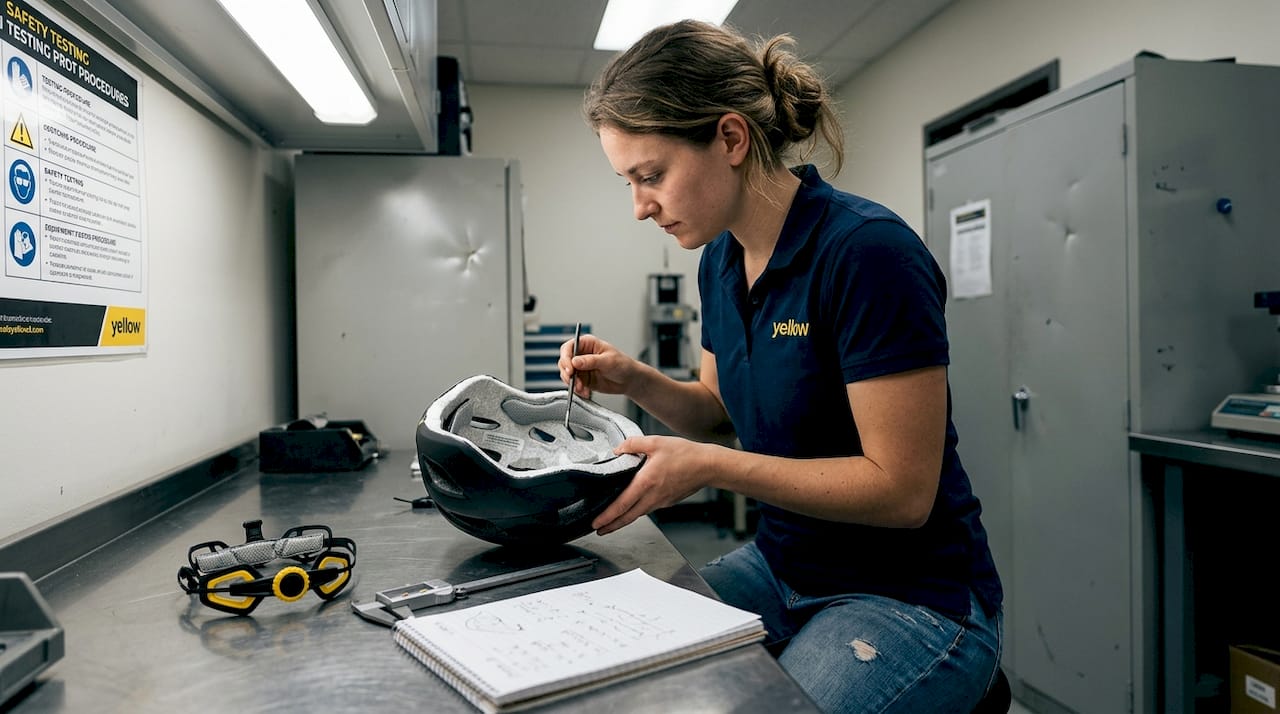
Lab testing under standards like CPSC (used in the United States) and EN1078 (used in Europe) involves dropping helmeted headforms onto anvils at speeds between 4.8 and 6.2 meters per second, measuring peak linear acceleration and confirming it stays below 300g. These tests are conducted with helmets perfectly positioned and secured on standardized headforms. No standard test accounts for a helmet that has shifted two centimeters before impact. The certification on your helmet assumes you are wearing it correctly.
Independent testing organizations go further. Virginia Tech’s STAR rating system includes oblique impact tests, which simulate the angled strikes common in real crashes. Their methodology specifically evaluates how well helmets retain position during these more realistic scenarios. Helmets that score highest tend to combine good rotational force management with robust retention, confirming that the two are inseparable.
Here is what the research tells us about the relationship between fit, materials, and protection outcomes:
| Safety factor | Depends on fit? | Notes |
|---|---|---|
| Linear impact protection (EPS) | Yes | Liner must stay positioned over impact zone |
| Rotational force reduction (MIPS) | Yes | Slip liner needs correct pressure to function |
| Retention system effectiveness | Directly | Loose retention fails under crash forces |
| Virginia Tech STAR rating | Indirectly | Oblique test scores reflect retention |
Specific findings from published biomechanics research reinforce this: thicker EPS liners lower peak linear acceleration by approximately 2g per millimeter and reduce peak rotational acceleration by up to 44.8 rad/s². Technologies like MIPS and SPIN reduce rotational forces transmitted to the brain by 12 to 73 percent depending on the design and impact scenario. Those are meaningful numbers. But they all assume the helmet is correctly positioned on the head at the moment of impact.
The key takeaway from the research on MIPS technology in helmets is this: MIPS is not a substitute for correct fit. It is an additional layer of protection for a helmet that is already doing its primary job.
Additional safety considerations:
- EPS liner: Must contact the skull evenly to distribute force across the full designed area
- MIPS slip liner: Requires consistent pressure from the fit system to generate the rotational slip effect
- Retention system: Acts as the anchor; loose retention allows post-impact helmet movement
- Padding: Provides contact comfort but compresses under force, making initial fit even more important
How to achieve and check the perfect helmet fit
Knowing that fit is critical and knowing how to achieve it are two different things. Here is exactly how to build a correct, repeatable fit process.
-
Measure your head circumference. Use a flexible tape measure around the widest part of your skull, typically about one inch above your eyebrows. This number in centimeters is your starting size reference. Most helmets list size ranges on the box or product page.
-
Try the helmet on before committing. Sizing charts are estimates. Head shapes vary, and a size M from one brand may feel completely different from a size M from another. If possible, try the helmet in person before purchasing. If buying online, check the return policy and be prepared to size swap.
-
Position it level, low, and forward. Place the front edge of the helmet roughly two finger-widths above your eyebrows. The rear should not drop so low that it touches your neck when you look up, but should still cover the back of your skull. This is the snug, level positioning that defines correct fit.
-
Route and adjust the side straps. The straps from the front and back of the helmet should meet just below and slightly in front of your ears, forming a V shape. Slide the adjusters to position them correctly, then tighten until the straps sit flat against your skin without digging in.
-
Tighten the chin strap. Buckle the chin strap and tighten it until you can slide only one or two fingers beneath it. Open your mouth wide. You should feel the helmet press slightly down on your head. That response confirms the chin strap is doing its job.
-
Use the retention dial. Turn the dial at the back until the helmet fits snugly against the back of your skull. Shake your head firmly in all directions. The helmet should move with your head, not on it. Then try to push the front brim upward. No movement is the goal.
-
Recheck before every ride. Padding compresses, straps loosen, dials slip. Rechecking for common fit issues like loosened straps or dial slippage takes thirty seconds and should become automatic.
Pro Tip: After any crash, no matter how minor it appears, replace your helmet. EPS foam deforms permanently to absorb impact. You cannot see this damage from the outside, but the liner’s protective capacity is gone. Never check your helmet fit and conclude you are good if the helmet has already taken an impact.
Why helmet fit is more important than features and price tags
We design and build helmets here at THE BEAM, and we will be direct with you: the most expensive helmet on the market will not save you if it is sitting tilted back on your head with a slack chin strap. That is not a controversial statement. It is what the research shows.
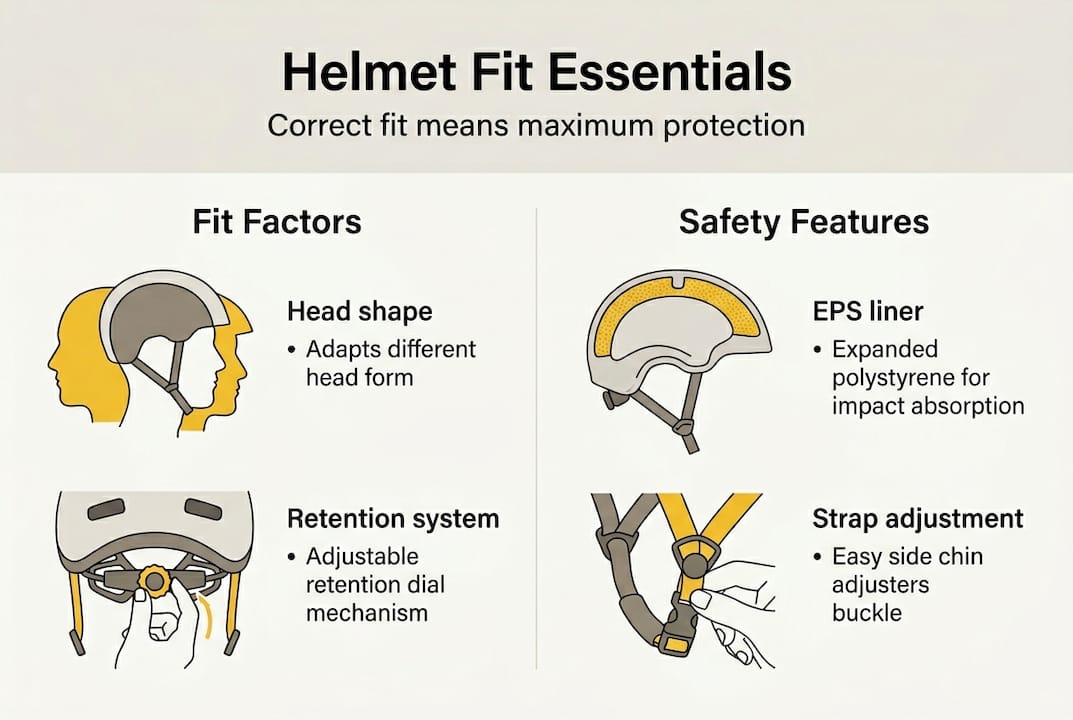
Cyclists shopping for a new helmet spend time comparing MIPS versus no MIPS, Virginia Tech star ratings, shell materials, ventilation counts, and price points. All of those things matter. But none of them create protection independently of correct fit. A helmet with MIPS and superior oblique impact scores earns those ratings on a correctly positioned, properly retained headform. Take the fit away and you have expensive foam sitting incorrectly on your skull.
What we see repeatedly is that cyclists invest in understanding MIPS and fit technology but skip the process of actually dialing in their fit. They buy a five-star helmet, toss it on, and ride. The hierarchy should be: fit first, features second. Always.
Try every helmet you consider purchasing. Focus on retention before airflow. Ask yourself whether the helmet stays put when you move your head vigorously. If it does not, no feature list will compensate. If it does, then the features and ratings become meaningful upgrades on top of a solid foundation.
Find your perfect helmet fit with The Beam
Putting this knowledge into practice means finding a helmet designed for your head shape, your riding style, and the conditions you ride in.

At THE BEAM, we build helmets for road, gravel, urban, and e-bike riders, with a range that covers all head sizes and shapes. Whether you are shopping from The Beam’s helmet collection for yourself or looking for helmets for kids, every model is built around the principle that retention and fit come before everything else. We also offer dedicated sizing guides and support to help you get the adjustments right. Explore our range of helmets for adults and find the model that fits your head, your ride, and your safety standards.
Frequently asked questions
How tight should my cycling helmet be?
A cycling helmet should feel snug against your skull in all directions, with no movement when you shake your head, but it should not cause pain or pressure points. The snug positioning standard means comfort should not come at the cost of retention.
Can MIPS or other tech compensate for poor fit?
No. Technologies like MIPS require correct positioning and consistent pressure from the fit system to function as designed. As independent testing confirms, MIPS and Virginia Tech ratings reflect performance on properly fitted helmets, not poorly worn ones.
How often should I check or readjust my helmet fit?
Check your fit before every ride. Padding compresses and straps loosen over time, so not rechecking fit is one of the most common errors cyclists make, especially after weeks of heavy use.
Does head shape matter as much as helmet size?
Yes. Both shape and circumference determine whether the helmet sits correctly and stays put. A wrong size or shape causes subtle rocking that no retention dial can fully correct, so always try multiple models to find your best match.


