

Busy city streets in France and Germany can leave cyclists feeling exposed when traffic approaches from behind. Staying safe in these environments means keeping your attention forward while staying aware of what’s happening around you. With a properly adjusted rear-view mirror, you gain an extra layer of confidence and control without risking unsafe head turns. Explore how compact visual safety devices like rear-view mirrors support smarter, safer urban cycling choices.
Table of Contents
- Definition And Purpose Of Rear-View Mirrors
- Types Of Rear-View Mirrors For Cyclists
- Key Features And Proper Adjustment
- Legal Requirements And Regulations In Europe
- Safety Benefits And Real-World Scenarios
- Common Drawbacks And Usage Mistakes
Key Takeaways
| Point | Details |
|---|---|
| Enhanced Safety | Rear-view mirrors significantly improve cyclists’ awareness of traffic, reducing collision risks. |
| Supplemental Tool | Mirrors are not foolproof; cyclists should combine their use with traditional safety techniques, such as shoulder checks. |
| Mirror Options | Different mirror types (handlebar, helmet, and eyeglass-mounted) cater to varying preferences and riding scenarios. |
| Proper Adjustment | Correct positioning and calibration of mirrors are crucial for maximizing visibility and safety while riding. |
Definition and Purpose of Rear-View Mirrors
Rear-view mirrors for cyclists are compact visual safety devices designed to provide riders with an enhanced awareness of traffic conditions behind them without requiring head turns. These specialized accessories mount onto bicycle handlebars, helmets, or eyewear, enabling urban cyclists to monitor approaching vehicles and potential hazards in their peripheral environment.
Cycling safety experts recognize rear-view mirrors as critical tools for reducing vulnerability on busy streets. Bicycle safety guidelines emphasize that these devices help riders maintain continuous situational awareness, which can dramatically reduce collision risks. By offering a convenient line of sight behind the cyclist, mirrors eliminate the need for potentially dangerous head movements that could destabilize bike handling.
The primary functions of rear-view mirrors for cyclists include:
- Detecting vehicles approaching from behind
- Monitoring traffic lane positioning
- Reducing blind spot vulnerabilities
- Providing continuous peripheral awareness
- Enabling safer lane changes and turns
While mirrors offer significant benefits, experienced cyclists understand they are not foolproof. Strategic positioning and complementary safety techniques remain essential. Mirrors should be considered supplemental tools, not absolute guarantees of safety.
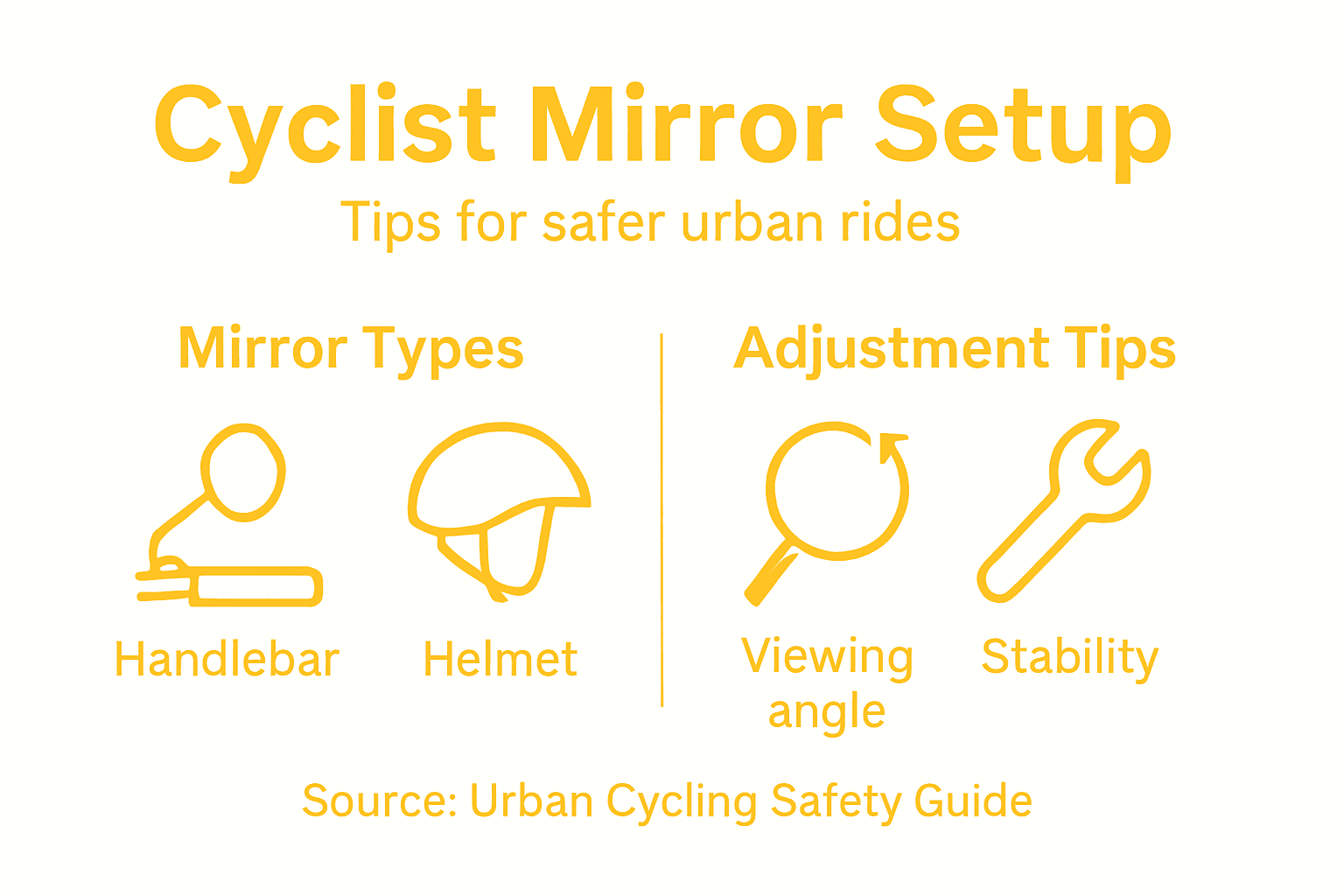
Pro tip: Position your rear-view mirror to provide maximum visibility without obstructing your primary forward view, and always perform a physical shoulder check before making significant traffic maneuvers.
Types of Rear-View Mirrors for Cyclists
Cyclists have multiple rear-view mirror options designed to enhance safety and provide flexible visibility solutions. Cyclist mirror configurations range from handlebar-mounted to helmet and eyewear attachments, each offering unique advantages for urban riders navigating complex traffic environments.
The primary types of rear-view mirrors include:
-
Handlebar Mirrors
- Clamp directly onto bicycle handlebars
- Often feature convex surfaces for wider viewing angles
- Provide stable, fixed positioning
- Most common and traditional mirror type
-
Helmet-Mounted Mirrors
- Attach directly to cycling helmet
- Offer more dynamic viewing perspectives
- Move with rider’s head movements
- Lightweight and easily adjustable
-
Eyeglass-Mounted Mirrors
- Clip onto eyewear frames
- Extremely lightweight
- Ideal for cyclists who already wear glasses
- Require more practice to use effectively
Each mirror type presents unique benefits and potential limitations. Strategic selection depends on individual riding style, urban environment, and personal comfort with different visibility technologies.
Here is a concise comparison of common rear-view mirror types for cyclists:
| Mirror Type | Typical Mounting Location | Ideal User Scenario | Notable Consideration |
|---|---|---|---|
| Handlebar-Mounted | Bicycle handlebars | Commuters on stable surfaces | May limit handlebar space |
| Helmet-Mounted | Cycling helmet | Riders needing flexible views | Sensitive to head movement |
| Eyeglass-Mounted | Eyewear frame | Existing glasses wearers | Can be tricky for new users |
Effective rear-view mirrors are not just accessories, but critical safety instruments that expand a cyclist’s awareness of surrounding traffic conditions.
Pro tip: Test multiple mirror types before committing to ensure the most comfortable and effective rear visibility solution for your specific cycling needs.
Key Features and Proper Adjustment
Cyclist rear-view mirrors are sophisticated safety devices with nuanced features designed to maximize visibility and rider awareness. Mirror adjustment principles emphasize the critical importance of precise positioning to minimize blind spots and enhance overall road safety.
Key features of high-quality cyclist rear-view mirrors include:
-
Optical Components
- Convex mirror surfaces
- Wide-angle reflection capabilities
- Shatter-resistant materials
- Anti-glare coatings
-
Mounting Mechanisms
- Adjustable ball-and-socket joints
- Secure, vibration-resistant clamps
- Lightweight design
- Compatible with multiple attachment points
-
Durability Considerations
- Weather-resistant construction
- Impact-resistant frames
- Rust-proof materials
- UV-stable components
Proper mirror adjustment requires careful calibration to individual riding posture and bicycle configuration. Strategic positioning means finding an angle that provides maximum rear visibility without compromising forward focus or creating additional visual distractions.

Below is a summary of critical adjustment factors to maximize mirror performance:
| Adjustment Factor | Impact on Safety | Practical Tip |
|---|---|---|
| Viewing Angle | Reduces blind spots | Adjust from riding position |
| Mount Stability | Prevents distraction | Test for vibration resistance |
| Mirror Height | Affects visibility comfort | Set at eye level if possible |
| Environmental Effects | Maintains clear sight | Choose weather-resistant models |
Effective mirror placement is less about perfect positioning and more about creating a consistent, reliable visual reference that enhances your situational awareness.
Pro tip: Adjust your mirror while seated in your typical riding position, ensuring you can view traffic without straining or moving your head excessively.
Legal Requirements and Regulations in Europe
European regulations surrounding bicycle rear-view mirrors present a complex landscape of safety standards and recommendations. Mirror approval requirements vary across different European Union member states, creating a nuanced framework for cyclist safety equipment standards.
Key regulatory considerations for rear-view mirrors in Europe include:
-
Component Approval Standards
- Type-approval certification
- Mandatory visibility specifications
- Uniform construction requirements
- Safety performance testing
-
Country-Specific Regulations
- Germany: Strict technical inspection rules
- France: Recommended but not mandatory
- Netherlands: Encourages additional safety equipment
- Switzerland: Specific mounting guidelines
-
Technical Specifications
- Minimum field of view requirements
- Impact resistance standards
- Material durability guidelines
- Mounting stability criteria
While no universal mandatory requirement exists for bicycle rear-view mirrors across Europe, safety recommendations strongly encourage their use in urban cycling environments. Different countries interpret and implement safety guidelines with varying degrees of stringency.
European safety regulations prioritize cyclist visibility and awareness, even when specific mirror regulations remain non-mandatory.
Pro tip: Research local municipal cycling regulations in your specific European country to understand precise safety equipment recommendations for rear-view mirrors.
Safety Benefits and Real-World Scenarios
Cyclist rear-view mirrors transform urban riding dynamics by providing critical visibility and situational awareness. Bicycle safety interventions demonstrate that these small devices can substantially reduce collision risks by enabling riders to monitor traffic without compromising forward attention.
Real-world safety benefits of rear-view mirrors include:
-
Traffic Interaction Advantages
- Early detection of approaching vehicles
- Reduced unexpected lane change risks
- Enhanced peripheral awareness
- Minimized sudden swerving incidents
-
Urban Cycling Scenarios
- Navigating complex intersections
- Monitoring dense traffic environments
- Preventing blind spot collisions
- Supporting defensive riding techniques
-
Psychological Safety Factors
- Increased rider confidence
- Reduced anxiety in heavy traffic
- Improved decision-making capabilities
- Better spatial understanding
Urban cyclists face complex navigation challenges where split-second awareness can mean the difference between safety and potential accidents. Rear-view mirrors provide an additional layer of protection beyond traditional safety equipment.
Situational awareness is not about seeing everything, but about understanding potential risks before they become immediate threats.
Pro tip: Practice using your rear-view mirror in low-traffic areas to develop muscle memory and comfortable scanning techniques before entering busier environments.
Common Drawbacks and Usage Mistakes
Rear-view mirrors for cyclists, while beneficial, come with inherent limitations that riders must understand to maintain optimal safety. Bicycle safety guidelines emphasize that mirrors are supplemental tools, not complete substitutes for active situational awareness.
Common drawbacks and usage mistakes include:
-
Optical Limitations
- Restricted field of view
- Potential blind spot creation
- Distorted perspective
- Potential visual interference
-
Mounting and Positioning Errors
- Improper angle adjustment
- Unstable mirror attachments
- Interference with other handlebar equipment
- Vibration-induced visibility issues
-
Behavioral Misunderstandings
- Over-reliance on mirror visibility
- Neglecting physical head checks
- Reduced active scanning behaviors
- False sense of complete security
Strategic awareness requires understanding that mirrors are supportive technologies, not absolute safety guarantees. Cyclists must combine mirror usage with traditional visibility techniques and continuous environmental monitoring.
A mirror expands your vision, but vigilance remains your most critical safety mechanism.
Pro tip: Regularly practice mirror scanning techniques in low-traffic areas to develop natural, quick glance habits without compromising your primary forward attention.
Enhance Your Urban Cycling Safety with THE BEAM
Rear-view mirrors are essential tools for cyclists who want to stay aware of the traffic behind them while maintaining full control of their ride. If you value reducing blind spots and staying safe during every turn and lane change, you need equipment designed to provide clear, stable rear visibility without distractions. THE BEAM offers a premium selection of REAR-VIEW MIRRORS – The Beam built with durable materials and adjustable mounts that align perfectly with your riding posture for maximum safety.

Don’t wait for an accident to prioritize your awareness. Equip yourself with innovative safety accessories from THE BEAM that merge protection, design, and real-world usability. Visit THE BEAM official website now to explore our full range including high visibility REFLECTORS – The Beam and helmets engineered for ultimate protection. Make the smart choice to boost your confidence and control on every urban ride.
Frequently Asked Questions
What are rear-view mirrors for cyclists?
Rear-view mirrors for cyclists are safety devices that attach to bicycles or helmets, allowing riders to see traffic behind them without turning their heads. They enhance awareness of surrounding conditions, helping to reduce collision risks.
How do I choose the right type of rear-view mirror for cycling?
Choosing the right mirror depends on your riding style and preferences. Handlebar mirrors provide stability and a fixed view, helmet-mounted mirrors offer dynamic perspectives, and eyeglass-mounted mirrors are lightweight and suitable for those who wear glasses. Test different types to find what feels most comfortable.
What are the key features to consider when adjusting a rear-view mirror?
Key features include proper viewing angle to minimize blind spots, stability of the mounting mechanism to prevent distractions, mirror height for maximum visibility, and durability against environmental elements. Ensure the mirror is positioned for easy, clear sight without obstructing your forward view.
Are there any legal requirements for using rear-view mirrors on bicycles?
While there are no universal mandatory requirements, different countries may have varying regulations regarding rear-view mirrors. Some countries encourage their use for safety, and it’s essential to research local laws to ensure compliance.
Recommended
- Rétroviseur vélo : Sécurité et visibilité accrues – The Beam
- Rétroviseur vélo : Sécurité et visibilité accrues – The Beam
- 7 Essential Cycling Safety Accessories for Urban Commuters – The Beam
- 7 Essential Cycling Safety Accessories for Urban Commuters – The Beam
- urban traffic simulation | 3D Cityplanner


