

Rear flashing lights on bicycles are prohibited in France under décret n°2024-1074, published in the Journal officiel on November 29, 2024. Orange turn indicators, however, are authorized as optional supplementary equipment, provided they are non-dazzling and visible both front and rear. The primary text is Article R313-5 of the Code de la route, now available on Legifrance. For a citizen-facing summary, Service-public has the practical breakdown.
The one-line verdict: your rear position light must be steady red, not flashing. A flashing orange turn indicator is legal. A flashing red rear light is not.
Key Takeaways
Under French law, a flashing red rear position light is illegal on a bicycle, while an orange flashing turn indicator is permitted as optional supplementary equipment under specific conditions set by décret n°2024-1074.
| Point | Details |
|---|---|
| Rear position light must be steady | Article R313-5 explicitly prohibits a flashing rear position light on cycles. |
| Orange indicators are optional and legal | Turn indicators in orange are allowed if non-dazzling and visible front and rear. |
| Check modes before buying | Confirm any rear light has a selectable steady mode; flashing-only devices are non-compliant. |
| Non-compliance is a first-class infraction | A flashing rear light can result in a fine under French contravention rules. |
| Thebeamofficial accessories | The FRAME FLASH 2.0 reflector line is built to meet French road requirements; customer service confirms specs. |
Table of Contents
- What the 2024 decree actually says about flashing bicycle lights
- Why cyclists were confused: contradictory texts and legacy decrees
- What you can and cannot install on your bicycle in France
- My light already flashes: a step-by-step compliance checklist
- Sanctions and enforcement: what you risk
- How to buy a compliant bicycle light in France
- Installation, visibility, and design guidance from Thebeamofficial
- Why Thebeamofficial published this guide
- Compliant lighting options from Thebeamofficial
- Sources
What the 2024 decree actually says about flashing bicycle lights
The decisive text is décret n°2024-1074, which amends several articles in Chapter R313 of the Code de la route. The Ministry of the Interior’s press release frames it as a visibility improvement for cyclists and EDPM (electric personal mobility device) users, but the core change for most riders is a restoration of an older prohibition that had become muddled by years of cycling Increase Fitness and Economical Health contradictory wording.
Here is what each key article now says in plain terms:
| Code de la route article | What it covers | What the decree changed |
|---|---|---|
| R313-1 | General lighting obligations for cycles | Clarified that supplementary lights are permitted alongside mandatory equipment |
| R313-4 | Front position light requirements | Steady white light required; supplementary front lights allowed |
| R313-5 | Rear position light requirements | Explicitly restores: the rear position light must not be flashing |
| R313-6 | Direction indicators | Orange clignotants authorized as optional supplementary equipment under conditions |
The R313 regulation text is downloadable as a PDF if you want to read the exact legislative wording. The key phrase in R313-5, as restored by the decree, is that the rear position light on a cycle “ne doit pas être clignotant” — must not be flashing.
What the decree also does, and this part gets less attention, is explicitly permit supplementary steady lights. You can add extra lights to your bike as long as they do not replace the mandatory equipment and comply with color and beam requirements. Orange direction indicators are the headline addition: they are optional, not mandatory, but legal when they meet the non-dazzling and dual-visibility conditions.
The three rules in brief:
- Rear position light: steady red, non-flashing, mandatory
- Front position light: steady white, non-flashing, mandatory
- Orange turn indicators: optional, flashing orange is allowed for this specific function, must be non-dazzling and visible from both front and rear
Why cyclists were confused: contradictory texts and legacy decrees
The confusion did not come from nowhere. For roughly a decade, the Code de la route’s lighting articles went through a series of revisions that left the flashing question genuinely ambiguous.
Before 2016, the non-flashing requirement for rear lights was stated clearly. A 2016 alignment effort, intended to bring French rules closer to European vehicle homologation standards, introduced wording that some read as permitting variable-intensity or flashing modes. Manufacturers of aftermarket lights seized on that ambiguity: products marketed with “flash,” “pulse,” and “strobe” modes proliferated, often with packaging that implied legal compliance in France.
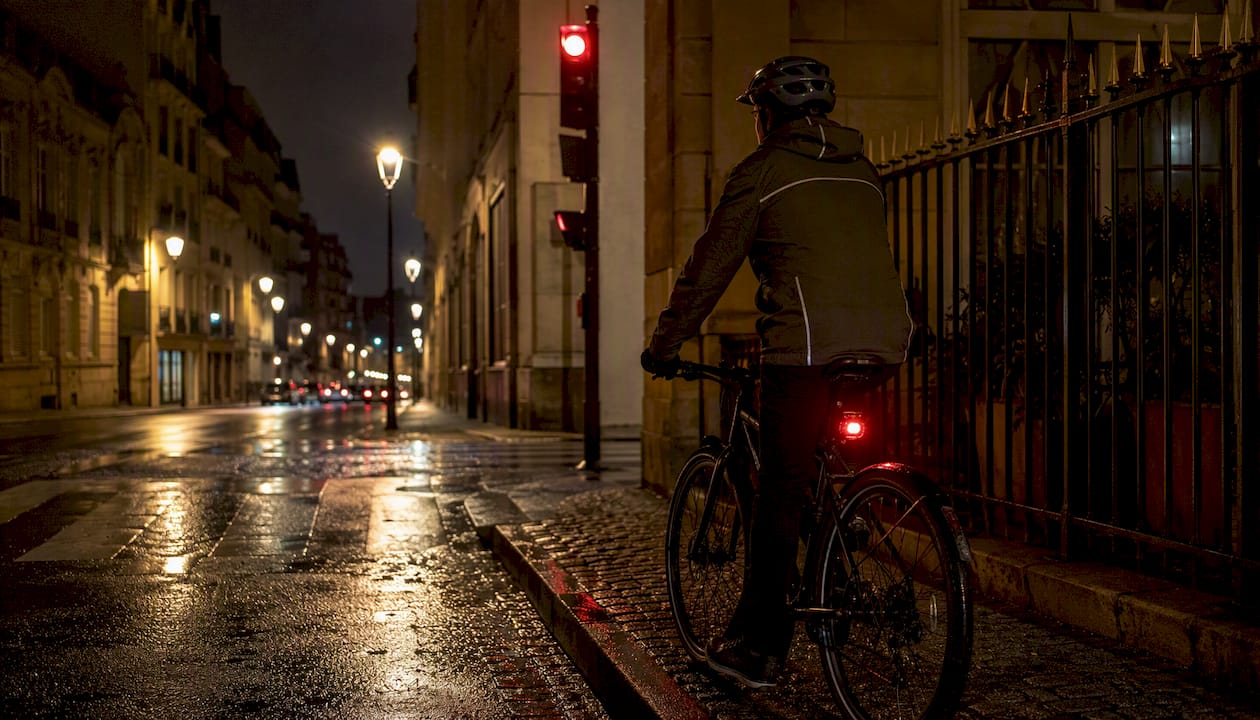
The problem was that European homologation texts (primarily ECE regulations for motor vehicles) were never designed to govern bicycle lighting directly. Applying them to cycles created a category mismatch. A flashing amber indicator on a car is a direction signal with a defined flash rate and intensity. A flashing red rear light on a bicycle, by contrast, mimics an emergency braking signal, which is exactly the confusion the Assemblée nationale’s parliamentary exchange on question n°3245 identifies as the safety rationale for the prohibition.
The timeline in brief:
- Pre-2016: non-flashing rear light requirement stated explicitly
- 2016: revision introduced ambiguous wording; flashing modes became a gray area
- 2024: décret n°2024-1074 corrects the ambiguity, restores the prohibition, and adds the orange indicator authorization
The practical fallout showed up in product listings. Lights sold with five or seven modes, including a “flash” setting, were described as road-legal. Some cycling press covered the ambiguity without resolution. Sécurité Routière’s updated guidance page now reflects the corrected position, but many older product pages and forum posts still circulate the pre-2024 interpretation.
One practical example: GPS-integrated rear lights with radar functions (a category that includes devices with automatic brightness variation) raised questions about whether “intensity variation” counted as flashing. The 2024 decree does not explicitly resolve every edge case, and legal commentary from Isouard Avocat notes that the distinction between a steady light with automatic brightness adaptation and a flashing light remains an open interpretive question for some connected devices.
What you can and cannot install on your bicycle in France
Turn the law into a simple do/don’t list and most compliance questions answer themselves.
Allowed:
- Steady white front position light (mandatory)
- Steady red rear position light (mandatory, non-flashing)
- Additional steady lights in white (front) or red (rear) as supplementary equipment
- Orange flashing turn indicators, provided they are non-dazzling and visible both forward and rearward
- Reflectors (no change to reflector rules)
Not allowed:
- Flashing red rear position light
- Flashing white front position light used as a position light
- Any rear light that uses red in a flashing mode, regardless of how the product is marketed
- Generic multi-mode lights where the “steady” mode cannot be confirmed or selected
When checking a product before buying, look for these specific attributes on the listing or spec sheet:
- Light color: white (front) or red (rear) for position lights; orange specifically for indicators
- Modes available: confirm a steady mode exists and is the default or selectable
- Beam direction: indicators must project both forward and rearward
- Non-dazzling specification: the product description or datasheet should confirm the beam does not exceed dazzling thresholds for other road users
- CE marking or conformity note: not a guarantee of Code de la route compliance, but a baseline quality signal
- IP rating: weather resistance matters for year-round riding; IP65 or above handles rain reliably
Pro Tip: Before buying any multi-mode rear light, search the manufacturer’s website for a firmware changelog or mode list. If the product has a “flash” or “strobe” mode and no way to disable it permanently, or if the steady mode is buried behind multiple button presses, treat it as a compliance risk. Ask the seller in writing whether the device can be set to steady-only, and keep that response.
For practical examples of compliant setups, Thebeamofficial’s guide on compliant bike signaling walks through real-world configurations.
My light already flashes: a step-by-step compliance checklist
If you already own a rear light with a flashing mode, here is what to do.
- Test all modes. Cycle through every mode on your current light and confirm whether a steady red mode exists. If it does, switch to it and use only that mode.
- Check the firmware. For connected or app-controlled lights, open the companion app and look for a firmware update. Some manufacturers have already pushed updates that disable or relabel non-compliant modes in response to the 2024 decree.
- Read the product label and packaging. Look for any mention of “feu de position” or “position light” in the product description. If the device is marketed as a position light and has a flashing mode, that is a compliance problem the manufacturer needs to address.
- Contact the seller. Send a written message (email is fine) asking whether the product is compliant with décret n°2024-1074 and Article R313-5. Request a written confirmation that the steady mode meets the non-flashing requirement. Keep the response.
- Request a return if necessary. If the seller cannot confirm compliance and the light has no usable steady mode, you have grounds to request a return or exchange under French consumer law. The product does not conform to its legal use context.
- Replace with a verified compliant light. If none of the above resolves the issue, replace the light. A basic steady red rear light from a reputable cycling retailer is inexpensive and unambiguously legal.
Pro Tip: Screenshot your purchase confirmation, the product listing as it appeared when you bought it, and any seller communications about compliance. If you are stopped by police and your light is questioned, a paper trail showing you acted in good faith and contacted the seller matters. It also strengthens any consumer dispute.
For a broader compliance walkthrough, Thebeamofficial’s high-visibility equipment guide covers the full equipment check process.
Sanctions and enforcement: what you risk
Non-compliant bicycle lighting falls under a first-class contravention (contravention de première classe) in France. The Legifrance enforcement reference and the parliamentary exchange on question n°3245 both confirm this classification.
A first-class contravention carries a fixed fine. It does not result in license points (cyclists do not hold a cycling license), but it is a formal infraction that can be issued on the spot during a police check.
Practical enforcement points:
- Police checks on cyclists are infrequent but do occur, particularly in urban areas and during targeted road-safety operations
- A non-compliant light can be flagged during any routine stop, not only lighting-specific checks
- Sellers who knowingly market non-compliant lights may face commercial liability, separate from the rider’s infraction
- Local government guidance, such as the Doubs regional authority page, has been explicit that flashing lights are now forbidden and that enforcement follows national rules
To verify current penalty amounts and the exact contravention classification, check the Legifrance enforcement page directly, since fine amounts can be updated by separate decree.
How to buy a compliant bicycle light in France
A short checklist covers most purchase decisions. Run through it before confirming any order.
Before you buy, verify:
- Color: rear position light must be red; front must be white; turn indicators must be orange
- Steady mode: confirm the product has a steady (non-flashing) mode for the position light function
- Orange indicator spec: if buying a turn indicator, confirm it emits orange light and projects both forward and rearward
- Non-dazzling beam: look for a beam angle or intensity specification; a product that claims compliance should state this
- CE marking: baseline conformity signal; not sufficient alone but worth checking
- Seller location and returns: buying from a seller based in France or the EU gives you stronger consumer protection if the product proves non-compliant
- Firmware update path: for connected lights, check whether the manufacturer supports firmware updates and whether the update history is publicly available
Questions to ask the seller:
- Does the rear position light have a flashing mode? If yes, can it be permanently disabled?
- Are the turn indicators specified as non-dazzling orange with forward and rearward visibility?
- Does the product comply with décret n°2024-1074 and Article R313-5 of the Code de la route?
| Specification field | What to look for |
|---|---|
| Light color | Red (rear), white (front), orange (indicator only) |
| Modes | Steady mode available and selectable |
| Luminous intensity | Non-dazzling; check candela value if listed |
| Beam direction | Indicators: forward and rearward projection confirmed |
| IP rating | IP65 or above for all-weather use |
| Firmware | Update path available; changelog publicly accessible |
| Conformity | CE marking present; Code de la route compliance stated |
Many aftermarket lights marketed with multiple modes do not provide the technical guarantees the law requires, including color accuracy and non-dazzling beam geometry. A product that looks bright and visible is not automatically legal. For guidance on how smart safety gear interacts with these regulatory requirements, Thebeamofficial’s analysis of smart safety gear for cyclists is worth reading before you buy.
Installation, visibility, and design guidance from Thebeamofficial
Getting the light right on paper is only half the job. How you mount it determines whether it actually works.
Mounting height and aim:
- Rear position lights should be mounted between 25 cm and 90 cm from the ground, centered or near-centered on the rear of the bike
- Aim the beam horizontally rearward, not upward (which dazzles drivers) or downward (which reduces visibility range)
- Turn indicators should be mounted so they are visible from both front and rear without obstruction from panniers, bags, or clothing
Installation checklist:
- Confirm the mount is secure and does not wobble at speed or over rough surfaces
- Check that wiring or clip mechanisms do not interfere with wheel rotation or braking
- After mounting, walk 50 meters behind the bike and verify the light is visible and the color reads correctly
- Test at dusk, not just in daylight; a light that looks bright in sunshine may be inadequate at low light
- For clip-on lights, re-check the mount after the first few rides; vibration loosens clips
For product designers and small manufacturers:
Orange indicator lights must meet specific angular spread requirements to qualify as non-dazzling. A beam that is too narrow fails the forward-and-rearward visibility condition; a beam that is too wide risks dazzling. The R313 regulation text contains the technical signaling definitions that apply.
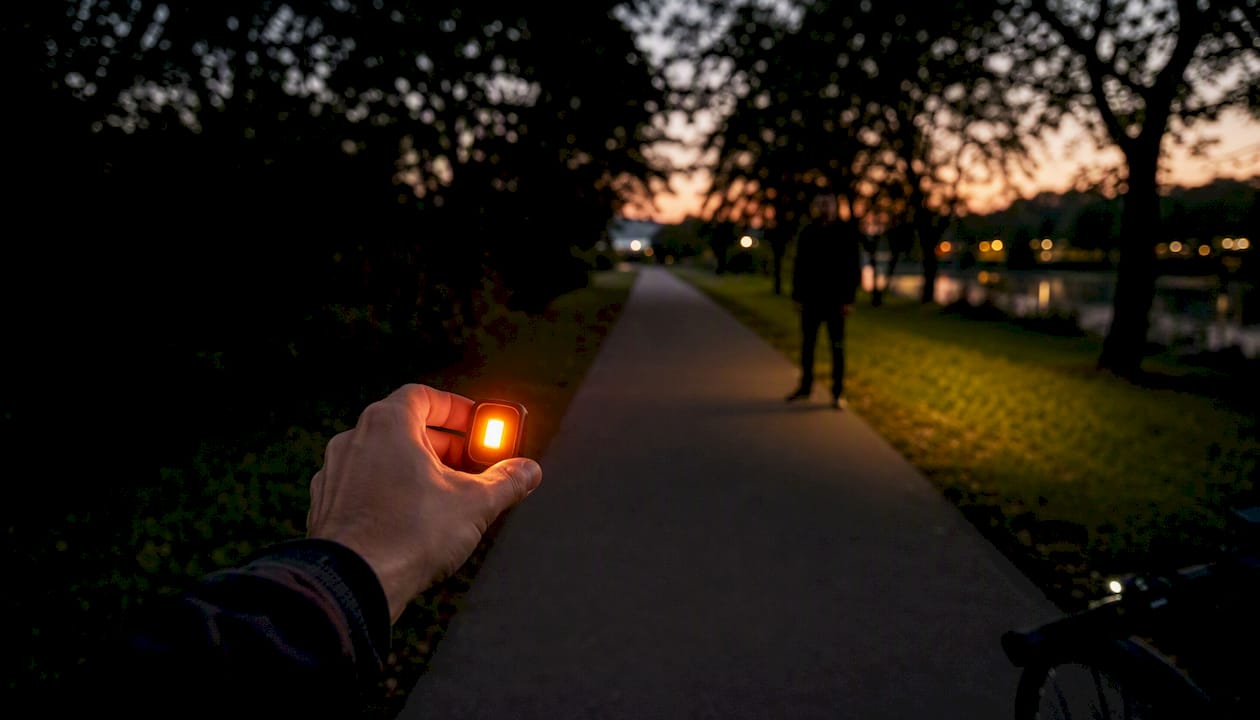
Pro Tip: Do a real-world dazzle test before committing to any indicator light. Ask a friend to stand 20 meters ahead of you at night and look directly at the light. If they find it uncomfortable to look at, it fails the non-dazzling condition regardless of what the spec sheet says.
For broader context on how regulation shapes product design in cycling safety, Thebeamofficial’s piece on 2026 cycling safety trends covers where the category is heading.
Why Thebeamofficial published this guide
The 2024 decree generated a lot of press coverage, but most of it was either too brief to be useful or too technical to be readable. Cyclists were left with a simple question, “is my rear light legal?”, and no clean answer. That gap is exactly why this guide exists.
At Thebeamofficial, cyclist safety is not a marketing angle. It is the reason the brand builds the products it does, from MIPS helmets to visibility accessories designed for real road conditions. When a regulatory change affects the equipment our customers use every day, explaining it clearly is part of the job. If you have a specific product question, whether about a light you already own or one you are considering, Thebeamofficial’s customer service team can confirm steady-mode specs and return eligibility.
Compliant lighting options from Thebeamofficial
Thebeamofficial’s accessory line is built around one principle: visibility that actually works on the road, not just in a product photo. The FRAME FLASH 2.0 motion-powered reflectors are designed to meet French road requirements, with steady-mode capability and the kind of build quality that holds up through a French winter.
If you have questions about whether a specific product meets the requirements of décret n°2024-1074, the customer service team can confirm specs, discuss return options, and point you to the right product for your setup. No guesswork, no ambiguous multi-mode lights. Browse the full accessory range and reach out directly if you need compliance confirmation before you buy.
Sources
These are the primary pages to consult. Each one is maintained by an official body and reflects the post-November 2024 legal position.
- Pour une meilleure visibilité des cyclistes et des trottinettistes, le code de la route autorise désormais l’ajout d’éclairages supplémentaires | Ministère de l’Intérieur
- Legifrance
- Service-public
- R313 regulation excerpt (PDF)
This article provides general legal information about French cycling regulations. For questions specific to your situation or equipment, consult the official sources listed above or a qualified legal professional.
This article is general information, not a substitute for advice from a qualified lawyer. Consult a qualified legal professional about your own circumstances before acting on anything here.


