

No, wearing earphones or any device on or in your ear that emits sound while cycling on the road is illegal in France under Article R412-6-1 of the French Highway Code. Sécurité Routière confirms this rule applies to every road user, cyclists included, with only electronic hearing-correction devices exempted.
Here’s what that means the moment you clip in:
- Any earbud, headphone, or single-ear device worn at or in the ear is banned, regardless of volume or whether it’s playing music, a podcast, or turn-by-turn directions.
- Playing music through an external speaker mounted on your bike or handlebars is the main lawful workaround, provided it isn’t hand-held and doesn’t blast loud enough to disturb others.
- Two sources anchor this: Article R412-6-1 itself, and the practical guidance published by Sécurité Routière on mandatory cycling equipment.
That’s the short version. The rest of this guide walks through the legal reasoning, the gray areas (bone-conduction headphones, group intercoms), what a fine actually costs, and how to keep music in your ride without breaking the law or your attention.
Key Takeaways
Staying legal while listening to music on a bike in France comes down to one rule: keep the sound source off your ears and on an external speaker instead.
| Point | Details |
|---|---|
| Core legal rule | Article R412-6-1 bans any ear-worn sound device for cyclists, with hearing aids as the only exception. |
| Bone conduction isn’t a loophole | The Conseil d’État ruled bone-conduction headphones count as ear-worn devices, closing that workaround. |
| Lawful listening option | Mount an external speaker to your handlebars or frame and keep the volume low enough to hear traffic. |
| Fines escalate quickly | Discounted fines start at 90 €, rising to 375 € late and up to 750 € if contested and lost. |
| Gear that supports awareness | The Beam’s helmets, mirrors, and reflectors help maintain the visibility and awareness that legal audio setups alone can’t guarantee. |
Table of Contents
- Musique casque vélo légal : ce que dit vraiment la réglementation
- What audio devices are banned, and what’s actually allowed?
- Are helmet intercoms and group communication systems legal?
- What are the fines for cycling with headphones in France?
- How can you listen to music legally while cycling?
- Does music actually help or hurt your cycling performance?
- Your Pre-Ride Audio Checklist
- Why Situational Awareness Beats a Perfect Playlist
- Ride Safer With Gear Built for Real-World Roads
- Frequently Asked Questions
- Sources
Musique casque vélo légal : ce que dit vraiment la réglementation
The rule itself is short, but it has a history. Decree n°2015-743, dated June 24, 2015, amended the Road Code to introduce the ban on ear-worn sound devices for anyone driving a vehicle in circulation, cyclists included. That amendment became enforceable on July 1, 2015, which is why you’ll sometimes see the rule referred to by its 2015 origin even though the article number (R412-6-1) is what’s cited in court and on tickets today.
The text of the article is direct: it forbids “the driver of a vehicle in circulation” from wearing at the ear any device capable of emitting sound. The only carve-out is for electronic hearing-correction devices, meaning hearing aids stay legal. Nothing else does, at least not when it sits at or in the ear.
Where this gets interesting is a Conseil d’État decision that tested the edges of the rule. The question was whether bone-conduction headphones, which don’t plug into the ear canal but rest against the bone near the ear, count as “worn at the ear” under the statute. The ruling treated them the same as traditional earphones because they’re still positioned at the ear and still deliver sound to the wearer, regardless of the transmission method. That single decision closed off what a lot of cyclists assumed was a loophole.
A few things worth knowing about how the rule actually gets applied:
- Sécurité Routière’s official equipment guidance for cyclists explicitly folds this ban into the broader list of mandatory rules, alongside helmet recommendations and lighting requirements.
- The Ministry of the Interior and local police forces enforce the rule through ordinary traffic stops, not specialized equipment checks.
- If you want to verify the current text yourself, Legifrance publishes the up-to-date version of Article R412-6-1, and it’s worth a bookmark if you ever need to check for updates.
What audio devices are banned, and what’s actually allowed?
The forbidden category is broader than most cyclists assume. It’s not just wired earbuds. Anything worn at or in the ear that’s capable of emitting sound falls under the ban: classic in-ear buds, over-ear headphones, single-ear Bluetooth devices, and open-ear designs that rest on or near the ear canal without sealing it.
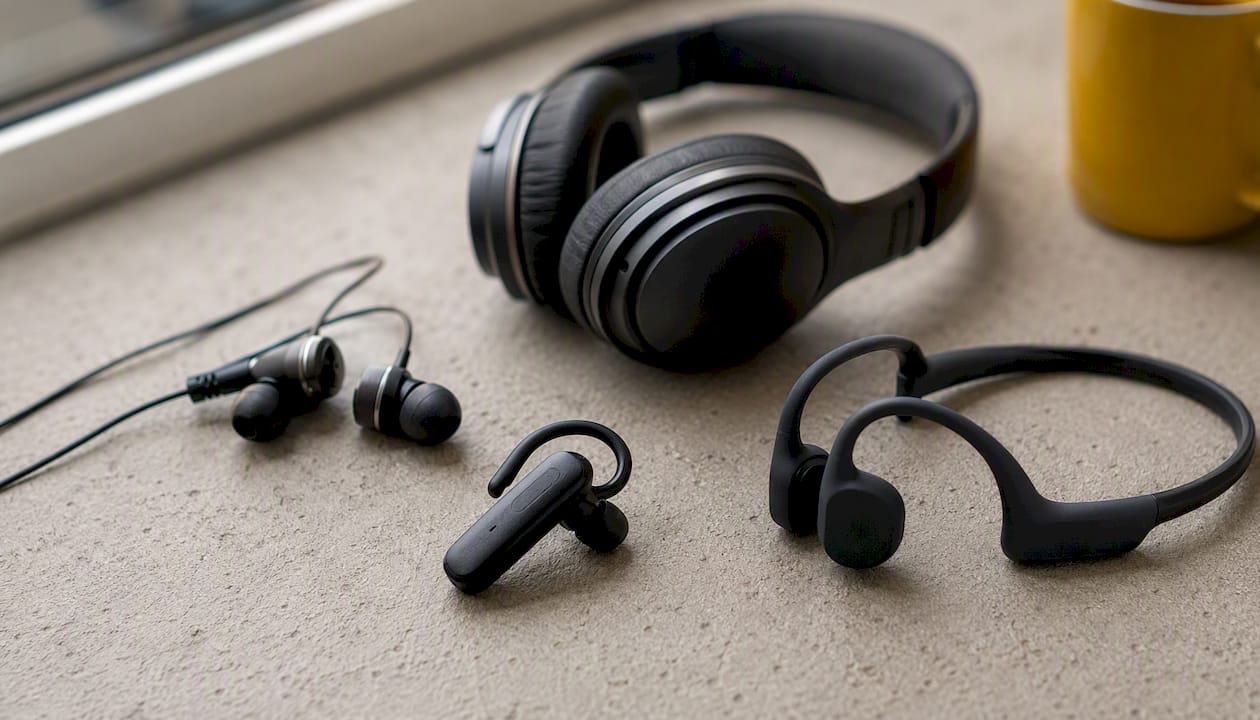
That last category catches a lot of people off guard.
Bone-conduction headphones and “transparency mode” earbuds are marketed as safer because they let ambient noise through. Legally, that marketing pitch doesn’t matter. The Conseil d’État decision mentioned above treats bone-conduction as equivalent to traditional ear-worn audio, because the device still sits at the ear and still transmits sound to the wearer. Whether that sound leaks in through the ear canal or through the jawbone is irrelevant to the statute’s wording.
What’s left, then? A few options remain genuinely lawful in practice:
- External speakers fixed to the bike frame or handlebars. Not hand-held, not worn on the body, just mounted and playing out loud.
- Helmet-integrated speakers, as long as the sound source sits away from the ear canal itself rather than inside or directly over it. This is a narrower category than most riders assume, so check the exact placement before buying.
- A smartphone on a secured handlebar mount, using its built-in speaker rather than a wired or Bluetooth ear connection.
Pro Tip: If a device is visually worn at or in the ear, expect it to trigger enforcement on sight. Officers don’t test whether it’s “on” or check the volume level. They flag what they can see, so the safest move is keeping anything that sits at your ear out of the picture entirely.
The bigger issue isn’t the ticket, though. It’s what you stop hearing. A rider with earbuds in, even at low volume, has a measurably narrower window to catch an ambulance siren, a car horn, or a pedestrian calling out before stepping off a curb. That’s not a hypothetical: it’s the exact scenario road-safety guidance around ear-worn devices is built to prevent, and it’s why Cycling Weekly’s coverage of the broader safety debate keeps circling back to attentional trade-offs rather than device design.
Are helmet intercoms and group communication systems legal?
Group rides create a specific problem the core statute doesn’t spell out cleanly: what about intercom systems that let riders talk to each other mid-ride? The honest answer is that it depends entirely on where the sound-emitting component sits.
If the intercom uses an in-ear or in-helmet speaker that sits at your ear canal, it’s functionally identical to the earbuds the law already bans. The fact that it’s transmitting a teammate’s voice instead of a Spotify playlist changes nothing about how Article R412-6-1 reads. Speaker-based systems, on the other hand, tend to sit on firmer legal ground, because the sound source isn’t positioned at the ear at all.
Here’s how that breaks down for group rides:
- Handlebar-mounted speaker units that broadcast a rider’s voice or a coordinator’s instructions out loud are the cleanest option, since nothing sits at anyone’s ear.
- Microphone-to-external-speaker setups, where one rider’s mic feeds a bike-mounted speaker rather than the receiving rider’s earbud, keep the same principle intact.
- Voice-prompt systems tied to an external speaker (route cues, pace alerts) work the same way: audible to the group, not delivered into anyone’s ear canal.
The trap to avoid is assuming a brand’s marketing language settles the question. “Open-ear” and “bone conduction” are engineering descriptions, not legal ones, and the Conseil d’État decision already ruled that bone conduction doesn’t get a pass just because it feels different from a traditional earbud. Enforcement is visual: an officer sees something at your ear, and that’s the trigger, regardless of what the manufacturer calls it.
What are the fines for cycling with headphones in France?
Cycling with an ear-worn audio device is treated as a road traffic contravention, and the fine structure follows the standard French system of discounted, standard, and increased payment tiers depending on how quickly you settle it.
| Fine Type | Amount | When It Applies |
|---|---|---|
| Discounted (minoré) | 90 € | Paid within 15 days of the notice |
| Standard (forfaitaire) | 135 € | Paid within the standard payment window |
| Increased (majoré) | 375 € | Paid after the standard deadline has passed |
| Contested and rejected | Up to 750 € | If you dispute the fine in court and lose |
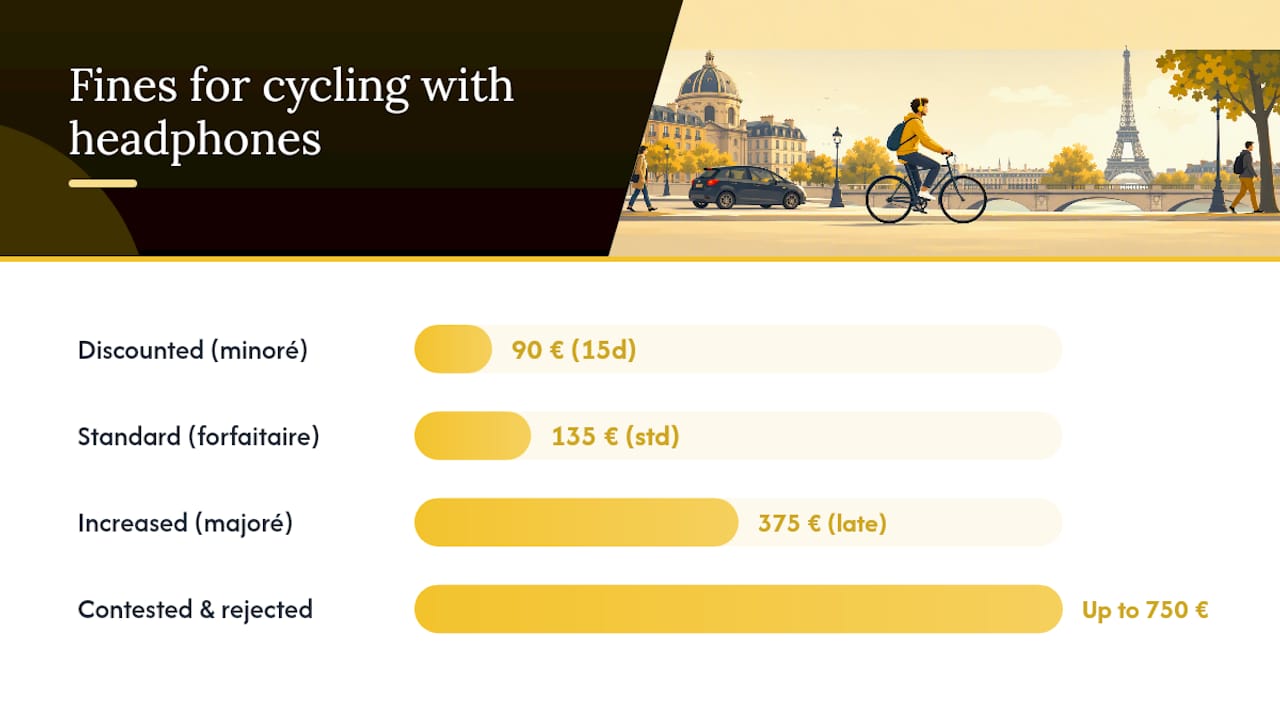
These figures come from reporting on the current enforcement practice around ear-worn audio infractions, and they mirror the tiered system used for most French traffic contraventions. Service-public outlines the general procedure for paying or contesting a fine if you want the administrative details.
A few practical notes on how this plays out on the road:
- Enforcement is entirely visual. An officer doesn’t need to prove the device was on, only that you were wearing it while riding in traffic.
- External speakers aren’t automatically safe from all sanctions. 24matins points out that while speakers aren’t explicitly banned, excessive volume can still get you fined under public-disturbance rules.
- The fine is the smaller risk. Losing awareness of a car merging into your lane or a pedestrian stepping off a curb is the outcome that actually hurts, and it’s the reason the rule exists in the first place, not the other way around.
How can you listen to music legally while cycling?
You’ve got real options here, and none of them require giving up music entirely. The trick is picking a setup where the sound source never sits at your ear.
- Mount a compact Bluetooth speaker to your handlebars or frame. Look for a secure clamp rather than a strap, since vibration on rough pavement will work a loose mount free within a few rides.
- Test the volume on a quiet street before you hit traffic. You want music audible to you without drowning out a car engine or a bell. If a friend riding next to you can’t hear you talk over it, it’s too loud, both for legal safety and for the neighbors.
- Run your first few rides on a familiar, low-traffic route. This lets you calibrate how much ambient awareness you’re actually retaining with the speaker on before you take it into denser streets.
- Use your phone’s speaker on a secured mount as a simpler alternative if you don’t want to buy a dedicated bike speaker. It’s quieter, but it works for casual routes.
Pro Tip: In heavy traffic, switch from continuous music to short, occasional audio cues, like a single track between intersections rather than a nonstop playlist. Pair that with regular mirror checks and defensive lane positioning, and you keep most of the enjoyment without most of the risk.
One limit worth repeating: even a fully legal external speaker can still get you fined if it’s loud enough to constitute a public disturbance. “Legal category of device” and “legal volume” are two separate questions, and French enforcement checks both.
Does music actually help or hurt your cycling performance?
Music changes how hard a ride feels, not how hard your body is actually working, and that distinction matters for deciding when to use it.
A controlled study out of the University of Jyväskylä found that self-selected music let cyclists sustain high-intensity efforts roughly 20% longer before hitting exhaustion. The mechanism wasn’t a physiological change. Heart rate and oxygen consumption tracked the same as riding in silence. What shifted was perceived effort: the music made the same physical strain feel more tolerable, which let riders push the exhaustion point further out.
“Your favourite playlist can help you train harder and longer” isn’t a marketing line here, it’s the literal finding: the effect lives in perception, not in your muscles or your cardiovascular system.
There’s a second layer to this from biomechanics research. A 2025 study in the Journal of NeuroEngineering and Rehabilitation found that “high-groove” music, tracks with a strong, predictable rhythmic pulse, improved joint coordination and muscle synergy during high-torque cycling efforts. That’s a real performance signal, but it’s one measured in controlled lab conditions, not on a street with traffic lights and delivery vans.
Put those two findings together and the practical takeaway is straightforward:
- Music genuinely helps with training tolerance and coordination during structured, controlled sessions like trainer workouts or closed-loop track efforts.
- Its psychological benefit is precisely the risk on open roads: it lowers your perceived effort while doing nothing to sharpen your awareness of hazards.
- Adaptive platforms that sync tempo to heart rate or cadence, discussed in a PMC review of biometric-driven audio tools, can preserve the motivational benefit for indoor training, though their accuracy depends on reliable sensors like chest straps rather than wrist-based readings; for more on tech-empowered athletic experiences, see tech-enhanced traditional sports examples.
The sensible split, then: save music for the trainer, the velodrome, or a route you know cold with almost no traffic. Save your full attention for anything with intersections, merging cars, or pedestrians you haven’t met yet.
Your Pre-Ride Audio Checklist
Run through this before clipping in with any audio setup, whether it’s music, navigation, or a group intercom.
- No device at or in your ear. Check your ears are clear before you roll, not after a stop sign.
- Speaker or phone mount is physically secure. Give it a firm shake test; if it wiggles, it’ll be gone by the second pothole.
- Volume stays low enough that you’d hear a car horn from 20 feet. If you can’t, turn it down.
- You’ve ridden the route before, or it’s genuinely low-traffic. Save the unfamiliar streets for silent rides.
- Both ears stay open to ambient sound. Nothing sealing the canal, nothing resting inside it.
- Mirrors are in use if your bike has them. They cover what your ears might miss.
- Group rides use speaker-based or handlebar-mounted communication, never in-ear intercom units.
One line covers all seven: keep the sound source off your ears and on your handlebars, and you’re both legal and safer for it.
Why Situational Awareness Beats a Perfect Playlist
Most cycling advice treats hearing loss on the road as a minor inconvenience next to the bigger risks: distracted drivers, poor infrastructure, bad weather. That ranking gets it backward. A driver who doesn’t see you is a risk you can partially manage with visibility gear and lane positioning. A hazard you can’t hear because your ears are sealed off is a risk you’ve voluntarily removed your own defense against.
The Jyväskylä research makes this trade-off concrete: music’s benefit is that it makes effort feel easier, which is exactly the mechanism that also makes you less likely to notice something wrong before it’s close. That’s not an argument against music on a bike. It’s an argument for being deliberate about where you use it. A trainer session in your garage and a commute through an intersection-heavy downtown are not the same risk environment, and treating them the same is where cyclists get into trouble.
What actually protects you isn’t the absence of music. It’s a setup that keeps your ears open no matter what’s playing, paired with gear that does the rest of the awareness work for you: a mirror that catches what’s behind you, a helmet built for real impact protection, reflective elements that make you visible before a driver’s attention even reaches your position. Legal compliance and genuine safety point in the same direction here, which is rarer than it sounds in traffic law.
Ride Safer With Gear Built for Real-World Roads
The Beam builds helmets and accessories for riders who want to stay legal and stay aware, not choose between them. If you’re setting up a compliant audio routine, your ears are only half the awareness equation. What you can see and what a driver can see of you matter just as much.

The VIRGO helmet with MIPS technology is built for the kind of protection that matters when attention lapses for even a second, whatever the cause. Pair it with a handlebar-mounted mirror to cover the blind spot your ears can no longer fill once you’ve got a speaker running, or add high-visibility reflectors so drivers spot you before you need to hear them coming. None of this depends on your audio setup. It works whether you’re riding in silence or with a speaker clipped to your frame.
Browse The Beam’s full helmet lineup and build a setup that keeps you legal, aware, and visible on every ride.
Frequently Asked Questions
Is it legal to ride a bike with earbuds in France? No. Wearing earbuds, or any device at or in the ear that emits sound, is prohibited under Article R412-6-1 while cycling in traffic. Hearing-correction devices are the only exemption.
Can you use a Bluetooth speaker on your bike legally? Generally yes, as long as it’s mounted rather than hand-held and doesn’t play loud enough to cause a public disturbance. Volume, not the speaker itself, is what can still get you fined.
Are bone-conduction headphones legal for cycling in France? No. A Conseil d’État decision treats bone-conduction devices the same as traditional ear-worn headphones, since they’re still positioned at the ear and deliver sound to the wearer.
What’s the fine for cycling with headphones in France? Fines start at 90 € if paid within 15 days, rise to 135 € at the standard rate, 375 € if paid late, and can reach 750 € if you contest the fine in court and lose.
Does listening to music actually make cycling easier? Research from the University of Jyväskylä found self-selected music let cyclists sustain high-intensity effort about 20% longer, by making the effort feel more tolerable rather than reducing the physical strain itself.


