

Match the helmet to your terrain, not the label on the box. If you spend most of your time on smooth, fast gravel or the road, a ventilated, lightweight lid with MIPS covers you fine. If your routes get technical, rocky, or remote, you want deeper rear coverage, a visor, and rotational protection built in. The sections below break down coverage, ventilation, MIPS, fit, and how to shop by ride profile, and Thebeamofficial builds helmets around exactly this logic.
TL;DR:
- Deeper shell coverage on gravel helmets is essential for technical, rocky terrain or remote rides where lateral or rear impacts are more likely.
- Helmet ventilation priorities differ: gravel helmets often have larger vents for low-speed airflow, while road helmets focus on airflow at high speed and aerodynamics.
- Rotational protection with MIPS or equivalent liners significantly reduces brain injury risk in angled crashes, especially on gravel or off-road terrain.
- Proper fit, including correct head measurement, retention, and try-on, is critical for safety and comfort during long rides.
- Certification standards like CPSC and EN 1078 do not differentiate between road and gravel helmets, so check for independent lab results and actual protective features.
Table of Contents
- Casque Gravel vs Route: What Actually Changes in the Shell
- Ventilation, Weight, and Aero: What You Give Up Either Way
- Why MIPS Matters More on Rough Terrain
- Getting the Fit Right for Long Days in the Saddle
- Which Helmet Fits Your Actual Riding, Not Just Your Bike
- Certification Standards You Should Actually Check
- Durability: What Wears Out First on Gravel vs Road
- Noise and Distraction: The Overlooked Difference
- Fitting Lights, Mirrors, and Glasses to Your Helmet
- What I’d Tell a Friend Shopping for One Helmet
- Find a Helmet Built Around These Exact Priorities
- Sources
- FAQ
Casque Gravel vs Route: What Actually Changes in the Shell
The real difference between a gravel helmet and a road helmet isn’t marketing. It’s the shell shape, and specifically how far it extends down and around the back of your skull.
Gravel helmets commonly use what’s known as a “deep-drop” shell, extending coverage further over the temples and occipital bone (the bony bump at the base of your skull) than a typical road helmet does, according to BikeRadar’s breakdown of gravel versus road helmet design. Road helmets tend to stop higher, trading that coverage for a lighter, more ventilated shell that suits a rider hunched over the bars at 30 km/h on tarmac.
That extra inch or two of coverage isn’t cosmetic. Picture a low-speed tip-over on a rutted fire road versus a high-speed slide on pavement. The gravel crash usually involves a shorter fall onto uneven, often angled ground, rock edges, roots, ledges, where the back and sides of the head are more likely to make contact first. A deeper shell puts foam exactly where that impact tends to land.
Both helmet types generally rely on the same core protective material: expanded polystyrene (EPS) foam, either in-molded with a thin polycarbonate shell or built as a hybrid construction. The foam does the actual work of crushing and absorbing energy on impact. Shape determines where that foam sits on your head, not how well it absorbs force once it gets there. That distinction matters because it means a well-built road helmet isn’t inherently “weaker,” it’s just covering different territory.
Where deep-drop coverage earns its keep:
- Riding rocky, technical singletrack or rutted double track where low-speed falls to the side or rear are common.
- Bikepacking or multi-day gravel trips where fatigue increases the odds of a sloppy dismount or slow-speed spill.
- Descending loose gravel or scree where a rider is more likely to go down sideways than pitch forward.
- Riding solo in remote areas where any added protection buys margin when help is far away.
If your gravel riding stays on smooth doubletrack or converted rail trails, that extra coverage matters less. The terrain itself, not the bike you’re riding, is what should drive the decision, a point Road makes clearly: a well-fitted road helmet with modern rotational protection can be entirely sufficient for a lot of gravel riding.
Ventilation, Weight, and Aero: What You Give Up Either Way
Every helmet decision is a trade-off, and ventilation is where it shows up first. Road helmets are built around airflow at speed, big vents, internal channeling, minimal material blocking air movement, because a road cyclist spends most of a ride moving fast enough to generate real cooling breeze.
Gravel riding breaks that assumption constantly. Climbs on loose or steep terrain often happen at 10 to 20 km/h, sometimes slower, which means far less airflow reaching your scalp exactly when you’re working hardest. Guides focused on gravel-specific helmet features flag low-speed ventilation as one of the most underrated differences between the two categories, and it’s the reason well-designed gravel lids often add larger vent channels or repositioned intake ports rather than just copying a road shell with a visor bolted on.
Quick gut-check: if your gravel rides involve sustained climbing at a jogging pace, prioritize a helmet with proven low-speed airflow over one optimized purely for wind-tunnel numbers.
Aerodynamics cuts the other way. Road helmets, especially aero road models, are shaped to reduce drag at 30+ km/h, which matters over long, fast rides where seconds add up. Add a visor or a deeper shell and you add surface area and turbulence, which is why BikeRadar notes that visors help with sun, rain, and mud but can hurt aerodynamics and even obstruct your view in an aggressive, low road position.
Weight follows a similar pattern. A featherweight road helmet feels great for a fast two-hour ride but isn’t necessarily the priority on a three-day bikepacking trip, where comfort, ventilation, and mount compatibility for lights or accessories matter more than shaving 40 grams.
Trade-offs to weigh before you buy:
- Sustained low-speed climbing favors gravel-specific vent design over raw aero numbers.
- Long, fast group rides or gravel races favor a lighter, more aero shape, even without a visor.
- Multi-day trips favor comfort and airflow over weight savings measured in single-digit grams.
- A visor helps in rain, sun, and mud, but costs you a bit of aero efficiency and can clip your sightline in a low, aggressive position.
Why MIPS Matters More on Rough Terrain
Rotational protection isn’t a gimmick, and understanding what it actually does changes how you shop. MIPS (Multi-directional Impact Protection System) is a thin, low-friction layer inside the helmet that allows a small amount of slip between your head and the shell during an angled impact. Most real-world crashes aren’t straight-on hits, they come in at an angle, and that angled contact creates rotational force on the brain that a standard foam liner alone doesn’t fully address.
Off-road and gravel falls are especially prone to these oblique impacts. You’re more likely to catch a pedal, wash out on loose gravel, or clip a rock at an angle than to hit something head-on, and both road.cc and Hill.Camp’s gravel helmet coverage point to rotational protection as one of the more meaningful upgrades a rider can make, regardless of whether the helmet is labeled “road” or “gravel.”
Here’s what to actually check before buying, rather than trusting a label:
- Look for MIPS or an equivalent slip-plane liner listed explicitly on the product page, not just implied by marketing language.
- Check for independent lab results. Virginia Tech’s helmet ratings program tests real helmets against real impact data, and a strong score there tells you more than any brand claim.
- Confirm the certification standard for your region (CPSC in the US, EN 1078 in the EU) is printed on the helmet or its packaging.
- Combine deep rear coverage with rotational protection if you ride technical terrain regularly. The two work together, not as substitutes for each other.
Pro Tip: Don’t assume a helmet has MIPS just because it looks like other gravel helmets on the shelf. Some brands charge a premium for the visor and the shell shape but skip rotational protection entirely, check the spec sheet, not the silhouette.
A gravel helmet with deep coverage and no rotational liner protects differently than a road helmet with MIPS but a shallower shell. Neither is automatically “better,” they’re solving different parts of the same problem, which is exactly why matching helmet to terrain matters more than matching helmet to bike type.
Getting the Fit Right for Long Days in the Saddle
None of the shell shape or MIPS discussion matters if the helmet doesn’t fit. A helmet that shifts, rocks, or pinches will get adjusted mid-ride, at best, and simply fail to protect properly in a fall, at worst.
- Measure your head circumference with a soft tape measure, wrapped about an inch above your eyebrows and ears, at the widest point of your skull. Compare that number to the brand’s size chart rather than guessing from past experience with a different helmet.
- Check the retention system. A quality occipital dial should sit snugly at the base of your skull, not creeping up toward your crown, and the strap splitters should form a clean V just below your ears without covering them.
- Test the pads and internal fit. Pads should contact your scalp evenly, no gaps, no single pressure point, and should be replaceable, since sweat and oil break them down over months of riding.
- Confirm sunglass compatibility. Vent spacing should let you slide temple arms in without them getting pinched against your head, a small detail that matters a lot on a four-hour ride.
- Do the shake test. With straps fastened, shake your head side to side and front to back. The helmet should move with your skull, not slide independently. If it rocks, try a smaller size or a different shape before adjusting straps further.
A helmet that’s technically the right size but the wrong shape for your head will never sit right, no matter how much you tighten the dial. If a helmet feels almost right, try a different model in the same size before assuming the fit issue is you.
Which Helmet Fits Your Actual Riding, Not Just Your Bike
Ride profile, not bike category, should drive the decision. Here’s how the choice breaks down for three common patterns.
Mostly road, occasional smooth gravel. Prioritize low weight, strong ventilation, and MIPS. You don’t need deep rear coverage for a gravel path that’s basically a wide dirt road, and a road-style helmet with rotational protection covers this use case well, a point Two Wheel Tales’ helmet buying guide backs up directly.
Long bikepacking or ultra-distance gravel. Prioritize comfort over multiple hours, low-speed ventilation for extended climbs, and accessory mounts for lights or a rearview camera. Weight matters less here than all-day livability.
Technical gravel or singletrack. Prioritize rear and temple coverage, a visor for mud and low sun, and confirmed rotational protection. This is where the deep-drop shell earns its keep, since falls are more frequent, slower speed, and more likely to hit at an angle.
Pro Tip: Before buying, ask yourself four questions: What terrain do I ride most? How long are my typical rides? What climate am I riding in? Do I need mounts for lights, a mirror, or a camera? Answer those honestly and the helmet choice usually sorts itself out.
- Terrain: smooth vs. technical determines how much rear coverage you actually need.
- Duration: longer rides push ventilation and comfort above raw weight savings.
- Climate: hot, still climbs demand better low-speed airflow than a cool, breezy coastal ride.
- Accessories: check mount compatibility for lights, mirrors, or cameras before you commit to a shell shape.
Certification Standards You Should Actually Check
Every helmet sold in the US must meet CPSC 16 CFR 1203 safety standards, and helmets sold in the EU carry the EN 1078 certification. Both set minimum requirements for impact absorption and retention strength, and neither standard distinguishes between “road” and “gravel” categories, they test the helmet as a helmet.
That’s worth sitting with for a second: there’s no separate legal safety bar for a gravel helmet versus a road helmet. The category is a marketing convenience, not a regulatory one. What actually varies between models within either category is whether the brand added voluntary, above-and-beyond protection, most commonly a MIPS or equivalent rotational liner, which isn’t required by CPSC or EN 1078 but consistently shows up as a meaningful upgrade in independent testing.
This is where lab scores matter more than labels. A helmet that passes CPSC or EN 1078 is legally sellable, but that’s a floor, not a ceiling. Look for published results from independent testing bodies rather than relying on the certification sticker alone, since two helmets can both be “certified” while performing very differently in real crash scenarios. If a brand doesn’t publish or reference third-party lab results anywhere on its product page, treat that as a gap worth asking about before you buy.
Durability: What Wears Out First on Gravel vs Road
Helmets don’t fail dramatically, they degrade quietly, and gravel riding accelerates that process in specific ways.
Dust, grit, and mud work into vent channels and strap hardware faster on gravel than on pavement, which means retention dials and buckles on gravel helmets see more mechanical stress over a season. EPS foam itself degrades primarily from UV exposure and impact, not from dirt, but a helmet that’s dropped repeatedly while strapped to a bikepacking rack or bounced around in a gravel crash takes far more of that impact stress than one that lives on a smooth road bike.
The outer shell matters here too. In-mold construction, where the polycarbonate shell is fused directly to the EPS foam during manufacturing, holds up better against the scrapes and minor drops common on gravel and technical terrain than helmets with a shell that’s simply glued on afterward. Check for this detail on the product page if you’re buying for rough use.
Padding is the component you’ll replace most often regardless of helmet type. Sweat and skin oil break down foam pads within a season or two of regular riding, and gravel’s slower, more strenuous climbs typically mean more sweat exposure per ride than a fast road spin. Buy a helmet with replaceable pads, and replace them proactively rather than waiting for them to visibly fall apart.
The universal rule that applies to both categories: any helmet involved in a real crash, even one that looks undamaged, should be replaced. EPS foam compresses permanently on impact even when the shell shows no visible cracking.
Noise and Distraction: The Overlooked Difference
Wind noise is rarely part of the road-versus-gravel conversation, but it affects how alert you stay on a long ride, and the two helmet styles handle it differently.
Deep-shell gravel helmets with larger vents and visors tend to generate more wind turbulence at speed, translating into a louder, buzzier ride, especially on fast descents. That noise isn’t just annoying, it can mask the sound of an approaching vehicle or another rider calling out on a shared trail, which matters more on gravel routes that sometimes share road sections with car traffic.
Road helmets, shaped for smoother airflow, tend to run quieter at speed, though the trade-off shows up in exactly the low-speed climbing scenarios covered earlier, where reduced venting means less airflow when you need it most.
A visor adds its own noise variable. At certain angles and speeds, a visor can create a low-frequency buzz or flutter that some riders barely notice and others find genuinely distracting over a multi-hour ride. If you’re sensitive to this, test a helmet with the visor on before committing, ideally on a fast downhill section where wind noise peaks.
The practical takeaway: if situational awareness around traffic matters for your typical route, a quieter, lower-profile helmet may serve you better than one optimized purely for coverage or ventilation.
Fitting Lights, Mirrors, and Glasses to Your Helmet
Accessory compatibility is where a lot of riders get surprised after they’ve already bought a helmet, so it’s worth checking before, not after.
Road helmets typically have minimal mounting points beyond a rear light clip, since the design philosophy favors weight and aero over add-ons. Gravel-oriented helmets more often include dedicated mounts for a rear light, a camera, or even a small mirror, reflecting the reality that gravel and bikepacking riders tend to carry more gear for longer, more remote rides.
Sunglass compatibility depends heavily on vent spacing and shell curvature near the temples. A helmet with narrow, tightly spaced vents can pinch or block glasses arms, forcing an awkward fit that gets worse over a long ride. Try your actual glasses on with any helmet you’re considering, not a generic pair, before buying.
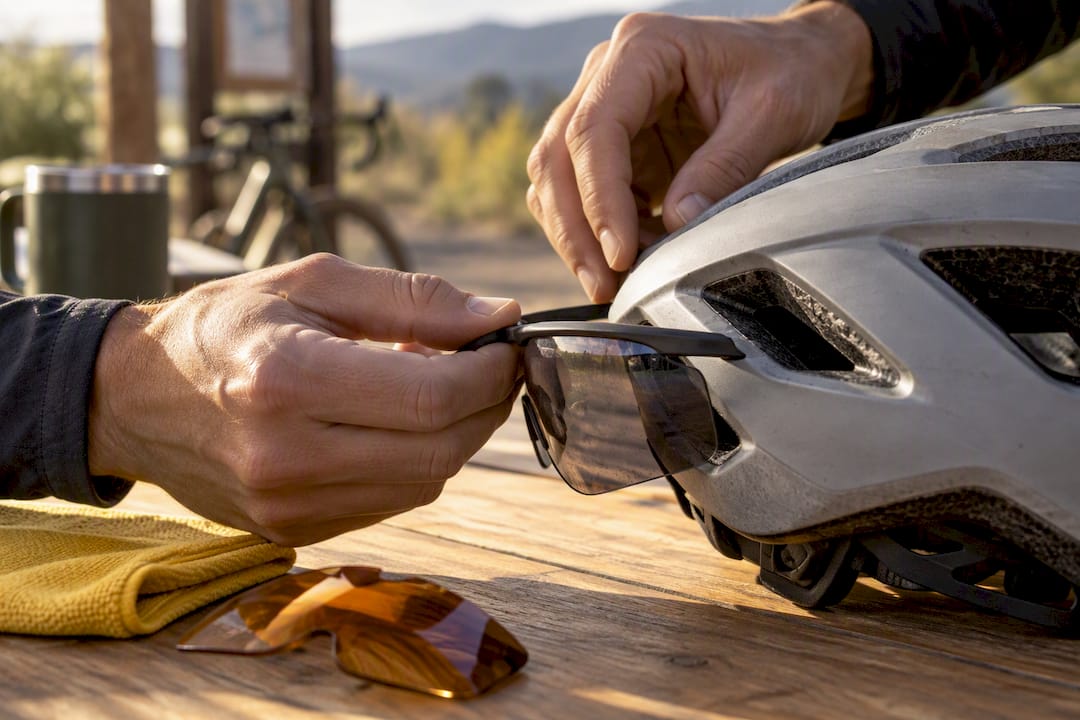
For rear visibility and lighting, check whether the helmet’s rear vents or shell shape leave room for a clip-on light without blocking airflow, an issue that comes up more on deep-shell gravel helmets than on slimmer road designs. Reflective accents built into the shell or straps add a passive visibility layer that works even if a light’s battery dies mid-ride, worth considering for anyone doing early morning or evening gravel sessions.
What I’d Tell a Friend Shopping for One Helmet
If you only remember one thing from this guide, remember this: buy for your terrain, not for the sticker on the box. A ventilated, MIPS-equipped helmet handles the vast majority of road and smooth-gravel riding just fine, and a deep-shell design earns its extra grams only when your routes turn genuinely technical or remote.
Before you commit to any helmet, run three checks. First, fit: does it stay put during a vigorous head shake with the straps fastened normally? Second, rotational protection: is MIPS or an equivalent liner actually listed on the spec sheet, not just implied by the price tag? Third, low-speed ventilation: will it still breathe on a slow, sweaty climb, not just at 30 km/h on flat pavement?
Try helmets on in person when you can. Head shapes vary enough between brands that a size that’s “correct” on paper can still feel wrong on your skull. Prioritize certified protection and honest fit over marketing language every time, that’s the difference that actually shows up in a fall.
— Sophie
Find a Helmet Built Around These Exact Priorities
Thebeamofficial designs helmets around the same logic covered in this guide: real coverage, certified rotational protection, and features that hold up to actual riding conditions instead of marketing copy. The flagship VIRGO integral helmet uses MIPS technology and a full-face design originally built for urban and commuting riders who need serious protection without sacrificing everyday usability, and it’s earned international design recognition, including a Red Dot award, for that approach.

If you ride a mix of road and gravel and want one helmet that doesn’t force a trade-off between ventilation and protection, browse the helmets collection to compare models against the fit and coverage checks from this guide. Pair your helmet with visibility accessories like CORKY or rear lighting from CYCLYK if your rides run into low light or shared traffic. Try any helmet on before your first long ride and check the product page for sizing details so the fit checks from earlier actually hold up on the road, or the gravel.
Sources
- What the heck is a gravel helmet? Gravel vs road helmets – the differences (and similarities) explained | BikeRadar
- Road
- Hill
FAQ
What Helmet Should I Wear for Gravel Riding?
For most gravel riding, a well-ventilated helmet with MIPS or equivalent rotational protection is enough, according to road.cc’s off-road testing. Reserve a deeper-shell, gravel-specific design for technical singletrack, bikepacking, or consistently rough terrain where extra rear and temple coverage matters more.
Can You Ride on Roads With a Gravel Bike?
Yes, gravel bikes handle paved roads without any issue, since they’re built with road-capable geometry and tires that roll fine on tarmac. The wider tires add a bit of rolling resistance compared to a dedicated road bike, but nothing that limits everyday road riding.
Can You Ride Gravel With a Road Bike?
You can ride smooth or lightly packed gravel on a road bike, though tire clearance and tire width limit how rough the terrain can get. Technical or loose gravel becomes harder to control on narrower road tires, which is where a gravel-specific bike, and helmet, start to matter more.
What’s the Difference Between a Mountain Bike Helmet and a Road Helmet?
Mountain bike helmets typically offer the deepest rear and side coverage of the three categories, often extending further down the skull than even gravel helmets, built for slower speeds and more technical falls. Road helmets prioritize ventilation and low weight for sustained speed, while gravel helmets usually sit in between the two, borrowing coverage ideas from mountain bike design and ventilation priorities from road design.
Does Every Helmet Need MIPS to Be Safe?
No, MIPS isn’t required by any certification standard, but independent testing consistently shows it reduces rotational force in angled impacts, which are common in both road and gravel falls. Thebeamofficial’s VIRGO helmet includes MIPS as a standard feature for exactly this reason.


