

TL;DR:
- Adaptive helmet ventilation actively regulates head temperature through adjustable vents, internal channels, or battery-powered fans. It enhances safety by maintaining cognitive clarity, reducing heat fatigue, and managing moisture during rides. Proper channel design and vent use are more important than vent count alone for effective cooling and fog prevention.
Adaptive helmet ventilation is defined as a dynamic airflow management system built into cycling helmets to actively regulate head temperature during a ride. Unlike fixed vents that rely entirely on wind speed, adaptive systems adjust airflow in real time through mechanical sliders, internal channel routing, or battery-powered fans. The result is a helmet that responds to your thermal load rather than forcing you to manage it yourself. For cyclists riding in heat, traffic, or variable conditions, this technology directly affects both comfort and safety.
How does adaptive helmet ventilation work?
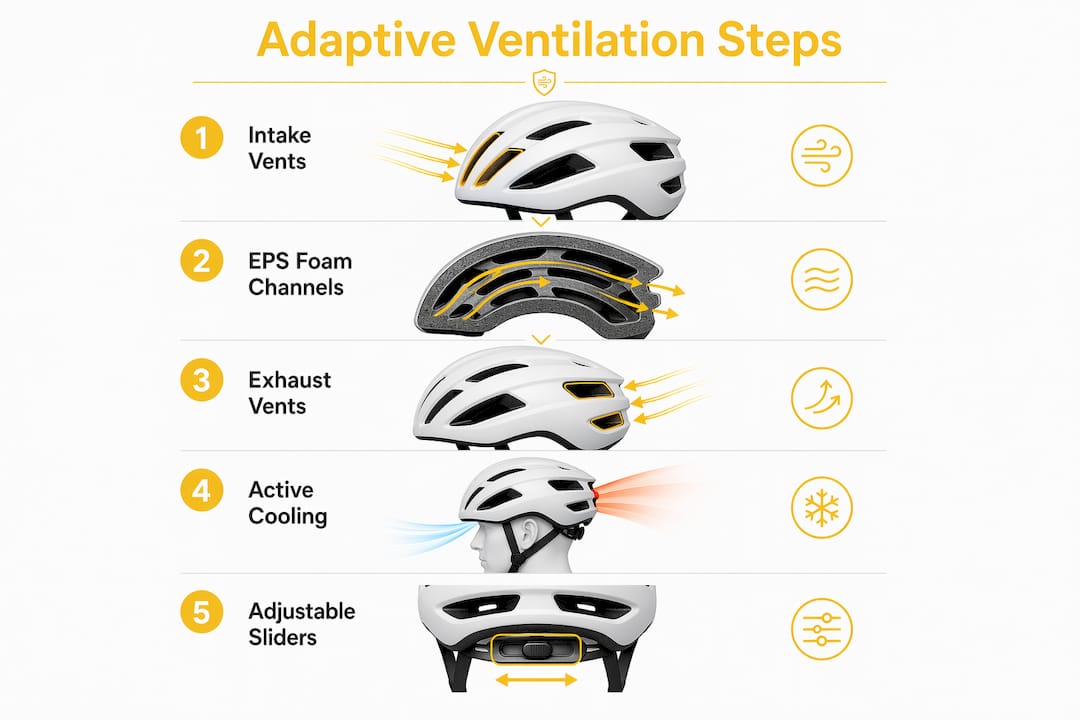
Adaptive ventilation operates through three core mechanisms working together: intake control, internal channel routing, and exhaust management. Understanding each one helps you evaluate any helmet claiming to offer this feature.
1. Intake and exhaust vent design
Every ventilated helmet has intake vents at the front and exhaust vents at the rear. In adaptive systems, the intake vents are adjustable, either through manual sliders or sensor-triggered actuators. Chin vents push air upward to reduce visor fog, while rear exhaust vents allow hot air to escape. The pressure differential between front and rear drives continuous airflow across the scalp.
2. Internal EPS foam channels
The foam liner inside a helmet is not just impact protection. In well-designed helmets, the expanded polystyrene (EPS) foam is carved with channels that route air directly along the scalp. Vent placement and internal channels matter more than vent count. A helmet with 12 well-placed vents connected by deep EPS channels outperforms one with 20 shallow vents that dead-end inside the foam.
3. Battery-powered active cooling
The most advanced tier of adaptive ventilation uses micro-fans powered by rechargeable lithium batteries. Variable speed fan technology conserves battery life while maintaining thermal control dynamically. Delhi traffic police helmets, for example, integrate compact cooling fans powered by rechargeable lithium batteries to reduce heat stress during prolonged outdoor exposure. These active systems charge fully in 3–4 hours and run for 4–5 hours of continuous cooling. That runtime covers most road rides, gran fondos, and full-day gravel events.
Pro Tip: If you ride in temperatures above 85°F regularly, prioritize helmets with adjustable intake sliders over fixed-vent designs. You can close them partially in cooler morning conditions and open them fully once the heat builds.
What are the key benefits of adaptive helmet ventilation for cyclists?
The benefits of helmet ventilation go well beyond staying comfortable. Thermal management inside a helmet is a direct safety variable.
- Cognitive protection. Excessive heat impairs cognitive performance and slows reaction times, raising crash risk in technical riding and traffic. Adaptive ventilation keeps head temperature lower, which keeps your decision-making sharper.
- Reduced heat fatigue. Thermal regulation through active helmet systems helps preserve endurance and mental focus on long rides. This matters most on climbs and in stop-and-go urban riding where airflow from forward motion disappears.
- Sweat and moisture management. Engineered airflow channels pull moisture away from the scalp, reducing the buildup that causes discomfort and skin irritation on multi-hour rides.
- Visor fog prevention. Proper vent adjustment is often more effective than anti-fog products, particularly in rainy conditions and heavy traffic where temperature differentials are highest.
- Extended riding endurance. Cyclists who maintain lower core and head temperatures sustain effort longer. Adaptive cooling technology removes a thermal ceiling that passive helmets cannot address.
“Ventilation is not just comfort but a safety feature essential to maintaining cognitive sharpness and reducing accident risk.” — Mountain Bike Helmet Ventilation and Airflow Explained
For a deeper look at why this matters across different riding styles, the guide on why helmet ventilation matters covers the physiological case in detail.
How does adaptive ventilation compare with traditional helmet systems?
Traditional helmet ventilation is passive. Air enters through fixed front vents, travels through whatever channels the foam allows, and exits at the rear. The system works only when you are moving fast enough to generate pressure at the intake. Stop at a red light, and airflow stops entirely.
Adaptive ventilation systems solve that problem through active or adjustable components. The comparison below shows where the two approaches diverge most sharply.
| Feature | Traditional passive vents | Adaptive ventilation systems |
|---|---|---|
| Airflow control | Fixed, speed-dependent | Adjustable or sensor-controlled |
| Performance at low speed | Minimal to none | Maintained via fans or channel design |
| Fog prevention | Limited | Active via chin vent adjustment |
| Battery requirement | None | 3–4 hour charge for active systems |
| Cognitive safety benefit | Indirect | Direct, measurable thermal reduction |
| Weight impact | Negligible | Slight increase with active components |
The trade-off with active cooling systems is weight and charging discipline. A helmet with a lithium battery cooling unit adds grams and requires you to charge it before a ride. For most cyclists, that is a minor inconvenience against the performance gain. For competitive riders where every gram counts, passive adaptive designs with optimized EPS channels and adjustable sliders offer a middle path.
Aerodynamics is the other variable. Larger vent openings improve airflow but increase drag. Adaptive systems that close vents at speed and open them in slow conditions actually solve this trade-off better than any fixed design. You get aerodynamic efficiency on descents and maximum cooling on climbs, from the same helmet.
For cyclists upgrading from a basic commuter helmet, the helmet safety upgrade guide from Thebeamofficial walks through what features to prioritize at each level.
What should cyclists know when choosing a helmet with adaptive ventilation?
Choosing the right adaptive ventilation helmet requires evaluating more than the spec sheet. Here is what to look for and how to use these systems effectively once you have one.
- Evaluate channel depth, not just vent count. Ask whether the manufacturer publishes information about EPS foam channel routing. Deep channels close to the scalp outperform shallow ones regardless of how many vents the helmet has.
- Check battery runtime against your ride length. Active cooling systems that run 4–5 hours cover most rides, but ultra-distance cyclists and e-bike commuters doing back-to-back days need to plan charging windows carefully.
- Use vent sliders dynamically. Open intake vents fully before climbs and in slow urban traffic. Close them partially on fast descents to reduce drag and wind noise. Most riders set their vents once and forget them, which wastes the technology.
- Confirm safety certification compatibility. Adaptive ventilation features must not compromise the helmet’s structural integrity or certification status. Look for CE EN 1078, CPSC, or MIPS certification alongside any active cooling claims.
- Match the system to your conditions. Battery-powered active cooling delivers the biggest benefit in temperatures above 85°F and in stop-and-go traffic. In mild climates or at consistent high speeds, optimized passive adaptive designs perform nearly as well with less maintenance.
Pro Tip: Before a long summer ride, charge your active cooling helmet overnight and test the fan function before you leave. A dead battery on a hot day defeats the entire system. Build it into your pre-ride checklist the same way you check tire pressure.
For e-bike riders specifically, the e-bike helmet tech guide from Thebeamofficial covers how adaptive ventilation pairs with smart helmet features like impact sensors and connected lighting.
Key takeaways
Adaptive helmet ventilation is the single most effective technology for managing rider head temperature, and it works through channel design, adjustable vents, and active cooling systems working together.
| Point | Details |
|---|---|
| Airflow path beats vent count | Deep EPS foam channels close to the scalp cool more effectively than a high number of shallow vents. |
| Active cooling extends runtime | Battery-powered systems charge in 3–4 hours and deliver 4–5 hours of consistent cooling. |
| Ventilation is a safety feature | Heat impairs cognitive performance and reaction time, making thermal management directly crash-relevant. |
| Adjust vents dynamically | Open vents on climbs and in traffic, close them on fast descents for both cooling and aerodynamic efficiency. |
| Certification still comes first | Any adaptive ventilation system must maintain the helmet’s structural safety certification to be worth using. |
What I’ve learned watching riders ignore their vents
I have spent years watching cyclists invest in high-end helmets and then ride with every vent slider locked shut because they set it once in a cool morning and never touched it again. The technology is only as good as the rider using it.
The most underrated shift in helmet design right now is not the battery-powered fan. It is the move toward smarter passive adaptive systems, where EPS channel geometry and vent placement do the work without any electronics. These designs are lighter, require zero maintenance, and perform consistently. The active cooling systems from Delhi traffic police deployments are genuinely impressive proof-of-concept cases, but the real mass-market opportunity is in helmets that adapt through geometry rather than gadgetry.
What excites me about the near future is AI-driven airflow control. Sensors already exist that can read skin temperature and humidity in real time. Connecting those readings to motorized vent actuators would give cyclists a helmet that genuinely responds to their physiology, not just the ambient temperature. Thebeamofficial is exactly the kind of brand positioned to bring that kind of thinking into production-ready cycling helmets, because the focus has always been on real-world usability rather than spec-sheet performance.
The one thing I would push back on in most ventilation discussions is the assumption that more vents always mean better cooling. It does not. A helmet with poorly routed channels and 20 vents will leave you hotter than one with 10 vents and deep scalp-proximity routing. Buy the channel design, not the vent count.
— Sophie
Ride cooler with Thebeamofficial helmets
Thebeamofficial designs helmets built around the same principles this article covers: airflow that works in real conditions, not just in a wind tunnel.

The Thebeamofficial helmet collection includes models engineered with deep EPS channel routing, adjustable ventilation systems, and MIPS technology for impact protection that does not compromise airflow. Whether you ride road, gravel, urban, or e-bike, there is a helmet in the range built for your thermal demands. Explore the full adults’ helmet collection to find a model with the ventilation architecture your rides require. If you want to go further, the complete helmet range covers every riding category Thebeamofficial serves.
FAQ
What is adaptive helmet ventilation?
Adaptive helmet ventilation is a system that dynamically adjusts airflow inside a cycling helmet through adjustable vents, internal EPS foam channels, or battery-powered fans to regulate head temperature during a ride.
How does adaptive ventilation improve rider safety?
Heat inside helmets impairs cognitive performance and slows reaction times, raising crash risk. Adaptive ventilation keeps head temperature lower, which directly supports sharper decision-making and faster responses.
How long do battery-powered helmet cooling systems last?
Active cooling helmets typically charge fully in 3–4 hours and run for 4–5 hours of continuous operation, covering most standard road and gravel rides.
Is vent count the best measure of helmet ventilation quality?
No. Internal channel design and vent placement matter more than the number of vents. Deep EPS foam channels routed close to the scalp deliver better cooling than a high vent count with shallow or disconnected channels.
Can adaptive ventilation prevent visor fogging?
Yes. Proper vent adjustment, particularly through chin vents that direct air upward across the visor, is more effective at preventing fog than anti-fog coatings in most riding conditions.


