

What actually puts cyclists at risk on the road?
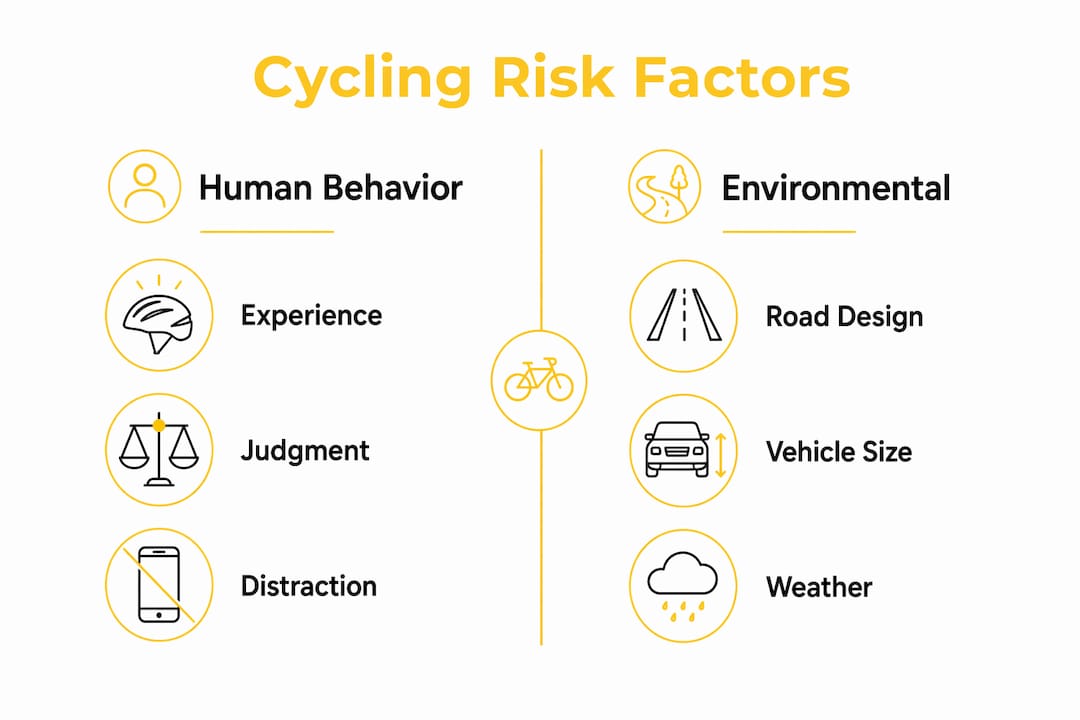
Road cycling risk factors fall into four main categories: human behavior, environmental conditions, psychological pressures, and equipment fit. Each one operates independently, but they frequently stack. A fatigued commuter riding through a poorly lit intersection during rain faces all four at once.
Here is a clear breakdown of what the research consistently flags:
- Behavioral factors: Failing to yield right of way and poor visibility are leading causes of fatal cyclist crashes. Distracted riding, traffic rule violations, and poor hazard scanning compound the risk.
- Environmental and infrastructure factors: High intersection density, mixed-traffic roads without separated lanes, and commercial zones with heavy pedestrian and vehicle interaction all raise crash probability.
- Psychological pressures: Time pressure drives speed and shortcuts. Route familiarity breeds complacency. Both are especially pronounced in commuter and delivery cyclists.
- Equipment and fit: Improper bike fit causes overuse injuries to the knee, lower back, and hips. Mechanical failures from poor maintenance cause non-crash injuries that rarely appear in traffic safety databases.
- Statistical context: According to the CDC, nearly 1,000 bicyclists die on U.S. roads each year in crashes involving a motor vehicle, with an estimated 120,000 emergency department visits annually for non-fatal crash injuries. Cyclists account for 2–3% of motor vehicle crash fatalities despite representing just 1% of all trips.
Understanding these categories is the first step toward riding with intention rather than just habit.
Table of Contents
- Human behavioral risk factors in road cycling
- How does road design affect your crash risk?
- Psychological and commuter-specific risk factors in urban cycling
- Non-crash injuries and why bike fit matters more than you think
- Crash and injury prevention practices that actually work
- How Thebeamofficial addresses the risk factors that matter most
- Vehicle-related risk factors: distracted drivers, large vehicles, and driver behavior
- What crash data tells us about injury patterns in road cycling
- How experience and skill level shape your actual risk exposure
- Key Takeaways
Human behavioral risk factors in road cycling
Behavior is the single most influential category in cycling crash causation. Riding style, decision-making, and attention all interact with every other risk factor cyclists face.
Failure to yield sits at the top of the list. When a cyclist or driver misjudges right of way at an intersection, the consequences are severe, particularly because cyclists have almost no structural protection in a collision. Visibility compounds this: drivers frequently fail to see cyclists until it is too late, and cyclists riding without lights or reflective gear make that problem worse.
- Distracted riding: Using a phone, listening to music at high volume, or looking away from traffic even briefly reduces hazard detection time.
- Traffic rule violations: Running red lights, ignoring stop signs, and riding against traffic all dramatically increase crash exposure.
- Poor hazard scanning: Cyclists who do not actively scan intersections, driveways, and parked car doors are consistently more likely to be involved in collisions.
- Riding in blind spots: Staying in a driver’s blind spot, especially near large vehicles, is one of the most preventable crash scenarios.
- Alcohol involvement: CDC data shows that more than one-third of fatal cyclist crashes involve alcohol on the part of the driver, the cyclist, or both.
Pro Tip: Practice active hazard scanning by looking two to three intersections ahead, not just at the road immediately in front of you. Anticipating a car turning left before it signals gives you reaction time that reactive riding never will.
Behavioral risks are also shaped by experience level. Newer cyclists tend to make more judgment errors at intersections and in traffic, while experienced riders can develop overconfidence that leads to complacency. Neither extreme is safe.
How does road design affect your crash risk?
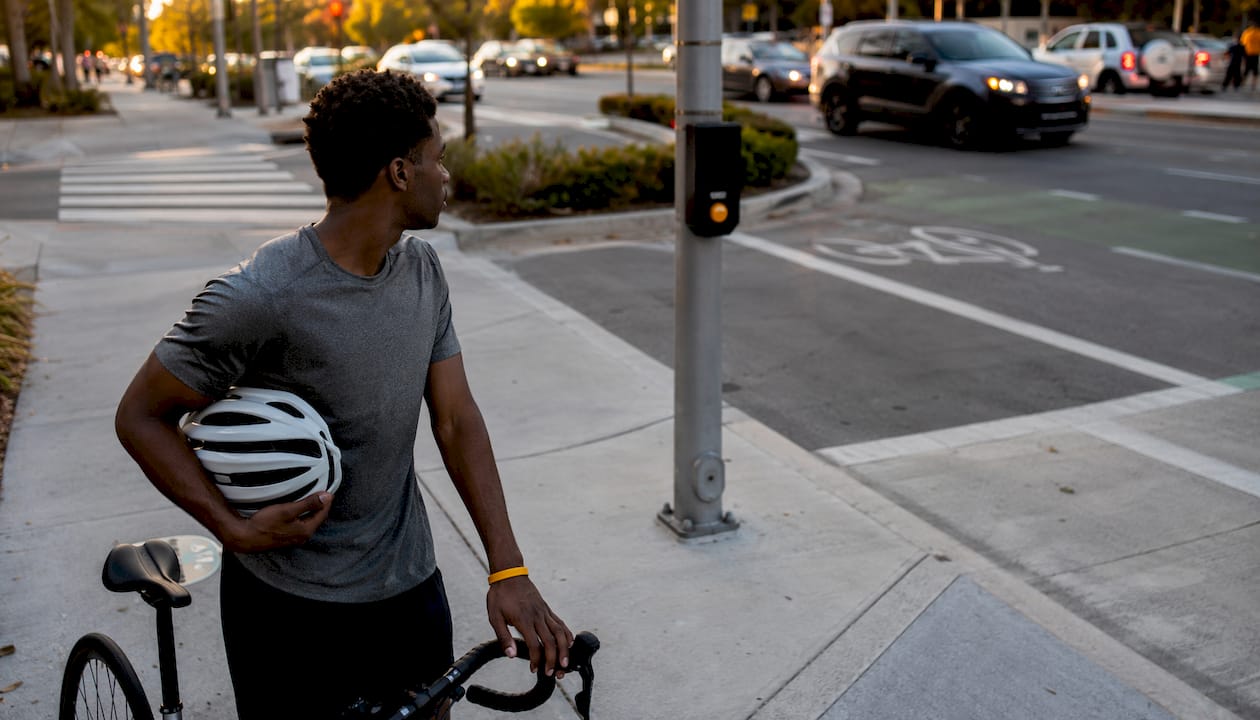
Infrastructure shapes crash probability in ways that individual behavior cannot fully offset. A cyclist riding perfectly can still be at elevated risk simply because of where they are riding.
| Environmental factor | Relative crash risk | Key mechanism |
|---|---|---|
| High intersection density | High | More conflict points between cyclists and vehicles |
| Mixed-traffic roads (no bike lane) | High | Direct exposure to fast-moving vehicles |
| Separated cycle tracks | Low | Physical barrier eliminates most vehicle conflicts |
| Commercial zones | High | Dense pedestrian and vehicle interaction |
| Rain and wet roads | Elevated | Reduced traction, longer braking distances |
| Low-light or night conditions | High | Reduced visibility for both cyclists and drivers |
| Residential streets | Lower | Reduced vehicle speed and volume |
Research across Spanish urban areas confirms that crash occurrence rises with intersection complexity and signal density. Dutch city analyses show that separated cycle lanes reduce crash frequency more effectively than simply lowering speed limits on shared roads. The implication is direct: infrastructure design matters more than speed limits alone.
Commercial zones deserve particular attention. Spatial analysis shows higher accident rates in areas with dense commercial activity, where delivery vehicles double-park, pedestrians step into the road unpredictably, and cyclists are forced into traffic lanes. Urban commuters who regularly pass through these zones face elevated exposure regardless of how carefully they ride.
Weather adds another layer. Rain reduces traction and braking response. Fog and mist cut visibility for both cyclists and drivers. Darkness is a persistent risk factor in crash data across multiple countries, particularly for cyclists without adequate lighting. Riding at night without front and rear lights is not just illegal in most U.S. states; it is one of the most statistically dangerous choices a cyclist can make.
Psychological and commuter-specific risk factors in urban cycling
The psychological dimension of cycling risk is underreported and underappreciated. For commuter cyclists and delivery riders, the mental environment of riding is often as hazardous as the physical one.
- Time pressure: Delivery riders under deadline pressure often exceed speed limits and engage in riskier behaviors, including running red lights and cutting through gaps that leave no margin for error.
- Route familiarity and complacency: Riding the same route daily creates a false sense of security. Cyclists stop actively scanning for hazards because the route feels predictable, even though traffic conditions change constantly.
- Fatigue: Prolonged urban riding under time pressure leads to cognitive fatigue that slows reaction time and degrades decision-making. UCL research on gig economy riders found that 16% of survey respondents admitted to struggling to stay awake while riding or driving during work.
- App-driven distraction: Gig workers using navigation apps reported that the app distracted them while riding. In one UCL survey, 40% of respondents confirmed the app had caused a distraction during a ride.
- Evening and night exposure: Fatigue peaks in the evening, coinciding with lower visibility and a higher proportion of impaired drivers on the road.
“The time pressure of gig work can make you travel over the speed limit.” A significant proportion of gig worker survey respondents agreed with this statement and reported riding through red lights under pressure. These are not edge cases. They are patterns.
The commuter who rides the same five miles to work every morning is not immune to these pressures. Even without a delivery deadline, the pressure to arrive on time, the mental autopilot of a familiar route, and the accumulated fatigue of a long workday all shape riding behavior in ways that increase crash risk. For urban commuting risk factors, the psychological layer is where many preventable crashes originate.
Non-crash injuries and why bike fit matters more than you think
Not every cycling injury involves a crash. A substantial share of cycling injuries come from overuse, mechanical failure, and road debris, and these rarely appear in traffic safety statistics.
Sports medicine research identifies improper bike fit as a primary cause of overuse injuries including knee pain, lower back pain, and hip discomfort. Poor saddle height forces the knee through an abnormal range of motion on every pedal stroke. A reach that is too long or too short strains the lower back and shoulders over time. These injuries develop gradually, which is exactly why cyclists often ignore them until they become chronic.
Patellofemoral pain syndrome, sometimes called “cyclist’s knee,” is among the most common reasons cyclists stop riding altogether. Research links it directly to poor bike fit and rapid increases in training volume. The injury itself is not dramatic. It builds quietly over weeks until it sidelines the rider entirely.
Non-crash injuries from mechanical issues and road hazards are also under-represented in crash databases, which means the true injury burden of cycling is higher than official statistics suggest. A blown tire at speed, a brake cable that snaps mid-descent, or a pothole that throws a rider off balance can all cause serious injury without involving another vehicle.
Pro Tip: Get a professional bike fit before increasing your weekly mileage. A certified fitter adjusts saddle height, cleat position, and handlebar reach to your actual body geometry, not the bike’s default setup. Revisit the fit if you change shoes, add significant mileage, or experience any recurring pain.
Experienced cyclists are not exempt from overuse risk. Research shows that sudden workload increases spike chronic pain and injury rates even in trained riders. The ten-percent rule, limiting weekly mileage increases to no more than 10%, exists for good reason.
Crash and injury prevention practices that actually work
Prevention is not a single action. It is a set of layered habits that reduce exposure across all the risk categories covered above.
- Wear a certified helmet with MIPS technology. Meta-analyses confirm that helmets with advanced impact technology lower traumatic brain injury risk. MIPS (Multi-directional Impact Protection System) addresses rotational forces that standard foam helmets do not, which are a major factor in concussion severity.
- Use front and rear lights, day and night. Daytime running lights reduce the chance of a driver failing to see you, particularly at intersections and in low-contrast conditions.
- Add high-visibility reflectors and reflective gear. Passive visibility aids work when your lights fail or your battery dies.
- Practice defensive riding. Assume drivers have not seen you. Take the lane when necessary. Never ride in a driver’s blind spot, especially alongside trucks or buses.
- Maintain your bike on a regular schedule. Check tire pressure, brake function, and drivetrain condition before every ride. A monthly mechanical inspection catches cable wear and bearing play before they cause failures.
- Develop your hazard recognition skills. Ride with more experienced cyclists. Take a cycling safety course. The League of American Bicyclists offers traffic skills training that directly addresses the behavioral risk factors most linked to crashes.
- Avoid riding fatigued. If you are too tired to focus, the risk calculus changes entirely. Fatigue impairs reaction time in ways that no amount of gear can compensate for.
For urban riders, cycling safety tips specific to city environments, including lane positioning, intersection protocols, and dooring avoidance, are worth reviewing separately from general road cycling guidance.
How Thebeamofficial addresses the risk factors that matter most
Thebeamofficial designs safety equipment specifically for the risk factors that research identifies as most consequential: head injury in crashes, visibility failures, and the inability to monitor traffic from behind.
The flagship product is the VIRGO integral helmet with MIPS technology. Integral helmets provide full-face coverage, protecting the chin and jaw in addition to the crown and sides. MIPS technology addresses rotational impact forces, which are responsible for a significant proportion of concussions and traumatic brain injuries in cycling crashes. For road and commuter cyclists who regularly share lanes with motor vehicles, the VIRGO represents a meaningful step up from standard open-face helmets.
Beyond the helmet, Thebeamofficial’s accessory line targets the visibility and situational awareness gaps that behavioral research consistently flags:
- Rear-view mirrors: Allow cyclists to monitor approaching traffic without turning their head, maintaining forward focus at intersections and during lane changes.
- High-visibility reflectors: Passive safety that works independently of battery life, improving cyclist detection in low-light and dawn or dusk conditions.
- Connected safety devices: Integrated products that enhance real-time awareness for commuters navigating complex urban environments.
Pro Tip: Pair the VIRGO helmet with a rear-view mirror for commuting routes that include high-traffic intersections. The combination addresses two of the most common crash precursors: head injury severity and failure to detect approaching vehicles.
These products integrate directly into the prevention framework outlined earlier. Visibility aids address the environmental and behavioral risk factors. The VIRGO addresses the consequence of a crash when prevention fails. Together, they cover both ends of the risk equation.

Thebeamofficial ships internationally through its e-commerce platform, with strong availability in the U.S., France, and Germany. Cyclists looking to build a complete road cycling safety setup can explore the full product range at thebeamofficial.com.
Vehicle-related risk factors: distracted drivers, large vehicles, and driver behavior
Motor vehicles are the primary source of fatal cycling risk in the United States. The type, size, and behavior of vehicles sharing the road with cyclists all shape crash probability and injury severity.

Distracted driving is the most pervasive vehicle-related risk. A driver looking at a phone for five seconds at 30 mph travels the length of a football field without watching the road. For a cyclist in that driver’s path, the margin for error is zero. NHTSA data consistently identifies distracted driving as a contributing factor in cyclist fatalities.
Large vehicles, particularly trucks and buses, create specific hazards. Their blind spots are larger, their turning radius is wider, and a cyclist caught in a turning truck’s path has almost no survivable outcome. Research from London found that heavy goods vehicles are disproportionately involved in fatal cyclist crashes relative to their share of traffic volume. Sideguards and proximity detection systems on large vehicles reduce this risk, but adoption remains uneven.
Driver behavior beyond distraction also matters. Speeding reduces the time a driver has to react to a cyclist and dramatically increases injury severity when a collision occurs. A cyclist struck at 20 mph faces a very different outcome than one struck at 40 mph. Research from London found that 20 mph speed limits are associated with 21% lower odds of cyclist injury compared to 30 mph roads, a finding consistent across multiple urban studies.
Alcohol-impaired drivers represent a concentrated risk during evening and nighttime hours, which overlaps with the period when cyclist visibility is already reduced. The combination of an impaired driver and a poorly lit cyclist is among the most lethal scenarios in road cycling.
What crash data tells us about injury patterns in road cycling
The injury picture in road cycling is more complex than most cyclists realize. Fatal crashes and non-fatal injuries follow different patterns, and understanding both shapes smarter prevention choices.
CDC data shows that about 59% of bicyclist deaths occur on road sections away from intersections, where higher speeds are common, while 29% occur at intersections. That split is counterintuitive for many cyclists who assume intersections are the primary danger. High-speed mid-block collisions, often involving a vehicle overtaking a cyclist, account for the majority of fatalities.
Age and sex create pronounced differences in risk. Adults ages 55–69 have the highest bicycle death rates. Adolescents ages 10–14 have the highest rates of emergency department visits for non-fatal injuries. Male cyclists have death rates seven times higher and injury rates four times higher than female cyclists, a gap that reflects both exposure differences and behavioral patterns.
Road cycling injuries tend to be more severe than mountain biking injuries, despite the common assumption that off-road riding is riskier. Higher speeds and frequent interaction with motor vehicles in urban settings drive this outcome. Head injuries, clavicle fractures, and road rash are the most common crash-related injuries in road cycling. Overuse injuries, particularly to the knee and lower back, dominate the non-crash injury category.
Non-crash injuries from mechanical failures and road hazards are systematically under-counted in traffic safety databases, which focus on vehicle collisions. The actual injury burden of cycling is higher than official crash statistics reflect.
How experience and skill level shape your actual risk exposure
Experience reduces crash risk, but it does not eliminate it, and it introduces a different set of risks that newer cyclists do not face.
Newer cyclists make more errors at intersections, struggle with traffic positioning, and are less able to anticipate hazards. Research consistently links inexperience to higher rates of judgment errors and traffic rule violations, particularly among younger riders. The learning curve is steepest in the first year of regular road riding.
Experienced cyclists develop better hazard recognition, smoother traffic integration, and more consistent defensive riding habits. Their crash rates are generally lower. But experience also brings overconfidence and complacency, the same psychological risks that affect commuters on familiar routes. An experienced cyclist who stops actively scanning because they “know” a route is operating on habit rather than attention.
Training volume creates a separate risk dimension for experienced riders. Research shows that sudden workload increases spike overuse injury rates even in trained cyclists. The rider who doubles their weekly mileage in preparation for a century ride is at elevated risk for patellofemoral pain, IT band syndrome, and lower back strain, regardless of how many years they have been riding.
Skill development is not a one-time achievement. Traffic patterns change, road conditions evolve, and new hazards emerge. Cyclists who treat skill-building as ongoing, through group rides, safety courses, or deliberate practice in complex traffic, maintain lower risk exposure than those who rely on accumulated habit alone. For riders looking to sharpen their approach to urban commuting risk factors, structured skill development is one of the highest-return investments available.
Key Takeaways
Road cycling crash and injury risk is driven by a combination of human behavior, infrastructure design, psychological pressure, and equipment fit, and addressing all four categories simultaneously produces the greatest safety benefit.
| Point | Details |
|---|---|
| Behavioral factors dominate crash causation | Failure to yield and visibility lapses are leading causes of fatal cyclist crashes in the U.S. |
| Infrastructure design outperforms speed limits | Separated cycle lanes reduce crash frequency more effectively than lowering speed limits on shared roads. |
| Psychological pressure is measurable | 47% of gig worker riders agreed time pressure caused them to exceed speed limits; 30% admitted running red lights under pressure. |
| Bike fit prevents chronic injury | Poor saddle height and reach are primary causes of overuse injuries like patellofemoral pain syndrome, which sideline cyclists long-term. |
| Helmets with MIPS reduce brain injury risk | Meta-analyses confirm advanced-impact helmet technology lowers traumatic brain injury risk in cycling crashes. |


