

If you ride a speed pedelec or a fast e-bike, NTA 8776 is the standard to look for. It builds on EN 1078 with tougher, e-bike-specific crash tests, while EN 1078 remains a solid baseline for regular pedal cycling.
- EN 1078: the standard baseline for pedal cycles, skateboards, and roller skates.
- NTA 8776: adds kerbstone-impact testing and enforces a peak linear acceleration limit near 250 g.
If your bike hits 25 km/h or more under motor assist, stop shopping the basic aisle and go straight to an NTA 8776 helmet.
Key Takeaways
NTA 8776 outperforms EN 1078 on e-bike-relevant crash tests because it adds kerbstone-impact simulation, environmental conditioning, and a stricter peak acceleration ceiling near 250 g.
| Point | Details |
|---|---|
| Match standard to speed | Choose NTA 8776 for speed pedelecs and fast e-bikes above 25 km/h; EN 1078 suits casual cycling under that speed. |
| Kerbstone testing is the key difference | NTA 8776 adds curb-edge impact simulation that EN 1078’s flat-anvil test doesn’t include. |
| Peak acceleration threshold matters | NTA 8776 caps peak linear acceleration around 250 g under varied temperature and wet conditions. |
| Check local rules | NTA 8776 uptake varies by country; the Netherlands mandates it for speed pedelecs, others don’t yet. |
| Consider Thebeamofficial for upgraded protection | The VIRGO helmet with MIPS technology targets the rotational and oblique impact risks that basic EN 1078 testing doesn’t fully cover. |
Authoritative Standards and Testing Documents to Consult
- NTA-8776 testing explainer: details dual-impact and environmental test methods.
- EN 1078 scope document: official requirements for pedal cyclist helmets.
- CPSC micromobility safety data: injury patterns behind e-bike helmet risk.
Table of Contents
- EN 1078 vs NTA 8776 at a Glance
- What Is NTA 8776 and Why Does It Exist for E-Bikes?
- What Does EN 1078 Actually Cover?
- How Do the Testing Methods and Thresholds Really Differ?
- Who Should Choose NTA 8776, EN 1078, or Something Else?
- How Do You Verify a Helmet’s Certification Before Buying?
- Is NTA 8776 Legally Required Where You Ride?
- The Beam’s Take on Choosing Between These Standards
- Sophie’s Perspective on Helmet Standards
- Ready to Upgrade Your Helmet?
- Sources
EN 1078 vs NTA 8776 at a Glance
The two standards share a family tree but diverge sharply on how hard they test a helmet and what kind of impact they expect it to survive.
| Factor | EN 1078 | NTA 8776 |
|---|---|---|
| Intended vehicle/speed | Pedal cycles, skateboards, roller skates | Speed pedelecs and faster e-bikes |
| Test types | Flat anvil impact | Flat anvil plus kerbstone anvil |
| Performance threshold | Linear acceleration limits (rotational added in draft revisions) | Peak linear acceleration around 250 g |
| Coverage area | Crown and sides | Extended coverage including temples and rear head |
| Environmental testing | Standard conditioning | Cold, hot, and simulated rain conditions |
| Tradeoffs | Lighter, more ventilated | Heavier shell, less airflow |
Pro Tip: If your commute mixes bike lanes with 30+ km/h stretches on a speed pedelec, the extra weight of an NTA-certified helmet is worth it. If you’re pedaling a standard city bike under 20 km/h, EN 1078 protection is plenty.
For e-bike riders specifically, prioritize the kerbstone/oblique test column and rear coverage over ventilation. Curb strikes at speed are a different injury pattern than a flat fall, and that’s exactly what NTA 8776 was built to address.
What Is NTA 8776 and Why Does It Exist for E-Bikes?
NTA 8776 is a Dutch technical agreement developed specifically because standard bicycle helmets weren’t designed around the crash mechanics of speed pedelecs. It’s a voluntary standard, meaning adoption varies by country, but where it’s used, it raises the bar considerably.
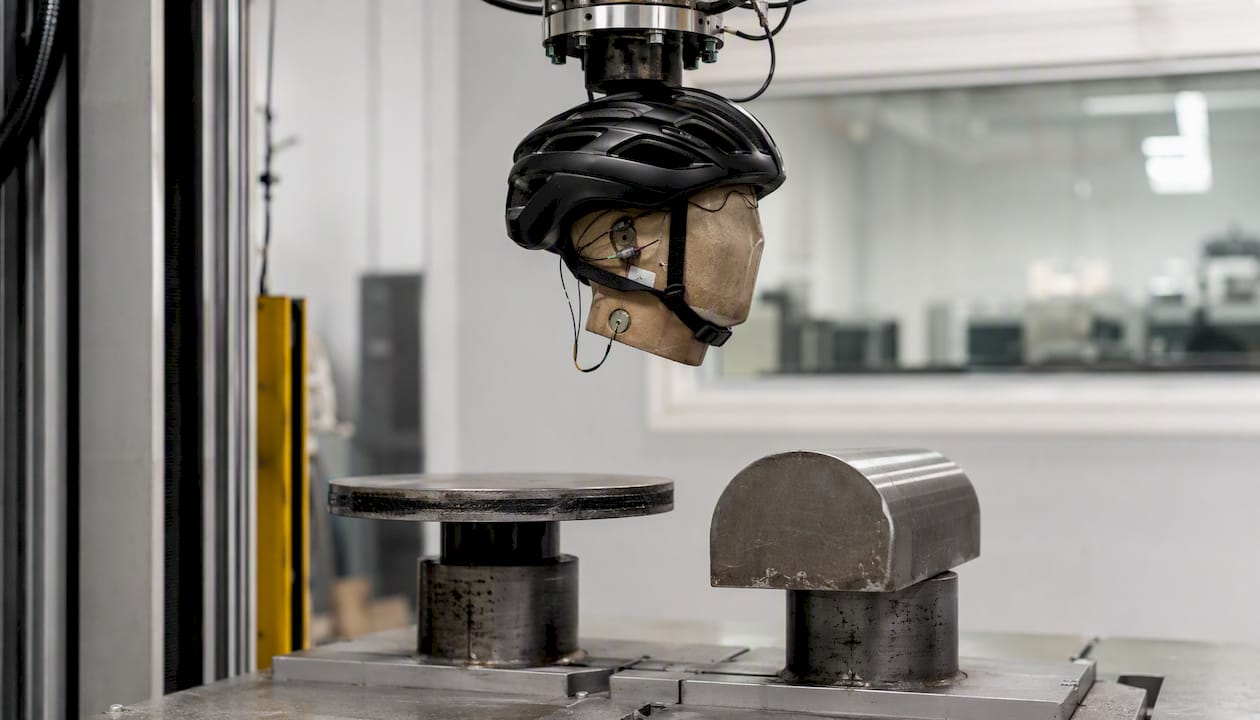
- Dual-impact testing: helmets get hit on both a flat anvil and a kerbstone-shaped anvil, simulating the edge-strike injuries common in curb and pothole crashes.
- Environmental conditioning: samples are tested cold, hot, and after simulated rain exposure, since a helmet that performs well at room temperature can behave differently at 0°C.
- Numeric ceiling: testing labs report a maximum peak linear acceleration around 250 g, a stricter bar than most baseline bicycle helmet tests.
An NTA label on the box tells you the helmet has cleared tests built around real e-bike crash scenarios, not just a straight drop test.
What Does EN 1078 Actually Cover?
EN 1078 is the baseline safety standard across Europe for helmets worn by pedal cyclists and similar transport equipment, including skateboarders and roller skaters. It’s been the default reference for decades.
- Shock absorption: the shell and liner must limit impact force within set thresholds on a flat anvil drop.
- Retention system: chin straps and buckles have to hold under load without failing or over-stretching.
- Field of vision and labeling: helmets must meet visibility requirements and carry clear certification marks.
A draft revision, prEN 1078, adds explicit rotational shock absorption criteria and oblique impact testing, which signals regulators recognize the gap NTA 8776 already addresses.
How Do the Testing Methods and Thresholds Really Differ?
The technical gap between these standards comes down to what each one simulates and how many angles it tests.
Both standards use instrumented headforms to measure impact force, but NTA 8776 tests against more surfaces and more conditions. EN 1078’s classic test drops a helmeted headform onto a flat anvil. NTA 8776 repeats that test, then adds a kerbstone anvil shaped like a curb edge, since real e-bike falls often involve exactly that kind of impact at speed.
| Test element | EN 1078 | NTA 8776 |
|---|---|---|
| Flat anvil drop | Yes | Yes |
| Kerbstone anvil drop | No (added in prEN 1078 draft) | Yes |
| Oblique/rotational impact | Draft stage only | Considered in design, tied to coverage area |
| Peak linear acceleration limit | Set per EN test protocol | Roughly 250 g |
| Temperature/rain conditioning | Standard range | Cold, hot, and wet conditions specifically tested |
The number that matters most: NTA 8776’s approximately 250 g peak linear acceleration ceiling, tested across both flat and kerbstone impacts, is the single clearest technical signal that this standard was built for higher-speed crash forces than EN 1078’s original flat-anvil protocol.
Who Should Choose NTA 8776, EN 1078, or Something Else?
Your riding profile should drive the decision more than brand loyalty or price.
- Casual city cyclist (under 20 km/h, mostly flat terrain): EN 1078 covers your realistic crash scenarios.
- E-bike commuter with moderate pedal assist (up to 25 km/h): EN 1078 is the legal minimum in most places, but NTA 8776 gives real margin.
- Speed pedelec or high-speed e-bike rider (25 to 45 km/h): BHSI experts recommend NTA 8776 or motorcycle-grade protection at these speeds.
- Mixed-condition urban courier: NTA 8776’s wet and cold-weather testing matters if you’re riding in all conditions, all year.
Pro Tip: If you’re regularly hitting speeds above 45 km/h or riding in heavy traffic, a motorcycle-grade helmet certified to ECE R22 is worth considering, even though it trades comfort and ventilation for a higher protection ceiling.
How Do You Verify a Helmet’s Certification Before Buying?
Don’t take a marketing page’s word for it. Certification marks are printed directly on the helmet shell or liner, and any legitimate seller lists them in the spec sheet.
- Check the interior label for the EN 1078 or NTA 8776 mark stamped or printed on the retention system or shell foam.
- Cross-reference the spec sheet on the product page against the certification claimed.
- Confirm fit first: even a certified helmet fails if it sits loose or tilts back on your head.
- Check ventilation and weight against your riding conditions, since NTA-rated helmets tend to run heavier.
- Look for rotational protection tech like MIPS, which reduces rotational force transfer during angled impacts.
- Read testing disclosures, not just badges. A helmet safety standards comparison can help you understand what each mark actually guarantees.
Pro Tip: If a listing says “meets safety standards” without naming EN 1078 or NTA 8776 specifically, treat that as a red flag, not a selling point.
Is NTA 8776 Legally Required Where You Ride?
NTA 8776 is a voluntary technical agreement, not a European regulation, so uptake differs by country. The Netherlands treats it as the minimum requirement for speed pedelec helmets, but other markets don’t mandate it yet.
Where NTA 8776 isn’t required, a motorcycle-grade ECE R22 helmet is a legal and often stronger alternative for speed pedelec riders, at the cost of extra weight and less airflow. Check your local speed pedelec classification before assuming your current helmet meets the legal bar.
The Beam’s Take on Choosing Between These Standards
For riders logging real miles on a fast e-bike, NTA 8776 is the standard worth seeking out first. EN 1078 remains acceptable for casual, lower-speed cycling, and ECE R22 makes sense once you’re routinely riding at motorcycle-adjacent speeds.
- Choose NTA 8776 if your e-bike or speed pedelec regularly exceeds 25 km/h.
- EN 1078 is fine for casual riders under that threshold with mostly flat, predictable routes.
- Consider ECE R22 only if you’re consistently riding above 45 km/h or in heavy motorized traffic.
Pro Tip: Don’t buy on standard alone. Fit, retention adjustment, and rotational protection like MIPS matter just as much as which certification is printed on the box. Our helmet upgrade guide walks through exactly when it’s time to move up a category.
Sophie’s Perspective on Helmet Standards
Most helmet marketing treats certification as a checkbox: does it say EN 1078, yes or no, done. That’s the wrong way to think about it, and this comparison should make that obvious. A helmet can be fully EN 1078 compliant and still be the wrong helmet for someone doing 35 km/h on a speed pedelec, because that standard was never built with that crash speed in mind.

What gets lost in most buying guides is that NTA 8776 isn’t a “premium upgrade.” It’s a response to a documented gap. The kerbstone test exists because curb strikes are a distinct injury pattern from flat falls, and regular cycling standards didn’t account for that. If you’re only reading one thing here, read this: match your helmet’s testing profile to your actual crash risk, not to your bike’s price tag or your helmet’s weight.
The honest gap in this space is legal lag. Regulation hasn’t caught up to how fast e-bikes have gotten, and that puts the burden on riders to self-select the right protection level. Don’t wait for the law to tell you what your speed already has.
Ready to Upgrade Your Helmet?
Thebeamofficial builds helmets specifically for riders who’ve outgrown basic bike-shop protection, including our flagship VIRGO full-face helmet with MIPS technology for exactly the kind of oblique and rotational impact scenarios that NTA 8776 testing simulates.

If you’re commuting on an e-bike, riding gravel, or logging serious urban miles, you need a helmet that treats speed and rotational force as real variables, not afterthoughts. That’s the gap Thebeamofficial was built to close: high-end protection without forcing you into motorcycle-level weight and heat. Browse the adult helmet collection to compare fit, ventilation, and MIPS-equipped models suited to faster riding, and check the full helmet lineup if you’re outfitting family members with different needs. Pick the protection level that matches your actual speed, not just your budget.


