

TL;DR:
- Helmet aerodynamics can account for up to 8% of total drag at speeds over 30 km/h.
- Body position and head tuck have a greater impact on drag than helmet design alone.
- Proper fit and rider posture are crucial for maximizing speed benefits from aerodynamic helmets.
Your helmet can account for up to 8% of your total aerodynamic drag at speeds above 30 km/h. That is not a small number. Most cyclists obsess over bike weight, tire pressure, or frame geometry, yet they grab whatever helmet fits and call it a day. The truth is that helmet design directly shapes how fast and efficiently you ride, and understanding the mechanics behind it can change how you approach every ride. This article breaks down what helmet aerodynamics actually means, how design features translate into real speed gains, and how your own body position plays a bigger role than most people realize.
Table of Contents
- What does helmet aerodynamics mean in cycling?
- How helmet design impacts speed and efficiency
- The role of head position and body posture
- Comparing helmet types: Aero, road, and urban models
- Why helmet aerodynamics is misunderstood—and what most cyclists miss
- Explore top-rated aerodynamic helmets at The Beam
- Frequently asked questions
Key Takeaways
| Point | Details |
|---|---|
| Helmet drag matters | Aerodynamic helmet design can impact cycling speed and efficiency by reducing drag. |
| Head position is critical | Changing your head angle affects drag much more than helmet shape alone. |
| Choose the right type | Select aero, road, or urban helmets based on your speed, usage, and comfort needs. |
| Fit beats flashy | A well-fitted helmet with proper posture provides better real-world performance than high-tech claims alone. |
What does helmet aerodynamics mean in cycling?
Helmet aerodynamics is the science of shaping and engineering a helmet to reduce the resistance it creates as you move through the air. Air resistance, or drag, is the single biggest force working against you at any speed above a slow crawl. The faster you ride, the more drag costs you in watts and energy. A well-designed helmet minimizes that cost.
“Aerodynamic drag from the helmet can be 2-8% of total drag at speeds over 30 km/h, making helmet shape a meaningful performance variable.”
That range matters. At the lower end, you are saving a modest amount of energy. At the upper end, you are talking about a measurable difference in speed over a long ride or race. Every watt you do not spend fighting drag is a watt you can put into your pedals.
Several design elements drive helmet aerodynamics:
- Shape: A rounded or teardrop profile cuts through air more cleanly than a blunt or irregular surface.
- Vents: Open vents cool your head but create turbulence. Fewer or covered vents reduce drag at the cost of airflow.
- Surface texture: Smooth surfaces generally reduce friction drag, though some dimpled textures can manage airflow in specific conditions.
- Tail length: Longer tails on aero helmets help airflow reattach smoothly behind your head, reducing the turbulent wake.
Understanding integrated helmet design helps clarify how modern helmets blend these elements into a single cohesive system rather than treating each feature in isolation. The best helmets do not just reduce drag in one spot. They manage airflow across the entire surface.
Why does every saved watt matter? At 40 km/h, overcoming aerodynamic drag consumes roughly 80-90% of your total power output. Shaving even 2% of that drag frees up meaningful energy over a 60-minute ride. For competitive cyclists, that is the difference between podium and pack. For endurance riders, it means arriving at the finish line with more in the tank.
How helmet design impacts speed and efficiency
Once you understand what helmet aerodynamics means, the next question is how specific design choices translate into real-world speed. The mechanics are straightforward once you see them clearly.
Drag comes in two main forms: pressure drag and friction drag. Pressure drag is caused by the blunt separation of air around an object. Friction drag comes from air moving across a surface. A well-shaped helmet addresses both. A streamlined profile reduces pressure drag by allowing air to flow around the helmet without separating violently. A smooth outer shell reduces friction drag.
Key stat: At speeds above 30 km/h, helmet drag impacts speed and energy usage in ways that compound over time. The helmet alone may change drag by less than 1.5%, but combined with head position, that figure can climb to 6.4%.
Here is how specific design features change airflow:
- Helmet shape: A teardrop or elongated profile guides air smoothly from front to back, reducing the wake behind your head.
- Vent placement and size: Fewer vents or internal channeling systems keep airflow controlled without creating drag-inducing turbulence.
- Visor and retention system: Protruding buckles, straps, or visors create small but real drag penalties. Flush-fitting systems minimize this.
- Fit and angle: A helmet that sits level and snug on your head performs as designed. A loose or tilted helmet disrupts airflow unpredictably.
Pro Tip: Before spending money on a new helmet, check how your current one fits and sits on your head. A properly fitted helmet at the correct angle will outperform an expensive aero helmet worn incorrectly.
For urban riders, helmet design for urban safety shows how city-focused helmets balance aerodynamic efficiency with the visibility and protection demands of traffic environments. And if you are considering a full-face option, learning about integral helmet benefits reveals how enclosed designs can actually perform well aerodynamically while offering superior coverage.
The role of head position and body posture
Here is where most cycling guides stop short. They explain helmet shapes and vent counts, then move on. But your body position, specifically how you hold your head, may matter more than the helmet you choose.
Research confirms that head position alters drag by up to 6.4%, which is significantly more than helmet shape alone can achieve. That is a striking finding. It means a rider on a budget helmet who holds an efficient head position will often out-perform a rider with a premium aero lid who sits upright.

| Factor | Drag reduction potential | Notes |
|---|---|---|
| Helmet shape alone | Up to 1.5% | Compared across similar helmet categories |
| Head position alone | Up to 6.4% | Lowering and tucking the chin |
| Combined (helmet + position) | Up to 8%+ | Synergistic effect at race speeds |
| Body posture (full tuck) | 15-20% | Full aerodynamic position on the bike |
Consider two scenarios. A time trial rider in a full aero tuck with chin down and a long-tail TT helmet is maximizing every aerodynamic variable. A casual commuter sitting upright on a city bike with a round urban helmet is not losing much sleep over drag coefficients. Both are valid. The point is that your riding style should match your helmet choice.
Pro Tip: On your next ride, consciously lower your chin slightly and tuck your elbows in. You will feel the difference in resistance, especially at speeds above 25 km/h. No new gear required.
For riders navigating city traffic, urban helmets comparison breaks down how different models balance aerodynamic efficiency with the practical demands of shoulder checks, stopping frequently, and staying visible.
Comparing helmet types: Aero, road, and urban models
Not all helmets are built for the same job. Understanding the trade-offs across helmet categories helps you make a smarter choice based on how and where you actually ride.
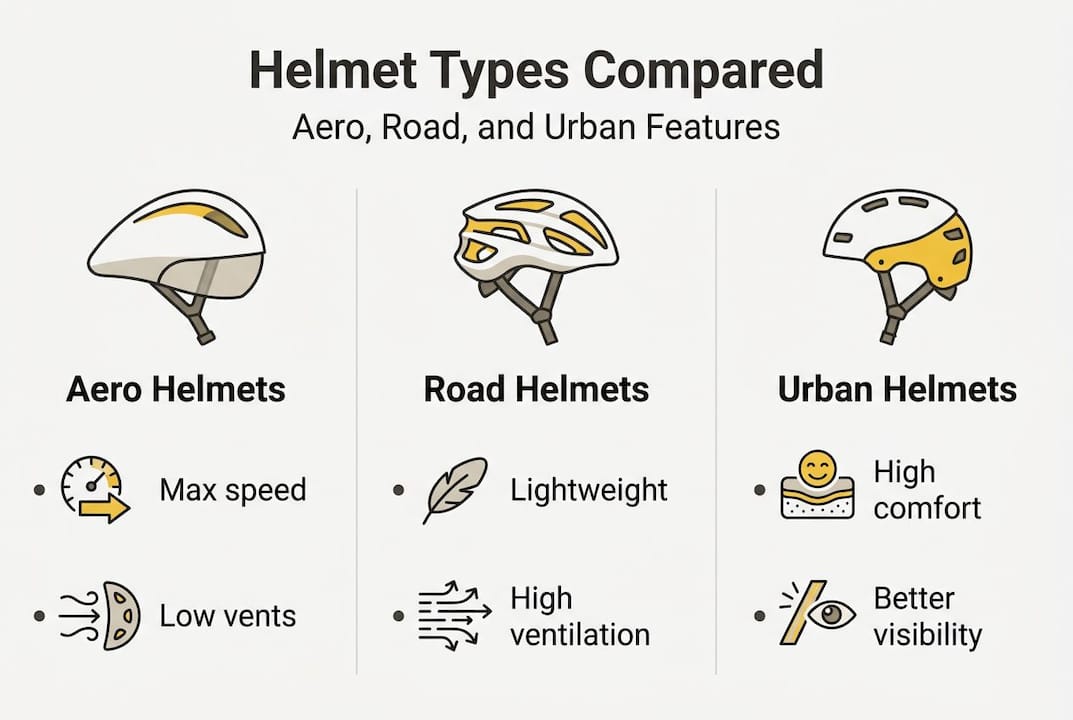
Different helmet types emphasize drag reduction, ventilation, or versatility, and no single design wins across all categories. Here is a practical breakdown:
| Helmet type | Drag performance | Ventilation | Weight | Best use case |
|---|---|---|---|---|
| Aero/TT | Excelente | Low | Moderate | Racing, time trials, triathlons |
| Road/performance | Good | High | Low | Long rides, climbing, gran fondos |
| Urban/commuter | Moderate | Moderate to high | Moderate | City riding, e-bikes, daily commutes |
| Integral/full-face | Moderate to good | Low to moderate | Higher | Gravel, e-bikes, high-risk environments |
Each type serves a distinct rider:
- Aero helmets are built for one thing: speed. Closed vents, smooth shells, and elongated tails make them fast but warm. They shine in races or time trials where sustained high speed matters.
- Road helmets balance drag reduction with ventilation. They are the most versatile option for cyclists who ride hard but also need to stay cool on long efforts.
- Urban helmets prioritize comfort, visibility, and ease of use. Aerodynamics are secondary, but modern urban designs have improved significantly.
- Integral helmets offer the most protection and work well for gravel and e-bike riders who face higher impact risks.
For a detailed look at how specific performance brands stack up, the Giro vs POC comparison offers a useful real-world perspective on how two leading road helmet makers approach the aero-ventilation balance differently.
Why helmet aerodynamics is misunderstood—and what most cyclists miss
After years of working with cyclists across road, gravel, and urban disciplines, we have noticed a consistent pattern: riders overvalue the helmet itself and undervalue everything around it.
The cycling industry does a great job selling aero gains. Wind tunnel numbers, drag coefficients, and computational fluid dynamics images look impressive. But those numbers are captured in controlled lab conditions with a mannequin holding a fixed head position. Real roads have crosswinds, traffic, and shoulder checks. Your head moves constantly.
The honest truth is that a helmet delivering 3% drag savings in a wind tunnel may deliver 0.5% in your actual commute or century ride. That does not mean aerodynamics are irrelevant. It means context matters enormously.
What we believe matters most, in order: fit first, then comfort, then realistic posture, and finally aerodynamic claims. A helmet that fits perfectly and encourages a natural, efficient head position will serve you better than a theoretically faster lid that shifts around or forces an uncomfortable angle. Exploring cyclist safety innovations shows how the best designs integrate all these factors rather than chasing a single metric.
Stop shopping for wind tunnel numbers. Start riding in helmets that feel right and stay in place.
Explore top-rated aerodynamic helmets at The Beam
If this article has shifted how you think about helmet selection, the next step is finding a helmet that actually delivers on all fronts: aerodynamics, fit, protection, and real-world usability.

At THE BEAM, we design helmets for cyclists who take both performance and safety seriously. From our VIRGO integral helmet with MIPS technology to our broader helmets collection, every model is built around the idea that speed and protection are not opposites. If you are curious about how our gear performs in demanding conditions, check out our ultracycling event where real riders push our products to their limits.
Frequently asked questions
How much faster can an aerodynamic helmet make you?
An aerodynamic helmet can reduce total drag by 2-8% at speeds over 30 km/h, potentially saving meaningful seconds or energy across longer distances depending on your riding position.
Does my head position matter more than helmet shape?
Yes. Head position can change drag by up to 6.4%, which is far more than helmet shape alone contributes, making posture the higher-leverage variable for most riders.
Are aero helmets less safe than regular ones?
Most aerodynamic helmets meet the same safety certification standards as conventional road helmets, though some designs trade ventilation and comfort for speed gains, which can affect wearability on longer rides.
Which is better for city riding, an aero or urban helmet?
Urban helmets are generally the better choice for city riding because they prioritize comfort, ventilation, and visibility, while aero models are optimized for sustained high-speed conditions that rarely occur in traffic.
Is it worth upgrading to an aerodynamic helmet?
If you consistently ride above 30 km/h or compete, aerodynamic gains are most significant at those speeds, but fit and head position will always amplify or undermine whatever aero advantage your helmet provides.


