

TL;DR:
- Fogging occurs when warm, moist breath condenses on a cold visor surface, creating visibility issues. Combining hydrophilic coatings, Pinlock inserts, and active ventilation maximizes anti-fog performance, especially in challenging conditions. Proper helmet maintenance and strategic vent use are essential for consistent clarity and safety on every ride.
Your visor fogs up mid-ride. You can’t see the road clearly. You reach up to wipe it and briefly lose control of your handlebar. That’s not just annoying. It’s a real safety risk. To explain helmet anti-fog features properly, you need to understand why fogging happens, what technologies actually stop it, and how to get those technologies working together. This article covers all of it, from the physics of condensation to the practical steps that keep your visor clear in cold mornings, rainy commutes, and everything in between.
Table of Contents
- Key Takeaways
- Explaining helmet anti-fog features: the science first
- How helmet anti-fog technology actually works
- Getting the most from your helmet’s ventilation system
- Practical anti-fog solutions: sprays, films, and breath deflectors
- Matching anti-fog features to your riding style
- What I’ve actually learned about helmet fogging after years on the road
- How Thebeamofficial builds anti-fog performance into every helmet
- FAQ
Key Takeaways
| Point | Details |
|---|---|
| Fogging is a physics problem | Warm breath meets a cool visor surface, and condensation forms unless something interrupts that process. |
| Multiple technologies exist | Hydrophilic coatings, Pinlock inserts, and ventilation systems each address fogging differently and work best together. |
| Ventilation is underrated | Opening chin and exhaust vents actively purges humid air and reduces fogging more than most riders realize. |
| Maintenance matters | Anti-fog coatings degrade with harsh cleaning; proper care with mild soap and microfiber cloths extends their life. |
| Match features to your ride | Cold-weather commuters need different anti-fog setups than fair-weather weekend cyclists. |
Explaining helmet anti-fog features: the science first
Before you can choose the right solution, you need to understand what you’re actually fighting. Fogging is not random. It follows predictable physics, and once you understand those physics, the technology makes a lot more sense.
When you breathe inside a helmet, you exhale warm, moisture-laden air. That air travels upward and hits the inside of your visor, which is cooled by the outside temperature. The visor surface is colder than the air hitting it, so the moisture in that air condenses into tiny water droplets. Those droplets scatter light and turn your once-clear visor into a frosted bathroom window.
Several factors make this worse:
- Cold ambient temperatures increase the temperature gap between your breath and the visor, accelerating condensation.
- High humidity environments mean the air around you already carries more moisture, reducing the visor’s ability to release trapped heat.
- Low riding speeds reduce natural airflow through the helmet, allowing humid air to stagnate against the visor surface.
- Tight chin area geometry in some helmets traps breath directly at the visor rather than routing it away.
What’s critical here is that no single factor causes fogging in isolation. A cold, humid morning commute through city traffic combines all four. That’s when your visor fogs the hardest and fastest, and it’s exactly why understanding the full picture matters before spending money on a solution.
How helmet anti-fog technology actually works
This is where it gets genuinely interesting. The cycling industry has developed several distinct technologies to interrupt condensation, and each one attacks the problem from a different angle. No single anti-fog technology is sufficient alone. Combining them is how you get reliable, all-condition performance.
Hydrophilic anti-fog coatings
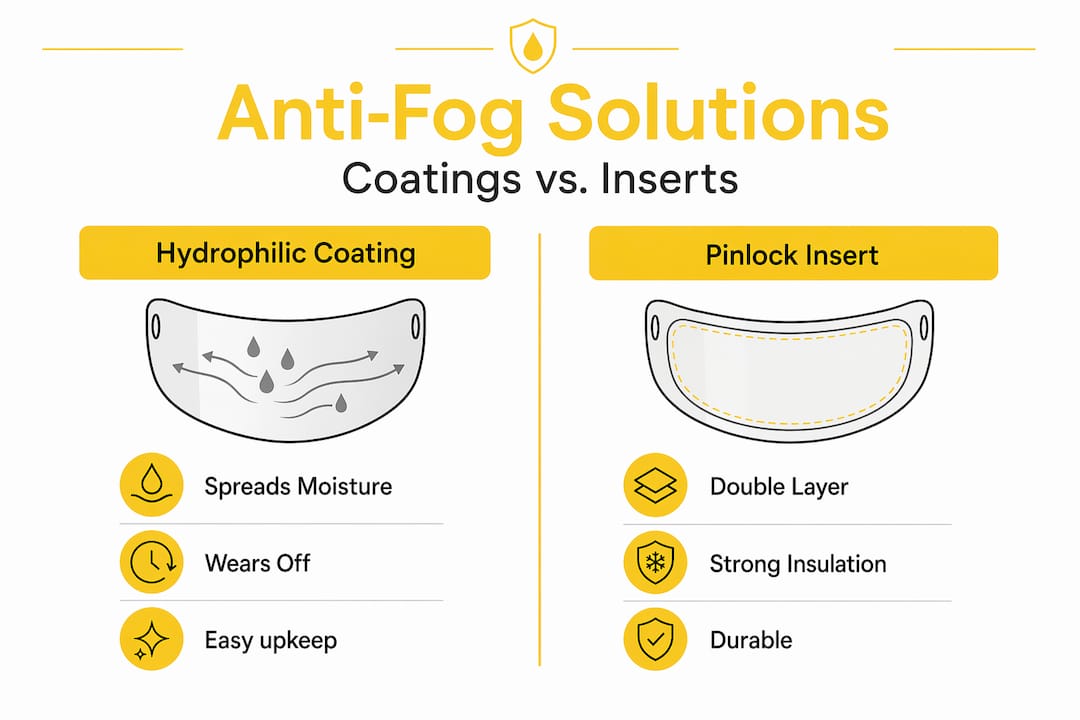
Hydrophilic coatings use chemistry to reduce the surface tension of water on the visor. Instead of forming light-scattering droplets, the moisture spreads into a thin, uniform film across the surface. That film is transparent, so your vision stays clear.

The limitation is real, though. Coatings wear down with use, exposure to UV, and above all, improper cleaning. Rubbing with a dry cloth or using anything with alcohol or ammonia strips the coating faster than any ride ever will.
Pinlock inserts and double-lens systems
Pinlock inserts work like double-glazed windows. They add a second lens layer inside the visor, held in place by two pins, creating an insulating air gap between the two surfaces. Because the inner lens is insulated from the cold outer visor, it stays closer to the temperature of the air inside the helmet. No temperature differential means no condensation.
This is widely considered the gold standard for anti-fog performance, particularly in cold or wet conditions. It’s more effective than a coating alone because it addresses the root cause: the temperature gap at the visor surface.
Pro Tip: If your helmet is Pinlock-ready, invest in the correct Pinlock lens for your exact visor model. A Pinlock that doesn’t seal properly at the edges loses most of its effectiveness.
Engineered ventilation and active airflow
Ventilation is the most underestimated anti-fog feature on any helmet. Front intake and rear exhaust vents create a pressure gradient that continuously moves air through the helmet interior. Fresh, drier air comes in through chin and forehead vents while warm, humid air exits through rear exhaust ports.
The result is a constantly refreshed microclimate inside the helmet. Humid air doesn’t sit against the visor long enough to condense. This works best at speed, but even at lower speeds a well-designed vent system buys you meaningful protection.
Here is a quick comparison of the three main anti-fog technologies:
| Technology | Mechanism | Best for | Limitation |
|---|---|---|---|
| Hydrophilic coating | Spreads moisture into transparent film | Mild conditions, lighter riders | Degrades over time, needs gentle care |
| Pinlock insert | Insulating air gap eliminates thermal bridge | Cold weather, commuters, rain | Requires Pinlock-compatible visor |
| Engineered ventilation | Purges humid air via airflow | All conditions, especially at speed | Less effective in slow traffic |
Getting the most from your helmet’s ventilation system
Ventilation is where most cyclists leave performance on the table. They buy a helmet with excellent vent design and then ride with half the vents closed because they feel cold. That tradeoff quietly works against visibility.
Here’s how to use ventilation strategically to prevent fogging:
- Open the chin vent first. The chin vent is the single most important vent for fog prevention. It draws fresh air directly across the lower visor surface, where most fogging starts. Closing vents traps moisture and consistently worsens fogging.
- Match top intake and rear exhaust vents. Opening front top vents without corresponding rear exhaust vents creates no through-flow. Air needs an entry and an exit to move. Both need to be open for the system to work.
- Adjust for weather, not just temperature. In rain, you might want to close certain vents to reduce water ingress. The key is to keep the chin vent cracked slightly even in rain, because a slight vent opening combined with a Pinlock insert outperforms a fully sealed visor in wet conditions.
- Compensate for low-speed conditions. At traffic speeds or in stop-and-go commuting, airflow drops sharply. This is when you need your Pinlock or anti-fog coating working hardest. Rely on your passive systems and keep whatever vents you have open.
Pro Tip: On cold morning rides, wear a thin neck gaiter pulled up slightly over your chin. It redirects your breath downward rather than up toward the visor, which meaningfully reduces fogging before your helmet’s ventilation has a chance to warm up.
El critical role of ventilation in managing your helmet’s internal climate extends well beyond just fog. Thermal regulation, sweat management, and overall riding comfort all connect back to how well your helmet moves air.
Practical anti-fog solutions: sprays, films, and breath deflectors
Beyond what your helmet ships with, there’s a solid category of aftermarket solutions worth knowing. They vary significantly in how well they work and how long they last.
- Anti-fog sprays are the most accessible option. They mimic hydrophilic coatings by temporarily altering the surface tension of your visor. The catch is they wear off quickly, sometimes within a single wet ride, and require reapplication. They’re useful as a quick fix or as a supplement to a primary system, not a replacement for one.
- Aftermarket anti-fog films are thin adhesive inserts that bond to the inside of the visor. They last longer than sprays and are more consistent in coverage. The installation requires care: air bubbles ruin the optical clarity, and any film that isn’t specifically designed for your visor shape may not adhere properly at the edges.
- Breath deflectors are one of the most practical and overlooked accessories in cycling. Attached to the chin bar or lower visor area, they physically redirect warm exhaled air downward rather than letting it rise to the visor. They don’t eliminate fogging on their own, but they significantly reduce the amount of moisture reaching the visor surface in the first place.
- Cleaning practices directly determine how long your anti-fog coating lasts. Anti-fog coatings degrade with environmental exposure and improper cleaning. Use lukewarm water, mild soap, and a clean microfiber cloth. Rinse the visor gently. Never rub dry. These aren’t suggestions; they’re what separates a coating that lasts one season from one that lasts three.
You can find a full breakdown of these practices in this helmet care guide, which covers visor cleaning alongside broader maintenance routines.
Matching anti-fog features to your riding style
Understanding the technology is one thing. Knowing which combination fits your actual riding is where the guide to preventing helmet fogging becomes personal.
Here’s how to think through the decision:
- Full-face and integral helmet riders have the best platform for comprehensive anti-fog systems. These helmets can accommodate Pinlock inserts, larger chin vents, and breath deflectors all at once. If you ride year-round in variable weather, a Pinlock-compatible full-face or integral helmet is the right starting point.
- Modular and open-face helmet riders have fewer built-in options and rely more on coatings and breath management. The open geometry does allow for better natural airflow, but in cold or rainy conditions you’ll want to supplement with a quality anti-fog spray and a breath deflector.
- Cold-weather and rainy-climate cyclists should treat Pinlock inserts as non-negotiable. The synergy of coating, insulation, and ventilation is especially noticeable when temperatures drop below 50°F. At that point a coating alone simply doesn’t have enough to work with.
- Daily commuters face the worst combination of factors: slow speeds, stop-and-go traffic, variable weather, and consistent breathing effort. This group benefits most from investing in both a Pinlock-ready helmet and quality breath deflector accessories.
- Weekend leisure cyclists in mild climates can often manage well with a properly maintained factory coating and good vent habits. The investment in aftermarket systems is lower, but regular cleaning remains non-negotiable.
For a deeper look at how ventilation design choices connect to rider safety and comfort across different riding types, the 2026 ventilation guide breaks it down by use case.
What I’ve actually learned about helmet fogging after years on the road
I’ve spent years talking with cyclists about gear frustrations, and helmet fogging sits near the top of the list. What surprises me every time is how many riders blame their helmet when the real issue is how they’re using it.
The most common mistake I see is treating anti-fog as a one-and-done feature. Someone buys a helmet with a factory coating, rides through a freezing November commute, gets fogged out anyway, and decides the coating doesn’t work. It probably does work. But no coating in the world compensates for a closed chin vent, a dirty visor, and 30°F air.
My honest take: ventilation habits do more for fog prevention than any product you can buy after the fact. I’ve ridden in conditions where a Pinlock-ready helmet with both vents wide open outperformed a helmet with a premium aftermarket film but poor airflow design. The physics are clear. Move the humid air out. Everything else is a supplement.
Maintenance also gets neglected in ways that genuinely frustrate me. Riders spend $200 on a helmet and then wipe the visor with a dry paper towel after every rain ride. That strips the coating in two months. Treat the visor like a lens on an expensive camera and it will perform like one.
The technology is good. The habits are what most people need to work on.
— Sophie
How Thebeamofficial builds anti-fog performance into every helmet
Thebeamofficial designs helmets with the understanding that anti-fog isn’t a single checkbox. The VIRGO integral helmet combines a Pinlock-ready visor, generously sized chin intake vents, and rear exhaust ports specifically engineered to create through-flow even at lower riding speeds.

The result is a system where the passive thermal insulation from the double-lens visor and the active airflow from the ventilation work together rather than independently. For riders who want to build out their setup, helmet accessories including breath deflectors and anti-fog films are available to complement any Thebeamofficial helmet. If you’re ready to start with the right foundation, browse the full adults’ helmet range and filter by the riding type that matches your conditions.
FAQ
How does helmet anti-fog work?
Helmet anti-fog features work by spreading moisture into a thin transparent film via hydrophilic coatings, insulating the visor with a Pinlock air gap to prevent condensation, or purging humid air through ventilation systems. Most effective helmets combine all three approaches.
Do anti-fog coatings actually work?
Yes, but they degrade over time. Anti-fog coatings spread moisture into a clear film instead of light-scattering droplets. Their effectiveness depends heavily on proper cleaning with mild soap and a microfiber cloth, and they should never be wiped with dry or abrasive materials.
What is a Pinlock insert and why does it matter?
A Pinlock insert is a secondary lens that attaches inside your visor and creates an insulating air gap between the two layers. It prevents condensation by eliminating the temperature difference at the inner visor surface, and it is widely regarded as the most reliable anti-fog solution for cold and wet riding conditions.
Why does my helmet still fog even with anti-fog features?
Most fogging that persists despite anti-fog features is caused by closed vents, damaged coatings, or a Pinlock insert that isn’t sealing correctly at the edges. Opening the chin vent and confirming the Pinlock seal are the two fastest fixes to try first.
Which cyclists benefit most from anti-fog helmets?
Cold-weather commuters and cyclists who ride in rain or high humidity benefit most. These riders face the highest condensation risk due to slow speeds, temperature extremes, and sustained breathing effort. An integral or full-face helmet with Pinlock compatibility and active ventilation is the best fit for their conditions.


