

TL;DR:
- Cyclist night riding safety relies on active lighting, passive reflective gear, and defensive riding techniques to increase visibility and reduce accidents. Combining bright lights, reflective placement on moving parts, and cautious habits significantly improves safety, especially in low-light conditions. Maintaining proper gear functionality and adopting careful behaviors can prevent most night-time cycling incidents.
Cyclist night riding safety is defined as the practice of combining active lighting, passive reflective gear, and defensive riding techniques to maximize visibility and minimize collision risk after dark. Research confirms that accidents drop 47% when riders use both front and rear lights compared to no lighting at all. That single statistic reframes how seriously you should treat your nighttime setup. This guide covers every layer of protection, from lumen standards and reflective placement to route selection and the defensive mindset that keeps you alive when drivers cannot see you.
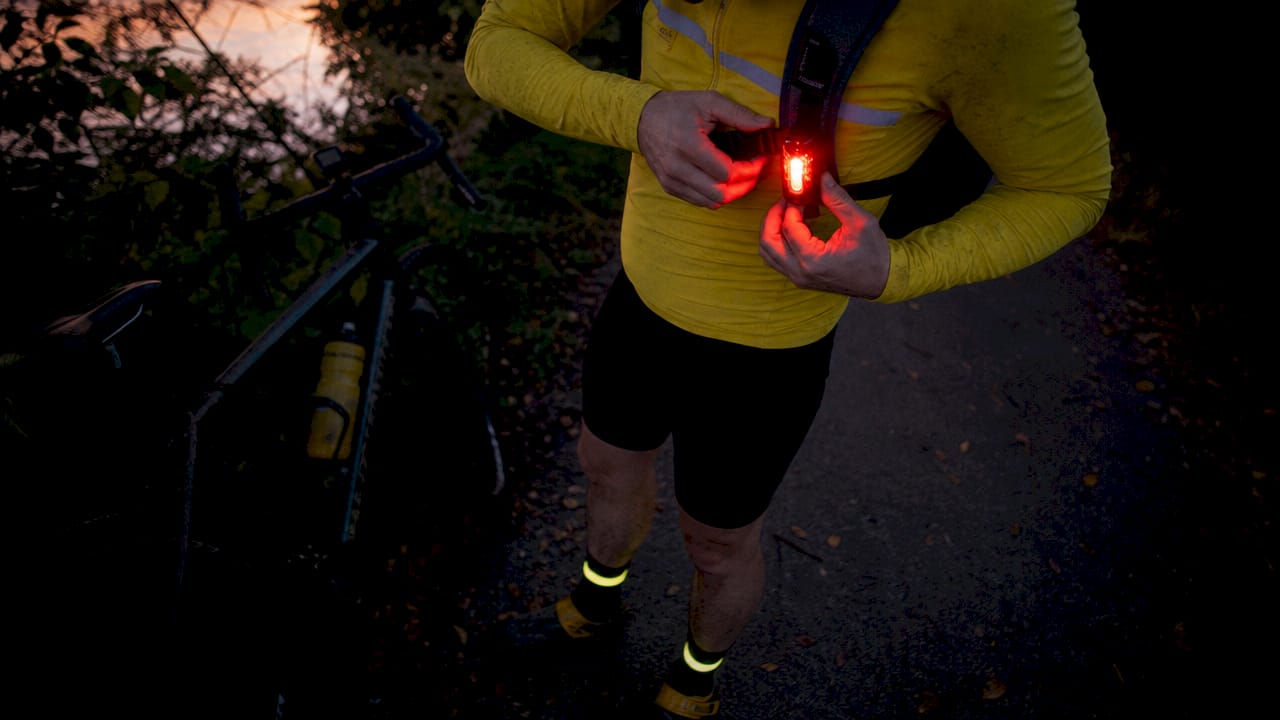
What is cyclist night riding safety and why does it matter?
Night riding safety is the structured approach to cycling after dark that treats visibility as a two-part problem: being seen by others and seeing the road yourself. Most riders focus on one or the other. The ones who get it right address both simultaneously.
The core framework has three pillars. First, active lighting, meaning front and rear lights that project and signal your presence. Second, passive visibility, meaning reflective clothing and accessories that bounce drivers’ headlights back toward them. Third, behavioral adjustments, meaning slower speeds, better lane positioning, and a defensive mindset that assumes drivers have not spotted you yet. Each pillar compensates for the weaknesses of the others. Lights fail when batteries die. Reflective gear does nothing if no headlights are pointed at you. Defensive riding fills the gap when both fail.
Permanent running lights reduce injury accidents by approximately 19% even during daytime hours. That figure tells you something important: visibility is not a night-only problem, but the stakes are dramatically higher after dark when reaction times shrink and road hazards become invisible.
What are the essential lighting requirements for safe night riding?
Lighting is the most technically demanding part of night riding safety, and most cyclists underinvest in it. The right setup depends on where you ride, not just how often.
Front light standards by environment
Industry standards recommend at least 400 lumens for urban riding and 800 to 1,500 lumens for rural or unlit roads. Urban environments have ambient streetlight that supplements your beam, so 400 lumens is a reasonable floor. Rural roads offer zero ambient light, which means your front beam is the only thing standing between you and a pothole, a gravel patch, or a deer. A high-lumen headlight rated at 2,200 lumens gives you the kind of throw distance that lets you actually react in time on dark country roads.
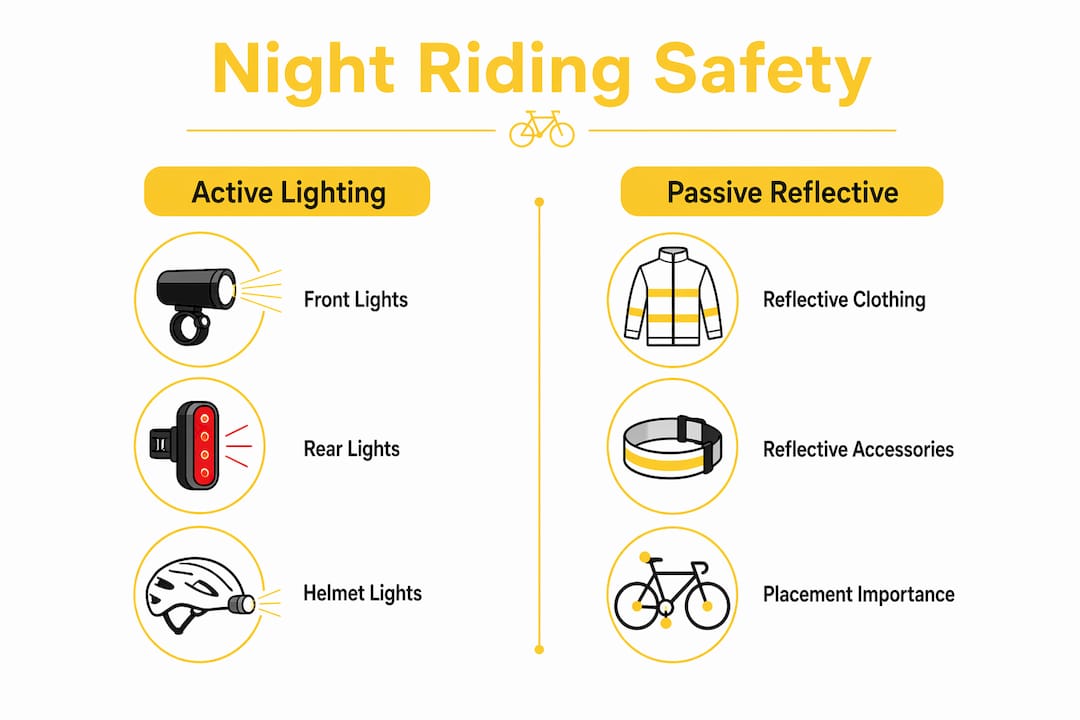
Rear lights, helmet lights, and mode selection
Flashing rear lights grab driver attention more effectively in urban environments than steady lights. The motion of a flash triggers peripheral vision in a way that a static red glow does not. A USB rechargeable rear light with multiple flash modes gives you flexibility across different riding conditions without carrying extra batteries.
Helmet lights add a dimension that handlebar-mounted lights cannot provide. When you turn your head to check traffic or scan an intersection, your helmet light follows your gaze. That dynamic visibility tells drivers exactly where you are looking and signals your intent before you move. It is one of the most underused tools in night riding.
One critical nuance: flashing modes impair your own night vision on completely dark roads. The strobe effect prevents your eyes from adapting to the darkness between flashes. On pitch-black rural routes, switch to a steady high-lumen beam. Use a secondary flashing light for driver attention while the steady beam handles your terrain visibility. Steady front beams also help drivers judge your speed and distance more accurately, which matters at intersections.
- Front light: 400 lumens minimum for urban, 800 to 1,500 lumens for rural roads
- Rear light: flashing mode for urban, steady red for rural or unlit stretches
- Helmet light: adds dynamic directional visibility when turning or scanning
- Dual setup: one steady beam for road illumination, one flashing light for driver attention
- Battery management: charge before every ride and carry a backup light
Pro Tip: Always carry a compact backup light in your jersey pocket. A dead battery at mile 40 of a night ride is not an inconvenience. It is a genuine safety emergency, and backup lights are the simplest insurance you can buy.
How does reflective gear improve cyclist visibility at night?
Reflective gear operates on a completely different principle than lighting. It does not generate light. It returns light. When a driver’s headlights hit retroreflective material on your clothing or bike, that light bounces directly back toward the driver’s eyes, making you appear to glow from their perspective.
Reflective gear reduces collision risk by 47% and motor vehicle collisions specifically by 55%. High-visibility clothing outperforms lighting alone in accident reduction. That finding surprises most cyclists, who assume lights are the dominant safety tool. Reflective materials work because they function passively and continuously without requiring battery power or rider attention.
Placement matters as much as quantity. Reflective material on moving body parts, specifically your ankles and wrists, creates a biological motion pattern that the human brain recognizes as a person. A static reflective strip on your frame is easy to miss. Reflective ankle bands moving in the pedaling rhythm are almost impossible to ignore. The same logic applies to wrist reflectors when you signal turns.
The most effective reflective materials for cyclists combine retroreflective tape or fabric with fluorescent colors. Fluorescent yellow-green is the most visible color to the human eye in low-light conditions and works during dusk and dawn when neither full daylight nor headlights dominate. Reflective elements take over once it gets fully dark.
| Reflective item | Best placement | Primary benefit |
|---|---|---|
| Reflective vest | Torso | Large surface area, visible from front and rear |
| Ankle bands | Both ankles | Motion-based recognition pattern for drivers |
| Helmet tape | Rear and sides | Elevates your highest visible point |
| Frame tape | Seat stays, fork | 360-degree passive visibility on the bike |
| Gloves with reflective strips | Hands | Amplifies turn signal visibility |
Layering high-visibility gear with active lighting creates a redundant system. If your rear light fails, your reflective vest still returns headlight beams. If you ride through a section with no oncoming traffic, your lights still illuminate the road ahead. Neither system alone is sufficient. Together, they cover each other’s blind spots.
What riding techniques optimize safety during night rides?
Equipment gets you most of the way there. Technique closes the gap. The behavioral side of night riding safety is where experienced cyclists separate themselves from beginners.
-
Reduce your speed to match your light’s throw distance. Adjusting speed to stop within your illuminated range is the single most important behavioral adjustment for night riding. If your front light illuminates 15 meters ahead and you are traveling fast enough that stopping takes 20 meters, you will hit whatever appears at the edge of your beam.
-
Ride more prominently in the lane. Riding closer to the lane center increases your visibility to drivers and keeps you away from road edge debris, drain covers, and gravel that accumulates at the margins. Many cyclists hug the curb out of habit. At night, that habit puts you in the most dangerous position.
-
Use hand signals earlier and more deliberately. Drivers need more time to process your intentions at night. Signal turns well in advance and hold the signal longer than you would during the day.
-
Choose well-lit, familiar routes. Roads you know in daylight hold surprises at night. Unfamiliar routes add cognitive load at exactly the moment you need full attention on hazards. Stick to routes you have ridden before until you build confidence with your lighting setup.
-
Eliminate audio distractions completely. Earphones remove one of your primary hazard detection systems. At night, you need to hear approaching vehicles, especially from behind where your rear light may not be visible yet.
-
Adopt the defensive assumption. Cyclists who avoid the invincibility trap of assuming lights alone make them safe consistently ride with better habits. Assume every driver at every intersection has not seen you. Make eye contact before proceeding. That single habit prevents more accidents than any piece of gear.
Pro Tip: Scout new night routes during daylight first. Note the locations of poor road surfaces, blind corners, and unlit stretches. Then ride them at night with that mental map already loaded.
Active vs. passive night safety: how do lights and reflective gear compare?
Understanding the difference between active and passive safety strategies helps you build a system rather than just accumulating gear.
Active and passive visibility together create a fail-safe system for night riding. Neither approach is complete on its own, and the research confirms that combined use reduces accidents more effectively than either method alone.
| Safety type | Method | Strength | Limitation |
|---|---|---|---|
| Active | Front and rear lights | Illuminates road, signals presence in all conditions | Requires battery power, can fail mid-ride |
| Active | Helmet light | Dynamic directional visibility when turning | Adds weight, requires separate charging |
| Passive | Reflective clothing | Works continuously without power | Requires a light source pointed at you |
| Passive | Bike reflectors | 360-degree coverage on the bike frame | Ineffective without ambient or vehicle light |
| Combined | Lights plus reflective gear | Redundant coverage across all failure modes | Requires deliberate setup and maintenance |
Weather and infrastructure add complexity. Rain reduces the effectiveness of reflective materials by scattering the returned light. Fog limits how far your front beam penetrates. In those conditions, the redundancy of a combined system matters even more. A rider with only lights loses significant protection in heavy rain. A rider with both lights and reflective gear retains meaningful visibility even when one system is compromised.
The practical takeaway is straightforward. Treat your lighting and your reflective gear as separate systems that must both be functional before every night ride. Checking one and neglecting the other is the most common mistake safety-conscious cyclists make.
Key takeaways
Night riding safety depends on combining active lighting, passive reflective gear, and defensive riding habits, because no single method provides complete protection across all conditions.
| Point | Details |
|---|---|
| Lighting standards matter | Use 400 lumens minimum for urban riding and 800 to 1,500 lumens for rural roads. |
| Reflective gear outperforms lights alone | Reflective clothing reduces motor vehicle collisions by 55%, more than lighting alone. |
| Mode selection is environment-specific | Use flashing lights in urban areas and steady beams on dark rural roads to protect your night vision. |
| Placement amplifies reflective effectiveness | Put reflective material on moving parts like ankles and wrists for maximum driver recognition. |
| Defensive habits complete the system | Assume drivers have not seen you, reduce speed to match your light’s range, and eliminate distractions. |
What I’ve learned after years of riding after dark
I used to think a good rear light was enough. Most urban cyclists do. You clip on a bright red flasher, assume drivers see you, and ride with the same confidence you have in daylight. That assumption is the most dangerous thing you can carry on a night ride.
The shift in my thinking came from paying attention to near-misses rather than ignoring them. Every close call I have had at night involved a driver who looked directly at me and still pulled out or turned across my path. The light was visible. The problem was that a single flashing point of light does not communicate size, speed, or direction clearly enough for a driver making a split-second decision. Reflective gear on my torso and ankles changed that. Suddenly I was not a blinking dot. I was a person-shaped object moving predictably through space.
The other habit that made the biggest difference was the battery check ritual. I charge every light after every ride, not before the next one. That way I never start a ride with a partially depleted battery and no awareness of how much runtime I have left. It takes 30 seconds and has saved me from riding home in the dark more times than I can count.
The mistake I see most often among experienced cyclists is overconfidence in flashing modes. Flashing rear lights are excellent for urban riding. They are genuinely problematic on dark rural roads where they strobe your own peripheral vision and make it harder to spot hazards at the road edge. Carry a light with both modes and use them deliberately based on your environment, not just habit.
El bike commuter visibility guide from Thebeamofficial covers the urban-specific version of these habits in more depth if your riding is primarily city-based. The principles transfer, but the gear priorities differ.
— Sophie
How Thebeamofficial’s safety gear supports your night rides
Thebeamofficial designs cycling safety equipment specifically for riders who take nighttime visibility seriously. The RS 1000 AI DashCam is the brand’s most advanced safety tool, combining rear-facing AI camera technology with real-time incident recording to give you both visibility and documentation on every ride.

For cyclists preparing for endurance or multi-day events that include night stages, the Ultracycling event page details how Thebeamofficial supports riders through extended low-light conditions. The VIRGO integral helmet with MIPS technology, rear-view mirrors, and high-visibility reflectors round out a system built for riders who refuse to compromise on protection after dark.
FAQ
What is the minimum lighting setup for safe night cycling?
The minimum safe setup includes a front light of at least 400 lumens for urban roads and a flashing rear light. Rural or unlit roads require 800 to 1,500 lumens at the front to illuminate hazards at a safe stopping distance.
Does reflective gear really make a difference at night?
Reflective gear reduces motor vehicle collisions by 55% and outperforms lighting alone in accident reduction. Placement on moving body parts like ankles and wrists increases recognition by creating a biological motion pattern drivers identify as a person.
Should I use flashing or steady lights at night?
Use flashing rear lights in urban environments where ambient light exists, and switch to steady high-lumen beams on dark rural roads. Flashing modes on completely dark roads impair your own night vision and reduce hazard detection.
How do I choose the right route for night riding?
Prioritize well-lit, familiar roads with smooth surfaces and lower traffic volume. Scout unfamiliar routes during daylight before riding them at night, and note the locations of poor road surfaces, blind corners, and unlit sections.
What is the single most effective habit for night riding safety?
Adopting a defensive mindset, specifically assuming that drivers at intersections have not seen you, prevents more accidents than any individual piece of gear. Make eye contact before proceeding and reduce speed to match your front light’s illumination range.


