

TL;DR:
- Proper preparation and safety gear are essential for minimizing risks in remote bikepacking.
- Key safety items include helmets, lights, reflectors, first aid kits, and GPS or emergency beacons.
- Balancing minimalism with safety depends on route, environment, and individual risk tolerance.
Many bikepackers assume that stripping weight down to the bare minimum is the ultimate expression of freedom. Pack light, move fast, worry less. But this logic breaks down the moment you’re caught in a mountain storm with no emergency layer, or navigating a remote trail with a flat tire and no way to signal for help. Real freedom on a bikepacking trip comes from preparation, not from cutting corners. This article walks you through the safety equipment that actually matters, the mindset that keeps you out of trouble, and a practical framework for balancing ultralight ambitions with real-world risk management.
Table of Contents
- Why safety is the foundation of bikepacking
- Essential safety equipment for bikepacking
- Balancing minimalism with safety for different bikepacking styles
- Practical safety strategies for every ride
- Why safety is non-negotiable: insights from experienced bikepackers
- Get equipped for safer, better bikepacking adventures
- Frequently asked questions
Key Takeaways
| Point | Details |
|---|---|
| Safety enables adventure | Proper safety planning transforms worry into freedom on the trail. |
| Essentials matter most | A few key items like helmets, lights, and reflectors have the biggest impact. |
| Balance, don’t compromise | Thoughtful packing means choosing versatile safety gear without needless bulk. |
| Mindset leads the way | Proactive habits and route planning help you adapt and stay safe throughout your ride. |
Why safety is the foundation of bikepacking
Bikepacking takes you far from the safety nets that road cyclists often take for granted: nearby traffic, populated areas, and quick emergency access. When you’re three days into a remote gravel route, the stakes for a bad decision are significantly higher. Weather can shift in minutes. Terrain can be unpredictable. And isolation, which is often the whole point of the adventure, also means that help is rarely close by.
These aren’t reasons to stay home. They’re reasons to prepare smarter.
“Road cycling accidents are statistically more severe than typical bikepacking injuries due to route selection and environment.”
This is actually encouraging news for bikepackers. Choosing off-road and remote routes tends to reduce exposure to high-speed vehicle traffic, which is one of the leading causes of serious cycling injuries. But lower baseline risk doesn’t mean zero risk. Falls, hypothermia, dehydration, and navigation errors are all real threats that require a proactive approach.
Safety in bikepacking serves three core functions:
- Prevention: Reducing the likelihood of an incident through smart gear choices and route planning.
- Preparedness: Having the tools and knowledge to handle an incident when it does happen.
- Peace of mind: Allowing you to fully enjoy the ride without anxiety eating into your experience.
The difference between a proactive and a reactive mindset is enormous. A reactive rider waits for something to go wrong and then scrambles. A proactive rider anticipates likely scenarios and builds a response into their kit and their habits before leaving home. Reviewing a solid bikepacking safety checklist before every trip is one of the simplest ways to shift from reactive to proactive thinking.
Scenarios where safety gear and planning have genuinely saved trips, and lives, include: getting caught in sudden temperature drops above the treeline, suffering a mechanical failure on a remote descent, or losing GPS signal in unfamiliar terrain. In each case, the difference between a story you laugh about later and a genuine emergency is almost always preparation.
Essential safety equipment for bikepacking
Knowing why safety matters leads directly to the practical question: what should actually be in your kit? The answer depends on your route and conditions, but certain items are non-negotiable regardless of where you ride.
High-visibility reflectors and reliable helmets are proven to reduce accidents for serious bikepackers, and they’re also among the lightest safety investments you can make relative to their impact.
| Safety item | Primary risk it addresses | Key feature to look for |
|---|---|---|
| Helmet (with MIPS) | Head trauma from falls | Rotational impact protection |
| Front and rear lights | Low-visibility collisions | Rechargeable, waterproof |
| High-vis reflectors | Being seen at dawn/dusk | 360-degree coverage |
| First aid kit | Cuts, sprains, blisters | Compact, trail-specific |
| GPS/locator beacon | Getting lost, emergency rescue | Satellite connectivity |
Here’s a numbered packing checklist to work through before any trip:
- Certified helmet with rotational impact protection (MIPS technology is worth the investment)
- Front white light and rear red light, both fully charged
- Frame-mounted or bag-mounted reflectors for passive visibility
- Compact first aid kit tailored to trail injuries
- Navigation device or GPS unit with offline maps downloaded
- Emergency communication device (satellite messenger for remote routes)
- Emergency bivvy or thermal layer for unexpected overnight exposure
For a deeper breakdown of how each item fits into a complete system, the ultracyclist safety checklist and the cycling safety gear guide are excellent starting points.
Pro Tip: When choosing between two similar items, always favor the one that serves multiple functions. A GPS unit that also sends emergency SOS signals, or a jacket that doubles as a wind layer and emergency shelter, reduces total pack weight while increasing your safety margin.
Tailoring your kit to the environment matters too. A three-day desert crossing demands more water-carrying capacity and sun protection. An alpine route in fall requires insulation and waterproofing. Matching your gear to your specific conditions is what separates thoughtful preparation from generic advice.
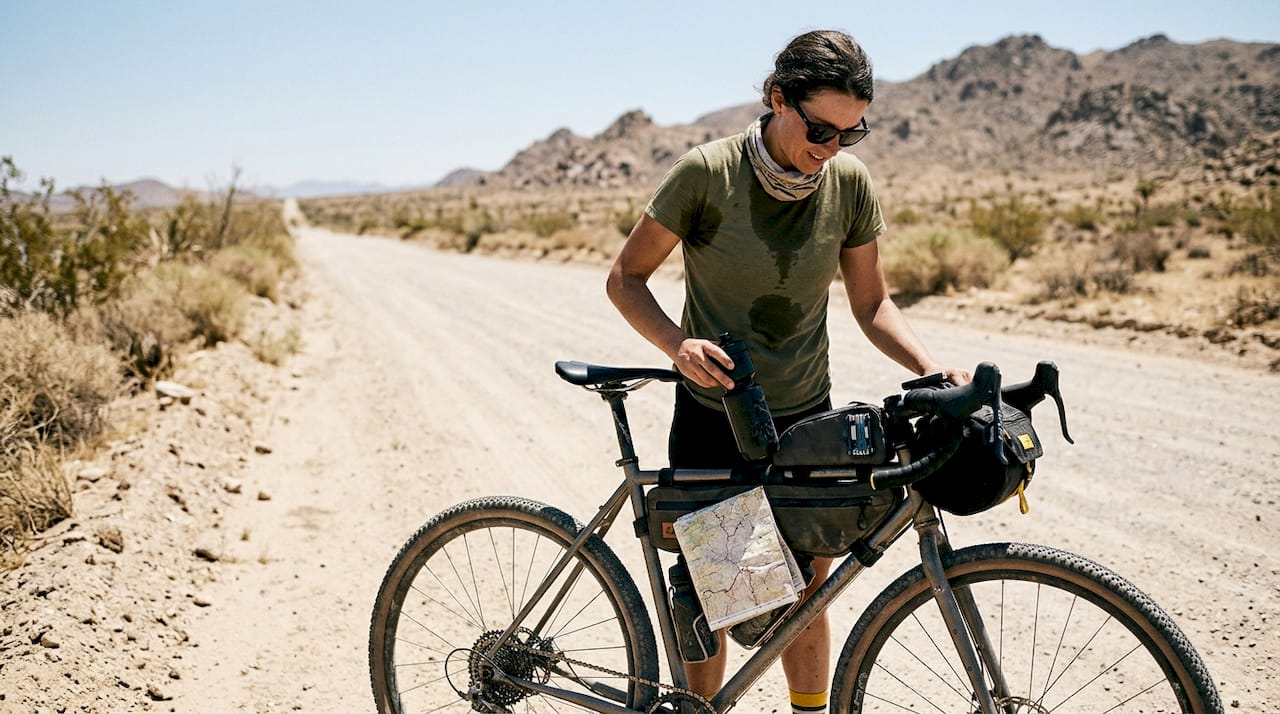
Balancing minimalism with safety for different bikepacking styles
Once you know the essential gear, the real challenge is figuring out how much is enough. This is where bikepacking culture gets genuinely interesting, and occasionally heated.
Some bikepackers aim for sub-8kg packs, treating every gram as a moral question. Others believe that comfort and safety justify carrying extra weight, especially on longer or more remote routes. Neither philosophy is wrong in absolute terms. The right answer depends on your specific adventure.
| Factor | Minimalist approach | Safety-first approach |
|---|---|---|
| Pack weight | Under 8kg total | 10kg or more accepted |
| Gear redundancy | Single-use, ultralight items | Backup tools and layers |
| Risk tolerance | Higher, relies on skill | Lower, relies on equipment |
| Best suited for | Short, well-mapped routes | Multi-day, remote adventures |
| Trade-off | Speed and agility | Confidence and resilience |
The urban cycling protection guide offers a useful lens here: even in lower-risk environments, the right protective gear changes your behavior and your confidence in ways that pure minimalism cannot.
Before packing, ask yourself these questions:
- How remote is my route, and how long would rescue take if needed?
- What is the weather forecast, and what is the worst-case scenario for conditions?
- Am I riding solo or with a group?
- Do I have the technical skills to manage mechanical failures without backup tools?
- What is the consequence of being wrong about any of these answers?
Your answers should directly shape your kit. A well-supported weekend route near a town is a very different risk profile from a five-day solo crossing of a mountain range. Treating them the same way is where bikepackers get into trouble.
Practical safety strategies for every ride
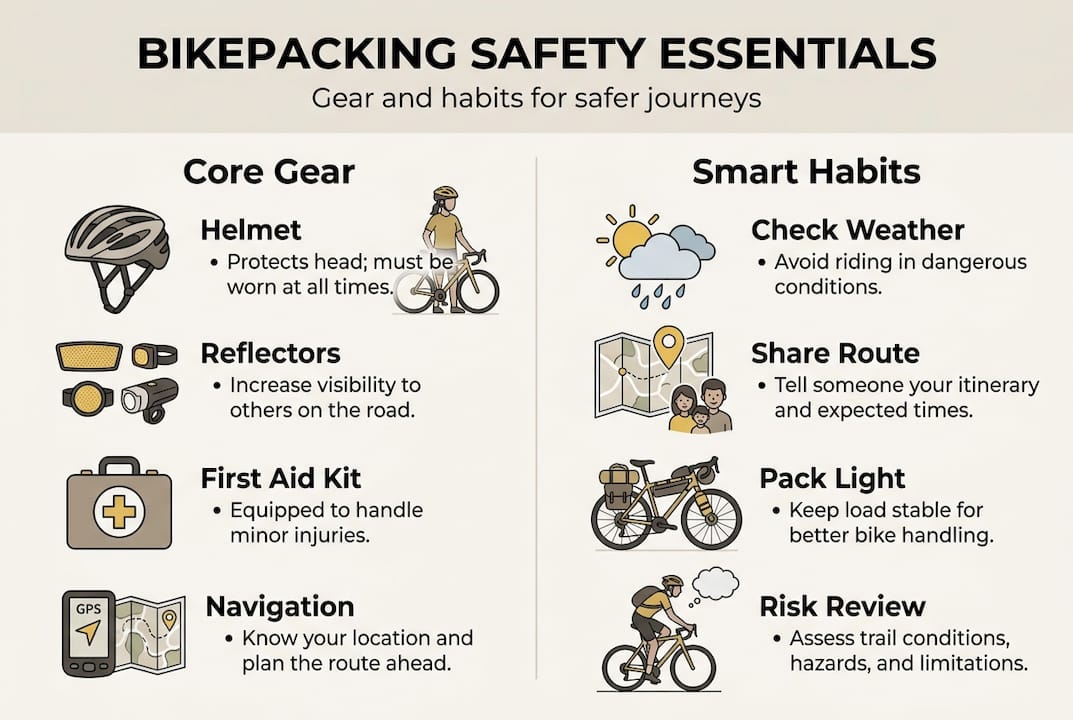
No matter how well you pack, safety relies on smart habits and adaptability during your journey. Gear is only part of the equation. The other part is how you behave before, during, and after each day on the bike.
Adaptable, proactive risk management is as important as carrying the right equipment. Here’s a sequential framework to build into every trip:
- Pre-ride check: Inspect your bike mechanically (brakes, tires, drivetrain), verify all lights and electronics are charged, and confirm your navigation is loaded and working offline.
- Route notification: Share your full route, including campsites and planned daily distances, with someone at home before you leave.
- Weather contingency: Identify bailout points on your route in advance. Know where you can get shelter or cut the trip short if conditions deteriorate.
- Daily check-in protocol: Set a specific time each day to contact your designated person. If they don’t hear from you by that time, they know to take action.
- On-trail adaptability: Be willing to change your plan. Pride in sticking to the original route is not worth a dangerous situation.
- Post-incident review: When something goes wrong, even a minor mechanical issue, take five minutes to understand why and what you’d do differently.
Pro Tip: Designate a specific contact person before every trip and give them a clear protocol: if you miss two consecutive check-ins, they call local emergency services with your last known location. This costs you nothing and could save your life on a remote route.
For structured guidance on planning your bikepacking safety, building these habits before they’re needed is far easier than improvising under pressure.
Small setbacks are also learning opportunities. A wrong turn that adds two hours to your day teaches you something about your navigation habits. A cold night in an underprepared camp teaches you something about your layering system. The riders who last longest in this sport are the ones who treat every imperfect moment as data, not failure.
Why safety is non-negotiable: insights from experienced bikepackers
Here’s something the ultralight community doesn’t always say out loud: the obsession with cutting weight can become its own kind of risk. We’ve seen it repeatedly. A rider shaves 200 grams by leaving behind a basic first aid kit, then spends three days managing an infected blister that could have been treated in minutes. Another skips a reflector to save weight and gets clipped by a car at dusk on a road crossing.
Veteran bikepackers don’t talk about safety gear as a burden. They talk about it as the thing that kept a bad moment from becoming a catastrophe. The real skill isn’t knowing how little you can carry. It’s knowing exactly what you cannot afford to leave behind, and why.
The most experienced riders we’ve spoken with share one consistent habit: they do a genuine risk assessment before every trip, not just a weight audit. They ask what could actually go wrong on this specific route, and they pack accordingly. That’s a very different process from defaulting to the lightest option every time. Reviewing bikepacking safety lessons from riders who’ve been through tough situations is one of the fastest ways to develop that judgment.
Get equipped for safer, better bikepacking adventures
Safety knowledge is only as good as the gear backing it up. At THE BEAM, we design equipment specifically for cyclists who take both their adventures and their protection seriously.
Our FRAME FLASH bike reflectors are built for bikepackers who want maximum visibility without adding bulk to their setup. Lightweight, durable, and designed for 360-degree coverage, they’re the kind of passive safety tool that works even when you’re too tired to remember to turn something on. Explore all bikepacking safety products from THE BEAM to find the gear that fits your riding style, your route, and your risk profile. Every piece we make is designed to keep you riding longer and safer.
Frequently asked questions
What safety gear is non-negotiable for any bikepacking trip?
A helmet, lights, reflectors, basic first aid kit, and a navigation device are considered essential for every ride. Core items that reduce risk have been validated across multiple cycling safety studies.
How do I balance carrying less with being safe?
Prioritize multi-use safety items and assess the real risks of your route before cutting anything from your kit. Most experienced bikepackers recommend thoughtful compromise rather than skipping essentials to save weight.
Does off-road bikepacking really reduce injury risk compared to road cycling?
Yes, off-road bikepacking typically involves lower injury severity compared to road cycling, largely due to reduced exposure to high-speed vehicle traffic.
What habits can make the biggest difference for solo bikepackers?
Always share your route with a trusted contact, set a daily check-in schedule, and build weather contingency plans into your route before you leave home.


