

Filtered earplugs paired with a properly fitted helmet fix wind noise faster than anything else you can try, cutting the roar by roughly 10 to 25 dB while letting traffic and voices through. Porous strap covers, thin headwear, and helmet adjustments help too, but each has real limits. None of it replaces hearing protection once you’re descending fast: wind noise at higher speeds can climb into levels that may put your ears at genuine risk.
TL;DR:
- Filtered earplugs can reduce wind noise by 10 to 25 dB, making them the most effective quick fix tested by riders.
- Proper helmet fit and head positioning can cut wind buffeting more than changing helmet models, often explaining more noise differences.
- Porous strap covers diffuse turbulence, providing some noise reduction without blocking ambient sounds critical for safety.
- Noise levels can spike by over 35 dB at higher speeds, so thicker filtration and a secure helmet fit are essential for fast descents.
- Testing noise reduction solutions on shorter rides helps prevent over-filtering that could impair awareness of nearby vehicles or fellow riders.
Table of Contents
- Quick fixes for bruit de vent casque vélo that actually work
- How much noise reduction should you actually expect?
- Why does wind actually roar in your ears on a bike?
- How to pick and use wind noise solutions without losing awareness
- Helmet design always trades ventilation against airflow smoothing, and that trade-off directly shapes how much wind noise reaches your ears.
- A common first step if wind noise is wrecking your rides
- How The Beam approaches quieter, safer rides
- Sources
Quick fixes for bruit de vent casque vélo that actually work
Riders searching for a fix to bruit de vent casque vélo, the wind roar that builds up around a bike helmet at speed, usually want something they can try this weekend, not a research paper. Here’s the order that gets results, ranked by how reliably each one works.
- Filtered earplugs. These use a small acoustic filter instead of a solid foam plug, cutting wind noise by 10 to 25 dB depending on the model while keeping horns, shouted warnings, and pack chatter audible. They’re the single most effective tool on this list, and the Alpine guide on wind noise notes that riders who skip them often develop headaches and fatigue on long rides.
- Helmet fit and head position. A helmet sitting slightly loose or tipped backward opens gaps that funnel turbulent air straight at your ear canal. Tightening the retention system and leveling the helmet on your head, rather than tilting it up, closes that gap and reduces buffeting more than most riders expect. Fit often explains more of the noise you hear than which helmet model you’re wearing.
- Porous strap covers (Cat Ears style). These small tufted pads attach to your helmet straps near the ears and diffuse turbulence instead of blocking it outright, which preserves your ability to hear the road around you.
- Thin headwear. A skull cap, thin balaclava, or wide headband placed under the helmet smooths some airflow around the ear and takes the edge off noise on windy days. It’s a mild fix, not a primary one.
- Foam plugs. Standard foam earplugs cut noise hard, sometimes too hard, muffling everything including cars and other riders. They work in a pinch but aren’t built for cycling, since they block indiscriminately rather than filtering.
Pro Tip: Test filtered earplugs on a short neighborhood loop before your first long ride. If you can’t hear a car approaching from behind at normal speed, the filter you picked is too aggressive for that ride.
How much noise reduction should you actually expect?
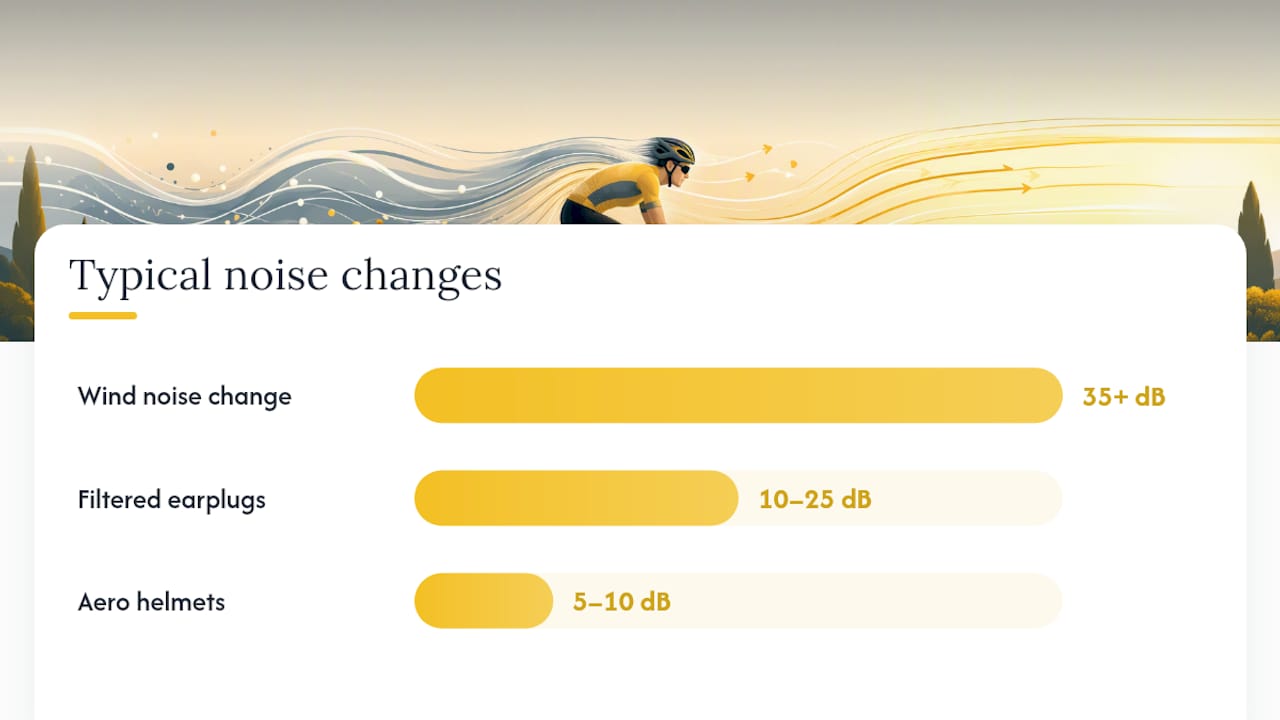
Numbers here vary a lot, and that variation is the whole story. A peer-reviewed wind-tunnel study measured wind noise climbing from about 84.9 dB at 10 mph to 120.3 dB at 60 mph, with the loudest readings hitting the downwind ear at a 90 degree wind angle. That’s a jump of over 35 dB across a realistic speed range, which is the difference between a noisy room and a jet engine at close range.
What that means for your gear choices:
- Filtered earplugs: roughly 10 to 25 dB reduction, the largest and most consistent gain of any single fix.
- Porous strap deflectors: a smaller but real reduction, since they diffuse turbulence rather than block it, which matters more on gusty days than on calm ones.
- Aero-oriented helmet shapes: roughly 5 to 10 dB less turbulence than heavily vented designs, but only in certain head angles and wind directions.
Why the spread? Head angle, crosswind direction, how many vents your helmet has, and even the shape of your outer ear all change how much turbulence reaches your eardrum. A helmet that’s whisper quiet riding into a headwind can roar in a crosswind.
For commuting and group rides in city traffic, a filtered plug rated near the low end of that range plus a solid helmet fit is usually enough. For fast descents where wind speed alone pushes past 40 or 50 mph, lean toward stronger filtration and treat hearing protection as non-negotiable rather than optional.
Why does wind actually roar in your ears on a bike?
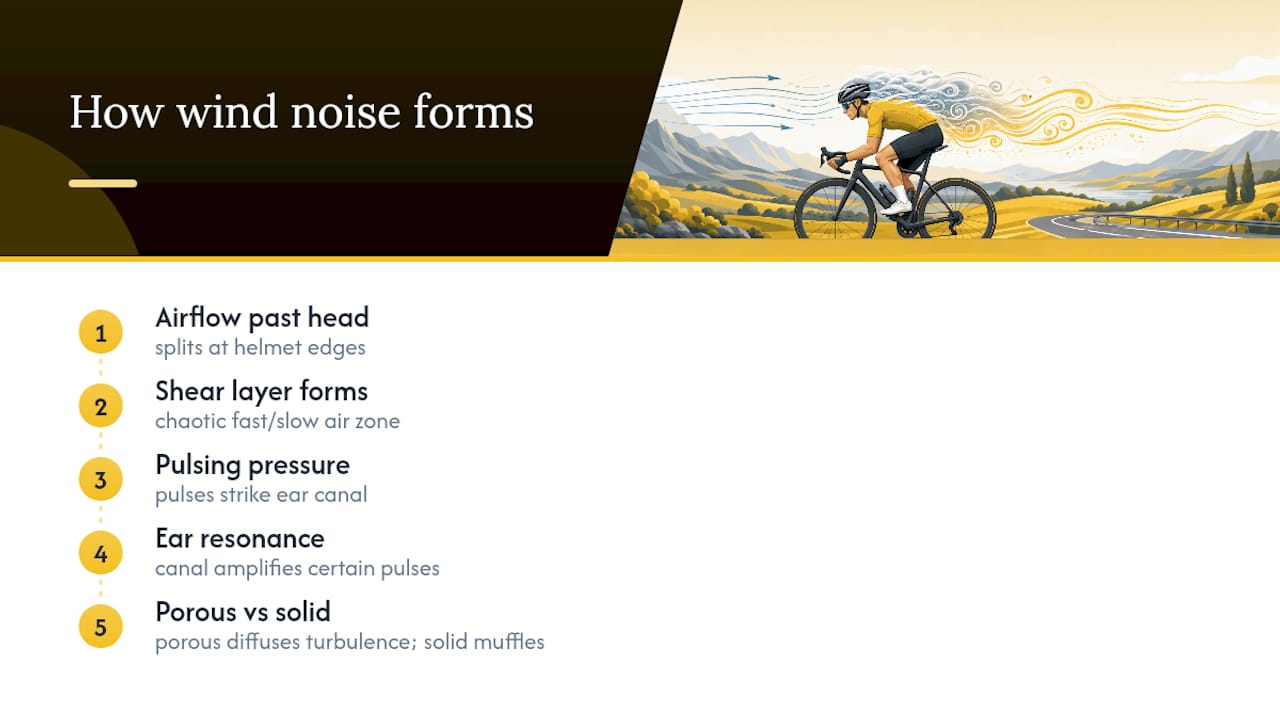
The sound isn’t wind itself, it’s turbulence. As air moves past your head and around your helmet’s edges, it separates into a shear layer, a chaotic zone where fast moving air outside meets slower air trapped near your skin. That shear layer slams into your ear canal in pulses, and your ear canal has its own natural resonant frequency, so it amplifies certain pulses instead of just passing them through. That resonance is most of what you’re hearing as “wind noise.”
Helmet vents, strap buckles, and the gap between helmet edge and ear all change how strong that shear layer gets. A steeper head angle, chin down, exposes more ear surface to direct airflow. A helmet that sits high or loose creates a wider gap where turbulence can swirl before hitting your ear.
This is why porous materials outperform solid blockers. A solid plug or a rigid ear cover stops sound by brute force, but it also stops the sounds you need. Porous, flow-conditioning materials diffuse the turbulence itself, breaking up the pressure pulses before they hit resonance, rather than simply muffling everything that reaches your ear. That’s the physics behind why a tufted strap cover or a well-chosen filtered plug beats a wad of cotton stuffed in your ear.
How to pick and use wind noise solutions without losing awareness
Getting quieter without going deaf to your surroundings takes a bit of deliberate testing, not just buying the first product you see.
- Pick your attenuation level based on how you ride. For commuting or group rides where you need to hear cars, other riders, and verbal calls, look for filtered plugs in the 10 to 15 dB range. Save stronger attenuation for solo, high-speed descents where wind alone is the dominant hazard.
- Run the fit checklist before you ride. Confirm your helmet retention system is snug, not just resting on your head. Check strap tension so the helmet doesn’t shift or tilt. Insert plugs to the depth the manufacturer recommends, not shallower for comfort. If you wear glasses or a helmet-mounted comms unit, test that the plug or strap cover doesn’t interfere with the seal or your temples.
- Test on a short, low-traffic route first. Ride a familiar loop with light traffic and deliberately listen for a horn, a car’s approach, or a training partner’s voice at normal volume. If any of those sound muffled or delayed to notice, drop down to a lower attenuation filter or reposition your strap covers.
- Adjust in small steps. Change one variable at a time, plug depth, strap tension, cover placement, so you know what actually fixed the problem instead of guessing.
- Get a baseline hearing check if you ride often. Cumulative wind exposure adds up over years, and industry guidance recommends a baseline audiogram for riders over 40 or anyone logging heavy weekly mileage. A quick professional check tells you where you stand before any damage becomes noticeable.
Pro Tip: Keep a spare set of lower-attenuation plugs in your saddle bag for group rides. Swapping to a lighter filter when you’re riding with others is a fast, free way to stay social without sacrificing the protection you rely on solo.
If you ever find yourself unable to hold a shouted conversation with a riding partner at normal speed, that’s your cue to dial back attenuation immediately, rather than push through it.
Helmet design always trades ventilation against airflow smoothing, and that trade-off directly shapes how much wind noise reaches your ears.
Helmet design always trades ventilation against airflow smoothing, and that trade-off directly shapes how much wind noise reaches your ears. More vents mean better cooling but more entry points for turbulent air; a smoother, more enclosed shell cuts turbulence but runs warmer. Neither extreme is automatically right, it depends on your riding style and climate.
What we’d tell any rider shopping for a helmet: prioritize a secure, adjustable retention system and internal padding you can fine-tune, since fit changes turbulence more than helmet model does. Look for designs that leave enough clearance near the ear for strap-mounted accessories like porous deflectors, rather than a tight shell that crowds them out. Our own posts on helmet aerodynamics and why ventilation matters go deeper into how shell shape and vent placement affect both airflow and the noise that comes with it.
A common first step if wind noise is wrecking your rides
Start with filtered earplugs and a real fit check, that combination solves most of the problem for most riders. Add porous strap covers if you’re still getting buffeted on windy days or descents. Give yourself a few rides to adjust; plugs feel strange at first, and that’s normal, not a sign you picked the wrong gear. Go gradual, and don’t force it.
— Sophie
How The Beam approaches quieter, safer rides
Wind noise usually comes down to fit and airflow management, and that’s exactly where helmet design earns its keep. A helmet that seals well around the retention system, offers adjustable internal padding, and leaves room near the ears for accessories gives you a real head start before you even add earplugs to the mix.

If you’re building out a full safety setup rather than a single fix, it’s worth looking at how visibility gear complements what you’re doing for your ears. Riding quieter is only half the safety picture. Being seen matters just as much, especially on commutes through mixed traffic, and that’s an area where scooter and cyclist accident cases often turn on exactly that question of who saw whom first. The FRAME FLASH bike reflector is a minimalist option worth checking out if you want visibility gear that doesn’t add bulk to your setup. For riders training toward longer distances, our ultracycling event page also shows how fit, airflow, and visibility choices play out over serious mileage. Check either page for current product photos and specs before you decide what to add to your kit.
This article is general information, not a substitute for advice from a qualified doctor. Consult a qualified healthcare professional about your own circumstances before acting on anything here.
Sources
- Evaluation of Noise Exposure Secondary to Wind Noise in Cyclists
- Cycling Hearing Protection — Wind Noise Guide | Roadman Cycling
- The Physics of Wind Noise
- Le vent dans les oreilles vous gêne lorsque vous faites du vélo? | Alpine


