

Yes, you can wear a ponytail with a bike helmet. The trick is choosing a design with real rear clearance and an adjustable rear cradle, not just a hole punched through the shell. DGCCRF consumer guidance confirms fit and retention should never be compromised for style, while brands like Liv Cycling and MIPS-equipped helmets from Thebeamofficial show how rear geometry and hairstyle can coexist without a trade-off.
Three features matter most when you’re shopping:
- Rear clearance or hairport: space or an opening at the back shell that lets hair pass through without bunching.
- Multi-position cradle height: a retention system that slides up or down so the cradle sits above or below your ponytail, not on top of it.
- Dialed rear adjustment: a turn dial that tightens horizontally without crushing the hair bundle vertically.
Put the helmet on with the exact ponytail you’d wear mid ride, then run through the fit checklist below before you decide anything.
Key Takeaways
Ponytail comfort in a bike helmet comes down to adjustable rear cradle height and genuine rear clearance, not a decorative hole in the shell.
| Point | Details |
|---|---|
| Rear clearance beats hairports | A gap between nape and cradle usually fits more hairstyles than a fixed hole. |
| Adjust height before tension | Set the cradle’s vertical position first, then tighten the rear dial. |
| Ponytail height guides helmet choice | Low and mid ponytails need cradle flexibility; high ponytails suit true hairports. |
| Never skip the safety basics | Helmet must sit level and low, with straps snug in a two-finger fit. |
| Thebeamofficial builds for this | The VIRGO helmet pairs MIPS technology with adjustable rear cradle geometry for ponytail wearers. |
Table of Contents
- What Makes a Bike Helmet Ponytail-Friendly?
- How Do You Test a Helmet Fit With a Ponytail?
- Which Ponytail Styles Work Best Under a Helmet?
- Does a Ponytail Affect Helmet Safety or Positioning?
- How The Beam Designs for Ponytail Comfort
- What Actually Matters When Buying for a Ponytail
- Find a Helmet Built Around Real Ponytail Fit
- Sources
What Makes a Bike Helmet Ponytail-Friendly?
A “hairport,” a cutout near the back of the shell, sounds like the obvious fix, but it isn’t always the best one. A hairport works well for high, thin ponytails threaded straight through. It causes problems for low or thick ponytails, which end up squeezed against a hard plastic edge instead of resting in soft padding.
The more reliable engineering, and what shows up in most well-designed women’s helmets today, is a gap built between the nape of your neck and the retention cradle itself. Instead of forcing hair through a hole, the whole rear assembly sits higher or lower on an adjustable track, leaving open space behind it. Liv Cycling’s technology guide documents exactly this approach, pairing multi-position cradles with what it calls hair-friendly rear fit systems.
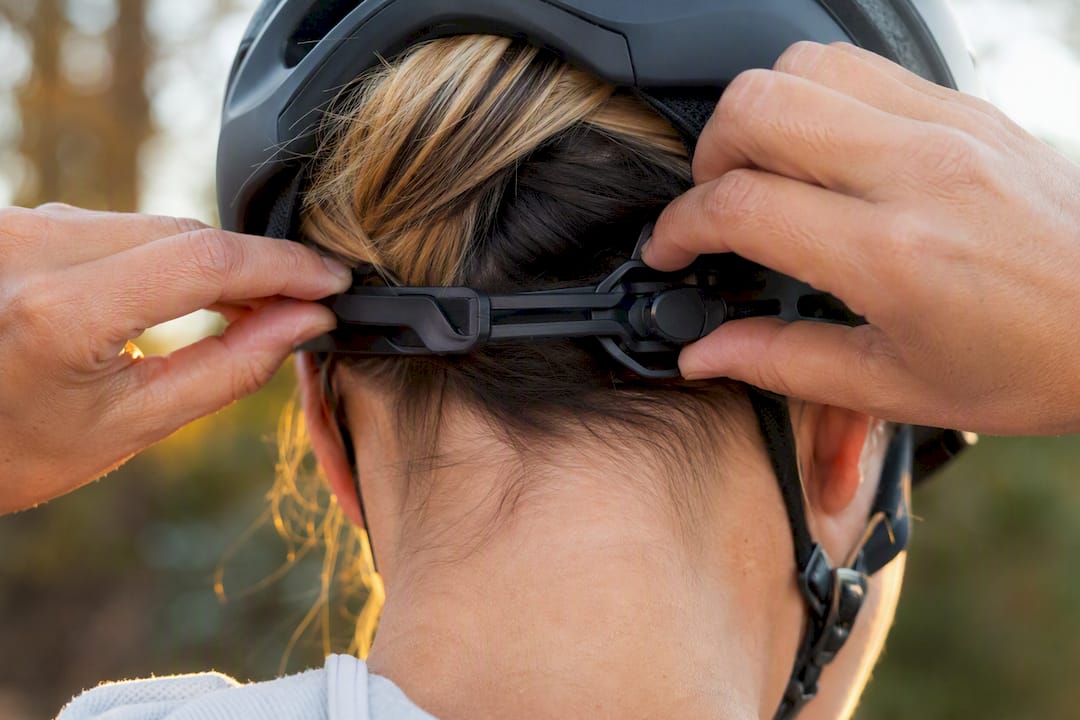
That rear geometry also interacts with ventilation and padding. A helmet with generous lower rear coverage protects more of your skull but needs a cradle design smart enough to avoid trapping hair against foam. When you’re reading spec sheets, watch for phrases like “cradle height adjustment,” “lower rear coverage,” or “ponytail-compatible design.” Cycling press covering women’s helmets increasingly lists these as buying criteria, not afterthoughts.
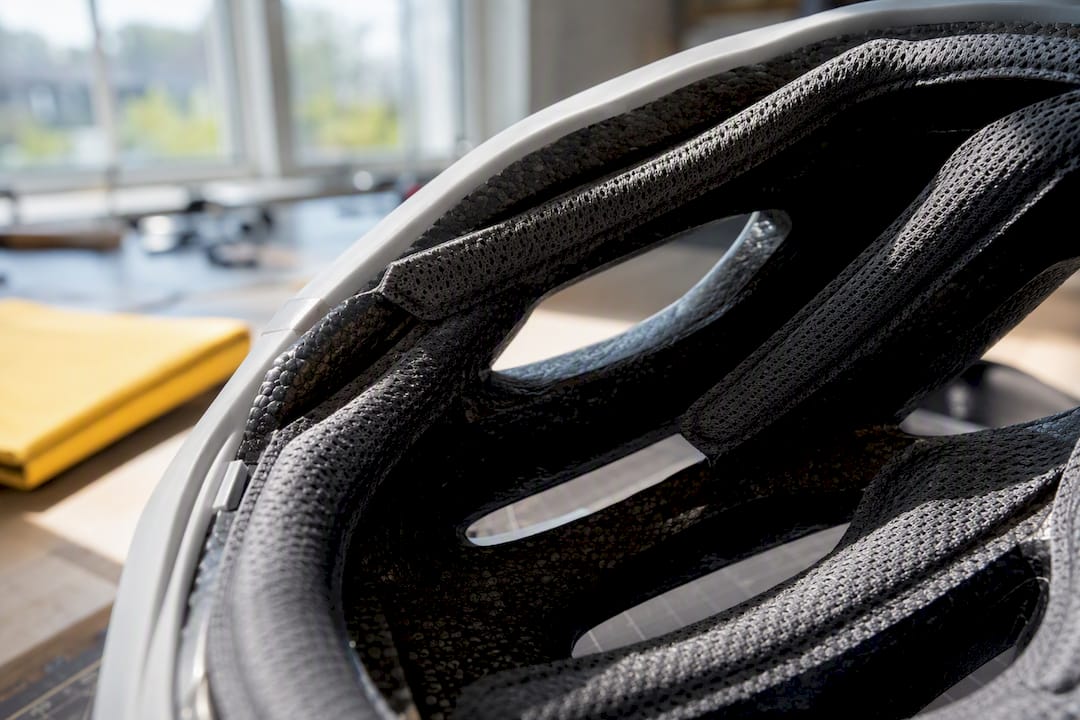
Pro Tip: Don’t judge a helmet by whether it has a visible hole. Some of the most ponytail-comfortable helmets on the market have no hairport at all, just a smartly shaped rear shell and a cradle that moves.
How Do You Test a Helmet Fit With a Ponytail?
Fit testing takes two minutes and saves you from buying a helmet that pinches by mile ten. Follow this order every time you try one on.
- Put your hair in the ponytail you actually ride with. Testing with hair down, or in a style you never use on the bike, tells you nothing useful.
- Seat the helmet level on your head and set the rear cradle to a middle starting height before tightening anything.
- Turn the rear dial gently, then adjust the cradle’s vertical position until your ponytail rests inside the opening without being pinned or compressed.
- Check the straps: you should fit two fingers between the strap and your jaw, and a light forward or backward pull shouldn’t shift the helmet.
- Feel for pressure at the nape. If you find a hot spot, don’t just tighten more. Re-seat the helmet, try a different cradle height, or move up or down a shell size.
Pro Tip: Set the vertical cradle height before you touch the horizontal dial. Tightening first almost always compresses the hair bundle and creates the exact pressure point you’re trying to avoid.
Practical guides on cycling with long hair back this order up: adjust position, then tension, always with your real hairstyle in place.
Which Ponytail Styles Work Best Under a Helmet?
Not every ponytail sits the same way, and the height you choose changes which helmet geometry works for you.
- Low ponytails pair best with helmets that have a wide rear opening and a cradle that sits high, leaving the tail free below the shell.
- Mid ponytails need the most cradle flexibility since they sit closest to where most retention systems naturally rest.
- High ponytails work well with true hairport designs since the hair passes through near the crown, above the bulk of the cradle.
- Thick hair often does better in a low braid or loose bun than a bulky ponytail, since braids compress more evenly under padding.
- Tie choice matters: soft, flat hair ties beat thick scrunchies or bulky knots, which create a single hard pressure point right where the cradle sits, a detail confirmed by cycling hair-care advice.
On long rides, sweat loosens hair and shifts your ponytail’s position. Reach back and re-seat it at rest stops, and loosen the rear dial slightly if you feel new pressure building after an hour or two in the saddle.
Does a Ponytail Affect Helmet Safety or Positioning?
A ponytail should never change how a helmet sits on your head. The shell still needs to sit level and low on your forehead, roughly two finger-widths above your eyebrows, and the straps still need to form a snug V under each ear regardless of what your hair is doing underneath.
Official guidance is blunt about it: fit and retention checks come first, and no hairstyle preference should override a snug, level fit. DGCCRF’s consumer guidance on helmets treats correct strap tension and helmet position as the baseline safety check, full stop.
MIPS and other rotational-impact systems reduce certain rotational forces during a crash, but they’re a supplement to correct fit, not a substitute for it. A MIPS-equipped helmet worn too high or too loose because of a ponytail loses most of that benefit anyway. If your hair volume genuinely won’t fit safely at a lower, correct position, that’s a signal to try a different shell size or profile, or to switch to a lower bun for that particular ride, not to loosen the straps.
How The Beam Designs for Ponytail Comfort
Sophie, who covers fit and safety topics for Thebeamofficial, has written more on retention systems in the helmet retention systems guide and the broader fit guide for every rider, both worth a read if you want the mechanics behind what’s above.
Thebeamofficial builds its helmets, including the VIRGO with MIPS technology, around adjustable rear cradle height and thoughtful lower rear coverage rather than a single hairport cutout. That means:
- Retention geometry that moves independently of dial tension, so you set height first, tension second.
- Rear shell shaping designed to leave clearance instead of forcing hair through one fixed opening.
- Padding placement that accounts for where a ponytail naturally sits during a ride.
Product photos and full specs are available at the end of this article. Try the fit checklist above with your own ponytail before you commit to a size.
What Actually Matters When Buying for a Ponytail
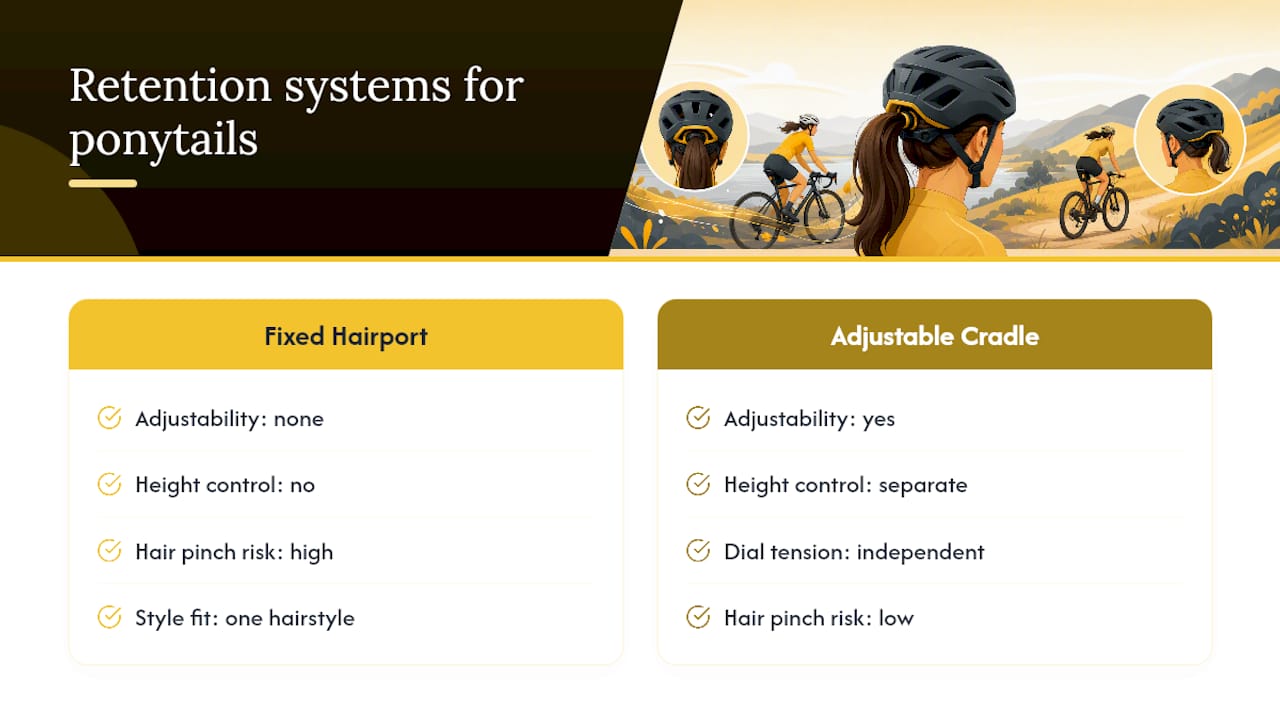
Most advice on this topic obsesses over whether a helmet has a hole in the back. That’s the wrong question. A hairport is a feature, not a guarantee, and plenty of “ponytail-friendly” helmets with a cutout still pinch hair against hard plastic if the cradle doesn’t move independently.
What the research actually points to is boring but true: adjustability wins. A helmet where you can set cradle height separately from dial tension will serve a low bun, a high pony, and a thick braid equally well, while a fixed hairport only serves one hairstyle well. If I had to give one piece of advice, it’s this: stop scanning for holes and start checking whether the retention system has a vertical range you can feel move under your hand.
The other thing conventional advice skips is trying the helmet with your actual ride-day hair, sweaty, slightly loose, tied the way you really tie it. A helmet that feels perfect on a smooth ponytail in a shop mirror can feel completely different two hours into a ride.
Find a Helmet Built Around Real Ponytail Fit
Thebeamofficial designs helmets around adjustable retention geometry instead of a single fixed cutout, which means one helmet can genuinely work across low buns, high ponytails, and everything in between. The flagship VIRGO helmet combines MIPS technology with a rear cradle built to move independently of strap tension, so you’re not stuck choosing between a secure fit and a comfortable ponytail.

If you ride at night or in low light, pairing your helmet with a compact accessory like the FRAME FLASH bike reflector rounds out your visibility setup without adding bulk. And if you want to see how The Beam’s safety-first approach shows up beyond helmets, the ultracycling event page is worth a look. For long commutes, Sitpack’s guide to commuter comfort pairs well with getting your helmet fit right.
Try the VIRGO on with your actual ponytail, run it through the fit checklist above, and see how the cradle handles your hair before you decide. Browse the VIRGO and shop Thebeamofficial’s full lineup to get started.
Sources
- Economie
- Guide des technologies casque vélo femme | Liv Cycling FR
- Cycling with Long Hair: Ponytails + Bike Helmets | Discerning Cyclist
- Top 5 du casque vélo femme : féminité et sécurité sur la route | Velotech


