

Gear names in cycling are not just labels. Call a fender a mudguard in the wrong shop, ask for the wrong bite valve, or confuse a pannier with a saddlebag, and you can end up with the wrong part, a wasted trip, or worse, a safety gap on your next ride. Accessory terminology is the shared language of cycling, and when you speak it fluently, you buy smarter, ride safer, and communicate faster with mechanics, fellow riders, and online communities. This guide breaks down the terms that matter most, from mudguards to hydration packs, so you can make confident, informed gear decisions every time.
Table of Contents
- Why cycling accessories terminology matters
- Glossary of essential cycling accessories
- Mudguards vs. fenders: What’s the difference?
- High-end hydration packs: More than just water carriers
- How terminology connects to real-world safety
- Find trusted cycling accessories and safety gear
- Frequently asked questions
Key Takeaways
| Point | Details |
|---|---|
| Learn common terms | Understanding accessory names helps you choose better gear and enhance safety. |
| Spot American vs. British usage | Knowing the difference between ‘fender’ and ‘mudguard’ prevents confusion. |
| Pick high-end features | Advanced hydration packs offer insulation, easy sipping, and the right capacity for long rides. |
| Safe choices need clear terms | Precise terminology means better decisions and safer rides. |
Why cycling accessories terminology matters
Every discipline in cycling has its own vocabulary. A gravel rider talking about “flap guards” and a road cyclist asking about “full-coverage fenders” may be describing nearly the same thing, but the difference in language can lead to completely different products. Accessory safety and comfort tips confirm that misunderstanding accessory terms can lead to using the wrong equipment, directly risking your safety and comfort on the road.
Knowing the right terms also helps you navigate group rides, cycling forums, and gear shops with authority. When you ask for the correct part by name, you get faster service, fewer mistakes, and better results. This matters even more when you are shopping online across different markets, where British and American English terms often differ for the same product.
Here is why terminology is a practical safety tool:
- Discipline-specific fit: MTB, road, gravel, and urban cycling each use different accessory standards. The right term points you to the right spec.
- Faster emergency communication: In a crash or mechanical failure, clear language gets you help faster.
- Better gear matching: Safety gear optimization starts with knowing what each accessory does and what it is called.
- Informed upgrades: When you understand what a component does, you can evaluate whether a premium version is worth it.
“The language of cycling gear is the first layer of protection. Get it right, and every decision downstream improves.” This is the core principle behind cycling safety terms explained for riders at every level.
Understanding key cycling terms is not about memorizing a dictionary. It is about building a practical toolkit that makes you a more confident, safer rider.
Glossary of essential cycling accessories
Let’s cut through the confusion with clear, direct definitions. These are the terms you will encounter most often across disciplines, shops, and safety guides.
| Term | Definition | Common synonym or note |
|---|---|---|
| Mudguard / Fender | Shield that blocks water and mud spray from wheels | “Mudguard” (British), “fender” (American) |
| Hydration pack | Wearable backpack with a water reservoir and drinking hose | Also called a “water pack” or “bladder pack” |
| Pannier | Bag mounted to a rack on the bike frame | Sometimes confused with saddlebag |
| Reflector | Passive light-reflecting device for visibility | Not the same as an active light |
| Cycling computer | Device tracking speed, distance, GPS, and metrics | Also called a “bike computer” or “head unit” |
| Saddlebag | Small bag mounted under the saddle | Not a pannier; much smaller capacity |
| Bite valve | Mouthpiece on a hydration pack hose | Part of the hydration system, not a standalone item |
| Rear-view mirror | Mirror mounted to helmet or handlebar for rearward visibility | Critical safety accessory for road and urban riders |
According to the authoritative glossary, a mudguard blocks mud spray from the wheel, while a hydration pack carries water in a wearable reservoir with a hose for hands-free drinking. These two definitions alone cover some of the most commonly confused terms in cycling retail.
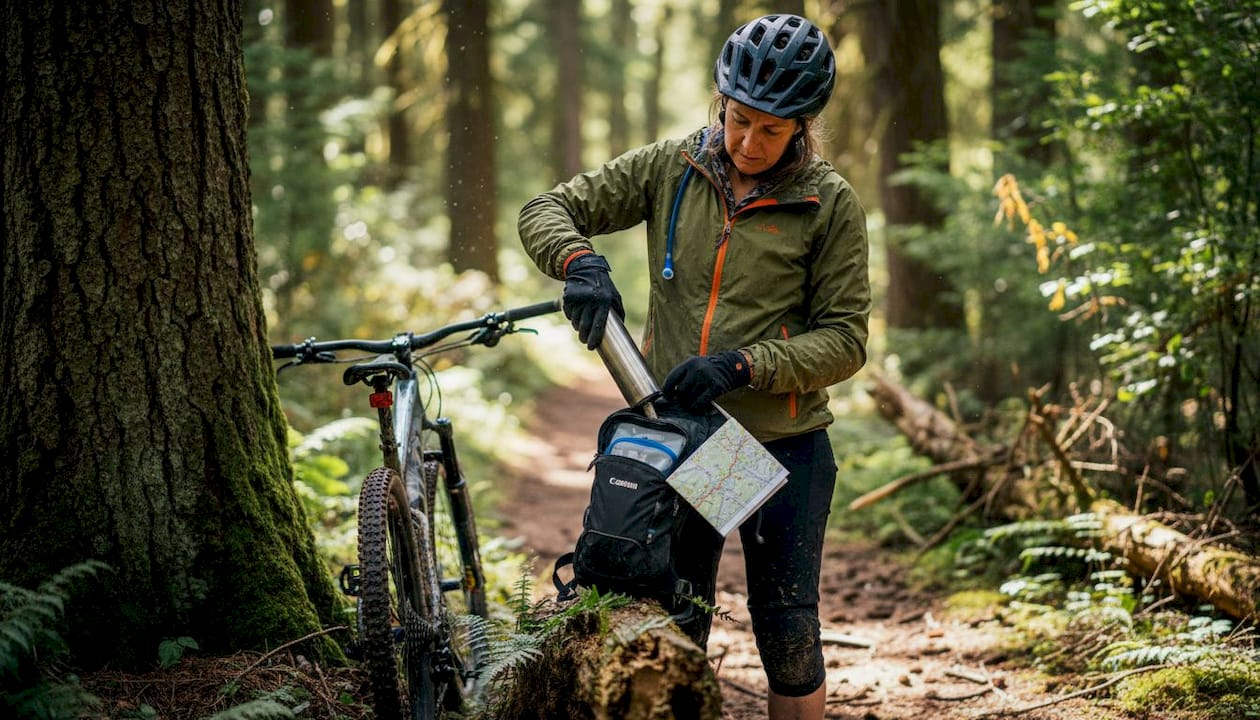
For riders focused on city commuting, urban cycling accessories include a broader set of terms around visibility, locking, and cargo carrying that go beyond trail-specific gear.
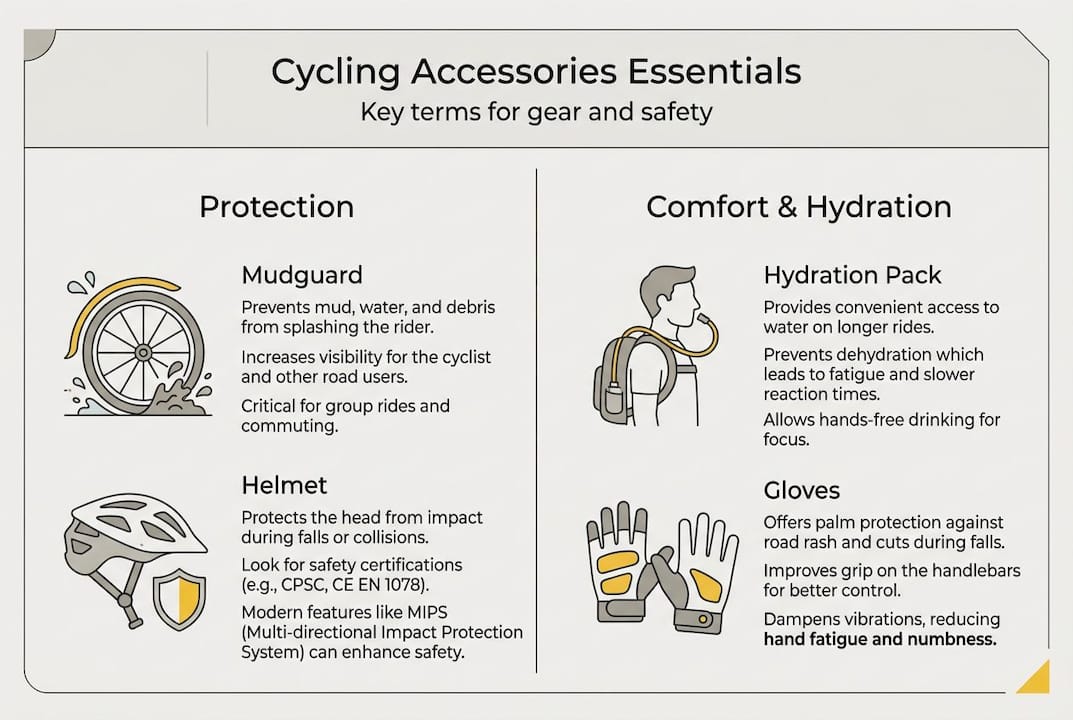
Pro Tip: When shopping internationally, always check whether a product listing uses British or American English. “Mudguard” and “fender” are the same item, but searching only one term can cut your results in half.
Mudguards vs. fenders: What’s the difference?
This is the question that trips up more riders than almost any other. The short answer: mudguard and fender refer to the same accessory. The longer answer is where it gets interesting.
“Mudguard” is the standard British English term. “Fender” is the American English equivalent. Both describe a rigid or semi-rigid shield mounted near the wheel to deflect water, mud, and road spray away from the rider and drivetrain. However, the design and fit vary significantly by discipline, and that is where the real distinction lies.
| Type | Fit | Main function | Common context |
|---|---|---|---|
| Full-coverage road fender | Bolted to frame eyelets | Maximum spray protection | Commuting, touring, wet-weather road riding |
| MTB mudguard | Clip-on or zip-tied, short profile | Clearance for suspension and mud | Trail riding, enduro, cross-country |
| Clip-on fender | Attaches under saddle or fork crown | Quick install, partial coverage | Road bikes without eyelets |
| Gravel mudguard | Mid-length, flexible material | Balance of coverage and clearance | Gravel, adventure riding |
Key factors that influence which term and type you need:
- Disc brakes: Fenders and mudguards must be positioned carefully on disc brake bikes to avoid rotor contamination from redirected spray. A poorly fitted guard can actually reduce braking performance.
- Wheel clearance: MTB mudguards are intentionally shorter to allow mud to pass through without clogging. Full road fenders would pack up instantly on a trail.
- Visibility: A rear fender keeps your back clean and keeps the rider behind you from getting sprayed, which matters in group rides and sportives.
- Frame compatibility: Not all road bikes have fender eyelets. Knowing this term before you shop saves a frustrating return.
For a deeper look at how these choices connect to overall protection, the security and comfort guide covers discipline-specific accessory selection in detail.
High-end hydration packs: More than just water carriers
A hydration pack looks simple from the outside. Inside, the terminology tells a different story, and understanding it separates a smart purchase from an expensive mistake.
The core components of any hydration pack:
- Bladder: The flexible water reservoir, typically made from BPA-free polyethylene. Capacity is measured in liters.
- Bite valve: The mouthpiece at the end of the drinking hose. You bite and sip; release and it seals.
- Shutoff: A clip or valve that stops water flow when you are not drinking, preventing leaks.
- Insulation: A sleeve or lining around the bladder and hose that slows heat transfer, keeping water cooler for longer.
Hydration packs for endurance enable hands-free fluid intake, and high-end models feature insulated bladders, shutoff bite valves, and a 2 to 3 liter capacity designed for multi-hour rides across all disciplines. That capacity benchmark is the industry standard for rides lasting three hours or more.
How to choose and use a hydration pack effectively:
- Match capacity to ride duration. A 1.5L bladder works for a 90-minute ride. For anything over three hours, go to 2L or 3L.
- Check the bite valve type. High-flow valves are better for intense efforts. Standard valves suit casual riding.
- Look for an insulated hose. The hose warms up faster than the bladder in summer heat. Insulation on the hose is a premium feature worth paying for.
- Prioritize easy cleaning. Wide-mouth bladder openings and dishwasher-safe components save time and reduce bacteria buildup.
- Test the fit loaded. A full 3L bladder adds roughly 3 kilograms. The pack should sit high on your back and not shift during climbs or descents.
For riders who want to optimize ride protection across all conditions, pairing a well-fitted hydration pack with the right helmet and visibility gear is a complete system, not just a collection of parts.
Pro Tip: After every ride, drain the bladder completely and leave it open to air-dry. Moisture trapped inside is the main cause of mold and off-taste. Store the bladder in your freezer between uses if you ride infrequently.
How terminology connects to real-world safety
Knowing what an accessory is called is not an academic exercise. It has direct, measurable consequences for how safely you ride and how quickly you can get help when something goes wrong.
Consider these real-world scenarios:
- Ordering online: You need a rear reflector but search for “tail light.” You end up with an active LED unit that requires charging, not the passive reflector required by law in your region.
- Reading a safety guide: A guide recommends a “shutoff bite valve” for your hydration pack. Without knowing the term, you skip the feature and end up with a leaking hose mid-ride.
- Discussing upgrades at a shop: You ask for a “mudguard” in an American shop. The mechanic may not immediately connect that to their fender stock, costing you time.
- Group ride communication: Calling out a hazard or equipment issue in the right terms gets a faster, clearer response from other riders.
Accurate accessory vocabulary is the foundation of better safety decisions. Cycling safety terminology directly supports injury risk reduction by helping riders select and use the right gear for their specific context.
“Riders who understand their gear vocabulary make faster, more accurate decisions in high-pressure situations. That speed can be the difference between a close call and a crash.”
This applies especially to commuters. Safety essentials for commuting cover a specific set of accessories, from reflectors to mirrors to lights, each with precise terminology that affects how you buy, install, and use them. Getting these terms right builds confidence in every cycling environment, from a local shop to a professional race briefing.
Find trusted cycling accessories and safety gear
You now have the vocabulary to shop smarter, ride safer, and communicate with confidence. The next step is putting that knowledge to work with gear that actually delivers on its promises.
At THE BEAM, we design high-end cycling safety equipment for riders who take protection seriously, whether you are commuting through a city, grinding gravel, or pushing pace on a road ride. Our shop helmets collection includes the VIRGO integral helmet with MIPS technology, built for real-world protection and everyday usability. Pair it with our helmet add-ons for enhanced visibility and comfort. Browse our full range of all cycling accessories, including rear-view mirrors, high-visibility reflectors, and connected safety products designed to keep you seen and protected on every ride.
Frequently asked questions
What’s the difference between a mudguard and a fender?
“Mudguard” is the British English term and “fender” is the American English equivalent for the same accessory. Design varies by discipline, with shorter MTB versions for clearance and full-length road versions for maximum spray coverage.
How do I choose the right hydration pack size for cycling?
For rides over three hours, choose a pack with a 2 to 3 liter reservoir to maintain consistent hydration. Shorter rides under 90 minutes can work with a 1 to 1.5 liter bladder.
Why do cycling safety guides stress accessory terminology?
Accurate terminology reduces purchasing mistakes, speeds up communication in emergencies, and ensures you select gear that matches your actual riding conditions and safety needs.
Can using the wrong cycling accessory really affect safety?
Yes. A terminology mix-up can result in buying an accessory that does not fit your bike, your discipline, or your safety requirements, creating real risk on every ride.


