

Most jurisdictions require a white front light, a red rear light or reflector, and reflective elements on wheels or pedals once daylight fades or visibility drops. Some regions also mandate high-visibility clothing for specific riding conditions. These are the baseline visibility standards for cyclists that traffic codes enforce, and gaps in any one of them are what typically draw a citation.
Before you roll out tonight, run this checklist:
- White front light (visible from the front, not angled at your shoes)
- Red rear light or rear retroreflector, unobstructed by bags or racks
- Wheel or pedal reflectors, intact and not cracked
- High-visibility garment or vest where local rules require it
- Battery check: charge or swap in spares before dusk, not after
Pro Tip: Test your rear light from thirty feet behind your bike, at the angle a driver would actually see it. If you can’t see it flashing, neither can they.
Key Takeaways
Meeting visibility standards for cyclists requires a certified front light, rear light or reflector, wheel or pedal reflectors, and correctly mounted high-visibility clothing where local law requires it.
| Point | Details |
|---|---|
| Check national codes first | EU guidance sets direction, but your country’s traffic code defines the enforceable specifics. |
| Match lumens to conditions | Use a moderate lumen range for lit streets and higher lumen outputs suitable for unlit roads, with steady beams at night. |
| Prioritize biomotion placement | Ankle, pedal, and wheel reflectors outperform static patches because motion catches driver attention. |
| Verify certification labels | Look for EN ISO 20471 or EN 13356 markings, not just the word “reflective” on a tag. |
| Choose tested, certified gear | THE BEAM’s FRAME FLASH reflectors and VIRGO helmet are built around certified reflective area and secure mounting. |
Table of Contents
- What Legal Standards Actually Require
- The Core Gear Categories You Need
- Which Certifications Actually Mean Something
- What Lumen Range Do You Actually Need?
- Where to Put Reflectors for Maximum Effect
- Common Mistakes That Undo Your Setup
- What Does Compliant Gear Cost?
- Your Two-Minute Pre-Ride Check
- What the Research Actually Shows
- Why Compliance Alone Isn’t the Same as Safety
- Get Gear Built Around These Standards
- Sources
What Legal Standards Actually Require
Legal visibility requirements come from two layers: EU-level road safety guidance that sets the direction, and national traffic codes that spell out the enforceable details. The European Commission’s road safety pages lay out the traffic rules that apply to cyclists across member states, and national codes build on that baseline with country-specific specifics on lighting, reflectors, and hi-vis clothing.
Across most European traffic codes, you’ll consistently find these requirements once light drops or visibility conditions worsen:
- A white or yellow front light, steady or flashing depending on jurisdiction
- A red rear light, red rear reflector, or both
- Reflectors on pedals, wheels, or both for side visibility at junctions
- Retroreflective material on clothing or accessories in some countries
The most common enforcement trap isn’t missing gear. It’s gear that’s present but useless: a rear light angled toward the ground, a reflector hidden behind a pannier, or a light clipped to a strap that swings and points sideways half the time. Officers checking compliance look for functioning, visible equipment, not just equipment that technically exists somewhere on the bike. The Cycling UK regulation appendix documents how inconsistently these rules get applied between regions, which is exactly why checking your own country’s transport authority page matters more than trusting a generic summary.
The Core Gear Categories You Need
Four main equipment categories cover the essentials of a visibility-compliant setup, each serving distinct functions.
Front lights handle two roles at once: they let you see the road ahead and let oncoming traffic see you. Handlebar mounts give the widest beam spread; helmet-mounted lights add height and let you “point” your beam at drivers by turning your head.
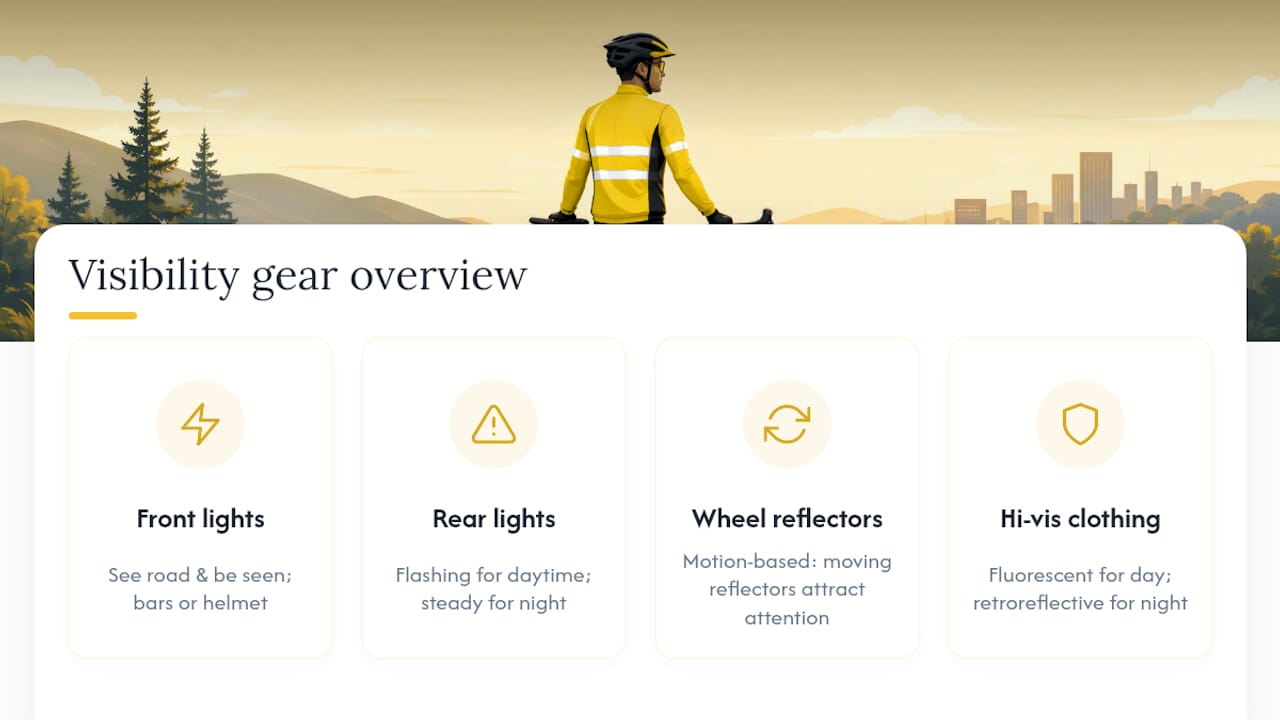
Rear lights and retroreflectors matter more than most riders assume, since a rear-facing driver has almost no other cue that you’re there. A flashing rear light draws attention faster in daylight; a steady one reads more clearly at night, when a flashing point of light can be mistaken for something stationary or distant.
Wheel, pedal, and ankle reflectors work because of motion, not brightness. A reflector that moves in a circular or up-and-down pattern registers as a person on a bike far faster than a static reflective patch.
High-visibility clothing splits into two jobs: fluorescent fabric for daytime contrast against foliage and pavement, retroreflective panels for nighttime headlight bounce-back. Vests, ankle bands, and helmet covers all fall into this category. THE BEAM’s VIRGO helmet and the FRAME FLASH reflector system were built around exactly these two functions: constant lighting and passive reflectivity working together instead of relying on just one.
Which Certifications Actually Mean Something
Not every “reflective” label on a jacket tag is backed by a real standard. EN ISO 20471 is the certification to look for on high-visibility garments. It rates a garment’s class based on the surface area of fluorescent and retroreflective material, not just the presence of some reflective trim. EN 13356 covers wearable reflective accessories like ankle bands, armbands, and vest add ons, again based on minimum reflective area and placement.
When you’re checking a label, look for:
- The specific EN standard number, not just “reflective” as marketing language
- A class rating (higher numbers generally mean more reflective coverage)
- Wash and care icons, since reflective coatings degrade with abrasion and heat
Pro Tip: A thin strip of reflective piping around a cuff looks compliant in a product photo but covers almost no surface area. A certified panel is a solid block of material, not a decorative line. If you can’t find an EN number on the tag, assume it’s decoration, not protection.
What Lumen Range Do You Actually Need?
For lit urban streets, a front light in the 200 to 400 lumen range is usually enough to be seen and to see potholes at low speed. Unlit rural roads or fast descents call for 800 to 1,500+ lumens with a focused beam pattern rather than a wide flood, since you need throw distance more than peripheral spread. Rear lights need far less power, usually a lower lumen range sufficient for wide-angle visibility, but wide-angle visibility matters more than raw output there.
Flashing and steady modes each have a job. Flashing patterns grab attention faster in daylight and are why permanent running lights are linked to lower multi-party crash rates in comparisons against riders using no lights at all during daytime hours. At night, though, a steady beam reads more clearly to a driver’s brain as “cyclist” rather than as a flickering distraction that’s harder to judge for distance and speed.
Runtime matters as much as brightness. A light rated for six hours on flash mode might last barely ninety minutes on high steady output, so check the actual mode you’ll ride in, not the marketing headline number.
Pro Tip: Angle your front light slightly downward, roughly ten degrees, so it lights the road without blinding oncoming drivers. Then check your rear light from a crouched position at car-window height. That’s the actual sightline a driver gets.
Where to Put Reflectors for Maximum Effect
Biomotion, the visual pattern created by reflectors on moving joints, is one of the most reliable conspicuity tricks available. Reflective bands on ankles or pedals create a bouncing point of light unique to a pedaling cyclist, and that pattern registers with drivers faster than a static patch of the same size. The Sheffield Lighting Research Group’s work on cyclist conspicuity backs this up: moving reflective points outperform equivalent stationary ones in driver recognition tests.
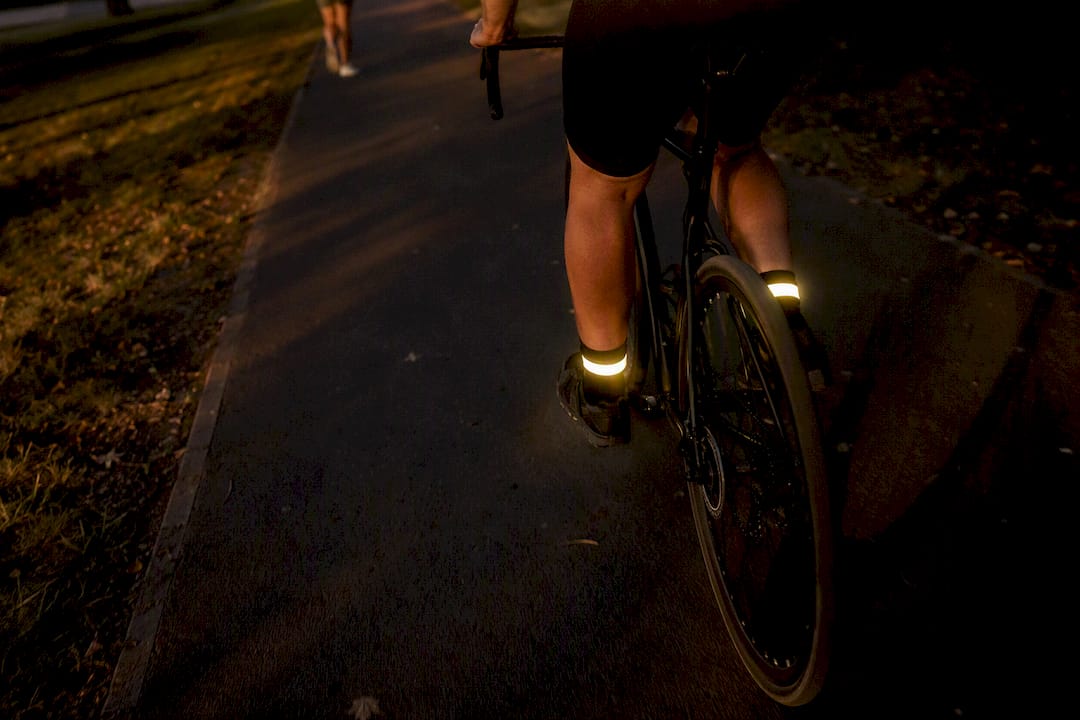
Beyond ankles, prioritize wheel-mounted reflectors and frame-level reflective strips for side visibility at intersections, where most car-versus-bike collisions actually happen. A Cochrane review of visibility aids found that retroreflective and fluorescent materials measurably improve detection distance, though it stops short of proving a direct injury reduction across populations.
Pro Tip: A large flat reflective panel beats thin piping every time, and check your setup with a loaded backpack or rack bag on. Cargo is the number one reason a compliant reflector becomes an invisible one.
Common Mistakes That Undo Your Setup
Small setup errors quietly cancel out good gear. Watch for these:
- A rear light aimed at the ground instead of level with traffic
- A pannier or jacket hem covering the rear reflector entirely
- Fluorescent-only clothing worn after dark, when retroreflective material is what actually works
- A flash-only front light used on an unlit road, where steady beam output matters more than blinking
- Cracked or missing spoke reflectors nobody notices until a police stop
What Does Compliant Gear Cost?
Basic compliance doesn’t require a big budget. Simple clip-on front and rear lights with reflectors run roughly €15 to €40 in most European markets. Midrange combo kits, pairing a brighter front light with a rechargeable rear light and certified reflective accessories, land between €40 and €100. Premium setups, including integrated helmet lighting and connected accessories like FRAME FLASH reflectors, typically fall in the €80 to €200+ range depending on features.
The cheapest option on a shelf rarely carries an EN certification. Prioritize your rear light and reflector quality first, since that’s where drivers approach fastest and have the least time to react.
Your Two-Minute Pre-Ride Check
Run this before every ride once daylight starts fading:
- Turn on front and rear lights, then walk ten steps back to confirm both are visible
- Check reflectors and ankle bands for cracks or obstruction
- Confirm battery charge and pack a spare or charger if it’s marginal
- Make sure helmet and jacket reflective panels aren’t covered by a hood or bag strap
Pro Tip: Keep a spare battery or a small power bank in your saddlebag permanently. The ride you forget to charge lights for is always the one that runs late.
What the Research Actually Shows
The evidence is strongest on detection, weaker on injury outcomes. A Cochrane review confirmed fluorescent materials improve daytime detection and that lamps, flashing lights, and retroreflective materials improve detection at night. Separately, research on permanent running lights associates their use with lower multi-party crash rates, and a 2025 lighting study proposes adding vertical illuminance standards to EN 13201 specifically to improve cyclist detection at conflict zones like intersections.
Detection studies consistently show cyclists become visible sooner and from farther away when wearing fluorescent or retroreflective gear. What remains harder to prove directly is how much that earlier detection translates into fewer serious injuries across an entire riding population, since real-world crash data involves too many variables to isolate lighting alone.
Why Compliance Alone Isn’t the Same as Safety
Meeting the legal minimum and actually being seen are two different bars, and conflating them is where a lot of well-meaning riders go wrong. A reflector that technically satisfies the law can still sit at an angle no driver ever catches. Real conspicuity comes from redundancy: light plus reflector plus biomotion plus garment, layered so that if one element fails or gets obscured, another still works. THE BEAM builds toward that redundancy on purpose, treating certified reflective area and tested mounting as the baseline, not the ceiling.
Get Gear Built Around These Standards
Reading the standards is one thing. Riding with gear that actually meets them, night after night, is another. THE BEAM designs around exactly the requirements covered above: certified reflective area, tested mounting angles, and lighting that holds up on unlit roads, not just in a product photo.
The FRAME FLASH reflector system gives you certified retroreflective coverage in a low-profile mount that won’t get buried under a jacket hem or pannier strap, solving the exact obstruction problem that causes most compliance failures. Pair it with the VIRGO helmet’s integrated visibility features for a setup that covers front, rear, and side recognition at once. Check the FRAME FLASH product page for current specs and pricing, and outfit your bike before your next dusk ride.
Sources
- The Science of Being Seen: A Guide to Safer Riding | Bicycling
- Traffic rules and regulations for cyclists and their vehicles
- Visibility aids for pedestrians and cyclists (Cochrane Review) | The Cochrane Library
- Study proposing vertical illuminance additions to EN 13201 (2025)
- Lightingresearchgroup
This article is general information, not a substitute for advice from a qualified lawyer. Consult a qualified legal professional about your own circumstances before acting on anything here.


