

TL;DR:
- E-bike injuries have increased sharply due to higher speeds, weight, and rider behavior.
- Preventable accidents often result from loss of control, intersection crashes, and poor road conditions.
- Proper training, safety gear, maintenance, and awareness significantly reduce e-bike risks.
E-bike injuries and fatalities have risen sharply in both the U.S. and Europe, leaving riders caught between excitement and uncertainty. Are e-bikes genuinely dangerous, or is the risk misunderstood? The honest answer is both. E-bikes introduce real new hazards rooted in speed, weight, and rider behavior, but most accidents are preventable with the right knowledge and gear. This guide breaks down the actual statistics, clarifies what makes e-bikes mechanically unique, covers the most common crash causes, and walks you through the equipment that genuinely reduces your risk out on the road.
Table of Contents
- Why e-bike safety matters: key statistics and risk factors
- What makes e-bike safety different from regular biking?
- The top causes of e-bike accidents and how to prevent them
- Essential gear and infrastructure for e-bike safety
- Our take: the uncomfortable truths (and overlooked wins) of e-bike safety
- Upgrade your ride’s safety with quality gear from The Beam
- Frequently asked questions
Key Takeaways
| Point | Details |
|---|---|
| E-bike risks are unique | Speed, weight, and electronic systems require new safety habits and skills. |
| Most accidents are preventable | Routine checks, defensive riding, and proper gear greatly reduce your chance of injury. |
| Certified gear is essential | Certified helmets and batteries significantly enhance your protection and reduce fire risk. |
| Infrastructure impacts safety | Well-designed bike paths and protected lanes lead to safer e-bike experiences for all. |
Why e-bike safety matters: key statistics and risk factors
E-bike adoption has exploded across the U.S. and Europe, but the safety conversation hasn’t kept pace. The numbers deserve attention. US e-bike fatalities reached 91 in 2022, while some European markets recorded post-pandemic injury increases of up to 400%. Those are not abstract figures. They represent real riders who, in many cases, weren’t aware of the specific risks their bikes introduced.
| Region | Trend | Key risk group |
|---|---|---|
| United States | Fatalities up year over year since 2020 | Adults 55+, delivery riders |
| European Union | Injuries up to 400% post-pandemic | Youth under 18, urban commuters |
| Urban areas globally | Highest crash density | All e-bike users in mixed traffic |
The causes behind these numbers matter as much as the numbers themselves. The rise in e-bike injuries has been linked to factors like unfamiliar handling, unexpected acceleration, and inadequate protective gear. E-bikes are also 3.5 times more likely to cause serious injury than regular bikes per crash, largely because of impact speed.
Common causes of e-bike crashes include:
- Loss of control due to unexpected motor-assisted acceleration
- Collisions at intersections where speed is underestimated by both rider and driver
- Poor road surfaces hitting harder at higher speeds
- Riding under the influence of alcohol or without proper training
- Inadequate or missing helmet use
Here’s the important counterpoint: e-bikes are not inherently more dangerous than regular bikes per mile traveled. The risk spikes when riders treat them as though they’re identical to conventional bicycles. Youth and seniors face compounded risk because reaction times, physical strength, and risk judgment differ significantly across age groups. A teenager on a 28 mph e-bike faces very different physics than an adult on a 12 mph pedal bike. The good news is that safety tips for e-bike riders can meaningfully close the gap between risk and reality.
“E-bikes are not the problem. The gap between what riders expect and what the bike actually does is the problem.”
What makes e-bike safety different from regular biking?
Understanding the scope of the risk means understanding what makes e-bikes mechanically distinct. It isn’t just about going faster. It’s about how the entire system behaves under different conditions.
Speed and acceleration are the most obvious differences. A Class 3 e-bike can reach 28 mph with pedal assist, nearly double what most recreational cyclists achieve. That extra speed compresses your reaction time dramatically. What feels like a comfortable gap on a regular bike may be dangerously small on an e-bike.
Weight is the factor most riders underestimate. A typical e-bike weighs between 40 and 70 pounds, compared to 15 to 25 pounds for a standard road bike. That mass increases stopping distances and changes how the bike handles in turns. Braking at the last moment, as many regular cyclists do habitually, becomes genuinely risky.
| Feature | Regular bike | E-bike |
|---|---|---|
| Average weight | 15 to 25 lbs | 40 to 70 lbs |
| Top assisted speed | 12 to 15 mph | Up to 28 mph |
| Stopping distance (at speed) | Shorter | Significantly longer |
| Battery/motor risks | None | Fire, electrical faults |
E-bikes require specific training to account for weight and speed differences that conventional cycling simply doesn’t prepare you for. This is especially true for youth and seniors, who are often the most enthusiastic adopters but the least prepared for the physics involved.
Motor and battery safety are their own category. Choosing safe batteries and chargers is critical because low-quality lithium batteries can overheat or catch fire, particularly during charging. Electrical faults also affect braking response in ways a mechanical failure on a regular bike wouldn’t.
The right helmet tech and smart features matter more on an e-bike than on a standard bicycle, and so do safety accessories for e-bikes like mirrors and reflectors that expand your awareness at speed.
Pro Tip: If you’re choosing between hub-drive and mid-drive motors, mid-drive motors place weight lower and more centrally, which gives you noticeably better handling and balance, especially on hills or tight urban corners.
The top causes of e-bike accidents and how to prevent them
Knowing what causes crashes gives you real leverage over your risk. Most e-bike accidents fall into a predictable set of categories, and most of them are preventable.
Top causes of e-bike accidents:
- Loss of control during acceleration or cornering
- Collisions with cars at intersections
- Poor road surfaces, particularly at higher speeds
- Riding at night without adequate lighting
- Riding under the influence of alcohol
- Mechanical failure from lack of maintenance
The single most effective prevention strategy is the pre-ride ABC(E) check, which stands for Air (tire pressure), Brakes, Chain and drivetrain, and Electronics/battery. Running through this takes under three minutes and catches the majority of mechanical issues before they become emergencies.
Pre-ride ABC(E) checklist:
- Air: Tires inflated to the correct PSI for your bike and rider weight
- Brakes: Both levers engage firmly and responsively; pads are not worn down
- Chain: Clean, lubricated, and not stretched
- Electronics: Battery charged, motor responding correctly, lights functional
Defensive riding is equally essential. Slow for road conditions, avoid distractions, and maintain a following distance that accounts for your bike’s longer stopping distance. E-bike accident statistics for e-bikes consistently show that rider behavior is the most controllable variable in crash outcomes.
For night and wet weather riding, your lighting setup and tire pressure become critical. Front and rear lights with at least 150 lumens front and a flashing rear mode significantly improve your visibility to drivers. Reduce tire pressure slightly in rain for better grip.
Also check your urban commuter safety tips for environment-specific strategies, and make sure you’ve nailed fitting your helmet correctly before any ride, since a poorly fitted helmet offers far less protection than the rating implies.
Pro Tip: On an e-bike, start braking earlier than you think you need to, and never apply full power mid-corner. The combination of weight and speed in a turn is where most control losses happen.
Essential gear and infrastructure for e-bike safety
Beyond behavior, your physical setup determines how well you survive if something does go wrong. The right gear and the right environment work together.
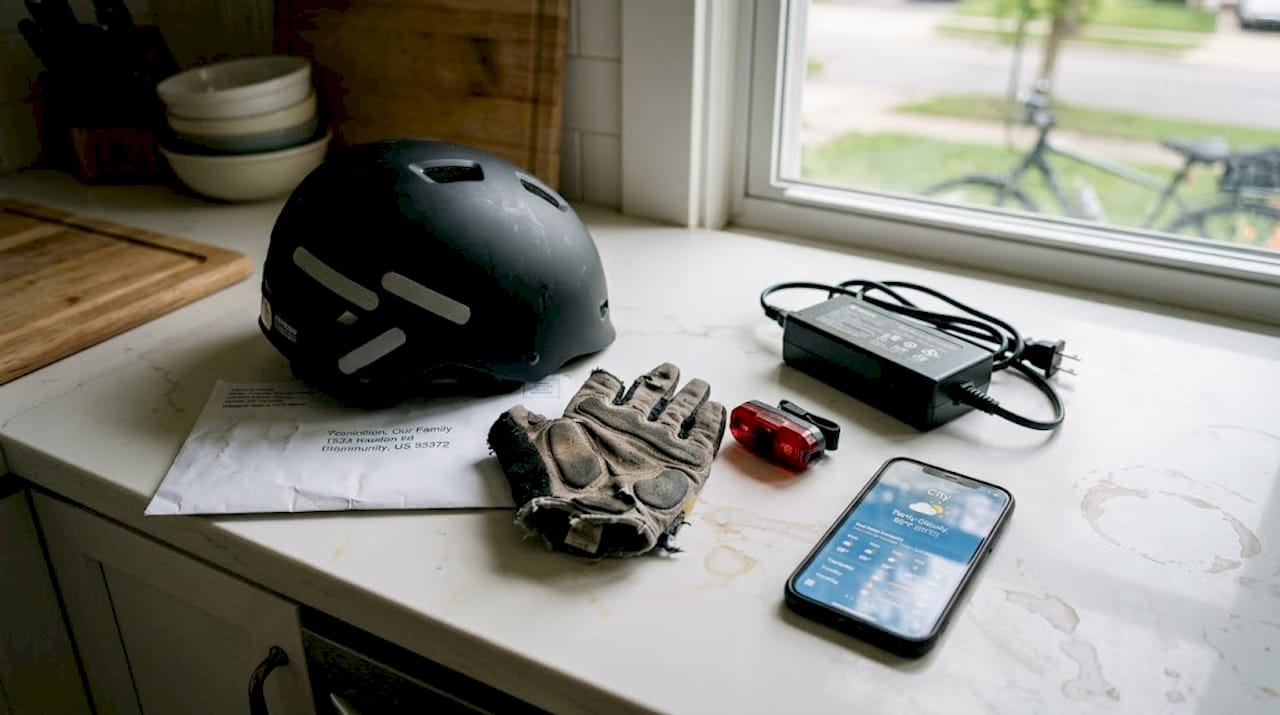
Helmet requirements vary by region and age, but the baseline is always a certified helmet worn correctly. In the U.S., CPSC certification is the legal minimum; in Europe, EN 1078 applies for standard cycling helmets. For e-bikes specifically, NTA 8776 (Netherlands) and EN 13687 offer better impact performance at higher speeds. Kids should always wear helmets regardless of local laws, and helmets should be replaced after any significant impact, even if they look fine.
Better infrastructure and protective gear are both proven to reduce e-bike risks. You can’t always control infrastructure, but you can choose routes with dedicated bike lanes and avoid high-traffic roads when alternatives exist.
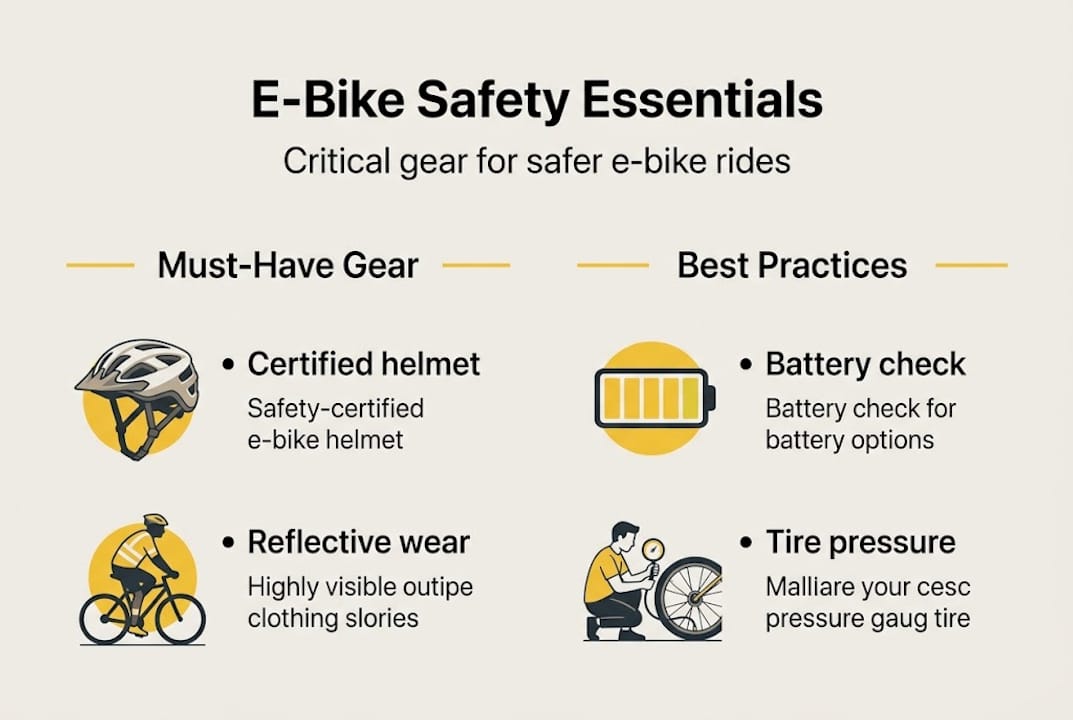
Essential e-bike safety gear checklist:
- Certified helmet (speed-rated for e-bikes where possible)
- Front white light (150+ lumens) and rear red light (flashing mode)
- High-visibility reflective vest or jacket
- Gloves for grip and hand protection
- Rear-view mirror for situational awareness
- Padded cycling shorts for comfort on longer rides
Battery safety practices deserve their own call-out. Only use batteries and chargers that meet UL 2849 (U.S.) or EN 15194 (EU) certification. Never charge overnight without supervision, and store batteries away from flammable materials. These steps alone cut fire risk dramatically.
For choosing e-bike helmet tech that genuinely improves safety, look for MIPS (Multi-directional Impact Protection System) technology, integrated lighting, and aerodynamic designs that perform at higher speeds. To optimize ride protection fully, combine your helmet with high-visibility accessories that function in both day and low-light conditions.
Pro Tip: Reflective elements that wrap around the sides of your bike or bag are more effective than rear-only reflectors. Drivers approaching from an angle, which accounts for most intersection collisions, need to see you from the side first.
Our take: the uncomfortable truths (and overlooked wins) of e-bike safety
Here’s what most e-bike safety guides won’t tell you directly: the technology is not the main problem. Rider mindset is. The vast majority of e-bike incidents are preventable through training and attitude shifts, not through better engineering alone.
The most overlooked risk remains cheap, uncertified batteries and chargers. Even experienced, safety-conscious riders sometimes accept a lower-quality charger because it’s convenient or cheaper. That’s where fires start. It’s not a dramatic, high-speed crash. It’s a quiet decision made at the point of purchase.
Where genuine optimism is warranted: safety improves fastest when riders treat e-bikes as a new vehicle category rather than a faster bicycle. Riders who take that shift seriously, particularly parents buying innovative safety methods for e-bikes for their kids, and urban delivery services investing in proper training and gear, see measurable reductions in incidents. The win is available. It just requires honesty about what an e-bike actually is.
Upgrade your ride’s safety with quality gear from The Beam
Every insight in this guide points back to the same conclusion: the right equipment is your most reliable safety investment. Certified helmets, smart visibility gear, and quality accessories don’t eliminate risk, but they dramatically change outcomes when things go wrong.

At The Beam, we design helmets and safety accessories specifically built for the demands of e-bike riding: higher speeds, urban environments, and the need for all-day wearability. Whether you’re looking to shop certified e-bike helmets, find the right fit from our kids’ helmets collection, or explore everything we offer, you can see all safety products and find gear that matches your riding life.
Frequently asked questions
Is riding an e-bike more dangerous than a regular bicycle?
E-bikes are not inherently more dangerous than regular bikes, but higher speeds and weight demand better skills, more situational awareness, and appropriate protective gear.
What are the most important e-bike safety checks before riding?
Run the ABC(E) pre-ride check: verify tire pressure, test brakes, inspect the chain, and confirm your battery and electronics are functioning before every ride.
What type of helmet should e-bike riders choose?
Certified helmets with advanced features like MIPS technology and speed-rated impact protection give e-bike riders significantly better coverage than standard cycling helmets.
Are battery fires a real concern for e-bike riders?
Battery fires are rare but serious; always use certified parts that meet UL 2849 or EN 15194 standards and never leave batteries charging unattended overnight.
Why are youth and urban delivery riders at higher risk?
Youth injuries are rising due to limited training and risk judgment, while delivery riders face compounded pressure from speed, traffic density, and long daily hours on the bike.


