

Optical clarity in a helmet visor determines how fast you spot a pothole, a merging car, or a deer at dusk. A visor is not just a windshield; it is the lens your eyes depend on for contrast, depth judgment, and glare control at speed, and a distorted or hazy one slows down every one of those functions before your brain even registers a problem.
Here’s what that means in practice: clarity issues degrade contrast sensitivity (your ability to distinguish an object from its background), stereopsis (depth perception from both eyes working together), and how your eyes handle oncoming light. All three shrink your reaction window.
Three things to check right now:
- Hold your visor up to a bright light and look for starbursts, haze, or micro-scratches across the field of view.
- Switch to a clear (not tinted or photochromic) visor before any ride after sunset.
- Rinse the visor with water before wiping it down, every time, to avoid grinding grit into the coating.
The sections below walk through the science, the materials, and the maintenance habits that keep your vision sharp on every ride.
Key Takeaways
Optical clarity determines how fast a rider detects hazards because it directly governs contrast sensitivity, depth perception, and glare tolerance at speed.
| Point | Details |
|---|---|
| Clarity is a safety spec | Contrast sensitivity and stereopsis studies show measurable declines tied to visor curvature and defects. |
| Night riding needs a clear visor | Starbursts from micro-scratches worsen dramatically under modern LED headlights. |
| Cleaning habits matter more than price | Rinse before wiping and avoid solvents to slow micro-scratch buildup and extend visor life. |
| Check specs, not just impact ratings | Look for stated light transmission percentages and optical tolerance before buying. |
| Thebeamofficial prioritizes verifiable optics | The VIRGO helmet line and its visor add-ons are built around documented optical performance, not just impact numbers. |
Standards and resources worth checking
- ECE rules: set minimum light transmission and tint labeling requirements for road-legal visors, detailed in this visor guide.
- BSI specification: covers technical test methods for visor optical performance, via BSI Knowledge.
- TÜV SÜD: explains ECE homologation and certification processes for market access, outlined at TÜV SÜD.
Use these when a spec sheet feels vague. If a listing can’t point to a transmission percentage or a certification standard, that gap is the answer.
Table of Contents
- What Does Optical Clarity Actually Mean on a Visor?
- How Does Poor Visor Clarity Change What You See and How You React?
- Which Visor Materials and Coatings Affect Clarity the Most?
- What Anti-Fog and Weather Systems Actually Work?
- How Should You Clean and When Should You Replace a Visor?
- What Should You Check Before Buying a New Visor?
- What Does the Research Actually Show About Visors and Vision?
- Sources
What Does Optical Clarity Actually Mean on a Visor?
Optical clarity is not one property. It is a bundle of measurable traits that determine whether the world looks normal through your visor or subtly warped.
Light transmission is the percentage of visible light that passes through the shell; clear visors typically deliver 85 to 95 percent transmission, while tinted versions cut that down for daytime glare control. Haze is scattered light from a hazy or pitted surface that washes out contrast, similar to looking through a dirty windshield. Prism and astigmatism describe how a visor bends light unevenly, often from curvature or manufacturing flaws, which can make straight lines appear to bow. Micro-scratches and coating delamination are surface defects that scatter or diffract light rather than letting it pass cleanly.
Here’s how each one actually shows up mid-ride:
- Haze: a general dulling of contrast, worse in flat overcast light or rain.
- Prism/astigmatism: mild but constant blur or a sense that objects at the edge of your vision are slightly stretched.
- Micro-scratches: sharp starburst flares around headlights and streetlights at night.
- Delamination: peeling or cloudy patches that get worse with every cleaning.
How Does Poor Visor Clarity Change What You See and How You React?
The chain runs straight from optics to outcomes: a defect in the visor reduces contrast or depth cues, that reduction slows the time it takes your brain to recognize a hazard, and slower recognition means less room to brake or swerve.
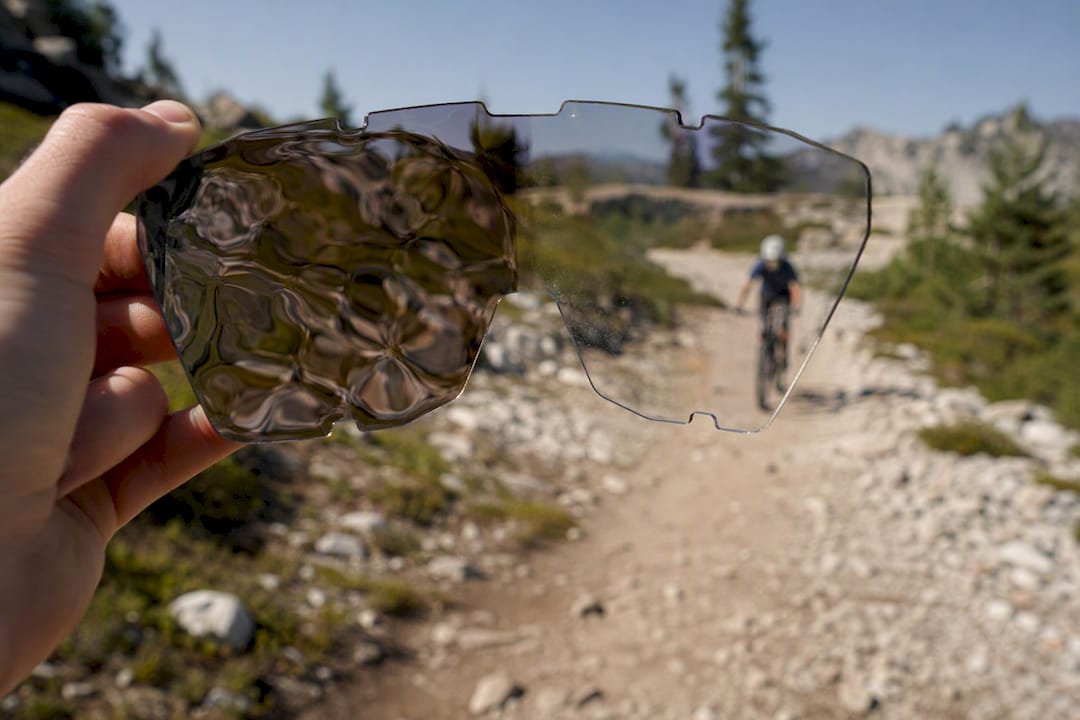
A peer-reviewed study measured drops in stereopsis, along with contrast sensitivity changes, in riders wearing full-face and half-face helmets. Researchers pointed to visor curvature and manufacturing-induced astigmatism as likely contributors, meaning the defect can be baked into a visor from the factory rather than caused only by wear over time, according to the study on helmet effects on functional vision.
The mechanisms that hurt you most:
- Starburst and point-source glare from oncoming headlights, worse with any scratch or pit on the surface.
- Contrast loss in wet or low-light conditions, where hazard edges already blend into the background.
- Reduced stereopsis from prismatic or curvature errors, which flattens your sense of how far away that car actually is.
Research note: the stereopsis and contrast findings come from controlled testing, which is strong evidence the effect is real. Sample sizes and riding conditions vary study to study, so treat the direction of the effect (clarity down, reaction time up) as solid, and the exact magnitude as still being refined.
Which Visor Materials and Coatings Affect Clarity the Most?
Almost every clear visor on the market starts as optical-grade polycarbonate, chosen because it is light, impact-resistant, and can be molded to a precise curvature. What separates a good visor from a mediocre one is what gets applied on top of that base material.
- Anti-scratch (hardcoat) layers extend surface life but can worsen starburst effects once the coating itself gets nicked, since the hard layer fractures rather than flexes.
- Anti-fog coatings and hydrophobic treatments manage moisture, though standalone chemical coatings tend to wear off faster than a laminated system.
- Anti-reflective coatings cut internal glare bounce, useful for night riding.
- Photochromic tints adjust to light automatically but interact directly with legal transmission limits, since ECE rules restrict how dark a visor can go and still be street-legal.
| Material/Coating | Clarity Impact | Durability | Typical Availability |
|---|---|---|---|
| Optical-grade polycarbonate (base) | Baseline clarity, depends on molding precision | High if undamaged | Standard on OEM and aftermarket visors |
| Anti-scratch hardcoat | Improves clarity longevity | Moderate; fractures on impact | Common on mid to premium visors |
| Anti-fog/hydrophobic coating | Maintains clarity in moisture | Lower; wears with cleaning | Aftermarket sprays or factory-applied |
| Anti-reflective coating | Reduces glare, aids night clarity | Moderate | Less common, usually premium tier |
| Photochromic tint | Variable transmission, legal limits apply | High | Growing aftermarket segment |
ECE rules set minimum light transmission thresholds and labeling requirements for tinted and photochromic visors, so a photochromic option needs to be checked against those limits before you count on it for night riding. When shopping OEM versus aftermarket, ask the seller directly what transmission percentage and optical tolerance the visor is rated for. Vague answers are a warning sign in themselves.
What Anti-Fog and Weather Systems Actually Work?
Fog is an optical clarity problem with a moisture cause, and the fix depends on how you ride.
- Pinlock inserts: a second, sealed lens that traps a pocket of air, the standard for commuters riding in cold or wet conditions.
- Dual-pane visors: built-in double-glazing effect, similar logic to Pinlock but integrated into the shell.
- Chemical anti-fog coatings: sprays or wipe-on treatments, useful as a backup but shorter-lived than a mechanical insert.
- Ventilation and breath management: chin vents and breath deflectors reduce moisture buildup at the source, which pairs well with any of the above.
- Hydrophobic coatings: bead rainwater off the outer surface so it doesn’t sheet across your line of sight.
Commuters in cold, wet climates get the most benefit from a Pinlock-equipped visor. Long daytime touring riders often do fine with ventilation alone. Night riders should prioritize whichever system keeps the outer surface distortion-free, since fog and glare compound each other after dark. Read more on helmet anti-fog features and how ventilation design factors into fog control.
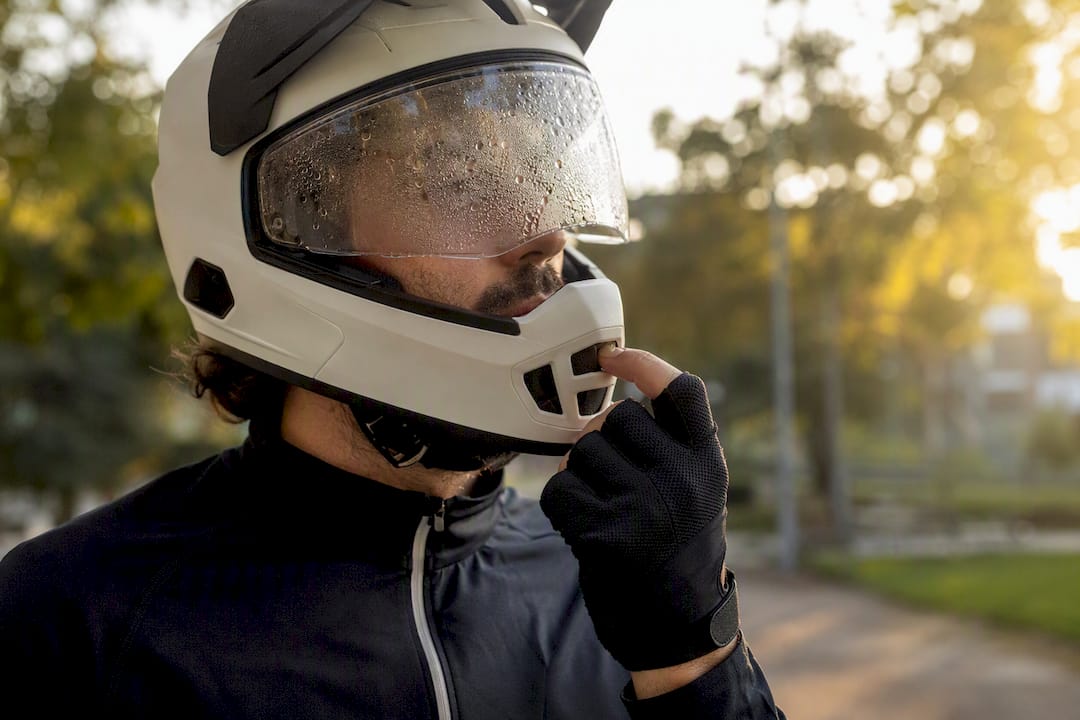
Pro Tip: Pair a Pinlock insert with an open chin vent rather than sealing everything shut. A fogged visor with good airflow clears faster than a sealed one, even with anti-fog coating applied.
How Should You Clean and When Should You Replace a Visor?
A wrong cleaning habit does more damage than months of normal riding. Here’s the routine that actually protects clarity:
- Rinse the visor under running water first to flush off grit and bugs.
- Wash with a dedicated visor cleaner or mild soap, never household glass cleaner or solvents.
- Wipe with a soft microfiber cloth, using light pressure only.
- Pat dry instead of dragging a cloth across the dry surface.
Simple behavior changes like rinsing before wiping reduce micro-scratch accumulation and meaningfully extend usable visor life, according to research on visor starburst causes.
Avoid: ammonia-based cleaners, paper towels, dry-wiping dust off before a ride, and storing the helmet visor-down where it rests on a hard surface.
Replace the visor when you notice:
- Persistent starbursts around lights that don’t clean off.
- Visible crazing (fine web-like cracks) or coating delamination.
- Warping that distorts straight lines.
- Heavy daily riders should expect to replace a visor more often than someone riding a few times a month, since scratch accumulation is a function of use, not just calendar age.
Modern LED headlights make this more urgent than it used to be. Their concentrated, blue-shifted beams diffract far more sharply off a scratched surface than older halogen bulbs did, so damage that was once cosmetic is now a real night hazard.
What Should You Check Before Buying a New Visor?
A few questions separate a visor that protects your vision from one that quietly degrades it:
- What is the certified light transmission percentage, and does it meet ECE or your regional standard?
- Does the spec sheet mention optical distortion or prism tolerance at all, or just impact ratings?
- Is there a documented warranty or straightforward replacement path if the coating fails early?
- Does it come with anti-fog options built in, or will you need an aftermarket Pinlock insert?
- Is it confirmed compatible with your specific helmet model, not just “universal fit”?
Red flags worth walking away from: no stated optical tolerance anywhere in the listing, zero mention of anti-scratch or hardcoat treatment, no replacement visors sold separately, or a seller who tells you dry-wiping is fine for daily care. Any one of those suggests the manufacturer didn’t prioritize the optics, only the shape.
What Does the Research Actually Show About Visors and Vision?
The clearest signal comes from controlled testing on stereopsis and contrast sensitivity, not marketing copy. Riders showed measurable stereopsis reductions while wearing full-face and half-face helmets, with visor curvature flagged as a contributing factor rather than a side issue, per the study on helmet visual effects.
Separately, testing in other visor-heavy sports found that standards vary widely in their optical tolerance windows, and dual-certified products tend to deliver better real-world comfort, according to research on optical quality in sports visors.
Beyond visible blur, even a small prism imbalance or curvature defect forces your eye muscles to compensate continuously. That invisible strain builds into headaches and visual fatigue over a long ride, often before a rider consciously notices anything looks distorted.
What this means for you:
- Favor visors with documented optical tolerance specs over ones sold purely on impact rating.
- Flatter, less aggressively curved visor geometry tends to introduce fewer prismatic errors.
- Treat eye strain on long rides as a possible visor issue, not just fatigue from the road.
A quick note from Sophie
Researching helmet visor specs taught me that riders obsess over impact ratings and skip optical tolerance entirely. One habit fixes most of it: rinse before you wipe, and swap the visor the moment starbursts show up.
Where to find visors built for clear vision
You’ve seen how much rides on a clean, distortion-free lens between your eyes and the road. Thebeamofficial builds the VIRGO helmet and its visor options around that same priority: optical performance you can actually verify, not just impact numbers on a spec sheet. If you’re due for a replacement visor or want to pair your helmet with a proper anti-fog insert, browse the adults’ helmets collection or check the helmet add-ons page for compatible visors and maintenance accessories, and pick the setup that matches how and when you actually ride.
Sources
- Effect of Full-Face and Half-Face Helmet on Functional Vision and Visual Reaction Time
- Guide to motorcycle helmet visors
- Why Do I See ‘Starbursts’ at Night? (Visor Micro-Scratches Explained) - Revv Rider
- How Optical Quality Impacts Performance When Choosing an Ice Hockey Visor - GY Optical
- ECE vehicle certification - TÜV SÜD


