

Don’t ride in a vehicle’s blind spot. Take the lane, hang well back, or move clearly ahead of the vehicle, and never sit alongside a truck or bus at a light. That single habit prevents most blind-spot crashes before they start.
Run through this before your next ride:
- Never pass a heavy vehicle on the right, even in a bike lane.
- Make eye contact with the driver through their mirror before you move.
- Stay about one meter clear of parked cars to dodge an opening door, as road-safety guidance recommends.
- At red lights, stop well behind trucks and buses, not beside them.
- Run lights and reflectors day and night, and check your helmet fit before rolling out.
A peer-reviewed injury-epidemiology study found that a large share of urban cyclist deaths happen at intersections, with heavy vehicles overrepresented in fatal crashes. Memorize the short version: if you can’t see the driver’s eyes, they can’t see you.
Key Takeaways
Blind-spot crashes are preventable when riders combine lane positioning, eye contact, and visibility gear instead of relying on any single tactic alone.
| Point | Details |
|---|---|
| Never flank heavy vehicles | Stay well behind or clearly ahead of trucks and buses at lights and junctions. |
| Keep one meter from parked cars | This distance reduces dooring risk according to French road-safety guidance. |
| Read wheel angle and sound | Front wheel movement and air-brake release warn of a turn before signals do. |
| Layer visibility gear | Lights, lateral reflectors, and a mirror extend awareness beyond positioning alone. |
| Equip for protection and detection | Thebeamofficial’s VIRGO MIPS helmet, FRAME FLASH reflectors, and mirrors support the tactics above without replacing them. |
Table of Contents
- What Is Angle Mort Cycliste and Why It’s So Dangerous
- Where Blind-Spot Collisions Happen Most in Cities
- What the Law Says About Blind Spots and Cyclist Distance
- How to Position Yourself at Lights and Junctions
- Gear and Habits That Cut Blind-Spot Risk
- Sharing the Road With Trucks and Buses
- Practical Kit We Recommend for Blind-Spot Safety
- Sources
What Is Angle Mort Cycliste and Why It’s So Dangerous
A blind spot, or angle mort, is the zone around a vehicle a driver can’t see, even checking mirrors. For cyclists, this “angle of danger” isn’t fixed. It grows with the vehicle’s width, and it expands further the instant a driver starts turning, merging, or pulling away from a stop.
That’s what makes an angle mort cycliste incident so hard to predict from the saddle. You might be visible one second and gone from view the next, simply because the vehicle changed angle. Paris municipal guidance puts it plainly: blind spots shift constantly, so a mirror check that worked five seconds ago tells you nothing about right now.
- Blind spots widen with vehicle size, so a box truck’s zone dwarfs a sedan’s.
- They expand mid-maneuver, meaning a stationary “safe” gap can vanish the moment the vehicle moves.
The takeaway is simple: if you can’t find the driver’s eyes in a mirror, assume you’re invisible to them.
Where Blind-Spot Collisions Happen Most in Cities
Most angle mort incidents cluster around a handful of predictable spots, and knowing them changes how you ride through the city.
- Heavy vehicles idling at red lights, especially when you’re beside the cab or trailer.
- Roundabouts, where vehicles pivot and their blind zone sweeps unpredictably.
- Intersections with right-turning cars or trucks that don’t see a cyclist going straight.
- Rows of parked cars, where a door can swing open with no warning (dooring).
- Advanced bike boxes positioned directly beside a truck’s flank.
Picture this: a truck stopped at a light starts moving, its trailer swings right on the turn, and a cyclist who tucked in beside it gets squeezed into the curb with zero room to escape. That single scenario accounts for a disproportionate share of fatal urban crashes involving heavy vehicles, according to the same injury-epidemiology research on cyclist safety-by-design.
What the Law Says About Blind Spots and Cyclist Distance
Since January 2021, every heavy vehicle over 3.5 tonnes in France must carry blind-spot warning stickers marking the zones where the driver can’t see you. Spot one on a truck or bus and treat that zone as off-limits, full stop.
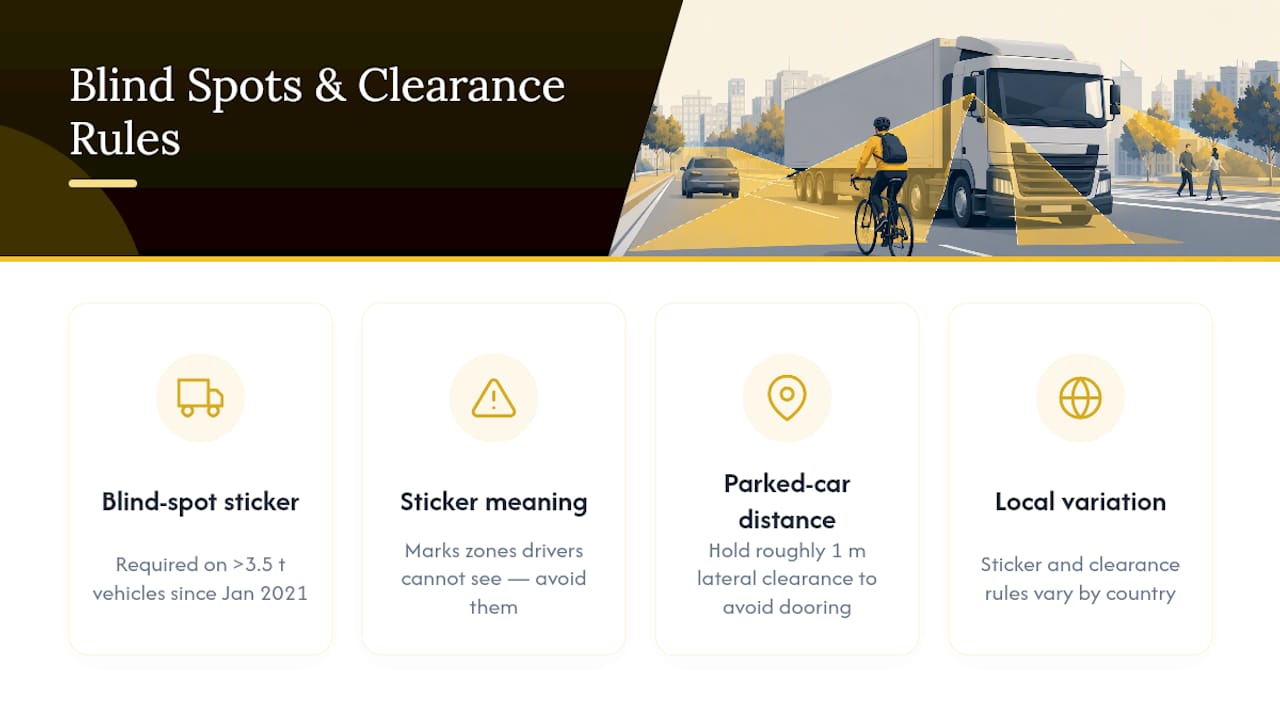
Official guidance also recommends cyclists hold roughly one meter of lateral clearance from parked cars to avoid dooring, a distance referenced in French road-safety materials. Rules on stickers and clearance distances vary by country, so check your own transport authority’s guidance if you ride outside France.
Pro Tip: Scan the rear and sides of trucks and buses for a yellow or orange blind-spot sticker before you position yourself near them. If you see one, it’s telling you exactly where not to be.
How to Position Yourself at Lights and Junctions
Riding defensively near traffic comes down to a repeatable sequence, not luck.
- Observe the vehicle’s wheel angle and body position as you approach.
- Choose your lane based on that read: take the full lane if there’s no safe gap, or use the bike lane only if it keeps you clearly visible.
- Signal your intention early with a hand gesture.
- Make eye contact with the driver, ideally through their mirror.
- Execute the move decisively once you’ve confirmed you’re seen.
Taking the lane beats hugging the curb whenever a bike lane would put you alongside a vehicle’s flank, especially near heavy traffic or a truck at a stop. A painted line doesn’t protect you if it channels you straight into a blind spot.
Some hard rules to keep in your head at every junction:
- Never pass a heavy vehicle on the right, moving or stopped.
- Never sit beside a truck’s cab or trailer at a red light.
- Never assume a driver has seen you just because you’ve seen them.
Experienced urban riders swear by two habits described by cycling advocacy groups: reading a truck’s front wheel angle before it turns, and listening for the hiss of air brakes releasing, which often signals a truck is about to move before any turn signal flashes.
Gear and Habits That Cut Blind-Spot Risk
Positioning is your first defense, but visibility gear closes the gap when a driver’s attention lags. European road-safety priorities point to certified helmets and active lighting as measures that meaningfully reduce injury severity and improve how easily other drivers spot you.
- Run front and rear lights every ride, day included, not just after dark.
- Add lateral reflectors so drivers catch movement from the side, not just head-on.
- Wear a properly fitted, MIPS-certified helmet for real head protection if a collision does happen.
- Mount a compact mirror to track traffic behind you without twisting your neck off your line.
- Check lights, reflectors, and mirror alignment before you clip in.
A wide-angle mirror, something in the 160-degree range, lets you monitor a following vehicle’s position continuously instead of guessing where it sits. That said, no sensor or mirror replaces the judgment call of taking the lane when the situation calls for it. Technology extends your awareness; it doesn’t do the thinking for you.
Sharing the Road With Trucks and Buses
Heavy vehicles deserve their own set of rules because their blind zones are bigger and their turning geometry is genuinely dangerous. A trailer’s rear wheels track inward on a turn, meaning the back of the vehicle can sweep into space a cyclist assumed was clear.
- Never pass a truck on the right, even for a few seconds at a light.
- At a stop, either hang back well behind the rear wheels or move clearly ahead of the cab, never alongside.
- Watch the front wheels for the first sign of a turn, and listen for air brakes releasing as an early warning that the vehicle is about to move.
- If you spot a blind-spot sticker, treat that entire marked zone as a no-go area.
Pro Tip: Treat every truck and bus as an exclusion zone by default. If there’s any doubt about whether the driver sees you, there isn’t room for you beside it.
Practical Kit We Recommend for Blind-Spot Safety
Good positioning cuts risk, and the right gear backs it up. THE BEAM’s VIRGO helmet with MIPS technology is built for real-world impact protection, so fit it snugly with the strap forming a V under your ears before every ride.
- VIRGO helmet (MIPS): adjust the retention dial until it’s snug without pressure points, and replace after any real impact.
- FRAME FLASH reflectors: mount them on the frame and fork angles facing sideways, where headlights catch you from a driver’s blind quarter.
- Rear-view mirrors: angle the mirror so you see the lane behind without turning your head more than a few degrees.
Gear like this supports the tactics above. It doesn’t replace them. Positioning still comes first.
A note from the road
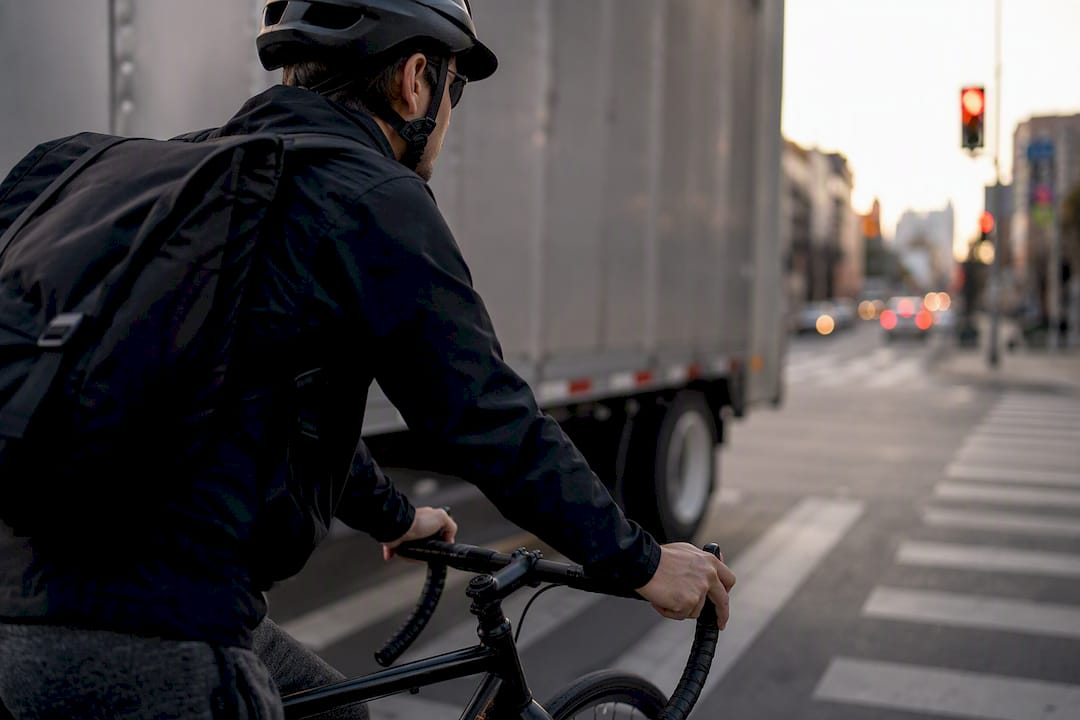
I’ve caught myself easing off the pedals at a light, watching a truck’s front wheel twitch right before it swings. That half-second read is what gets you to take the lane instead of hugging the curb.
How Thebeamofficial Fits Your Blind-Spot Strategy
The tactics above only work if drivers can actually see you and your head is protected when they don’t. Thebeamofficial builds specifically for that gap: the VIRGO helmet with MIPS technology absorbs rotational impact forces that a standard helmet doesn’t address, and FRAME FLASH reflectors light up your sides exactly where a vehicle’s blind spot lives.
If you commute through intersections and roundabouts daily, pairing a mirror with FRAME FLASH reflectors closes the visibility gap that positioning alone can’t fix. Browse the full product lineup to see official photos and find the setup that matches how you ride, then check sizing before your next commute.
Sources
- Signalisation des angles morts des véhicules | Centre-Val de Loire (service public)
- Legifrance — legal reference (door safety guidance cited by road-safety authorities)
- Safe system approach to preventing cyclist fatalities: safety by design for urban and rural environments — Injury Epidemiology
- How to ride a bike safely in Paris — Paris municipal guidance


