

TL;DR:
- Misinformation about cycling safety leads to dangerous habits and underestimated risks for riders. Wearing helmets at all speeds, choosing protection based on crash data, and understanding terrain-specific tire performance are crucial for safety. Recognizing psychological biases and continually reviewing gear and habits prevent complacency and improve urban cycling safety.
Misinformation about cycling safety is more dangerous than most riders realize. When you believe a myth, you don’t just make one bad decision: you build an entire set of habits around it. You might skip your helmet for a quick errand, choose the wrong gear for your commute, or feel calm in situations that actually put you at serious risk. This article cuts through five of the most persistent cycling safety myths, backs each one with real research, and gives you practical, evidence-based steps to ride with confidence. Whether you’re commuting daily or logging weekend miles, the truth matters.
Table of Contents
- Myth 1: Helmets aren’t necessary unless riding at high speed
- Myth 2: All bike helmets protect equally
- Myth 3: Wider tires are always slower
- Myth 4: E-bikes are just like regular bikes when it comes to safety
- Myth 5: Urban cycling feels safe, so it must be safe
- Our unique take: how to actually ride safer, beyond the myths
- Safer cycling starts with the right gear
- Frequently asked questions
Key Takeaways
| Point | Details |
|---|---|
| Helmet use matters | Wearing any helmet dramatically cuts your risk of serious head and facial injury in a crash. |
| Quality helmets vary | Choosing advanced or lab-tested helmets can offer extra protection over basic ones. |
| Context impacts tire choice | Wider tires may actually boost safety and speed on rougher roads or surfaces. |
| E-bikes need special care | Their speed and weight require better brakes and heightened attention for safe riding. |
| Perception isn’t reality | Feeling safe in city traffic doesn’t always mean actual risk is gone, so stay alert. |
Myth 1: Helmets aren’t necessary unless riding at high speed
This is probably the most dangerous cycling myth in circulation. The reasoning sounds logical at first: if you’re just rolling slowly through a neighborhood or hopping between stops on a city commute, a crash won’t hurt that badly. The problem is that most serious cycling injuries don’t happen at racing speeds. They happen at ordinary, everyday speeds on ordinary roads.
The research is clear. Helmet use dramatically reduces the risk of head and facial injuries for cyclists in crashes, including collisions involving motor vehicles. The protective effect isn’t reserved for downhill sprinters or criterium racers. It applies to anyone on a bike, at any speed, in any setting.
Here’s why speed doesn’t define risk the way most people assume:
- Low-speed falls are common. Slipping on wet pavement, hitting a curb, or catching a foot on a pedal all happen at low speeds and still send your head toward hard ground.
- Urban obstacles are unpredictable. Potholes, tram tracks, sudden car door openings and pedestrians stepping off curbs create crash scenarios with almost no warning.
- Head injuries don’t scale linearly with speed. The angle of impact, the surface you hit, and how your head rotates all influence injury severity more than your riding speed alone.
- E-bike commuters often exceed 20 mph without realizing it. What feels like a casual ride can involve speeds where an unprotected head impact becomes very serious.
Understanding the full picture of cycling safety concepts means recognizing that helmet use is a baseline, not an upgrade for serious riders only.
Pro Tip: When selecting a helmet, look beyond the basic certification sticker. Seek out helmets with lab-tested advanced protection features like MIPS (Multi-directional Impact Protection System), which is designed to reduce rotational forces during oblique impacts. That’s the kind of crash urban riders actually experience most often.
Myth 2: All bike helmets protect equally
Once riders accept that helmets matter, many fall into the next trap: assuming any certified helmet offers the same level of protection. Certification is a floor, not a ceiling. Two helmets can both pass the same standard and still perform very differently in a real crash.
A 2025 lab study published in Scientific Reports found that air-filled helmets reduced linear brain-injury risk compared to EPS (expanded polystyrene) foam helmets in oblique impacts, reporting approximately a 44% reduction in overall linear risk versus the best-performing foam helmet tested. That’s a significant gap between two helmets that might both carry the same certification mark.
Here’s what drives the difference in protection:
- Foam density and construction vary widely across price points and brands, affecting how well energy is absorbed.
- Oblique impacts are the most common crash type in real-world cycling, yet many certifications focus primarily on direct, linear impacts.
- Fit and retention systems affect whether the helmet stays in the correct position during a crash. A loose helmet can shift on impact, exposing unprotected areas.
- Ventilation cutouts make helmets lighter and cooler but also reduce the area of protective material between your skull and the ground.
| Helmet type | Linear impact performance | Oblique impact performance | Weight | Ventilation |
|---|---|---|---|---|
| Standard EPS foam | Baseline | Variable | Light to medium | High |
| MIPS-equipped EPS foam | Moderate improvement | Improved rotation management | Slightly heavier | Moderate to high |
| Air-filled design | Significant improvement | Notable reduction in brain-injury risk | Variable | Variable |
| Integral/full-face helmet | High | High | Heavier | Lower |
Choosing a helmet is one of the most consequential gear decisions you make as a cyclist. Reviewing the latest urban gear safety data can help you understand which features match your actual riding environment.
Pro Tip: When you’re upgrading your helmet, check whether the product has been tested against newer metrics like rotational acceleration thresholds, not just traditional linear impact benchmarks. Some brands publish these results directly. If they don’t, that tells you something too.
Myth 3: Wider tires are always slower
Cycling culture has carried the “skinny tires are faster” belief for decades. Road racers and time trial specialists built it into orthodoxy, and it stuck. But the reality is more nuanced than the conventional wisdom suggests, particularly for the conditions most everyday cyclists actually ride in.
On a perfectly smooth velodrome, narrow tires do minimize rolling resistance and aerodynamic drag. But most of us aren’t riding on velodromes. We’re riding on urban streets with cracks, rough patches, painted surfaces, and pavement that hasn’t been resurfaced since the 1990s. On rough and textured surfaces, wider tires can actually show lower rolling resistance than narrow ones because they deform less over each bump. Less vertical movement means less wasted energy.
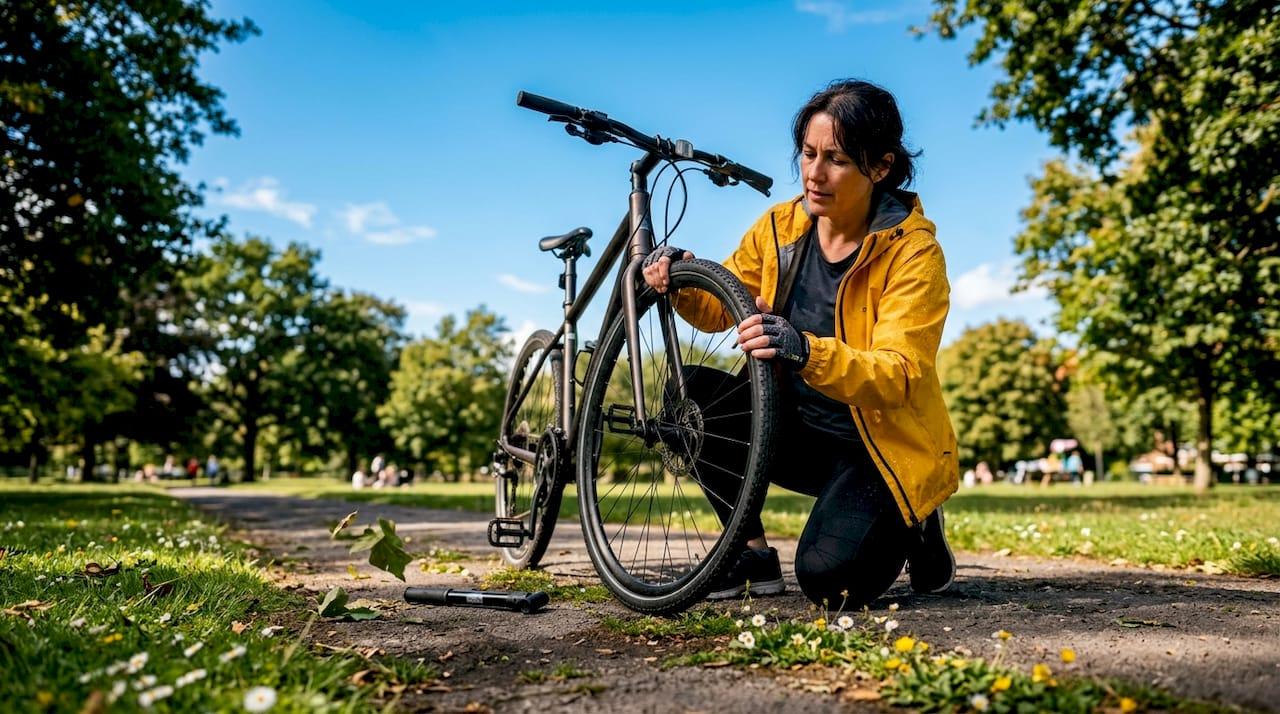
| Surface type | 23mm tire rolling resistance | 32mm tire rolling resistance | Practical result |
|---|---|---|---|
| Smooth pavement | Lower | Slightly higher | Narrow tire is marginally faster |
| Rough/cracked pavement | Higher | Lower | Wider tire conserves energy |
| Mixed urban surfaces | Variable | More consistent | Wider tire often wins overall |
| Gravel or compacted dirt | Much higher | Manageable | Wider tire is clearly faster |
Beyond speed, wider tires bring real safety advantages that narrow tires can’t match:
- Better grip in wet conditions. A wider contact patch increases traction when roads are slick.
- More confidence on uneven surfaces. Pothole absorption and road debris handling improve noticeably with a wider tire.
- Lower inflation pressure. Wider tires run at lower PSI, which improves comfort and reduces the chance of pinch flats on rough edges.
- Reduced vibration. Less fatigue over a long commute means better focus and reaction time toward the end of a ride.
Matching your tire choice to your actual terrain is a key part of the commuter cycling safety essentials mindset. Don’t default to what looks fast. Default to what works for your roads.
Myth 4: E-bikes are just like regular bikes when it comes to safety
E-bike adoption has accelerated dramatically over the past few years, and with that growth has come a wave of new riders who underestimate how different these machines are from conventional bicycles. The basic motion is similar: two wheels, pedaling, handlebar steering. But the physics are not the same.
E-bikes carry more mass and reach higher speeds, which fundamentally changes braking distance requirements and the level of attention needed to ride safely. A conventional bike weighing 20 pounds stops very differently than an e-bike weighing 55 to 70 pounds, especially when both are moving at 20 mph. The consequences of misjudging a gap or failing to anticipate a stop are magnified considerably.
Here are the safety practices every e-bike rider should build into their routine:
- Recalibrate your braking distance. Start braking earlier than you would on a traditional bike. Practice emergency stops in an empty parking lot so you understand your bike’s actual stopping distance at different speeds.
- Check your brakes regularly. The extra weight and speed put more stress on brake pads and hydraulic lines. Monthly inspections are a minimum. Weekly is better for daily commuters.
- Wear full protection. Many urban e-bike riders treat their ride like a leisurely pedal, but the speeds involved justify a higher level of head protection, including full-face or integral helmets for higher-assist classes.
- Be deliberate at intersections. E-bikes accelerate faster than most drivers expect. Assume you are less visible than you think, and don’t rely on eye contact with drivers to confirm they see you.
- Understand your assist modes. Switching from eco to turbo mode mid-ride without anticipating the extra torque has caused more than a few unexpected wobbles and close calls.
- Secure your battery and check connections. A loose battery can shift weight unexpectedly, and electrical faults are a real concern for e-bike fires in storage and during rides.
Improving your urban cycling security habits is especially important on an e-bike because the margin for error is smaller. More speed means less time to react.
Myth 5: Urban cycling feels safe, so it must be safe
This myth is subtler and more psychological than the others, but it may be the most widespread. After a close call with a car, many cyclists feel a wave of relief once it passes. That relief is real, but it can trick your brain into logging the situation as “handled” rather than “dangerous.” The near-miss becomes evidence that you’re okay, when it should be evidence that the situation was risky.
Research supports this concern. A Monash University study found that cyclists’ safety perception diverges from their actual exposure to risk on urban streets, even in controlled simulation environments. Cyclists consistently rated their situations as safer than objective risk measurements indicated. This isn’t a personal failing. It’s how human perception works under routine conditions. The danger fades because the outcome was fine.
Responsible cycling media has pushed back against the overconfident “cycling is completely safe” framing for good reason. Cycling isn’t inherently dangerous, but it isn’t risk-free either. Acknowledging that gap honestly is the foundation of genuine safety.
Practical steps to keep perception aligned with reality:
- Use rear visibility tools actively. A rear-view mirror or rear radar device keeps you aware of traffic approaching from behind, where perception typically fails fastest.
- Ride with high-visibility lighting day and night. Not just at dusk. Daytime running lights improve your detectability by drivers in a measurable way.
- Treat every intersection as an unknown. The most dangerous moments in urban cycling happen in the few seconds when multiple road users are negotiating space simultaneously.
- Review your recent rides mentally. If you had three close calls in a week and wrote them all off as fine, they are data points worth addressing.
Understanding why cycling safety matters in practical terms, not just theoretical ones, changes how you interact with every ride.
Our unique take: how to actually ride safer, beyond the myths
Here’s what years of working with cyclists across disciplines have taught us: most riders think safety is a gear problem. Get the right helmet, the right lights, and the right tires, and you’re covered. Gear matters enormously. We wouldn’t be in this business if it didn’t. But gear is only as effective as the awareness surrounding it.
The real myth that ties all five together is the belief that a single purchase or a single habit creates safety. It doesn’t. Safety is a system. The helmet you wear needs to be the right one, worn correctly, every time. The tires you choose should match your terrain, not just your ambition. The e-bike you commute on demands skills your old city bike never required. And your sense of calm in traffic is a feeling, not a measurement.
We’ve noticed that the cyclists who make the biggest improvements aren’t always the ones who upgrade their equipment first. They’re the ones who question their assumptions. They ask whether the helmet they’ve had for four years still meets current protection standards. They notice that the route they’ve ridden a hundred times has a blind corner they’ve been lucky about, not careful about. They understand that evidence-based safety frameworks exist precisely because intuition alone isn’t enough.
Pro Tip: Set a seasonal reminder to review both your safety equipment and your riding habits. Ask yourself not just “is my gear in good shape?” but also “have my habits drifted since I last thought carefully about this?” Both questions matter equally.
Complacency is its own kind of myth. It tells you that because nothing has gone wrong yet, your current approach is correct. Evidence-based riding means staying curious about what you don’t know and honest about where your exposure actually sits.
Safer cycling starts with the right gear
You’ve just worked through five major myths and the real research behind them. Now it’s time to act on it.

At THE BEAM, every product we design reflects the same principle this article is built on: protection should be real, not assumed. Our tested and certified helmets are built for urban commuters, gravel riders, e-bike users, and road cyclists who want genuine performance backed by science. Beyond helmets, our range of helmet add-ons and cycling safety accessories including rear-view mirrors, high-visibility reflectors, and connected devices address the full visibility and awareness picture. Because the best safety system combines the right equipment and the right mindset working together.
Frequently asked questions
Do helmets really make a difference in city cycling accidents?
Yes. Research shows helmets reduce head or facial injury risk by around two-thirds in crashes, including low-speed urban incidents where riders most often assume they’re safe without one.
Are e-bikes more dangerous than regular bikes?
Not inherently, but their added weight and higher speeds change braking distance requirements significantly, meaning riders need specific skills and habits that don’t automatically carry over from conventional cycling.
Is it true that wider tires are slower?
Not always. On rough terrain, wider tires lower rolling resistance and often deliver a faster, more controlled ride than narrow tires on the same surface.
Why do cyclists sometimes feel safer than they actually are in cities?
Research shows that perception of safety diverges from actual risk exposure on urban streets, particularly after near-miss interactions that the brain resolves as “handled” rather than flagging as genuine hazards.


