

TL;DR:
- Most cyclists own helmets, but few realize environmental wear degrades helmet protection long before visible damage occurs. Regular inspection, proper storage, and timely replacement—every 3 to 5 years—are essential to ensure helmets still provide maximum safety. Upgrading to modern helmets with advanced protection features enhances safety beyond just replacing aging gear.
Most cyclists own a helmet but very few can confidently answer a simple question: is it still protecting you? Helmet lifespan explained is not just a technical topic. It directly affects whether your head survives a crash or not. The foam inside your helmet is engineered to absorb one serious impact, and environmental wear quietly erodes its effectiveness long before the outer shell shows any sign of trouble. This guide walks you through what determines helmet longevity, which factors speed up aging, and exactly when you need to replace your helmet, no matter how good it still looks.
Table of Contents
- Understanding what determines a helmet’s lifespan
- How use, environmental factors, and helmet care affect longevity
- Recognizing the signs it’s time to replace your helmet
- Helmet lifespan in different riding scenarios
- How evolving helmet standards and technology impact replacement choices
- Practical tips for maximizing your helmet’s safety and lifespan
- Why helmet lifespan guidelines exist beyond just material degradation
- Stay safe on the road with the right helmet and support
- Frequently asked questions
Key Takeaways
| Point | Details |
|---|---|
| Helmet lifespan varies | Helmet safety decreases over 3 to 5 years due to wear, even without crashes. |
| Replace after impact | Any crash contacting your head requires immediate helmet replacement. |
| Inspect regularly | Check for cracks, strap wear, faded shell, and loose fits to judge helmet condition. |
| Protect from environment | Avoid sun, heat, harsh chemicals, and improper storage to extend helmet life. |
| Consider new technology | Replacing older helmets can improve safety thanks to advances in materials and standards. |
Understanding what determines a helmet’s lifespan
Most helmets are built around a core of expanded polystyrene foam, commonly known as EPS. This material is not designed to flex and recover. It crushes on impact to absorb the energy that would otherwise travel into your skull. That single-use design is also its biggest limitation: once crushed, even microscopically, it no longer protects you the same way.
The standard industry recommendation across both European and U.S. markets is to replace your helmet every 3 to 5 years. This timeline accounts for more than just the foam. The outer shell, interior padding, chin strap webbing, buckles, and retention system all degrade independently. As studies on helmet materials and protection show, it is rarely one catastrophic failure but the gradual combination of small degradations that erodes total protection.
Here is what genuinely ages inside your helmet:
- EPS foam: EPS foam in helmets can last decades without significant structural change in a lab, but real-world exposure to heat, UV, and impacts degrades it faster
- Strap webbing: UV light and sweat cause nylon fibers to weaken and fray, reducing the helmet’s ability to stay in position during a crash
- Buckles and adjustment systems: Plastic components become brittle with age, especially under repeated temperature cycles
- Comfort padding: Retains moisture and skin oils that accelerate foam breakdown beneath them
“Helmet foam is designed for one-time impact; after a crash, even if no damage is visible, it must be replaced.”
The tricky part is that none of this degradation announces itself visually. Your five-year-old helmet can look pristine while quietly offering a fraction of its original protection.
With a clearer understanding of helmet materials and lifespan basics, let’s explore the external and usage factors that accelerate helmet aging.
How use, environmental factors, and helmet care affect longevity
The way you use and store your helmet matters almost as much as how often you ride. UV light, sweat, heat, and handling quietly degrade the foam and shell long before visible damage appears. A helmet left on a sunny car dashboard for one summer accumulates damage equivalent to years of normal use.

Sweat is a particularly underestimated threat. The salts and oils in perspiration work into the foam and padding, retaining moisture that weakens the EPS structure over time. Riders who commute daily or ride in hot climates accelerate this process considerably compared to fair-weather riders in cooler regions.
Chemical exposure is another overlooked issue. Some sunscreen sprays and chemical cleaners damage helmet plastics, accelerating breakdown. This is especially relevant for cyclists who apply aerosol sunscreen while wearing their helmet before a long ride.
The following habits shorten helmet life faster than most riders realize:
- Storing the helmet in a hot car, garage, or direct sunlight
- Cleaning with solvents, alcohol wipes, or abrasive cloths
- Hanging it by the straps for months, which stresses the webbing attachment points
- Stacking gear on top of it during transport
Following proven helmet care tips and sticking to manufacturer-recommended helmet maintenance routines can meaningfully slow all of these processes. Gentle cleaning with mild soap and lukewarm water after sweaty rides, storing in a cool dry place, and regular strap inspections add real years to your helmet’s effective lifespan. For additional context on when replacement becomes necessary, the helmet replacement guidelines from the Bicycle Helmet Safety Institute are a reliable reference.
Pro Tip: Rinse the inside of your helmet with cool water after every long ride. It takes 30 seconds and removes the salt deposits that accelerate foam deterioration. Let it air dry naturally, away from heat sources.
Now that you know what factors influence helmet durability, let’s discuss how to identify when your helmet needs replacing.
Recognizing the signs it’s time to replace your helmet
Some signals are obvious. Others will fool you completely if you are not looking for them deliberately.
Here is a practical inspection sequence to run through every few months:
- Check for cracks. Run your fingers along the outer shell, including around the vents. Even hairline cracks compromise structural integrity.
- Inspect the straps. Fraying, discoloration, or stiffness in the webbing means the material is failing.
- Test the buckle and retention system. Buckles should click firmly and hold without slipping. The dial or ratchet fit system should not feel loose or skip.
- Look at the foam. If you can see the EPS through damaged padding, or notice any dents or flat spots, that foam has already been compromised.
- Check the shell color. Significant fading signals UV exposure that has affected the entire helmet, not just the paint.
- Find the interior label. This shows the manufacturing date and applicable safety standard. In Europe, look for EN 1078 or CE certification. In the U.S., CPSC certification applies.
The most common mistake cyclists make is waiting for something visible to justify a replacement. But as the evidence on spotting helmet wear signs confirms, internal damage is the real risk.
After a crash, replace immediately. It does not matter how small the fall felt. If your head made contact, foam crushes permanently and cannot be assessed reliably by eye. The helmet that just saved your head cannot be trusted to do it again.
For second-hand helmets, checking the interior label verification is essential. An outside sticker or box date tells you nothing reliable about actual wear history.
Pro Tip: Take a photo of your helmet’s interior label and save it on your phone. When you need to verify age or certification quickly, it is right there without disassembling the fit system.
| Condition | Action required |
|---|---|
| Visible cracks in shell or foam | Replace immediately |
| Post-crash, any head contact | Replace immediately |
| Frayed or stiff straps | Replace within weeks |
| Loose buckle or wobbly fit | Replace soon |
| Faded shell, older than 5 years | Schedule replacement |
| No visible damage, under 3 years | Continue regular inspection |
For riders who want to understand the full scope of proven helmet safety steps, this kind of proactive inspection is the foundation.
Understanding these signs helps you avoid risky delays, so let’s compare replacement timelines under different rider scenarios.
Helmet lifespan in different riding scenarios
Helmet lifespan is not a fixed number. It scales with how hard you use the helmet. A daily commuter in Paris or Chicago and a weekend trail rider do not share the same replacement timeline, even if they bought the same helmet on the same day.
| Rider type | Typical usage | Recommended replacement |
|---|---|---|
| Daily commuter | 5+ rides per week, year-round | 2 to 3 years |
| Regular fitness cyclist | 3 to 4 rides per week | 3 years |
| Weekend recreational rider | 1 to 2 rides per week | 3 to 5 years |
| Occasional seasonal rider | Monthly or less | 5 years maximum |
Daily riders compress foam liners and stress straps faster, often prompting replacement within three seasons or fewer. The physical cumulative stress on the strap system alone, through daily buckling and unbuckling, adds up faster than most people expect.
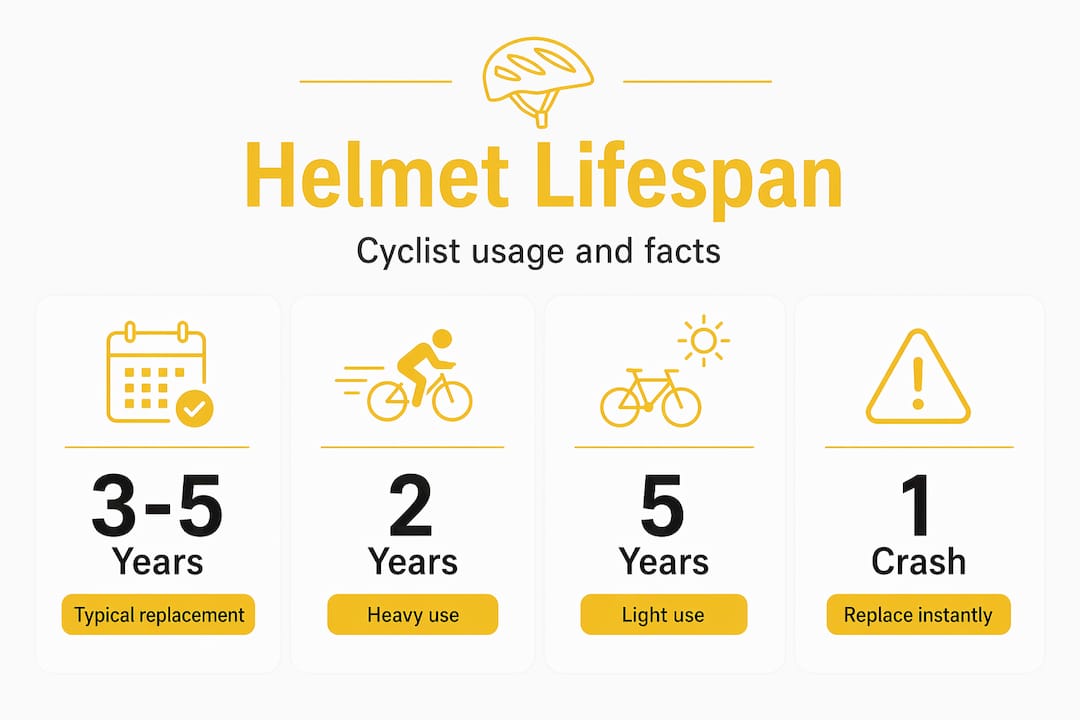
At the other end, weekend cyclists may safely extend helmet lifespan toward five years, but only by actively watching for wear signs rather than passively assuming the helmet is still fine.
Climate matters too. A cyclist in Arizona or southern France, where summers bring intense UV exposure and heat, should lean toward the shorter end of any range. A cyclist in Germany or the Pacific Northwest with cooler, cloudier conditions gets a little more margin. Staying on top of helmet wear signs regardless of your climate remains the most reliable safeguard.
Armed with usage-based timelines, let’s look at how evolving standards and technology influence helmet replacement decisions.
How evolving helmet standards and technology impact replacement choices
Here is something most cyclists do not factor into the replacement decision: the helmet you can buy today is meaningfully better than one made five years ago. Replacing a helmet is not just about material fatigue. It is also an upgrade in protection capability.
The bike industry continues to develop new helmet technologies offering better materials and improved brain protection. Specific improvements now common in current-generation helmets include:
- MIPS (Multi-directional Impact Protection System): Reduces rotational forces on the brain during angled impacts, a major factor in concussion risk
- WaveCel and Koroyd liners: Energy-absorbing structures that outperform standard EPS in specific impact scenarios
- Improved ventilation systems: Better airflow means less heat stress on foam and a more comfortable fit that riders maintain correctly
- Adjustable retention systems: More precise fit means the helmet stays positioned correctly during a crash
Safety standards for head protection are not static. Updated benchmarks, including the newer 2026 helmet standards focusing on rotational brain injury, mean that a certified helmet from 2020 may not meet the benchmarks engineers consider optimal today. Replacing an aging helmet also brings you into compliance with the most current testing standards, which matters in Europe especially as CE certification categories continue to evolve.
Upgrading every few years is not just about wear. It is about ensuring you benefit from what helmet engineering now knows about how brains get injured.
With these insights, let’s move to practical steps for applying helmet lifespan knowledge every day.
Practical tips for maximizing your helmet’s safety and lifespan
Good habits extend helmet life and ensure you catch problems before they compromise your protection.
- Inspect before every ride. A 10-second visual check for cracks and strap condition takes no time and catches obvious problems early.
- Clean with mild soap and cool water. Do this after any sweat-heavy ride, and always let the helmet air dry before storing.
- Store in a cool, dry location. Away from windows, car trunks, and anywhere temperatures spike above 30°C (86°F) regularly.
- Never drop or throw your helmet. Even an accidental drop onto concrete from waist height can micro-crush the foam.
- Replace after any crash involving head contact. No exceptions. Even if it looks fine.
- Follow your riding-frequency timeline. Use the table in the previous section as your personal schedule, not the manufacturer’s maximum.
Regular inspections, proper storage, and attention to wear and environmental factors are the only reliable ways to know if your helmet still protects you. Passive trust in an old helmet is one of the most common and invisible safety risks cyclists carry.
Pro Tip: Mark the purchase date on a small piece of tape inside your helmet. Three years from now, you will not need to guess when you bought it or dig up the receipt.
Reviewing your full helmet maintenance approach annually, and cross-referencing it with updated helmet wear signs, keeps both your knowledge and your gear current.
Why helmet lifespan guidelines exist beyond just material degradation
The 3-to-5-year rule is not purely engineering. Part of it is legal caution, and riders deserve to understand that distinction.
Replacement guidelines stem from safety concerns and legal considerations, acknowledging real unknowns in how consumers actually use their helmets. A manufacturer cannot control whether you store your helmet on a hot windowsill, whether you bought it second-hand with an undisclosed crash history, or whether you cleaned it with the wrong spray. A conservative replacement timeline protects you from those unknowns.
Interestingly, some marketing claims about foam “drying out” or “losing gas” are not scientifically supported. EPS foam does not expire the way food does. The Bicycle Helmet Safety Institute has been candid about this: the science on foam longevity does not fully justify the 3-to-5-year rule on its own. What does justify it is the combination of strap degradation, retention system wear, UV damage to the shell, and the simple reality that most people cannot accurately inspect their own helmet for hidden damage.
Here is our honest take: treat the guideline as a ceiling, not a safety net. If you ride hard, ride daily, or ride in harsh conditions, three years is the right number. If you are a light weekend rider with good storage habits, five years is defensible but requires active inspection, not passive assumption. The cost of a new helmet is trivially small compared to what it protects. Erring on the side of early replacement is always the right call.
Staying current with helmet safety upgrades is not just about following rules. It is about making an informed choice with your eyes open.
Stay safe on the road with the right helmet and support
Understanding helmet lifespan is only half the equation. The other half is making sure your next helmet is actually worth wearing. At The Beam, we design helmets and cycling safety gear for riders who take protection seriously, from daily urban commuters to endurance athletes pushing long-distance routes.
Our VIRGO integral helmet, built with MIPS technology, reflects everything covered in this article: materials chosen for real-world durability, a retention system designed to last, and protection benchmarked against current standards. If you are approaching your replacement window or heading into a major ride, we also share expert guidance through our content hub and events. For riders planning a serious challenge, our ultracycling event is built around the kind of safety-first culture this article describes. Your head is worth the right gear.
Frequently asked questions
How often should I replace my bike helmet if I’ve never crashed wearing it?
Most experts recommend replacing your helmet every 3 to 5 years even without a crash because UV, heat, and sweat degrade materials regardless of visible damage. Your riding frequency and storage conditions determine where in that range your timeline falls.
Can I tell if my helmet is damaged just by inspecting the outside shell?
No. A helmet can have internal foam damage or micro-fractures invisible from outside, and foam crush is often hidden beneath the shell. Always inspect straps, test the fit system, and treat any impact as a reason to replace.
Is it safe to buy a second-hand helmet?
Buying a used helmet carries real risk because you cannot verify crash or wear history. Always check the interior labels for manufacturing date and safety certification, and avoid any helmet whose history you cannot confirm.
Do sunscreen and cleaning products affect helmet safety?
Yes. Some sunscreen sprays and cleaning products are harsh to helmet plastics, causing breakdown over time. Stick to mild soap and water, and apply sunscreen before putting your helmet on.
Can I rely on a helmet older than 5 years if it shows no visible damage?
No. Manufacturers and safety experts advise replacement after 3 to 5 years because helmet replacement timelines align with the engineered protective lifespan of all components together, not just the foam. Invisible degradation is the core risk.


