

TL;DR:
- Helmets can silently degrade over time due to UV, heat, sweat, and minor impacts, compromising safety. Experts recommend replacing helmets after any crash, every 3 to 5 years, or if the fit or retention system deteriorates. Regular thorough inspections and prompt replacement after damage ensure optimal protection during rides.
Your helmet looks fine. The shell is intact, the straps seem solid, and you haven’t had a serious crash in years. So you’re good, right? Not necessarily. Thousands of cyclists ride every day with helmets that appear perfectly functional but have silently lost their ability to protect. UV radiation, heat, sweat chemistry, and even minor impacts degrade the internal foam in ways that no visual check can reveal. Understanding the real rules around helmet replacement isn’t about being overly cautious — it’s about making sure your most critical piece of safety gear actually does its job when it counts.
Table of Contents
- Why helmet replacement matters: The hidden risks
- When should you replace your helmet? Evidence-backed triggers
- How to inspect your helmet: Fit, damage, and materials checklist
- Industry guidelines vs. real-world practice: What experts really recommend
- Why erring on the side of replacement beats “waiting for proof”
- Ready to upgrade? Trusted helmets and essential accessories
- Frequently asked questions
Key Takeaways
| Point | Details |
|---|---|
| Replace after crash | Any head impact, even minor, means it’s time for a new helmet regardless of visible damage. |
| Check regularly for fit | If your helmet no longer fits snugly or the retention system fails, replace it immediately. |
| Follow the 3–5 year rule | Replace your helmet every 3 to 5 years, even if it still looks new, to account for invisible wear. |
| Prioritize safety over cost | Choosing to replace early is safer than waiting for clear damage, especially with high-end helmets. |
Why helmet replacement matters: The hidden risks
Most riders understand that a helmet needs replacing after a serious crash. What fewer realize is that the damage threshold is far lower than they think — and that time alone is enough to render a helmet unsafe.
Cycling helmets rely on expanded polystyrene (EPS) foam, the same dense white material used in packing material, to absorb impact energy by crushing permanently. This is the key word: permanently. As the helmet protection technology inside your helmet works by deforming on impact, even a single significant event can exhaust its capacity. Helmets are single-impact devices: after a crash with head contact, they should be replaced even if there is no visible damage. The foam may look perfectly fine while being structurally spent.
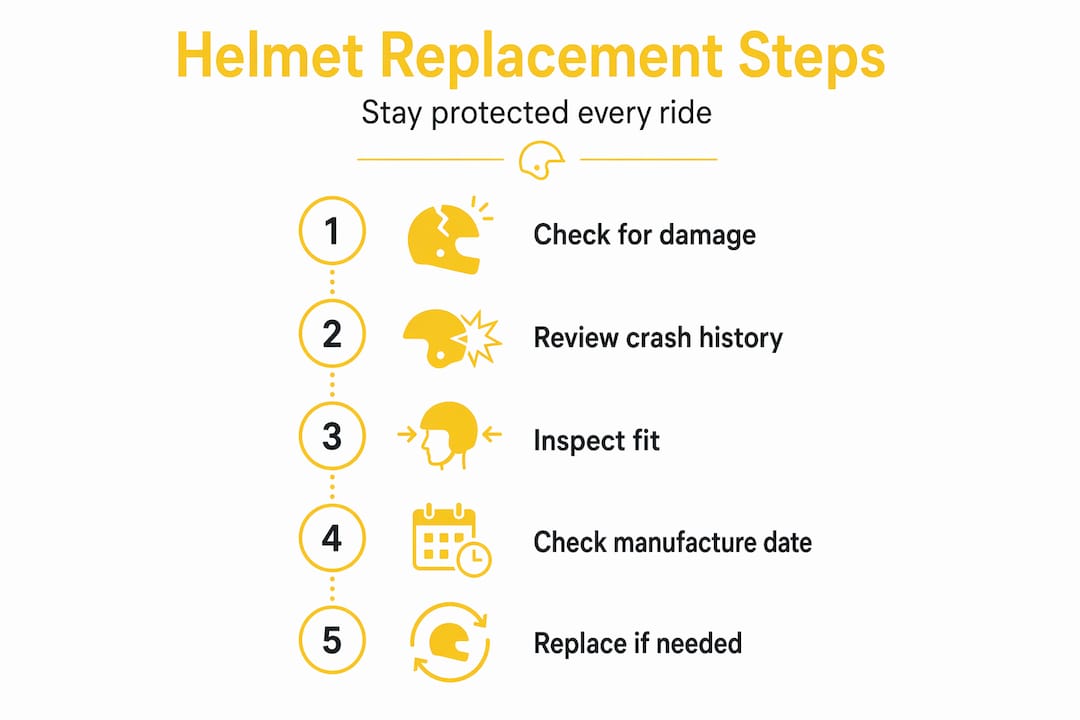
Beyond crashes, there’s another threat most cyclists completely underestimate: slow environmental degradation. The effects of sun exposure on gear are well-documented, and helmets are no exception. UV radiation breaks down the polycarbonate outer shell over time, making it more brittle. Heat — whether from direct sunlight, a hot car, or body temperature — weakens adhesive bonds inside the helmet. Sweat introduces salt and oils that degrade foam chemistry from the inside out. Manufacturers recommend periodic replacement due to material degradation from UV, heat, and sweat, even when a helmet looks perfectly fine.
Here’s a quick summary of the degradation factors at work:
- Impact compression: EPS foam crushes to absorb energy and does not rebound. One hard impact can be enough to exhaust its protective capacity.
- UV exposure: Breaks down the outer shell’s polymer structure, reducing its ability to distribute impact loads across the foam.
- Heat cycling: Repeated warming and cooling causes micro-fractures in both the shell and foam liner.
- Sweat and chemical exposure: Salts and skin oils penetrate the foam over time, altering its density and crush behavior.
- Age-related stiffening: Older EPS becomes less responsive and may crack rather than compress progressively during an impact.
“The most dangerous helmet is one that looks fine but has already absorbed its one protective impact.” This is the hidden risk that even experienced cyclists often overlook.
The troubling reality is that none of these failure modes are visible from the outside. A helmet that has been through a forceful drop, left in a hot car repeatedly, or simply used for six years of sweaty summer rides may look brand new while offering significantly reduced protection.
When should you replace your helmet? Evidence-backed triggers
Knowing why helmets degrade is useful. Knowing when to act is what actually keeps you safe. The industry has established clear triggers, and understanding how to apply them in edge cases is just as important as knowing the rules themselves.
The core triggers for helmet replacement are well-established:
- After any crash involving head contact. Even a slow-speed fall where your helmet touched the ground. Helmets are designed as single-impact devices and should be replaced regardless of visible damage.
- Every 3 to 5 years. This is the window manufacturers universally recommend based on material degradation from regular use, regardless of crash history.
- When the retention system fails. If the dial, straps, or buckles no longer hold the helmet securely in position, the helmet cannot do its job — even if the shell and foam are intact.
- After significant drops or forceful impacts. If your helmet hits the ground hard, whether on your head or not, internal damage is possible.
- When fit changes noticeably. If the helmet rocks, sits too high, or feels different than it used to, this can indicate foam compression or strap degradation.
For crash replacement guidance, the principle is the same across cycling disciplines: when in doubt, replace. Many helmet manufacturers also offer crash replacement programs that reduce the cost of doing so.
| Replacement trigger | Rationale | Recommended by |
|---|---|---|
| Crash with head contact | EPS foam may be fully compressed | Helmet manufacturers, safety bodies |
| 3 to 5 years of regular use | UV, heat, and sweat degrade materials | Industry consensus |
| Failed retention system | Helmet cannot stay positioned correctly | Bicycle Helmet Safety Institute |
| Forceful drop without wearing | Internal foam damage is possible | Expert safety guidance |
| Noticeable fit change | Structural compression may have occurred | Helmet manufacturers |
Pro Tip: Check the manufacture date printed inside your helmet (not the purchase date). Helmets that sit in warehouses or shops for a year before you buy them have already begun the aging clock. If you can’t find the date, that alone is a reason to consider replacement.
One edge case worth addressing: a “minor” event that felt insignificant. Perhaps your bike fell over in a parking lot and the helmet bounced off concrete, or you took a slow topple while clipping out at a stop. Even minor but forceful events can justify replacement, especially if the helmet made significant contact with a hard surface. The force required to damage EPS foam is lower than most people expect. When in doubt, the only correct answer is to replace.
For a broader view of proven safety steps around helmet decisions, being conservative is always the right call.
How to inspect your helmet: Fit, damage, and materials checklist
Regular inspection is a critical habit, but it needs to be done correctly. Glancing at the outside and calling it good is not an inspection. Here is a methodical approach that covers all the failure modes that matter.
Step-by-step helmet inspection:
- Remove all padding and accessories. Detach any camera mounts, lights, or removable pads so you can see the bare shell and inner foam surface clearly.
- Inspect the outer shell. Look for cracks, crazing (fine surface cracks that look like a cracked glaze), dents, or any point where the shell has separated from the foam underneath.
- Check the EPS foam liner. Look for compression marks, cracks, or areas where the foam feels softer or more yielding than surrounding areas. Press gently across the foam surface.
- Test the retention system. Engage the adjustment dial fully and check that it holds without slipping. Shake the helmet to see if it moves independently of the harness.
- Examine all straps and buckles. Look for fraying, fading (a sign of UV degradation), cracking at buckle hinges, and any stitching that has loosened.
- Test the fit on your head. The helmet should sit level, two fingers above your eyebrows, and should not rock forward, backward, or side to side when you push on it with both hands.
- Check the chin strap. Fastened, it should allow only two fingers between the strap and your chin. Any more slack and the helmet will not stay positioned in a crash.
Proper helmet inspection also involves checking helmet care routines between rides, including how you store and clean the helmet.
| Good fit indicators | Bad fit indicators |
|---|---|
| Sits level, two fingers above brow | Tilts back or forward |
| Stable when pushed side to side | Rocks or wobbles |
| Chin strap snug with two-finger gap | Loose strap, more than two fingers |
| Retention system locks firmly | Dial slips or will not tighten |
| No gaps between foam and head | Helmet feels loose or oversized |
| Comfortable pressure across crown | Pressure points or pinching |
Inspecting for subtle helmet wear is a skill that develops with practice. The critical point from the Bicycle Helmet Safety Institute is that you should replace any helmet or component if it no longer fits correctly or its retention system is compromised. Fit is not secondary to shell integrity — it is equally essential for protection. For added peace of mind regarding UV exposure, consider protective gear for UV exposure during long outdoor rides where both you and your helmet take significant sun exposure.
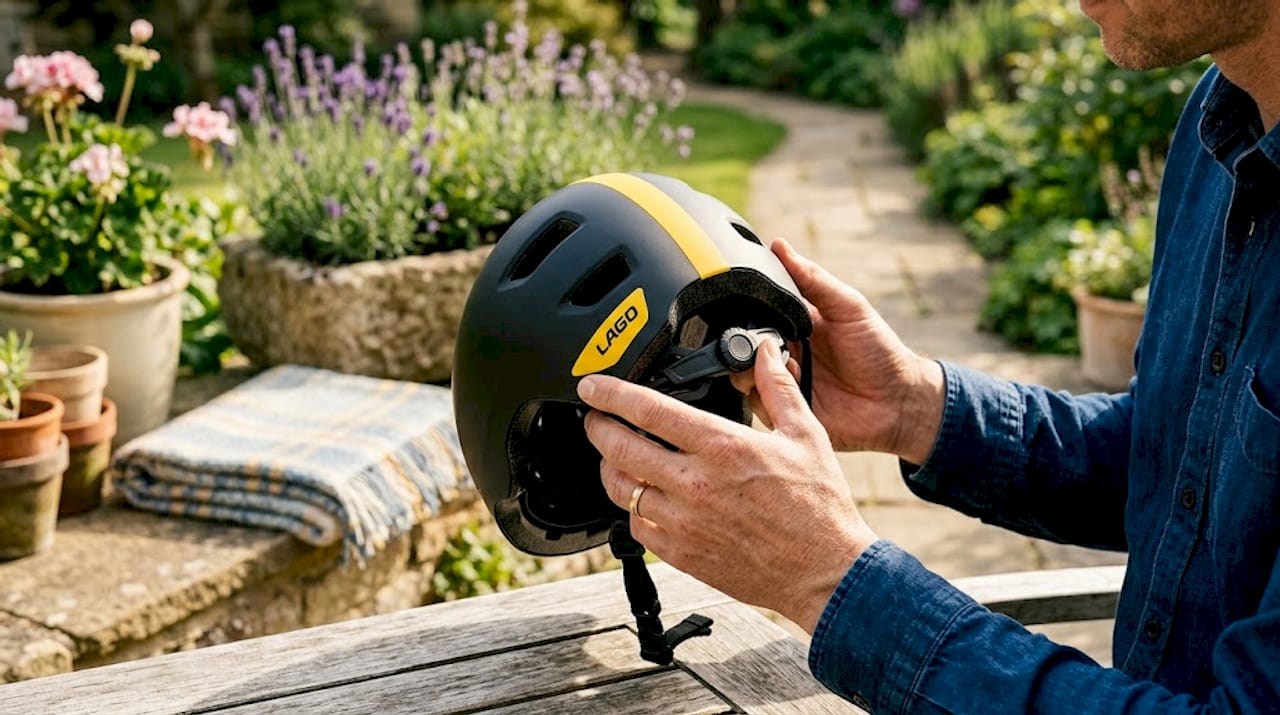
Pro Tip: For high-end helmets with MIPS (Multi-directional Impact Protection System) liners, inspect the low-friction slip plane inside the helmet for deformation or cracking. MIPS components can be damaged independently of the outer shell and foam, reducing rotational protection even when the rest of the helmet appears fine.
Industry guidelines vs. real-world practice: What experts really recommend
Official guidelines give you a framework. Real-world practice reveals why that framework sometimes isn’t enough.
Standards bodies and manufacturers are aligned on the core rules: replace after impact, replace every 3 to 5 years, replace when retention or fit is compromised. But there’s an important gap between what the standards say and how most cyclists actually behave. Many riders push past the 5-year mark because their helmet “still feels fine.” Others skip replacement after minor crashes for the same reason.
Even minor events can justify replacement if the helmet hits the ground with enough force to compress the foam, even slightly. The challenge is that cyclists cannot measure whether that threshold was crossed. This is precisely why expert guidance defaults to replacement over guessing.
“When the question is whether your helmet still protects your head, the answer should never rely on visual evidence alone. Replace it, and ride knowing your protection is real.”
There is also a subtler issue worth noting: some research suggests that EPS foam in controlled lab conditions may retain performance characteristics longer than 5 years when stored under ideal conditions. However, most official guidance still treats helmets as single-impact devices and recommends replacement after crashes and within the 5-year window. “Controlled lab conditions” does not describe how helmets are actually used and stored.
Here are the actionable safety-first decision rules every cyclist should internalize:
- If your helmet has been in a crash, replace it before your next ride.
- If your helmet is more than 5 years old from the manufacture date, replace it regardless of appearance.
- If you cannot verify the manufacture date, treat the helmet as suspect and consider replacement.
- If the retention system, straps, or buckles show any degradation, act immediately.
- If you’re unsure whether an impact was forceful enough to cause damage, replace it.
For help choosing a safe helmet that meets current standards and fits your riding style, starting with clear criteria makes the decision straightforward.
Why erring on the side of replacement beats “waiting for proof”
Here is something that doesn’t get said enough: expensive helmets create a psychological trap. When you spend $300 or more on a premium cycling helmet, there’s a natural and understandable reluctance to let go of it early. The cost feels like a reason to keep using it. But this is exactly backward.
Investing in a high-quality helmet means you understand that your head protection matters. That same logic should lead you to replace it on schedule, not to stretch its life beyond safe limits because the price tag is still fresh in your memory. The investment case for safety gear isn’t in how long you can make it last — it’s in the reliable protection it provides every single time you ride.
What most cyclists get wrong is the assumption that “visible” equates to “structural.” You can see a cracked shell. You cannot see compressed EPS foam, degraded adhesive bonds, or UV-brittled polymer layers. Experienced riders and crash survivors often describe the same realization: the helmet that saved them looked fine afterward, but when they looked inside, the foam had clearly absorbed a massive amount of energy. That foam would never perform the same way again.
The most disciplined approach comes from treating your helmet like a consumable, not a durable good. A set of brake pads that are worn down to the metal is obviously finished. A helmet at 4 years old with a single minor crash and some UV fading is less obviously finished, but the risk profile may be just as serious. Check for subtle helmet wear consistently, set a calendar reminder for the 3-year mark, and build replacement into your annual gear review. Proactive riders don’t wait for a second crash to prove the first one mattered.
Ready to upgrade? Trusted helmets and essential accessories
When the inspection checklist tells you it’s time, acting quickly is the right move. Riding on a compromised helmet — even for one more week while you “think it over” — is a risk that simply isn’t worth taking.

At THE BEAM, we design helmets and accessories specifically for cyclists who take safety seriously without compromising on performance or style. Our shop helmets collection includes the VIRGO integral helmet with MIPS technology, built for road, gravel, urban, and e-bike riders who need certified protection they can rely on every day. Beyond the helmet itself, our helmet add-ons and broader range of cycling accessories — including rear-view mirrors, high-visibility reflectors, and connected safety products — help you build a complete protection setup that works in real-world riding conditions.
Frequently asked questions
How often should you replace a cycling helmet if it has never been in a crash?
Manufacturers recommend replacing every 3 to 5 years due to material degradation from sun, sweat, and regular use, even without any crash history.
What should I do if my helmet looks fine but was dropped on the ground?
If the drop was forceful, replace the helmet immediately, since internal EPS foam may be compressed beyond its protective capacity even when no external damage is visible.
Can I just replace the strap or padding instead of the whole helmet?
If the shell and foam are intact and only the fit system is compromised, replacing those components may restore function; if there is any doubt about the shell or foam, full helmet replacement is always the safest choice.
Do higher-end helmets last longer than budget models?
No. All helmet types should follow the same replacement timeline after impact or by the 5-year mark, since EPS foam and shell materials degrade on the same schedule regardless of price point.


