

TL;DR:
- Properly fitted helmets can reduce head injury risk by 85 percent, but safety gear must be layered for full protection. Combining visibility aids, impact-resistant helmets with rotational technology, and protective clothing addresses different crash phases and injury types. Systemic infrastructure and driver awareness are essential complements to individual safety gear, which should be regularly updated and tailored to riding conditions.
Most cyclists know they should wear a helmet. Far fewer understand that helmet alone covers only part of the risk equation when you’re on a bike. Understanding why choose safety-first bike gear means looking at the full picture: visibility, impact protection, rotational force, and the real-world conditions where crashes actually happen. The data here is not subtle. Properly fitted helmets can reduce head injury risk by 85%, yet most riders still treat safety gear as optional rather than required. That gap between evidence and behavior is exactly what this article addresses.
Table of Contents
- Key takeaways
- Why choose safety-first bike gear
- Essential types of safety gear and what they do
- Helmet safety: fit, certifications, and long-term health
- Visibility and lighting gear: being seen saves lives
- How to choose the right safety gear for your riding style
- Gear in context: what safety equipment cannot do alone
- My take: the gear gap no one talks about
- Ride smarter with Thebeamofficial
- FAQ
Key takeaways
| Point | Details |
|---|---|
| Helmets alone are not enough | True safety requires visibility aids, protective clothing, and certified helmets working together. |
| Certifications are not equal | Standard certifications miss rotational impacts; independent ratings like Virginia Tech STAR fill that gap. |
| Visibility beats high-vis alone | Dynamic lights on moving parts dramatically outperform static reflective vests for driver detection. |
| Replacement timing matters | Helmet foam degrades over time, so replace yours every 3 to 5 years regardless of visible damage. |
| Gear fits your context | Choose safety equipment based on your riding style, environment, and risk factors, not just price. |
Why choose safety-first bike gear
The short answer: because the stakes are real, and the gear that actually protects you goes well beyond what most riders currently own.
Head injuries account for the majority of serious cycling fatalities and long-term disabilities. A well-fitted, certified helmet reduces severe brain injury by 88%, according to a meta-analysis of more than 50,000 cyclists. Those numbers are hard to argue with. But helmet protection only activates at the moment of impact. Before that moment arrives, visibility gear, protective clothing, and good situational awareness are the things that prevent the crash from happening at all.
Think about the anatomy of a typical cycling accident. A driver fails to detect a cyclist at a junction. Contact occurs. Injury follows. A helmet helps at the last stage. But the right lighting or reflective system on your bike or body could have stopped the sequence two steps earlier. That is the core logic behind safety-first bike gear: layer your protection so that each element covers a different phase of the risk chain.
The importance of bike safety gear also extends further than crash prevention. Protective gloves reduce abrasion injuries in falls that do not involve vehicles at all. Padded shorts reduce fatigue on longer rides, which directly affects alertness and reaction time. Even something as overlooked as proper cycling footwear prevents ankle injuries from clipless pedal mishaps. Every piece serves a function.
Essential types of safety gear and what they do
Safety-first bike gear breaks down into four broad categories, each targeting a different type of risk.
- Helmets: Your primary defense against traumatic brain injury. Look for certified models with MIPS or equivalent rotational protection technology. The VIRGO integral helmet from Thebeamofficial incorporates MIPS and meets rigorous international certification standards.
- Active lighting systems: Front and rear lights, ideally with both steady and flashing modes, significantly improve your detection by drivers in all light conditions. More on this below.
- Visibility accessories: Retroreflective materials, high-visibility clothing, and motion-based reflectors on ankles or pedals make you detectable from further away and at more angles.
- Protective clothing: Padded shorts, reinforced jackets, gloves, and cycling shoes protect soft tissue in falls and reduce fatigue-related errors.
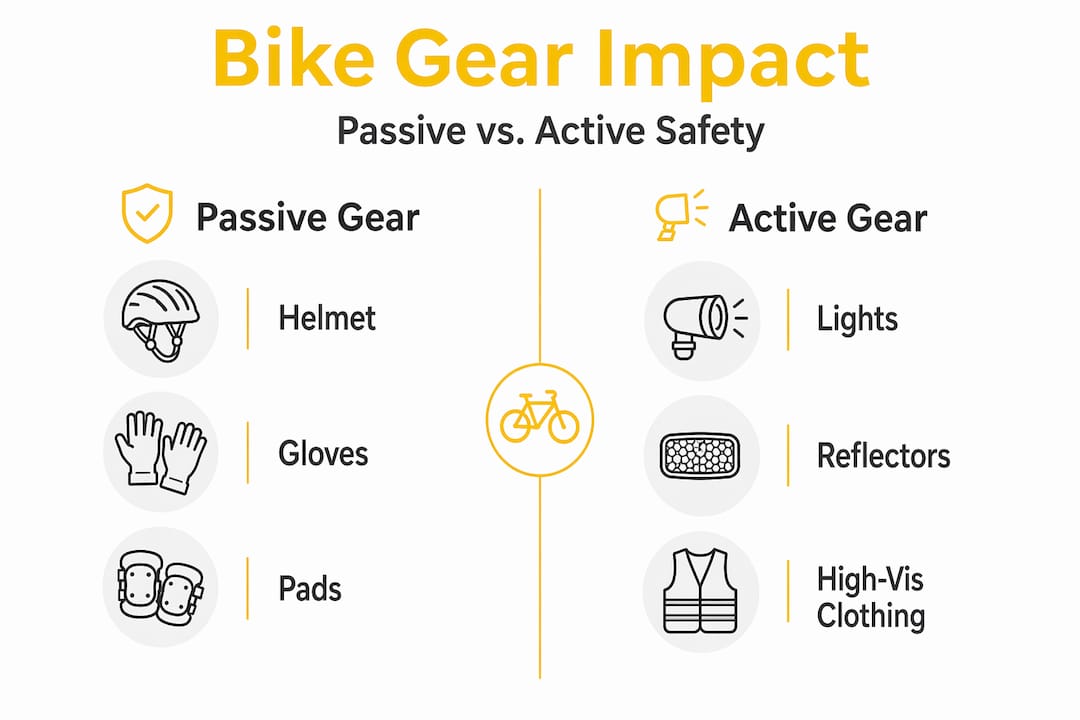
| Gear type | Primary risk addressed | Passive or active |
|---|---|---|
| Certified helmet with MIPS | Head and brain injury | Passive |
| Front and rear lights | Low-visibility collisions | Active |
| Retroreflective clothing | Driver detection failure | Passive |
| Padded gloves and shorts | Abrasion and fatigue injuries | Passive |
| Motion-based ankle reflectors | Cognitive detection by drivers | Active/Passive hybrid |
Pro Tip: When buying a helmet, do not skip trying it on in the store or checking the brand’s fit guide online. A helmet that sits too high or shifts on your head in a crash is significantly less protective than the certification suggests.
Helmet safety: fit, certifications, and long-term health
Helmet selection is where most cyclists make their biggest mistake. They read a certification label, see that it passed a test, and assume all helmets at that certification level are equivalent. They are not.
Standard certifications like CPSC (used in the U.S.) and EN 1078 (Europe) test linear impact forces only. They do not measure what happens during oblique or angled impacts, which are actually the primary cause of concussions during real-world crashes. Rotational forces are the mechanism behind most brain injuries that do not show up on a CT scan but still cause lasting cognitive damage.
The Virginia Tech STAR rating system independently evaluates how well a helmet mitigates those rotational forces. It fills a real gap that standard certification misses entirely. When you see a helmet listed in the Virginia Tech top performers, that means it has been tested against the physics that actually injure cyclists.
Here is a practical checklist for choosing a helmet worth wearing:
- Verify standard certification. Confirm CPSC (U.S.) or EN 1078 (Europe) compliance as your baseline.
- Check independent ratings. Look for Virginia Tech STAR ratings; five stars is the current top tier.
- Prioritize rotational protection. Confirm the helmet uses MIPS or a functionally equivalent technology.
- Test fit before buying. The helmet should sit level, cover your forehead, and not rock side to side more than one inch.
- Track your replacement schedule. Helmet foam degrades in 3 to 5 years, so mark your purchase date on the inside.
There is also a long-term benefit that rarely gets mentioned in gear discussions. Consistent helmet use correlates with a 42% reduction in dementia risk. The mechanism is straightforward: every sub-concussive impact adds up over a lifetime of riding. A helmet absorbs those smaller hits too, not just the big crash. That alone is a compelling reason to why invest in bike safety gear at the helmet level.
Pro Tip: After any crash that involves head contact, replace your helmet immediately. The foam compresses on impact in ways you cannot see from outside, and it will not perform the same way in a second incident.
Visibility and lighting gear: being seen saves lives
There is a critical distinction in visibility science between sensory conspicuity and cognitive conspicuity. Sensory conspicuity means the driver’s eye physically detects something. Cognitive conspicuity means their brain recognizes it as a cyclist who needs space. High-visibility vests handle the first. Getting cognitive recognition requires something more.
Research has shown that static high-vis gear has limited effectiveness compared to placing lights or reflectors on moving parts of the body. The human brain is wired to detect biological motion. Ankle and pedal movements produce a rhythmic pattern that drivers’ brains immediately classify as a person on a bike, even in cluttered visual environments. A reflector strapped to a bike frame does not trigger that same cognitive response.
The lighting data is equally striking. A randomized trial of 5,380 cyclists found that daytime running lights cut multi-party accidents by 71%. That is a massive reduction from a single, consistent gear change. And while you might assume lights are only for night riding, that figure comes from daytime conditions.
- Use a flashing rear light during the day for high urban traffic environments. Flashing lights are more noticeable than steady ones when competing with background lighting in cities.
- Use a steady front light at night. Flashing can disorient oncoming traffic and reduce your own depth perception cues.
- Add retroreflective ankle bands or a motion-sensitive light to your lower legs. This leverages biological motion detection.
- Do not rely on a single rear light. Two lights at different heights and angles cover more visual angles and provide backup redundancy.
Visibility gear, particularly cycling safety accessories designed for motion-based detection, is one of the highest-return investments a cyclist can make relative to its cost.
How to choose the right safety gear for your riding style
Choosing the best safety-first bike gear is not about buying everything at once. It is about reading your own risk profile and prioritizing accordingly.
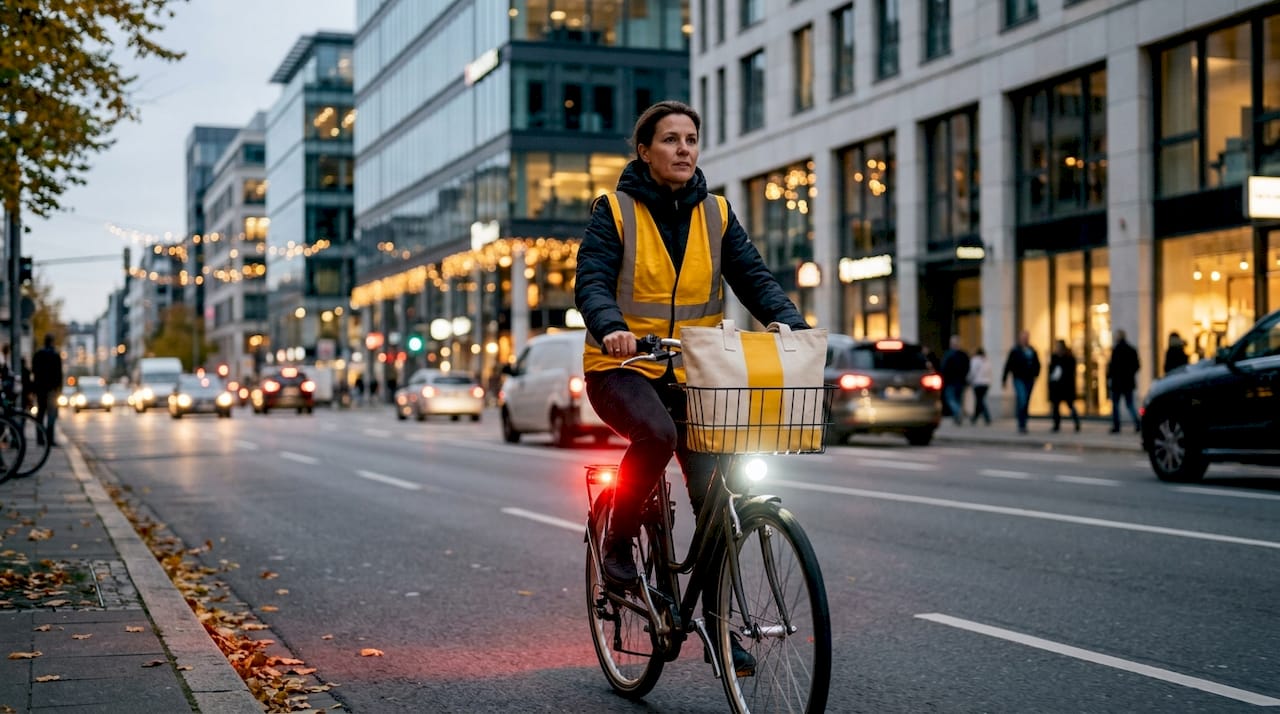
Start with your riding context. A commuter navigating urban traffic faces different risks than a weekend road cyclist on rural lanes. Urban riders need maximum visibility gear, front and rear lights, and a helmet rated for low-speed but high-frequency impact scenarios. Road cyclists doing long distances need aerodynamic helmets with strong rotational protection, gloves for handling security, and high-contrast clothing for rural roads where vehicles move fast.
You can explore tailored recommendations at the cycling safety gear guide from Thebeamofficial, which breaks down gear selection by riding discipline and exposure level. For e-bike riders specifically, the speed differential from standard bikes adds a meaningful layer of risk, covered in detail in the e-bike safety gear guide.
Key biking safety considerations when building your gear kit:
- Prioritize your head first. No other gear choice has a comparable impact on serious injury outcomes.
- Layer your visibility. Passive reflectors and active lights are not substitutes for each other. Use both.
- Do not overbuy at the expense of fit. A mid-range helmet that fits correctly outperforms an expensive one that does not.
- Check for recalls and certification updates. Safety standards evolve, and older gear may not meet current benchmarks.
- Budget for replacement. Treat helmets like tires. They wear out and need to be swapped on a schedule, not just after visible damage.
Pro Tip: If you are unsure where to start, audit your current kit against the table in this article. Identify which risk categories have no coverage, and fill those gaps first rather than upgrading gear you already have.
Gear in context: what safety equipment cannot do alone
Individual gear is your last line of defense, not your first. The most effective cycling safety gains come from systemic changes: protected bike lanes, lower vehicle speed limits near cycling infrastructure, and enforcement of driver behavior around cyclists.
Protected bike lanes reduce cycling fatalities dramatically in cities where they have been implemented well. Lower speed limits in urban areas directly reduce crash severity because kinetic energy rises with the square of speed. A car hitting a cyclist at 20 mph delivers less than half the force of the same car at 30 mph. Infrastructure matters at a scale that individual gear cannot match.
Gear protects the individual. Infrastructure protects every cyclist. Both matter, and neither should be used as an argument against the other.
Driver education programs that specifically address cyclist detection and behavior around bikes have shown meaningful safety improvements where implemented. Law enforcement of traffic laws near cycling infrastructure reinforces what education starts. These are systemic improvements that individual cyclists cannot control but benefit from.
What this means practically: wear your gear every ride, advocate for better infrastructure in your area, and do not let the absence of perfect infrastructure become a reason to skip the protection you can control.
My take: the gear gap no one talks about
I have spent years following cycling safety research, talking to riders across all experience levels, and watching behavior on actual roads. And I keep seeing the same pattern. Cyclists who would never get in a car without a seatbelt will ride without lights in low-light conditions or wear a decade-old helmet because it “looks fine.”
The cultural lag around helmet adoption is real, and it frustrates me. The evidence is not ambiguous. The protection is measurable. Yet adoption still trails what the data warrants. Part of that is comfort. Part of it is the false sense of security that comes from familiarity with a route or confidence in riding skill. Neither protects you from a driver who does not see you.
What I have found is that the moment riders understand the mechanism behind the gear, not just the recommendation, behavior shifts. When you understand that biological motion on your ankles is what triggers driver recognition, you do not skip the ankle reflector. When you understand that your five-year-old helmet foam has degraded to the point of significantly reduced protection, you replace it. The evidence is not there to make you anxious. It is there to help you make better decisions.
Treat safety-first bike gear as part of your bike, not an accessory you can leave home. Your ride deserves it. So do you.
— Sophie
Ride smarter with Thebeamofficial
Thebeamofficial designs safety gear for cyclists who take protection seriously without compromising on performance or style. The flagship VIRGO integral helmet combines MIPS rotational protection with EN 1078 certification and a design built for real-world riding. For adult riders ready to upgrade their head protection, the adults’ helmets collection covers road, gravel, urban, and e-bike disciplines. If you are gearing up younger riders, the kids’ helmets range meets the same rigorous standards in smaller sizes. Round out your kit with visibility and protection accessories through the helmet add-ons collection, including rear-view mirrors, connected reflectors, and high-visibility aids designed to be seen. Every ride is worth protecting.
FAQ
Why is safety-first bike gear better than basic gear?
Safety-first bike gear prioritizes certified protection, rotational impact mitigation, and active visibility features that basic gear typically lacks. The result is measurably better outcomes in both crash prevention and injury reduction.
What certifications should a bike helmet have?
At minimum, look for CPSC certification in the U.S. or EN 1078 in Europe, combined with a high Virginia Tech STAR rating to confirm rotational force protection. Standard certifications alone do not cover concussion risk from oblique impacts.
How often should I replace my bike helmet?
Replace your helmet every 3 to 5 years due to foam degradation, and immediately after any crash involving head contact, even if the exterior looks undamaged.
Do lights really reduce cycling accidents?
Yes. Daytime running lights alone produced a 71% reduction in multi-party accidents in a one-year randomized controlled trial with over 5,000 cyclists. Lights are one of the highest-impact safety investments available.
What visibility gear works best for urban cycling?
A combination of flashing rear lights, steady front lights, and retroreflective materials on moving parts like ankles produces the best results. Dynamic motion-based visibility activates cognitive detection in drivers, which static vests alone cannot reliably achieve.


