

TL;DR:
- Helmet certification labels confirm a helmet has passed independent safety tests specific to regional standards.
- Understanding these marks helps ensure you buy helmets engineered for your riding style and legal requirements.
The terminology of helmet certifications refers to standardized codes and labels that confirm a helmet has passed specific safety tests required for legal sale and real-world crash protection. Knowing what CPSC, EN 1078, ASTM F1952, and Snell B95 actually mean is the difference between buying a helmet that protects you and buying one that only looks like it does. These codes are not marketing language. They are the result of drop tests, impact force measurements, and retention system evaluations conducted by accredited third-party laboratories. This guide breaks down each term, explains what the testing behind it involves, and shows you how to read a label correctly before your next purchase.
What does the terminology of helmet certifications actually mean?
Helmet certification terminology is the set of standardized labels, codes, and marks that appear on helmets to confirm compliance with safety testing regulations. Each code corresponds to a specific test regime designed around the hazards of a particular riding style or region. Certification codes like CPSC and EN 1078 are not interchangeable product features. They are legal and technical declarations that a helmet model has been independently verified to meet defined protection thresholds.

The most common certification types for helmets fall into two categories: mandatory regulatory standards and voluntary enhanced standards. Regulatory standards, such as CPSC 16 CFR Part 1203 in the United States and EN 1078 in Europe, are required for a helmet to be legally sold in those markets. Voluntary certifications like Snell and ASTM indicate the manufacturer chose to exceed the legal minimum, which typically signals a higher safety margin.
Here is a breakdown of the major certifications you will encounter:
- CPSC 16 CFR Part 1203: The U.S. Consumer Product Safety Commission standard. CPSC compliance is mandatory for any bicycle helmet sold in the United States and covers impact attenuation, retention system strength, and labeling requirements.
- EN 1078: The European standard for cycling helmets, indicated by a CE mark. It prescribes a peak linear acceleration limit of 250 g during impact tests using flat and kerbstone anvils.
- ASTM F1952: A voluntary standard developed for downhill mountain bike helmets. It includes chin bar safety requirements for full-face helmets and tests at higher impact velocities than CPSC.
- Snell B95: A voluntary certification from the Snell Memorial Foundation that tests shell integrity after multiple high-energy impacts, pushing protection well beyond legal minimums.
- AS/NZS 2063: The standard used in Australia and New Zealand, legally required in those markets and not recognized as equivalent to CPSC or EN 1078.
Pro Tip: If you ride in both the U.S. and Europe, look for helmets that carry both CPSC and CE marks. Dual certification is increasingly common, but always verify the edition number on the label to confirm it reflects the current standard version.
How do testing procedures differ across helmet safety standards?
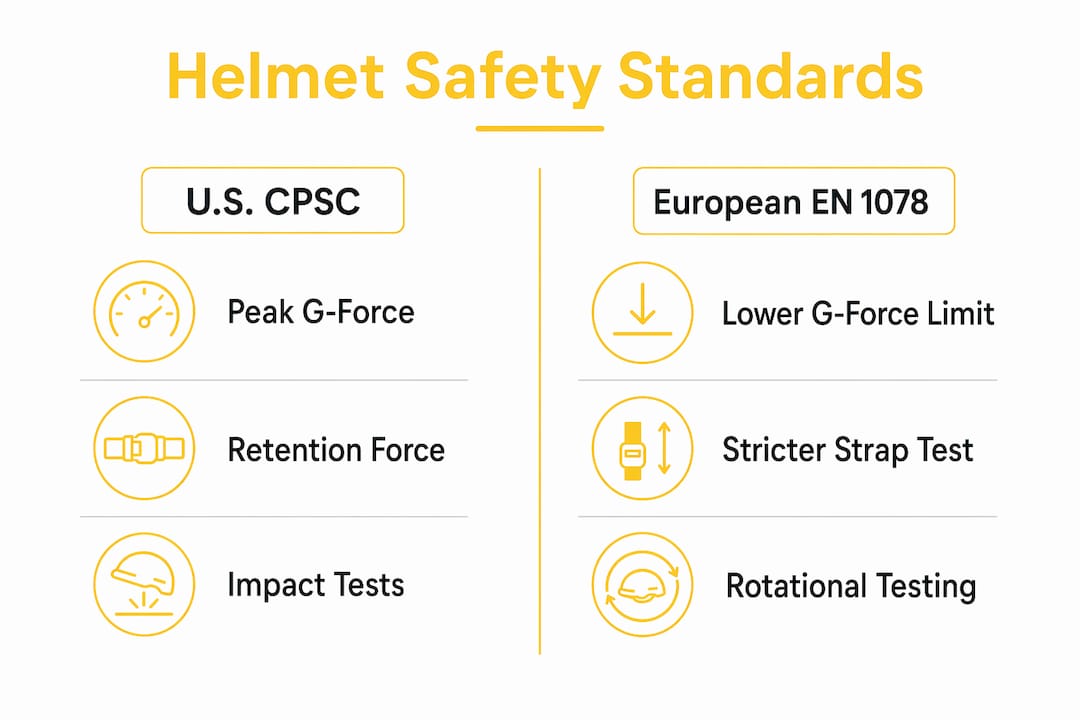
The protection a certification delivers depends entirely on the rigor of the tests behind it. Standards differ in four key areas: impact velocity, peak acceleration limits, retention system force requirements, and coverage area.
| Standard | Peak G-Force Limit | Retention Force Range | Rotational Testing |
|---|---|---|---|
| CPSC 16 CFR Part 1203 | 300 g | 150 to 250 N | Not required |
| EN 1078 | 250 g | 150 to 250 N | Not required |
| ASTM F1952 | Lower threshold, higher velocity | Extended chin bar testing | Not required |
| Snell B95 | Multiple impact sequences | Extended coverage area | Shell integrity focus |
The CPSC standard allows a higher peak acceleration of 300 g, while EN 1078 sets a stricter 250 g ceiling. This does not mean European helmets are automatically safer. The two standards use different drop heights, different anvil shapes, and different test head forms, making direct comparison more complex than a single number suggests. Testing involves drop tower methodologies and, in newer standards, angular acceleration measurements to gauge rotational impact forces.
Retention system testing evaluates whether the chin strap and buckle system will hold the helmet on your head during a crash. Retention forces between 150 and 250 Newtons are the standard range across most certifications. A strap that fails this test means the helmet can come off before it absorbs the impact, which eliminates most of its protective value.
Third-party certification audits are what give these marks credibility. Manufacturers cannot self-certify under CPSC or Snell. An accredited laboratory must conduct the tests, and batch production is subject to ongoing compliance checks. This traceability is part of why the label inside your helmet carries a lot number alongside the certification code.
Pro Tip: Newer standards from organizations like the Virginia Tech Helmet Lab rate helmets on a star system based on rotational impact performance. This is not a certification in the regulatory sense, but it adds useful data on top of mandatory standards, particularly for road cyclists who experience oblique impacts in real crashes.
What do certification labels tell you and how do you read them?
Certification labels act as a roadmap showing the exact standards a helmet passed, with standard numbers, certification marks, and batch codes displayed clearly to verify authenticity. Knowing how to read this label is one of the most practical skills a cyclist can develop.
Here is what a complete certification label contains, in the order you will typically find it:
- Certification code and edition: For example, “CPSC 16 CFR Part 1203” or “EN 1078:1997+A1:2012.” The edition number matters. An older edition may not reflect current safety requirements.
- Manufacturer name and country of origin: Required under both CPSC and EN 1078 to establish traceability.
- Model name or number: Identifies the specific helmet design that was tested, not just the brand.
- Production date or lot number: Allows recall tracking and helps you determine whether the helmet is approaching the end of its service life.
- Fit and warning instructions: Certified helmets must include legible instructions for proper fit and warnings specific to the standard tested against.
A common mistake is confusing product feature names with certifications. MIPS, WaveCel, and Koroyd are impact-absorbing technologies. They are not certifications. A helmet with MIPS still needs to carry a CPSC or EN 1078 mark to be legally compliant. Technologies like MIPS do not substitute for meeting base standards. They are additions on top of a certified foundation.
Regional differences in labeling also matter. In the U.S., the CPSC mark must be permanently affixed inside the helmet or on the retention straps. In Europe, the CE mark appears on the outside, and the EN 1078 reference appears on the interior label. Certification marks differ internationally and are not interchangeable. Buying a CE-marked helmet for use in the U.S. does not satisfy CPSC requirements, and vice versa.
How to choose the right certified helmet for your riding style
Translating certification knowledge into a purchase decision requires matching the standard to your activity, your location, and the protection level you actually need.
- Road cycling and commuting: CPSC (U.S.) or EN 1078 (Europe) covers the baseline. Look for current edition numbers and avoid helmets with only older standard references.
- Downhill and enduro mountain biking: ASTM F1952 is the relevant standard for full-face helmets. A helmet without this certification has not been tested for the chin bar impacts common in downhill crashes.
- Youth helmets: CPSC applies to all bicycle helmets sold in the U.S., including children’s models. The ASTM F1447 standard also applies specifically to recreational youth helmets and is worth confirming on the label.
- E-bike riding: Some regions are beginning to require NTA 8776 or EN 1078 with extended coverage for e-bike speeds. Check your local regulation before purchasing.
- Travel between regions: Dual certification under CPSC and EN 1078 is increasingly common. Confirm both marks appear on the label and that the edition numbers are current.
Voluntary certifications like Snell B95 indicate the manufacturer invested in testing beyond the legal floor. This is a meaningful signal. Manufacturers often seek both regulatory and voluntary certifications to demonstrate compliance and signal higher product quality. If two helmets pass CPSC and one also carries Snell, the Snell helmet has survived a more demanding test sequence.
Understanding helmet certification levels also helps you avoid paying a premium for marketing language. A helmet described as “military grade” or “ultra-protective” with no certification mark is a red flag, not a selling point.
Key takeaways
Helmet certification terminology is the most reliable tool cyclists have for evaluating real protection before a crash happens.
| Point | Details |
|---|---|
| Regulatory vs. voluntary standards | CPSC and EN 1078 are legally required; Snell and ASTM F1952 indicate protection beyond the legal minimum. |
| Testing criteria vary by standard | CPSC allows 300 g peak acceleration; EN 1078 limits it to 250 g, using different drop heights and anvil types. |
| Labels contain traceable data | Certification labels include edition numbers, lot codes, and manufacturer details needed to verify authenticity. |
| Technologies are not certifications | MIPS, WaveCel, and similar systems add protection but do not replace CPSC or EN 1078 compliance marks. |
| Match certification to activity | Downhill riders need ASTM F1952; e-bike riders should check for NTA 8776 or region-specific requirements. |
Why I think most cyclists are reading helmet labels wrong
I have spent years looking at how cyclists approach helmet purchases, and the pattern is consistent. Most riders check fit, check price, and check color. The label gets a two-second glance, if that. The result is that a lot of people are riding with helmets that passed a test designed for a completely different activity.
The deeper issue is that the evolution of head protection standards has outpaced consumer literacy. Standards are updated, edition numbers change, and new technologies get layered on top of existing certifications. A helmet that was cutting-edge in 2018 may now carry an outdated edition reference that no longer reflects current testing methodology. That is not obvious from the outside of the box.
What I find most frustrating is the conflation of features with certifications. A brand can legally print “advanced impact protection” on a helmet that only carries the bare minimum CPSC mark. That language is not regulated. The certification mark is. Consumers who understand the difference are genuinely better protected, not just better informed.
My honest recommendation: spend 60 seconds reading the interior label before you buy any helmet. Check the certification code, check the edition number, and check whether the standard matches your riding context. That one habit, applied consistently, does more for your safety than any single technology upgrade.
— Sophie
Gear that matches your certification standards

At Thebeamofficial, every helmet in our lineup is built to meet the certification standards relevant to your riding context, whether that is CPSC for U.S. riders or EN 1078 for European cyclists. Our VIRGO integral helmet carries MIPS technology on top of its certified foundation, not instead of it. Beyond helmets, visibility is the other half of crash prevention. Our FRAME FLASH bike reflectors are designed for cyclists who take safety seriously at every level. If you are a serious endurance rider, our ultracycling events bring together safety-conscious cyclists who understand that protection starts with the right gear and the right knowledge.
FAQ
What does CPSC mean on a bicycle helmet?
CPSC stands for the U.S. Consumer Product Safety Commission. A CPSC mark on a helmet confirms it meets the mandatory federal standard 16 CFR Part 1203, covering impact attenuation, retention system strength, and labeling requirements for bicycle helmets sold in the United States.
Is EN 1078 the same as CPSC certification?
No. EN 1078 is the European standard indicated by a CE mark, and CPSC is the U.S. standard. They use different test methods, drop heights, and peak acceleration limits, making them distinct certifications that are not legally interchangeable across regions.
Do helmets expire?
Most manufacturers recommend replacing a helmet every three to five years due to material degradation in the foam liner, even without visible damage. The production date on the interior certification label helps you track the helmet’s age and determine when replacement is warranted.
What is the difference between Snell and ASTM certifications?
Snell B95 is a voluntary certification testing shell integrity across multiple high-energy impacts, applicable to general cycling helmets. ASTM F1952 is a voluntary standard specifically for downhill mountain bike helmets, including chin bar impact testing for full-face designs. Both exceed the protection levels required by CPSC or EN 1078.
Does MIPS replace a helmet certification?
No. MIPS is a rotational impact technology, not a safety certification. A helmet with MIPS must still carry a regulatory certification mark such as CPSC or EN 1078 to be legally sold and to confirm it has passed standardized impact testing.


