

TL;DR:
- Integrated helmet lights ensure consistent visibility by always being worn with the helmet, reducing forgetfulness. They provide head-aligned, multidirectional signals that significantly enhance cyclist safety, especially in urban and off-road conditions. Pairing integrated helmet lights with bar-mounted lights offers comprehensive coverage and redundancy for maximum safety.
Integrated helmet lights are built-in lighting systems mounted directly onto cycling helmets, and they represent one of the most reliable ways to maintain consistent rider visibility across every ride. Unlike clip-on rear lights that get left on the kitchen counter or forgotten in a bag, integrated systems travel with the helmet. A Danish RCT with 5,380 cyclists found that continuous daytime running lights reduced multiparty accident risk by 25% overall and by 71% at night. That single statistic reframes the conversation: integrated helmet illumination is not a luxury upgrade. It is a safety baseline.
1. Advantages of integrated helmet lights for consistent visibility
The core advantage of integrated helmet lighting is behavioral, not technical. When the light is part of the helmet, you cannot ride without it. Clip-on lights require a separate decision every time you leave the house, and that decision fails regularly. Integrated lights eliminate the clip-on forgetfulness problem entirely, ensuring rear visibility on every single ride.
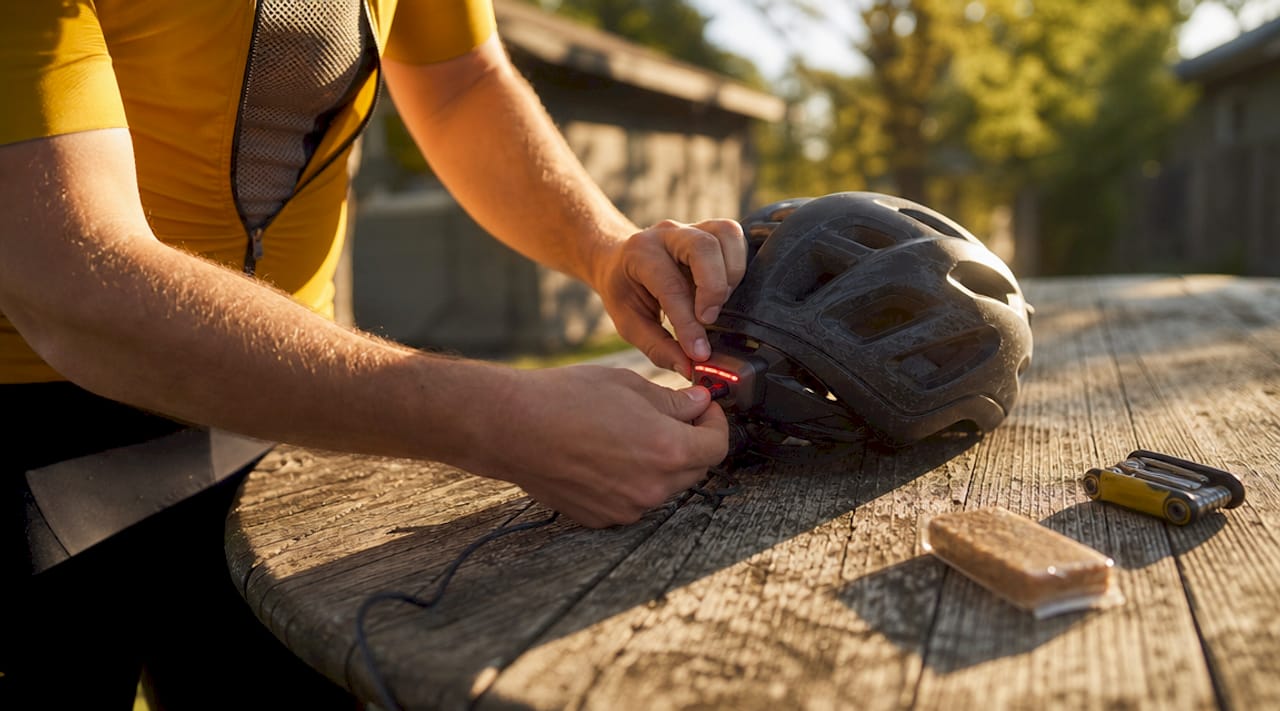
This matters most in urban commuting, where short trips feel low-risk and riders skip the light setup. The ILM USB-rechargeable helmet with its built-in rear LED is a direct example of this philosophy: the light is charged with the helmet, stored with the helmet, and worn with the helmet. The mental model shifts from “did I grab my light?” to “is my helmet charged?” That is a simpler, more reliable system.
Pro Tip: Charge your helmet every time you charge your phone. Pair the two habits and you will never start a ride with a dead rear light.
2. How integrated lights reduce accident risk with real data
The 25% risk reduction from continuous lighting in the Danish study is the most cited figure in cyclist safety research, and it deserves context. That reduction applies to multiparty accidents, meaning collisions involving other road users. The 71% reduction at night is even more significant because low-light conditions are when driver reaction time is most compressed.
Helmet lights contribute to this risk reduction in a specific way: they move with your head. When you check traffic over your shoulder, the light faces oncoming vehicles. When you look left at an intersection, the light signals your presence in that direction. Bar-mounted rear lights are fixed to the bike frame and do not replicate this multidirectional conspicuity. The combination of both systems is what multiple lighting sources provide: redundancy and coverage that a single fixed light cannot match.
- Helmet lights provide conspicuity aligned with head movement
- Fixed bar lights cover the direct rear angle
- Combined systems create overlapping visibility zones
- Consistent use (enabled by integration) is what activates the safety benefit
3. Performance features that define the best integrated systems
Not all integrated helmet lighting performs equally. The ILM helmet’s rear LED is visible from 400 to 500 feet in fast-flash mode, comparable to a 30-lumen clip-on rear light at 15 feet. That is adequate for urban commuting and mixed-light conditions, but it is not a high-output trail light.
At the other end of the spectrum, the Exposure Zenith 4 delivers 2,360 lumens output with multiple modes, USB-C charging, and over three hours of runtime on high settings. That level of output is designed for technical off-road riding where the helmet light serves as a primary illumination source, not just a conspicuity signal. The gap between these two products illustrates the range of what “integrated helmet lighting” covers.
Key performance factors to evaluate before buying:
- Lumen output: 30 to 50 lumens for urban conspicuity; 500 or more for trail illumination
- Battery runtime: Minimum four hours for commuters; longer for multi-hour rides
- Charging port: USB-C is faster and more universal than micro-USB
- Modes: Steady, flash, and high-output modes cover different conditions
- Weight: Heavier lights shift helmet balance; check total helmet weight with the unit attached
Pro Tip: If your helmet light uses USB-C, carry a short USB-C cable in your jersey pocket. A five-minute top-up at a café can add an hour of runtime.
4. Advantages of integrated bike lights for off-road riding
Off-road riding creates a specific visibility problem that bar-mounted lights cannot solve alone. When you corner on a technical trail, your handlebars point straight ahead while your head turns toward the exit of the turn. A bar light illuminates where the bike is going. A helmet light illuminates where you are looking. The Exposure Zenith 4 review from off-road.cc confirms that helmet lights improve cornering visibility by illuminating the trail ahead before the bike is aligned with it.
This is not a marginal benefit on technical terrain. Seeing a root or a rock two seconds earlier is the difference between a clean line and a crash. Helmet lights aligned with head movement give you that preview. For gravel riders and mountain bikers, this functional advantage is arguably more important than the conspicuity benefit that matters most to road and urban cyclists.
The practical setup for off-road riding follows a clear hierarchy:
- Bar-mounted light as primary illumination (high lumen output, fixed beam)
- Helmet-mounted light as directional supplement (follows head movement)
- Integrated rear helmet light for visibility to following riders or vehicles
- Mode selection based on terrain: steady beam for technical sections, flash for open trails with other users
5. Urban commuting benefits of helmet illumination
Urban riding is where integrated lighting systems deliver the most consistent safety return. City commutes involve frequent stops, intersections, and direction changes. Each of those moments is when driver awareness of cyclists is lowest and when head-aligned lighting makes the biggest difference.
The reliability factor is decisive for commuters. A rider who commutes five days a week and occasionally forgets a clip-on light is unprotected on those days. An integrated system removes that variable. The light is either charged and working, or it needs charging. That is a single maintenance task instead of a daily decision. For riders using urban cycling helmets with built-in rear lights, the entire safety setup is managed at the helmet level.
Dense traffic also amplifies the value of multidirectional visibility. When you are surrounded by vehicles at a busy intersection, a rear light that moves with your head signals your presence to drivers in multiple directions simultaneously. A fixed bar light only covers the direct rear arc.
6. Integrated versus clip-on and bar-mounted lights: a direct comparison
Integrated helmet lights are primarily conspicuity tools, not illumination sources. That distinction shapes every comparison with clip-on and bar-mounted alternatives. Bar lights win on raw lumen output. Clip-ons win on modularity. Integrated helmet lights win on consistency and multidirectional coverage.
| Feature | Integrated helmet light | Clip-on rear light | Bar-mounted front light |
|---|---|---|---|
| Consistency of use | Always worn with helmet | Requires separate attachment | Mounted on bike, easy to forget |
| Directional coverage | Follows head movement | Fixed rear angle | Fixed forward angle |
| Lumen output | Low to medium (30 to 2,360) | Low to medium (20 to 100) | High (500 to 2,000+) |
| Charging | Integrated with helmet | Separate device | Separate device |
| Best use case | Conspicuity and cornering | Rear visibility backup | Primary illumination |
| Price range | $50 to $300+ (helmet included) | $15 to $60 | $30 to $200+ |
The recommended approach for most riders is a combined system. Use the integrated helmet light for conspicuity and head-aligned visibility. Use a bar-mounted front light for road illumination. Add a dedicated rear bar light if your route includes long stretches of unlit road. Multiple independent lights create the failsafe redundancy that single-source setups cannot provide.
Pro Tip: When evaluating integrated helmet lights, check whether the light is removable for charging or charges in place. Removable units are easier to manage but add a small risk of being left behind.
7. Practical usability and what riders actually experience
The shift from clip-on to integrated lighting changes the operational focus from “remembering to turn on a light” to “managing fit and battery.” That is a meaningful improvement for most riders, but it introduces its own maintenance habits. Charging flap durability on some helmets degrades over time. Smart helmets with app connectivity add setup complexity that not every rider wants.
Weight distribution matters more than total weight. A 50-gram light positioned at the rear of a helmet changes the balance point differently than the same weight at the front. Riders with longer commutes or aggressive riding positions notice this more than casual riders. Airflow is another factor: some integrated designs reduce ventilation slightly compared to a bare helmet shell.
The usability sweet spot is a helmet where the integrated light charges via USB-C, runs for at least four hours on a standard mode, and adds less than 60 grams to the total helmet weight. Products that meet those criteria, like the ILM helmet for urban riders or the Exposure Zenith 4 for off-road use, demonstrate that the trade-offs are manageable when the integration is well executed. You can also explore reflector-based visibility strategies as a complementary layer to active lighting for maximum night-time coverage.
Key takeaways
Integrated helmet lights deliver their greatest safety value through consistent use and head-aligned visibility, making them the most reliable conspicuity tool available to cyclists.
| Point | Details |
|---|---|
| Consistency beats intensity | Integrated lights are always worn, eliminating the clip-on forgetfulness problem that leaves riders unprotected. |
| Head movement multiplies coverage | Helmet lights follow your gaze, providing multidirectional visibility that fixed bar lights cannot replicate. |
| Data supports the investment | A Danish RCT found continuous lighting reduces multiparty accident risk by 25% overall and 71% at night. |
| Combined systems are the standard | Pair integrated helmet lights for conspicuity with bar-mounted lights for illumination to cover all visibility needs. |
| Match the product to the use case | Urban commuters need 30 to 100 lumens and long battery life; off-road riders need 500 or more lumens with multiple modes. |
What I have learned from riding with integrated lights
I spent two seasons commuting on a fixed-gear bike with only a clip-on rear light before switching to an integrated helmet setup. The difference was not dramatic on any single ride. It was cumulative. I stopped having the “did I grab my light?” moment at the end of the driveway. I stopped arriving at work and realizing the light was still clipped to my previous jacket. That mental overhead disappears completely with an integrated system, and you only notice how much it cost you once it is gone.
The trade-off I did not expect was the charging discipline. A clip-on light with a dead battery is obvious because you pick it up and attach it. A helmet with a dead integrated light is less obvious because you put the helmet on regardless. I now check the charge indicator every morning as part of putting the helmet on. It takes two seconds and has become automatic.
My honest recommendation: do not treat integrated lighting as a replacement for bar lights. Treat it as the layer that never fails. Your bar light might get knocked off, stolen, or left at home. Your helmet light travels with your head every time. That reliability is the actual product you are buying, regardless of the lumen spec on the box.
— Sophie
Upgrade your visibility with Thebeamofficial
Thebeamofficial designs helmets with integrated lighting built around real-world riding conditions, not just spec sheets. The VIRGO integral helmet with MIPS technology combines certified head protection with a focus on visibility features that work across urban commutes, gravel routes, and everyday rides.
Whether you are looking for adults’ helmets with integrated lighting or a kids’ helmet that keeps younger riders visible on every school run, Thebeamofficial’s range covers both. The brand also offers helmet add-ons including reflectors and connected accessories to build out a full visibility system around any helmet in the collection.
FAQ
What are the main advantages of integrated helmet lights?
Integrated helmet lights are always worn with the helmet, eliminating the risk of forgetting a separate clip-on light. They also provide head-aligned visibility that moves with your gaze, covering multiple directions simultaneously.
Do integrated helmet lights replace bar-mounted bike lights?
No. Integrated helmet lights are primarily conspicuity tools with lower lumen output than dedicated bar lights. The recommended setup pairs a helmet light for multidirectional visibility with a bar-mounted light for road illumination.
How much do integrated helmet lights reduce accident risk?
A Danish RCT found that continuous cycling lights reduce multiparty accident risk by 25% overall and by 71% at night. Consistent use, which integrated systems make easier, is what activates that safety benefit.
Are integrated helmet lights useful for off-road riding?
Yes. During cornering on technical terrain, helmet lights illuminate the trail in the direction you are looking before the bike is aligned with that line. The Exposure Zenith 4, with 2,360 lumens output, is designed specifically for this use case.
What battery life should I look for in an integrated helmet light?
For urban commuting, a minimum of four hours on standard mode covers most daily ride scenarios. Off-road riders doing multi-hour sessions should prioritize helmets or add-on lights with USB-C fast charging and runtime above six hours on medium modes.


