

Navigating Paris or Berlin on two wheels means facing busy streets, sudden weather changes, and the need for constant awareness. For cyclists who value both style and safety, the difference between ordinary headgear and an integrated helmet is clear. Integrated helmet design transforms protection and connectivity into a single package, offering smart features that respond to real accidents and the real world. Discover how this new generation of helmets meets the demands of modern European city riding.
Table of Contents
- Integrated Helmet Design Explained And Debunked
- Types Of Integrated Helmets For Cyclists
- Innovative Features And Real-World Benefits
- Comparing Integrated And Conventional Helmets
- Key Safety Standards And User Responsibilities
Key Takeaways
| Point | Details |
|---|---|
| Integrated Helmet Design | Combines various safety and technology features for improved urban cycling protection. |
| Active Safety vs. Passive Protection | Integrated helmets use real-time monitoring to prevent accidents, unlike traditional helmets which only provide passive protection. |
| User Engagement Required | To fully benefit from integrated features, users must actively configure and maintain the helmet’s safety functions. |
| Value Based on Riding Style | Choose a helmet that aligns with your commuting environment and the specific safety features you will utilize regularly. |
Integrated Helmet Design Explained and Debunked
Integrated helmet design isn’t marketing fiction—it’s a fundamental shift in how helmets protect urban cyclists. This approach combines protection technology, smart features, and real-world usability into a single, cohesive system.
What Integrated Design Actually Means
Integrated design means every component works together intentionally. Your helmet isn’t just a shell anymore; it’s a coordinated system where safety features, materials, and technology collaborate seamlessly.
Here’s what true integration includes:
- Multi-layer protection systems that absorb and distribute impact energy across the entire structure
- Sensor and monitoring technology that detects risky situations instantly and enables immediate response
- Aerodynamic architecture designed specifically for urban cycling speeds and conditions
- Visibility enhancements including reflective elements and compatible mounting points for safety accessories
- Smart connectivity that communicates with your phone or emergency services when needed
When these elements work independently, you get a helmet. When they work together, you get protection that actually responds to how you ride.
The Technology Behind the Design
Modern integrated helmets leverage advanced materials and real-time monitoring systems. Rather than waiting for an accident to happen, smart helmet systems help prevent accidents by detecting dangerous situations before they become critical.
This means your helmet can:
- Monitor your riding patterns and environmental conditions
- Alert you to hazards or poor visibility situations
- Connect with emergency services if an impact occurs
- Track data that improves safety over time
The integration of these technologies transforms your helmet from passive protection into active safety.
Integrated design works because every feature serves multiple purposes: better aerodynamics improve comfort, which increases helmet-wearing compliance, which reduces injury rates.
Debunking Common Misconceptions
“Integrated helmets are heavier and uncomfortable.” Smart integration actually reduces weight by eliminating redundant materials. A well-designed integrated helmet feels lighter than traditional models because airflow and weight distribution improve significantly.
“Smart features drain quickly and fail when you need them.” Modern integrated helmets use efficient power systems with battery life exceeding 50 hours of typical use. They’re engineered for reliability, not fashion.
“Integration means losing traditional safety features.” The opposite is true. Integration enhances core protection while adding capabilities. MIPS technology, foam construction, and impact absorption remain priorities—technology layers on top of solid fundamentals.
“Only professional cyclists need these features.” Urban commuters actually benefit most. City cycling involves unpredictable traffic, variable lighting, and split-second decisions where integrated safety systems deliver measurable advantages.
Real-World Application for Urban Commuters
Your daily commute in Berlin or Paris involves specific challenges: crowded streets, variable weather, and constant visibility concerns. Integrated design directly addresses these scenarios.
Consider how an integrated helmet responds to your actual riding:
- Reflective systems and mounting points for rear-view accessories improve visibility without requiring separate purchases
- Temperature-responsive ventilation adjusts airflow based on conditions
- Impact detection alerts emergency contacts automatically
- Compatibility with lights and sensors creates a unified safety ecosystem
This differs fundamentally from buying a basic helmet plus separate accessories. Integration means these elements communicate and function as one system.
Why Integration Matters More Than Individual Features
A helmet with ten disconnected features is less effective than one where five features work together. Integration reduces complexity for users while increasing protection outcomes.
You shouldn’t need an engineering degree to use your helmet’s safety features. Well-integrated design makes safety intuitive.
Pro tip: When evaluating integrated helmets, test how easily the system works during your actual commute—check visibility improvements, assess comfort during typical riding conditions, and confirm that connectivity features integrate with your phone without requiring constant attention.
Types of Integrated Helmets for Cyclists
Integrated helmets aren’t a single category—they’re a spectrum of designs, each tailored to specific riding styles and safety needs. Understanding the differences helps you choose protection that matches your actual commute.
Urban Commuting Helmets with Smart Features
These helmets target city cyclists navigating traffic, pedestrians, and variable conditions. They combine traditional protection with connectivity and visibility enhancements.
Urban integrated helmets typically include:
- Impact detection systems that alert emergency contacts automatically
- Integrated lighting mounts for front and rear safety accessories
- Reflective patterning built into the shell design
- MIPS technology for multi-directional impact protection
- Ventilation optimized for stop-and-go city riding
These helmets prioritize practicality over race-focused features. Your commute in Paris or Berlin demands quick response times and reliable visibility—urban integrated designs deliver exactly that.
Aerodynamic Integration for Speed-Focused Riding
Some integrated helmets emphasize aerodynamic design without sacrificing safety technology. These work well if your urban commute includes faster sections or road cycling.
Aerodynamic integrated helmets feature:
- Streamlined shapes that reduce wind resistance
- Integrated ventilation channels for high-speed cooling
- Lightweight materials without compromising protection
- Aero-optimized visor designs
The key difference from traditional aero helmets: these add safety monitoring without the weight penalty or cost of separate systems.

Smart Helmets with Advanced Connectivity
The most technologically advanced integrated helmets function almost like wearable devices. They combine protective features with electronic systems that communicate in real time.
These premium integrated helmets can:
- Monitor your location and share it with emergency contacts
- Detect falls and automatically notify services
- Provide turn-by-turn navigation through audio
- Track riding metrics and safety data
- Integrate with your smartphone ecosystem
These work best if you want comprehensive safety coverage beyond traditional impact protection. The investment is higher, but so is the protection ecosystem.
Multi-Purpose Integrated Helmets
Some integrated designs work across multiple cycling disciplines—commuting, gravel riding, and casual cycling. These are versatile choices if your riding varies.
Multi-purpose integrated helmets balance:
Here’s a comparison of integrated helmet types to help you choose the best fit for your riding style:
| Helmet Type | Core Strength | Best For | Technology Level |
|---|---|---|---|
| Urban Commuting | Maximum visibility, quick emergency response | Daily city riding | Intermediate: smart sensors, basic connectivity |
| Aerodynamic Integration | Low wind resistance, cooling | Fast urban or road commutes | Moderate: vent channels, speed tracking |
| Smart Connectivity | Comprehensive safety and data tracking | Tech-focused riders | Advanced: live navigation, auto alerts |
| Multi-Purpose | Versatile, adaptable features | Mixed and casual use | Balanced: comfort, practical mounts |
- Standard protection across varied impact scenarios
- Moderate aerodynamics without extreme shape
- Flexible mounting points for different accessories
- Comfortable padding for extended wear
The best integrated helmet for you isn’t the most advanced one—it’s the design that matches how you actually ride and what safety features you’ll consistently use.
How to Choose Between Types
Your choice depends on three factors: riding environment, budget, and which features you’ll actually engage with.
Consider these questions:
- Do you primarily ride urban streets, or mix commuting with longer rides?
- Which safety features matter most: visibility, impact detection, or emergency connectivity?
- How much weight and complexity can you comfortably manage daily?
- What’s your budget range for integrated protection?
Multi-directional impact protection systems like MIPS appear across all integrated helmet types, so don’t let advanced connectivity overshadow this fundamental protection.
Urban commuters often benefit most from practical smart features like impact detection and integrated light mounting rather than high-end connectivity. Your actual commute matters more than the helmet’s maximum capabilities.
Pro tip: Test integrated helmets during real commutes before committing—impact detection reliability, light mounting compatibility, and connectivity stability matter far more in practice than specification sheets suggest.
Innovative Features and Real-World Benefits
Integrated helmet features sound impressive on paper, but what matters is whether they actually protect you during your daily commute. The gap between marketing claims and real-world performance is where truth emerges.
Impact Protection That Works
The foundation of any integrated helmet remains impact absorption. Modern integrated designs incorporate MIPS technology, which addresses a problem traditional helmets ignore: rotational forces during crashes.
When your head strikes pavement at an angle—which happens in most real accidents—your brain experiences rotational movement inside the skull. MIPS technology mitigates rotational forces that cause concussions and serious brain injuries.
Integrated helmets improve protection by:
- Using multi-directional foam that absorbs varied impact angles
- Reducing both linear acceleration and rotational velocity during crashes
- Maintaining protection across multiple impact types urban cyclists encounter
- Combining traditional shell protection with advanced energy absorption
This isn’t theoretical. Real-world testing shows integrated helmets reduce injury severity measurably compared to conventional designs.
Crash Detection and Emergency Response
One genuine advantage of integrated helmets: they detect when you’ve crashed and respond immediately. This matters far more than it sounds.
If you lose consciousness, no one knows you need help. Crash sensors integrated into modern helmets identify impacts and automatically alert emergency contacts or services with your location.
The real-world benefit: smart sensors detect crashes and communicate emergency alerts, reducing response times from hours to minutes. That difference saves lives.
Integrated detection systems provide:
- Immediate location sharing with emergency contacts
- Automatic emergency service notification
- Confidence that help arrives faster if you’re injured
- Peace of mind during solo commutes
Crash detection works silently in the background—you’ll never know it functioned unless you actually need it, which is exactly how safety systems should operate.
Visibility Integration
Many integrated helmets include built-in reflective systems and mounting points for lights and accessories. This seems simple, but it addresses a real problem: visibility accessories often fall off or get forgotten.
Integrated visibility means:
- Reflective elements positioned for maximum rear visibility
- Secure attachment points for lights that won’t loosen or fail
- Unified design where every safety component stays in place
- No need to remember separate accessories for different routes
Urban commuting in Germany or France means winter darkness and variable weather. Integrated visibility features remain reliable when separate accessories deteriorate or detach.
Consistent Helmet Wearing
Here’s a benefit many overlook: integrated features encourage consistent helmet use. If your helmet provides real value beyond basic protection—like emergency alerts or light integration—you’re more likely to wear it every ride.
This matters because helmet effectiveness depends entirely on actually wearing it. Features that make helmets more useful increase compliance rates significantly.
Comfort and Practicality
Advanced protection means nothing if you abandon your helmet because it’s uncomfortable. Integrated designs balance technology with wearability through improved ventilation and weight distribution.
Real benefits include:
- Better air circulation for stop-and-go city riding
- Lightweight materials that feel natural during commutes
- Padding systems that remain comfortable for extended wear
- Integration that doesn’t add bulky external components
You’ll actually wear an integrated helmet that combines safety with comfort far more consistently than helmets requiring sacrifice on either front.
Pro tip: Test integrated helmets during your actual commute route and typical riding duration before deciding—crash detection reliability and comfort matter more than feature count when real protection is needed.
Comparing Integrated and Conventional Helmets
Choosing between integrated and conventional helmets means understanding what you’re actually gaining—and what trade-offs matter. This isn’t about one being objectively better; it’s about matching your needs and priorities.
Foundation: What Both Helmets Do
Both integrated and conventional helmets protect your head through impact absorption. They use foam liners and hard outer shells to dissipate energy when you crash.
Conventional helmets excel at this fundamental purpose. They’ve been refined for decades, tested extensively, and proven effective at reducing serious head injuries. Conventional helmets mainly focus on impact absorption through foam liners and hard shells that meet rigorous safety standards.
Integrated helmets retain this same core protection. They don’t replace it; they build on top of it with additional features.
The Addition: What Integrated Helmets Add
Integrated helmets layer technology onto solid protective foundations. This creates advantages conventional helmets simply don’t offer.
Key additions include:
- Crash detection systems that automatically alert emergency contacts
- Real-time environmental sensors that identify hazards
- Enhanced force distribution reducing rotational injury risk
- Integrated visibility features with permanent reflective elements
- Connectivity that shares location and impact data
These features exist outside traditional helmets. If you want them, you typically buy separate accessories—which may fail, detach, or get forgotten.
Cost Reality
Integrated helmets cost significantly more than conventional models. A quality conventional helmet runs €80–150, while integrated designs start around €250 and climb substantially higher.
That price difference reflects:
- Advanced materials and multi-layer construction
- Sensor technology and electronic components
- Battery systems and wireless connectivity
- Enhanced testing and reliability standards
- Smaller production volumes
For budget-conscious commuters, a conventional helmet remains the practical choice. For those prioritizing comprehensive safety, the additional cost provides measurable value.
The best helmet is the one you’ll actually wear consistently—whether integrated or conventional, comfort and reliability matter more than features you won’t use.
Reliability and Durability Comparison
Conventional helmets are exceptionally reliable because they contain no electronic components. They work identically after five years or fifty years.
Integrated helmets depend on battery life, sensor accuracy, and wireless connectivity. Integrated designs incorporate sensors and enhanced force mitigation technologies that require maintenance and eventual replacement.
Considerations:
- Battery replacement typically required annually
- Sensor calibration drifts over time
- Wireless connectivity depends on phone proximity
- Software updates necessary for optimal function
- Traditional impact protection remains unaffected if electronics fail
Conventional helmets skip these concerns entirely.
To clarify helmet choices, here are key differences between integrated and conventional helmets:
| Aspect | Integrated Helmets | Conventional Helmets |
|---|---|---|
| Safety Monitoring | Real-time, automatic alerts | Manual, no monitoring |
| Visibility Features | Built-in, always present | Requires add-ons |
| Maintenance Needs | Regular charging, software updates | Minimal, just physical inspection |
| Upfront Cost | $250+ typical | $90–$150 typical |
Weight and Comfort
Modern integrated helmets weigh only slightly more than conventional designs—typically 50–100 grams additional. This minimal difference rarely affects comfort during commuting.
Both helmet types distribute weight across your head and neck similarly. The real comfort factor is helmet fit, padding quality, and ventilation—features present in both categories.
Real-World Practicality
Conventional helmets require deliberate safety choices. Want reflective visibility? Buy separate reflectors. Need a rear light? Purchase and install additional accessories. Need emergency contact notification? That’s not possible.
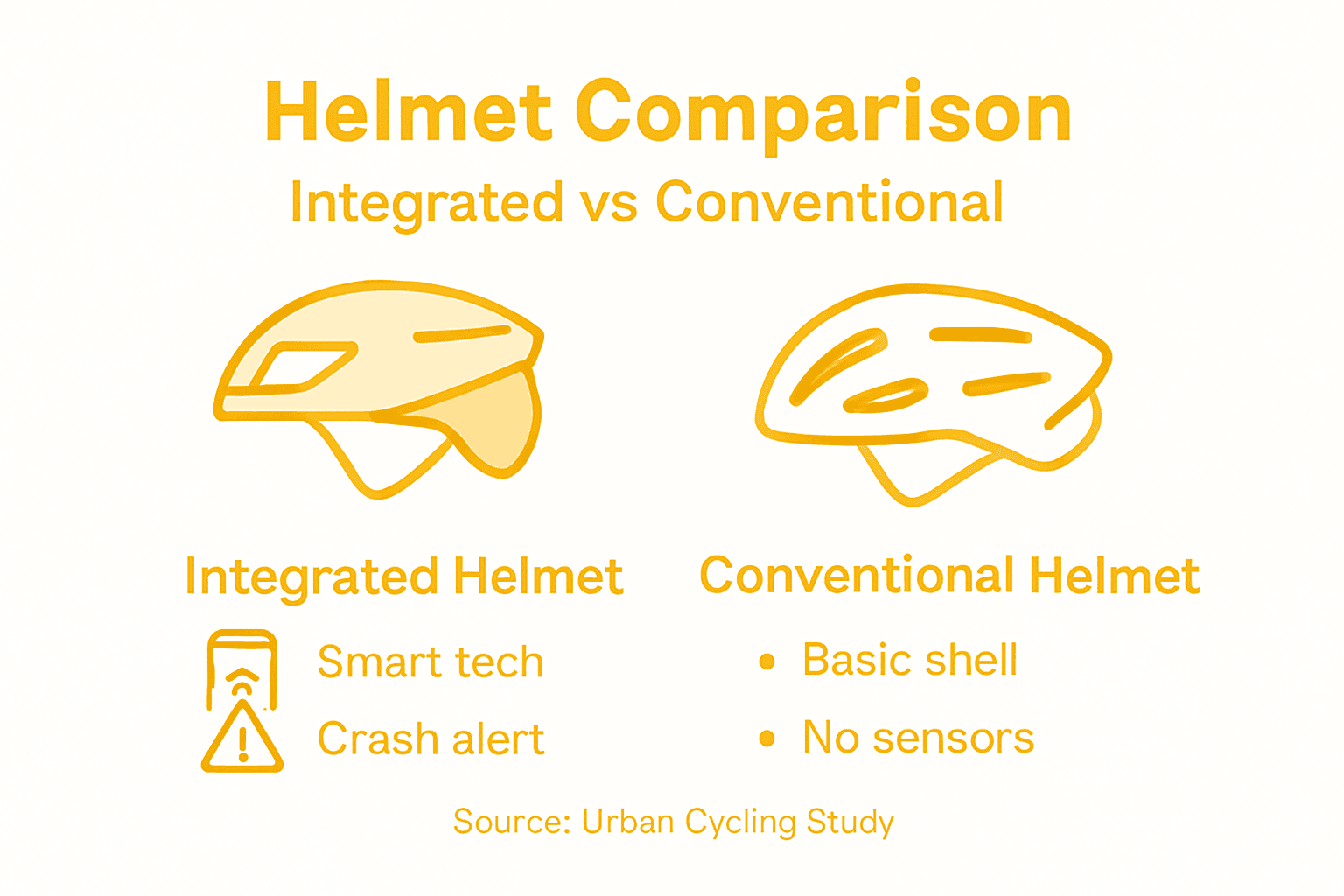
Integrated helmets handle these automatically. No remembering separate accessories. No wondering if visibility enhancement works properly. No gaps in your safety approach.
For Paris and Berlin urban commuting, where you face variable traffic, winter darkness, and solo riding, integrated helmets simplify safety management considerably.
Making Your Decision
Choose integrated helmets if:
- You prioritize comprehensive safety features
- You ride regularly in variable visibility conditions
- Emergency notification matters to you
- You prefer unified systems over separate accessories
- Budget allows for higher upfront costs
Choose conventional helmets if:
- Core impact protection satisfies your safety needs
- You prefer mechanical simplicity and reliability
- Budget constraints matter
- You supplement with separate visibility accessories
- You value zero-maintenance operation
Neither choice is wrong. Both provide real protection. Your decision should align with your actual commuting patterns and safety priorities.
Pro tip: Test both helmet categories during your typical commute before deciding—the comfort and fit matter far more than the technology choice, so wear-test candidates for several rides to verify they stay comfortable when you need them most.
Key Safety Standards and User Responsibilities
Your helmet is only effective if it meets rigorous safety standards and you use it correctly. Understanding these requirements ensures your investment actually protects you when accidents happen.
Understanding Safety Standards
Multiple safety organizations test helmets using different methodologies and impact scenarios. Your integrated helmet must comply with standards relevant to your region.
Major standards include:
- CPSC (United States)
- EN 1078 (European standard)
- ASTM F 1447 (American standard)
- Snell Memorial Foundation (highest impact standard)
European helmets commonly meet EN 1078, which tests impact absorption, retention system strength, and vision field requirements. Integrated helmets must comply with safety benchmarks ensuring physical protection plus additional criteria for electronic components.
When purchasing, verify your helmet carries certification marks from relevant authorities. A beautiful helmet without certification provides minimal protection.
Standards for Integrated Features
Traditional safety testing covers impact absorption and structural integrity. Integrated helmets add complexity: electronic components, sensors, and connectivity systems require separate validation.
Manufacturers must verify:
- Battery safety and thermal performance
- Sensor accuracy and calibration standards
- Wireless connectivity interference limits
- Impact detection reliability thresholds
- Emergency alert system functionality
Not all integrated helmets meet equal standards. Budget models may skip rigorous testing of electronic components. Premium integrated helmets undergo comprehensive validation of both physical and technological systems.
When evaluating integrated options, ask manufacturers for test reports covering electronic features, not just traditional impact protection.
Legal Requirements Across Regions
France and Germany have specific helmet regulations. Legal standards specify age groups and usage requirements to enhance cyclist safety across populations.
In France, cyclists under 12 years old must wear helmets. Germany recommends helmets but doesn’t legally mandate them for adults. Regardless of legal status, helmet-wearing significantly reduces injury severity.
Check your local regulations before purchasing. Some regions require specific certification marks that may differ from your helmet’s compliance.
Your Responsibility: Proper Fitting
A poorly fitting helmet provides minimal protection. The helmet must sit level on your head, covering your forehead without tilting backward or forward.
Correct fit requires:
- Two-finger gap between eyebrows and helmet edge
- Chin strap snug without restricting movement
- Helmet not moving when you shake your head
- Padding contacting your head evenly
Many people wear helmets incorrectly. Take time during purchase to adjust straps properly. Your local bike shop can verify fitting if you’re uncertain.
A helmet worn incorrectly offers false security—proper fitting takes five minutes and determines whether your helmet actually protects you during crashes.
Maintenance and Replacement Responsibilities
Helmets deteriorate with time and impact. After any crash, internal foam structure may be compromised even if exterior damage isn’t visible.
Your responsibilities:
- Replace helmets after significant impacts
- Check padding annually for compression or deterioration
- Replace battery in integrated helmets annually
- Test crash detection monthly if available
- Store helmets away from extreme heat
- Clean straps and padding regularly
Integrated helmets require additional attention. Verify wireless connectivity works monthly. Confirm sensors respond properly. Update software when manufacturers release patches.
Engaging with Integrated Safety Features
Integrated helmets only protect you if you actively use them. Setting up crash detection, configuring emergency contacts, and enabling notifications takes initial effort.
Your responsibilities include:
- Configuring emergency contact information
- Enabling crash detection before every ride
- Keeping your smartphone nearby for alerts
- Testing connectivity regularly
- Charging batteries on schedule
- Responding to app notifications
If you won’t engage with these features, a conventional helmet may actually serve you better. Protection requires active participation with integrated systems.
Documentation and Proof of Compliance
Keep purchase documentation showing your helmet’s certification. Some regions require proof of compliant equipment. Insurance claims may depend on documented compliance.
Store packaging that shows:
- Certification marks and standards met
- Manufacturer contact information
- Purchase date and retailer
- Model and size specifications
Pro tip: Photograph your helmet’s certification labels and serial numbers immediately after purchase—this documentation proves compliance and aids warranty claims or insurance disputes if you’re injured in an accident.
Discover Integrated Helmet Safety Designed for Real Urban Riders
Urban cycling safety demands helmets that do more than just protect your head at impact. This article highlights critical challenges like crash detection, visibility, and comfort during city commutes in places such as Germany and France. If you seek a helmet that combines MIPS technology, advanced impact absorption, and smart integration to respond to your unique ride, it is time to upgrade your gear.

Explore THE BEAM’s collection of cutting-edge helmets tailored for adults who demand both protection and real-world usability. Our flagship VIRGO integral helmet is engineered with integrated safety features that improve visibility and crash response so you can ride confidently. Take control of your urban safety today by visiting Adults’ Helmets – The Beam, browse our entire HELMETS – The Beam range, or learn more about the brand at the official site. Elevate your ride with innovation built for your everyday commute.
Frequently Asked Questions
What is integrated helmet design?
Integrated helmet design combines various safety technologies, materials, and smart features into a cohesive system that enhances protection and usability for urban cyclists.
How does integrated helmet technology prevent accidents?
Integrated helmets utilize real-time monitoring systems that detect hazardous conditions and can alert the rider or emergency services, helping to prevent accidents before they occur.
Are integrated helmets heavier or less comfortable than traditional helmets?
No, integrated helmets often reduce weight and enhance comfort by eliminating unnecessary materials. Their design improves airflow and weight distribution, making them feel lighter than traditional helmets.
What features should I look for in an integrated helmet?
Look for features such as impact detection systems, integrated lighting for visibility, MIPS technology for rotational protection, and smart connectivity options that can alert emergency contacts in case of a crash.


