

Riding through the crowded streets of Paris or Berlin means every trip holds surprises, from abrupt car doors to fast-moving scooters. For safety-conscious cyclists, helmet design is about much more than appearance. Well-crafted helmets offer real protection, with research showing that helmeted cyclists are 60% less likely to sustain serious head injuries in crashes. Discover how innovative materials and smart features can make your city rides safer and more comfortable without sacrificing your sense of style.
Table of Contents
- What Helmet Design Means For Cyclist Safety
- Types And Features Of Modern Helmets
- Material Innovations And Protective Technologies
- Balancing Style, Comfort, And Urban Usability
- Standards, Testing, And Common Design Misconceptions
Key Takeaways
| Point | Details |
|---|---|
| Helmet Design Matters | A well-designed helmet can significantly reduce the risk of serious head injuries by absorbing impact forces efficiently. |
| Urban Considerations | Urban cycling presents unique risks; helmets should offer features like visibility enhancement and comfort to encourage regular use. |
| Modern Features | Look for helmets with advanced technologies, such as rotational impact protection and smart features, to enhance safety and usability. |
| Understanding Standards | Familiarize yourself with helmet certification standards to ensure adequate protection and prioritize helmets designed for real-world crash scenarios. |
What Helmet Design Means for Cyclist Safety
Helmet design is not just about aesthetics—it’s about preventing serious injury when crashes happen. A well-designed helmet absorbs impact forces that would otherwise transfer directly to your skull and brain. The difference between a mediocre design and an innovative one can determine whether you walk away with minor scrapes or suffer a life-altering head injury.
Your helmet works by redirecting and dispersing crash energy. The outer shell spreads impact across a wider area, while the foam padding underneath compresses to absorb shock. Modern helmets go beyond this basic principle with advanced features that address real-world cycling scenarios.
How Design Protects Your Head
Data shows that helmeted cyclists are 60% less likely to sustain serious head injuries in crashes. The protection improves further in high-risk situations—exactly what urban commuters face daily in dense traffic.
Well-designed helmets offer several critical protections:
- Rotational impact reduction through technologies like MIPS, which allows the helmet to move slightly during angled impacts
- Multi-directional coverage that protects the sides and back of your head, not just the top
- Optimized foam density that responds differently to low-speed and high-speed impacts
- Ventilation channels that prevent heat buildup without compromising structural integrity
- Weight distribution that keeps pressure points minimal during extended wear
Your helmet’s effectiveness depends on both material science and thoughtful engineering that considers how real crashes actually happen.
Urban cycling presents unique dangers. You’re navigating narrow streets, dodging parked cars, and riding at moderate speeds through congested areas. Unlike road cycling crashes at high speeds or mountain biking falls from standing heights, urban impacts often involve angled collisions with vehicles or pavement at varied angles.
Innovative design addresses these specific scenarios. When you understand how certification standards test helmets, you’ll see that modern certifications finally account for rotational forces, not just vertical drops.
Design Features That Matter in Cities
Several design elements become critical when you’re cycling through Paris, Berlin, or any congested European city:
- Integrated visibility design with reflective surfaces positioned where cars actually look
- Low-profile shape that fits under urban commute practicality
- Quick-fit adjustment systems you can operate with gloves on
- Comfort engineering that encourages daily use rather than discouraging it
- Durability testing that accounts for repeated small impacts from urban obstacles
Comfort matters more than you might think. If your helmet feels restrictive or hot, you’re more likely to skip it on short trips. Poor design discourages consistent use, which eliminates protection entirely.
Research on helmet effectiveness reveals that protection improves across all age groups and crash types when helmets are actually worn. The best helmet design is one you’ll actually use every commute.
Pro tip: Test a helmet’s comfort by wearing it for 30 minutes before buying—pressure points become obvious during longer sessions, and you’ll know if you’ll genuinely wear it daily.
Types and Features of Modern Helmets
Modern helmet design has evolved far beyond the basic foam shell your parents wore. Today’s urban cycling helmets incorporate multiple protective technologies, sustainable materials, and smart features that address the specific dangers you face commuting through congested European streets.
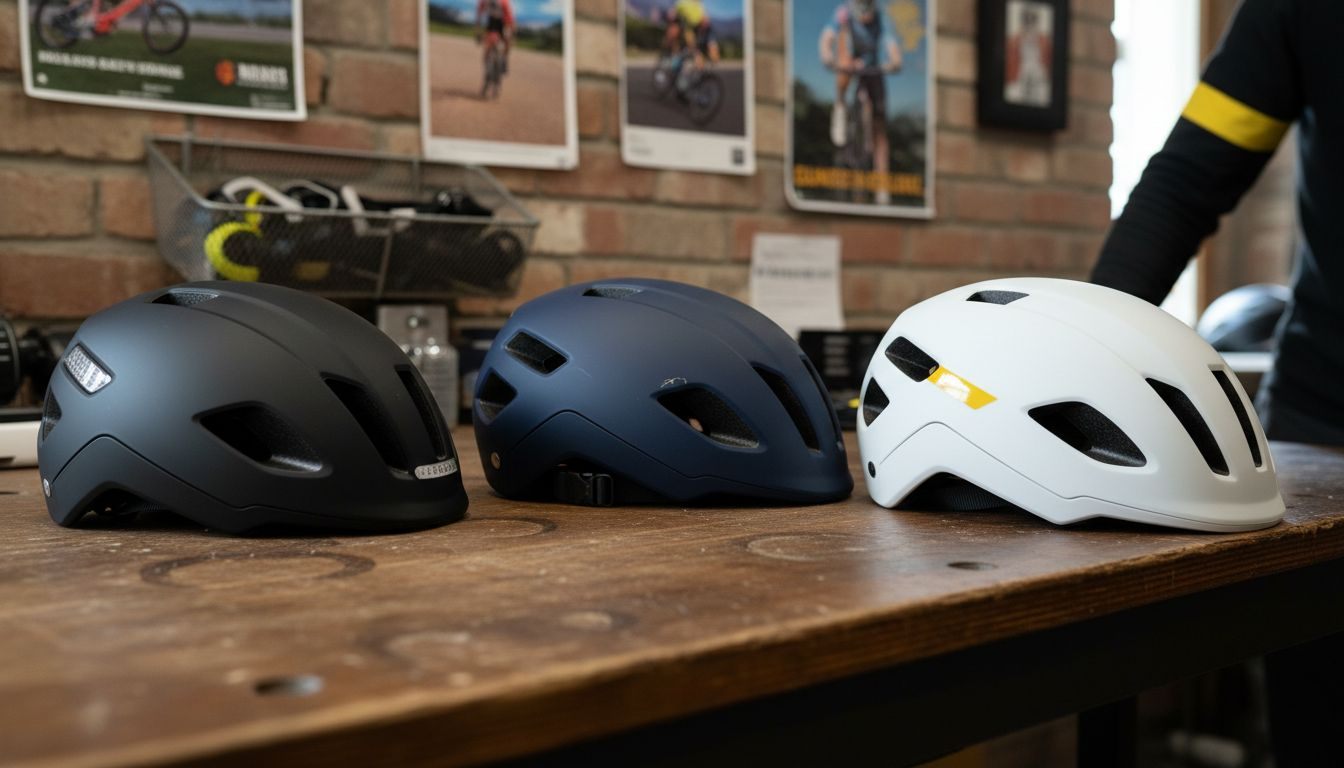
The diversity of helmet types means you can find one engineered specifically for your riding style. Whether you’re a daily commuter, an e-bike rider, or someone navigating mixed traffic, modern helmets offer specialized protection and features tailored to your needs.
Core Helmet Categories for Urban Cycling
Urban helmets differ fundamentally from road or mountain bike helmets. They prioritize visibility, comfort for frequent stops, and protection from side impacts—the crashes that actually happen in city traffic.
Key types include:
- Urban commute helmets with integrated lights and reflective surfaces
- E-bike helmets designed for the higher speeds and weights involved in electric cycling
- Compact folding helmets that collapse for easy storage in bags or backpacks
- All-terrain urban helmets offering protection for mixed surfaces and varied traffic conditions
Each category emphasizes different protective features. A road helmet prioritizes aerodynamics; an urban helmet prioritizes crash survivability in realistic scenarios.
Here’s how core helmet categories address urban cycling needs:
| Category | Primary Focus | Unique Features | Best For |
|---|---|---|---|
| Urban commute helmet | Visibility and comfort | Integrated lights, reflectors | Daily city rides |
| E-bike helmet | High-speed protection | Reinforced shell, electronics | Electric bike commutes |
| Compact folding helmet | Portability and convenience | Collapsible structure, storage | Space-limited commutes |
| All-terrain urban | Versatile protection | Mixed surface design, durability | Multi-route cyclists |
Innovation in Materials and Design
Manufacturers are moving beyond traditional foam liners. Recent developments include cork-based protective liners that provide excellent impact absorption while offering ecological benefits. These materials often enable collapsible designs that maintain safety standards while improving portability.
Modern helmets balance protection, sustainability, and the practical reality of daily urban commuting—you need something that actually fits your lifestyle.
Materials matter because they determine how your helmet performs across different impact scenarios. Advanced foam compounds respond differently to low-speed collisions versus high-impact crashes, protecting you across the full range of urban cycling accidents.
Smart Helmet Technology
The newest innovation reshaping helmet safety is smart helmet integration with sensors and connectivity features. Modern smart helmets include accident detection systems, GPS tracking, Bluetooth communication, and rear-view cameras.
These features enhance urban safety by:
- Detecting crashes automatically and alerting emergency contacts
- Providing navigation feedback through haptic vibrations, keeping your eyes on the road
- Monitoring environmental awareness with rear cameras and sensors
- Recording riding data that helps you improve your commute habits
- Enabling visibility features like integrated rear lights or turn signals
Smart helmets transform a passive safety device into an active protection system that works with your commute, not against it.
Feature Selection for Your Commute
When evaluating modern helmets, consider which features actually matter for your specific riding conditions. A commuter in Berlin facing aggressive traffic has different needs than someone cycling leisure routes through parks.
Priority features vary by situation:
- Dense urban traffic: advanced ventilation, visibility integration, quick adjustment
- Longer commutes: comfort engineering, weight distribution, aerodynamic design
- Mixed conditions: versatile protection, durable construction, integrated lights
- E-bikes: reinforced structure for higher speeds, integrated electronics compatibility
The best helmet combines protection with features you’ll actually use consistently.
Pro tip: Choose a helmet with one or two smart features that genuinely improve your commute—like rear cameras or accident detection—rather than overwhelming technology you’ll ignore after the first month.
Material Innovations and Protective Technologies
Helmet materials have undergone a fundamental transformation. The foam and plastic shells from decades past are being replaced by engineered compounds and sustainable alternatives that provide superior protection while addressing environmental concerns. Understanding these innovations helps you choose a helmet that truly protects your head in real-world urban crashes.
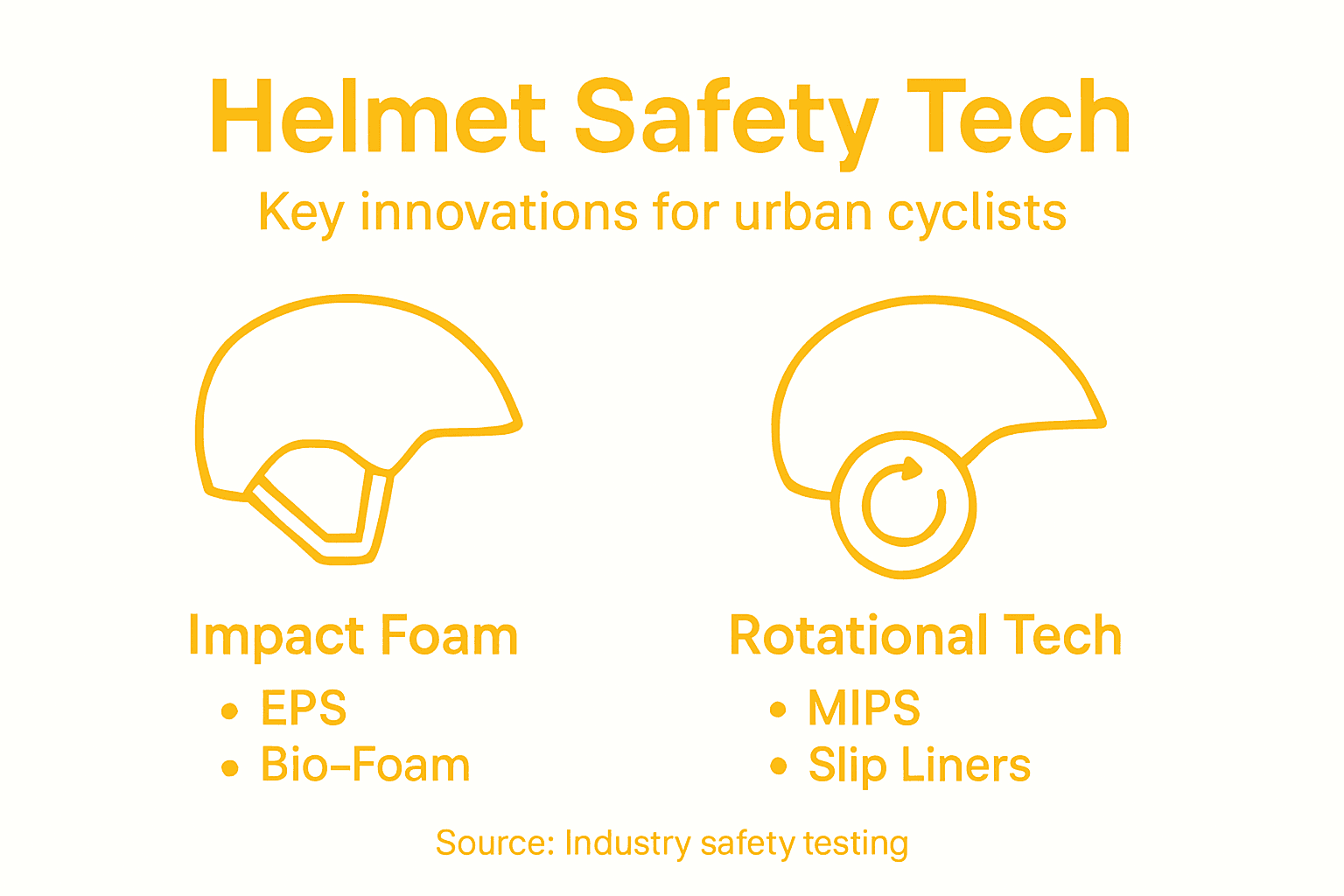
Modern protective technologies extend far beyond traditional foam liners. Manufacturers now layer multiple materials, each designed to handle different types of impact forces that occur during actual urban cycling accidents.
The Evolution of Protective Materials
Traditional expanded polystyrene (EPS) foam has dominated helmet construction for years. It works by compressing on impact to absorb energy, but it has limitations. Once compressed, it loses effectiveness and must be replaced after a single significant crash.
Newer materials offer distinct advantages:
- Multi-density foam compounds that respond differently to varied impact speeds
- Cork-based liners providing superior multi-impact protection and recyclability
- Layered composite structures combining materials for optimized energy absorption
- Viscoelastic polymers that adjust stiffness based on impact velocity
- Rotational damping materials that reduce twisting forces on the brain
Each material choice influences how your helmet protects you during crashes. The best helmets combine multiple materials strategically to handle the complex physics of real impacts.
Here’s a quick reference to modern helmet material technologies:
| Material | Key Advantage | Urban Benefit | Limitation |
|---|---|---|---|
| Multi-density foam | Adapts to impact speed | Handles varied crashes | May add complexity |
| Cork-based liner | Multi-impact, sustainable | Better for frequent use | Can be heavier |
| Composite structure | Optimized energy absorption | Superior protection | Higher cost |
| Viscoelastic polymer | Adjusts to crash severity | Improved comfort | Limited recyclability |
| Rotational damping | Reduces brain twisting kinematics | Protects in angled impacts | May lack ventilation |
Understanding Rotational Impact Protection
Traditional helmet testing focused on linear acceleration—how fast your head decelerates in a straight line. But real crashes aren’t straight line impacts. When your head hits pavement at an angle or collides with a vehicle, rotational forces twist your brain inside your skull.
These rotational forces cause severe brain injuries that linear-only protection cannot prevent. Advanced research shows that rotational kinematics require new safety criteria beyond traditional impact testing standards.
Modern helmets must protect against both linear acceleration and rotational forces—the twisting motion that causes the most severe brain injuries.
Protective technologies addressing rotational impacts include slip-plane liners that allow controlled movement and specially engineered foam that absorbs twisting energy differently than straight-line impacts.
Material Selection for Urban Conditions
Urban cycling presents specific material challenges. Your helmet faces repeated minor impacts from potholes, curbs, and tight spaces. It needs ventilation to prevent heat buildup during stop-and-go traffic. It must withstand moisture and temperature changes across European seasons.
Materials chosen for urban helmets account for:
- Durability across repeated small impacts rather than single catastrophic crashes
- Ventilation efficiency without compromising protective structure
- Weather resistance for rain, humidity, and temperature variation
- Weight management for comfortable all-day wear
- Sustainability and recyclability at end of life
Cork and bio-based foams excel in urban applications because they handle repeated impacts better than synthetic foams while remaining environmentally responsible.
Smart Material Integration
The newest innovations embed sensing capabilities directly into protective materials. Pressure-sensitive foams can detect impact severity in real time. Materials with integrated accelerometers provide crash data to emergency contacts instantly.
These smart materials maintain protective function while adding safety monitoring capabilities that traditional helmets cannot provide.
Pro tip: Look for helmets with multi-material construction that specifically mentions rotational protection—this indicates the manufacturer understands modern crash science, not just traditional linear impact testing.
Balancing Style, Comfort, and Urban Usability
A helmet is only effective if you actually wear it. This simple truth drives modern helmet design—protecting your head means nothing if discomfort or inconvenience keeps you from putting on your helmet for daily commutes. The best innovations address the real barriers urban cyclists face: heat, weight, storage, and aesthetics.
Urban helmet design recognizes that you’re not racing down mountains. You’re navigating crowded streets, stopping at lights, and managing a helmet that needs to fit your lifestyle, not fight against it.
The Comfort Challenge
Traditional helmets prioritize protection while treating comfort as secondary. This creates a fundamental problem—helmets that feel heavy, hot, or awkward get left behind. Research shows that perceived discomfort and inconvenience represent major barriers to helmet adoption among urban cyclists.
Modern urban helmets address comfort through:
- Advanced ventilation systems with strategically positioned channels that move air without reducing protection
- Lightweight materials that distribute weight across your head rather than concentrating pressure points
- Moisture-wicking liners that prevent sweat buildup during stop-and-go commuting
- Adjustable fit systems you can operate with gloves or one hand
- Ergonomic padding designed for extended wearing periods
Comfort engineering isn’t about sacrificing protection—it’s about recognizing that a helmet sitting at home offers zero protection.
Style and Social Acceptance
Your helmet’s appearance influences whether you’ll wear it consistently. In European cities, cycling culture varies significantly. A helmet design that looks natural in Berlin might feel out of place in Paris. Modern manufacturers acknowledge this by offering diverse aesthetic options that appeal to different cycling communities.
Style factors that matter for urban use:
- Visual integration with your commute clothing and bike setup
- Color options from understated neutrals to bold statements
- Sleek profile that doesn’t overwhelm your head visually
- Finishes that feel premium rather than plastic
- Customization options for personal expression
The most important style element is one you’ll actually choose to wear every single commute, rain or shine.
Urban Practicality and Storage
Urban cyclists face unique storage challenges. Your helmet needs to fit in a backpack, rest in a locker, or hang from your bag without becoming a bulky inconvenience. This is where compact, foldable designs address practical storage needs while maintaining full safety certification.
Foldable helmets collapse to roughly half their normal size, fitting easily into urban commute scenarios. They don’t sacrifice protection—they simply reorganize the internal structure for space efficiency without compromising material coverage or impact absorption.
Practical features for daily urban use:
- Compact storage that fits standard commute bags
- Integrated carry handles for easy transport
- Quick-release systems for fast adjustment at traffic lights
- Lightweight construction that won’t weigh down your commute
- Durable materials that withstand repeated folding
Integration with Urban Lifestyle
Your helmet should enhance your commute, not complicate it. Modern designs incorporate features that acknowledge urban realities—integrated lights for visibility, reflective surfaces that don’t look tactical, and ventilation systems that work in both winter and summer European weather.
The best helmets feel like natural extensions of your commute gear rather than safety equipment you’re tolerating. When a helmet fits comfortably, looks good, and works practically with your urban cycling routine, you’ll actually wear it consistently.
Pro tip: Test a helmet’s comfort during a 20-minute commute simulation in a store—walk around, bend over, adjust it frequently, and notice how it feels during stop-and-go movement, not just standing still.
Standards, Testing, and Common Design Misconceptions
Helmet standards exist to ensure minimum safety levels, but many cyclists misunderstand what these certifications actually mean. A helmet with a certification sticker doesn’t guarantee it’s the best protection for your specific riding conditions. Understanding testing standards helps you make informed decisions about which helmets truly protect you in urban crashes.
Different standards test helmets in different ways. This creates confusion about which certified helmets offer superior protection and why some innovations matter more than marketing claims suggest.
How Helmet Testing Works
Traditional helmet testing drops helmets from fixed heights onto rigid surfaces, measuring linear acceleration during impact. This method has dominated for decades because it’s repeatable and measurable. However, real crashes are far more complex.
Standard testing configurations include:
- Drop tests from predetermined heights onto different surface types
- Linear acceleration measurement tracking how quickly your head decelerates
- Coverage testing verifying material integrity after impacts
- Strap strength testing ensuring chin straps don’t fail
- Retention system evaluation confirming helmets stay on during crashes
These tests provide baseline safety assurance, but testing methodologies shape helmet design in ways that don’t always reflect real-world crash physics. Understanding what tests actually measure helps you recognize which features matter most for urban protection.
The Rotational Impact Revolution
Major helmet testing standards historically focused exclusively on linear acceleration. Drop a helmet straight down, measure how fast it stops—that’s your safety metric. But actual crashes involve angled impacts that create rotational forces twisting your brain inside your skull.
Rotational impacts cause the most severe brain injuries, yet traditional testing completely ignored them. This gap between test standards and real-world injury mechanisms drove major research initiatives.
Modern helmet innovation addresses rotational forces that traditional testing never measured—this represents the biggest advancement in protective technology in decades.
New testing frameworks now incorporate rotational motion effects and biomechanical injury thresholds based on actual brain injury research. Helmets designed for rotational protection significantly outperform those meeting only linear acceleration standards.
Common Design Misconceptions
Many cyclists believe that more coverage automatically means better protection. Thicker foam, heavier shells, and bulkier designs don’t necessarily protect you better—sometimes they perform worse.
Widespread misconceptions include:
- Thicker foam equals better protection (material composition matters far more than thickness)
- Heavier helmets are more protective (weight doesn’t correlate with impact absorption)
- All certified helmets offer equivalent safety (standards vary significantly by region)
- One impact makes helmets completely useless (modern materials handle repeated minor impacts)
- Expensive helmets always protect better (price reflects brand reputation and features, not always superior protection)
Market confusion stems from inconsistent standards across regions. European standards, American standards, and Australian standards all differ slightly. A helmet certified in one region might not meet another region’s requirements.
Certification Standards Explained
European EN 1078 standard governs helmet certification across European Union countries. It tests linear acceleration, coverage, retention, and structural integrity. American CPSC standard emphasizes different test configurations and thresholds.
When selecting a helmet, verify which certifications matter for your location. An integral helmet designed for rotational protection offers advantages over helmets meeting only basic linear acceleration requirements. Look for helmets specifically designed with modern crash biomechanics in mind, not just baseline standard compliance.
Pro tip: Choose helmets meeting current European standards (EN 1078) and specifically engineered for rotational protection rather than focusing solely on price or brand reputation.
Discover High-Performance Urban Helmets Designed for Real-World Protection
Urban cycling demands helmets that go beyond basic safety standards to address the complex challenges of city riding such as rotational impact, visibility, and comfort. If you want a helmet engineered with innovative materials, MIPS technology, and thoughtful design features tailored specifically for urban commuters, THE BEAM offers a collection that matches your need for both protection and usability. Experience helmets that balance style, ventilation, and advanced multipurpose safety, so you never have to compromise on comfort or security during your daily rides.

Explore our full range of Adults’ Helmets – The Beam and equip yourself with cutting-edge safety solutions proven to reduce serious head injuries. Visit THE BEAM today to find your ideal helmet and complete your urban cycling setup with accessories designed to boost visibility and enhance crash protection. Don’t wait until the next accident to protect your most vital asset—your head. Act now and ride confidently with THE BEAM.
Frequently Asked Questions
What features should I look for in a helmet for urban cycling?
Look for helmets with integrated visibility features like reflective surfaces, ventilation channels for comfort, and a low-profile shape. Additionally, consider quick-fit adjustment systems for easy wear and durability to withstand the urban environment.
How does helmet design contribute to reducing head injuries during urban cycling?
Modern helmets use materials and designs that absorb and disperse impact forces. Features like MIPS (Multi-directional Impact Protection System) help reduce rotational forces during angled impacts, protecting the brain from serious injuries.
Are there different helmet types specific to urban cycling?
Yes, urban cycling helmets are designed with different focuses, including urban commute helmets with integrated lights, e-bike helmets for higher speeds, and compact folding helmets for easy storage.
How important is comfort in helmet selection for everyday use?
Comfort is crucial because a helmet that feels uncomfortable will likely be left behind. Look for lightweight designs, moisture-wicking liners, and adjustable fit systems to ensure you wear your helmet consistently for protection.


