

Stop fog fast by stacking three fixes together: airflow through your vents and frame, breath control away from the lens, and an anti-fog treatment on the surface itself. No single trick handles every condition, from a humid dawn commute to a cold mountain descent. Some helmet ventilation and visor systems are built around this layered logic, which is the same approach many experienced riders eventually land on.
TL;DR:
- Proper airflow by opening vents and tilting your chin down significantly reduces fogging during rides, especially when combined with nosepad adjustments.
- Ventilation design in eyewear, including vent channels and combined anti-fog coatings, plays a larger role in fog resistance than lens coatings alone.
- Regular pre-ride helmet vent opening and proper fitting prevent fogging caused by trapped moisture, particularly on full-face and aero helmets.
- Anti-fog sprays, wipes, and inserts vary in effectiveness and durability, with proper cleaning and reapplication necessary for sustained clarity.
- Managing sweat through pacing, headbands, and layered gear minimizes moisture buildup, reducing fogging during high-effort cycling in humid conditions.
Table of Contents
- Immediate On-Ride Fixes to Prevent Fogging While Cycling
- Choosing Cycling Eyewear That Resists Fog
- Helmet and Visor Tricks That Stop Breath From Fogging Your View
- Anti-Fog Sprays, Inserts, and Roadside Hacks: What Works and What Doesn’t
- Keeping Your Anti-Fog Coating Alive Between Rides
- When Contacts, Inserts, or a Visor System Make More Sense Than Glasses
- Thebeamofficial’s Approach to Ventilation-First Design
- Why Lenses Fog When Cycling in the First Place
- Weather Conditions That Make Fogging Worse (and How to Plan Around Them)
- Comparing Anti-Fog Products by Effectiveness and Durability
- How Sweat and Effort Level Change Your Fogging Risk
- Matching Cycling Glasses to Your Helmet Type
- A Rider’s Note on What Actually Works
- Gear That Helps You Ride Fog-Free
- Sources
- FAQ
Immediate On-Ride Fixes to Prevent Fogging While Cycling
When your lenses cloud up mid-ride, you need something that works in seconds, not a shopping list for later. The fastest fix is almost always airflow: crack your helmet vents wider, tilt your chin down slightly, and let moving air sweep across the inside of the lens.
Here’s the sequence that works on the road:
- Open every vent you can reach, front and rear, without slowing down.
- Push your glasses out very slightly on the nosepads, creating a small standoff gap between lens and skin.
- Exhale downward and slightly to the side instead of straight up into the lens.
- Pull any neck gaiter or buff down below your chin if it’s redirecting breath upward.
- If fog persists, pull over, wipe with a microfiber cloth, and apply a quick-hit anti-fog wipe if you’re carrying one.
That nosepad adjustment matters more than most riders realize. A few extra millimeters of standoff distance changes how air circulates behind the lens, and it costs nothing.
Pro Tip: Carry one individually wrapped anti-fog wipe in your jersey pocket. They weigh almost nothing, and a 10 second wipe at a stoplight beats squinting through fog for the next five miles.
Choosing Cycling Eyewear That Resists Fog
Ventilation architecture, not the coating on the lens, is what separates glasses that stay clear from ones that don’t. Fogging happens when warm, moist breath or sweat meets a cooler lens surface and condenses, and the ventilation channels and exhaust paths built into the frame are what keep that condensation from settling.
Look for these features when evaluating a pair:
- Vent channels at the top and bottom of the frame that let air pass across the inner lens surface continuously.
- Hydrophilic anti-fog coatings, which absorb moisture into a thin, clear film rather than letting it bead into droplets.
- Hydrophobic or oleophobic coatings, which shed water and oils but do less for pure condensation. Combining both is more realistic than expecting one coating to solve everything.
- Adjustable, grippy nosepads that hold a consistent standoff gap even when you’re sweating.
- Lightweight frames, since heavier glasses sag and close that gap over a long ride.
- Interchangeable lens systems, which let you swap in a more ventilated lens for hot, humid rides and a clearer one for overcast conditions.
Pairing solid ventilation with an oleophobic coating gives you the most dependable result in actual riding conditions, especially on climbs where exertion spikes your breath rate. A detailed eyewear selection guide can help you compare frame designs before you buy.
Helmet and Visor Tricks That Stop Breath From Fogging Your View
Your helmet plays a bigger role in fogging than most riders give it credit for, especially if you’re running a full-face or aero helmet with a visor. Before you clip in, spend 30 seconds with your vents open and helmet on, breathing normally. This pre-ventilation routine stabilizes the humidity inside the helmet and prevents the sealed “moisture burst” that hits the moment you start pedaling into cold air.
A few things to check and adjust:
- Confirm your breath deflector or chin curtain sits snug against your chin, not gapped open.
- Widen front vents at low speed and in stop-and-go traffic; narrow them slightly at higher speeds where airflow does more of the work naturally.
- If you wear a gaiter or balaclava, fold it below your nose rather than over it.
- Test any face covering on a short warm-up loop before committing to it for a long ride.
Chin curtains work by redirecting exhaled air downward instead of letting it drift up toward your lenses, but fitting them incorrectly can trap moisture and make fogging worse, so check the fit before you rely on one. Dynamic vent management, opening vents wide at low speed and easing off at higher speed, keeps the internal atmosphere balanced instead of swinging between too humid and too cold.
Pro Tip: If your visor fogs the moment you stop at a light, that’s a sign your vents are too closed for the conditions. Open one more notch than feels necessary. You’ll adjust in a block or two.
An anti-fog helmet feature breakdown covers how visor geometry and vent placement interact in more depth.
Anti-Fog Sprays, Inserts, and Roadside Hacks: What Works and What Doesn’t
Anti-fog sprays and wipes work by coating the lens with surfactants that spread moisture into a thin, transparent film instead of letting it bead into fog-causing droplets. Reapplication frequency depends heavily on conditions; a spray that lasts a full week of commutes might need reapplying after one sweaty climb in humid weather.
A practical way to think about lifespan and use:
- Sprays typically hold up for several rides before losing effectiveness, less in high humidity or heavy sweat.
- Wipes are single-use and best kept for emergency fixes mid ride rather than daily maintenance.
- Anti-fog inserts or strips fitted behind a motorcycle-style visor or goggle can extend clarity between full reapplications.
- Reapply after any wash with dish soap or alcohol-based cleaner, both of which strip the coating.
There’s no verified figure for exactly how many rides a given spray lasts since it depends on sweat rate, humidity, and lens material, so treat manufacturer claims as a starting point, not a guarantee.
Home remedies like dish soap, shaving cream, or spit have a real history of working in a pinch, but they can leave residue or degrade factory coatings over repeated use. Save them for genuine emergencies, not your regular routine.
Keeping Your Anti-Fog Coating Alive Between Rides
Coatings degrade from the same things that clean your lenses the wrong way. Alcohol-based cleaners, paper towels, and dish soap all strip hydrophilic coatings faster than normal wear would.
- Clean lenses with a microfiber cloth and a lens-safe, non-alcohol spray.
- Store glasses in a case with airflow, not sealed in a damp jersey pocket, to avoid mildew buildup.
- Watch for a coating that no longer beads water evenly. That’s your cue it’s failing.
- Expect factory anti-fog coatings to perform well for a full riding season under typical conditions before effectiveness declines, though heavy sweat and frequent washing can reduce this lifespan.
- Replace lenses once scratches or coating breakdown start affecting clarity rather than just cosmetics.
When Contacts, Inserts, or a Visor System Make More Sense Than Glasses
Some riders never solve fogging with glasses alone, and that’s a fair reason to consider a different vision setup entirely.
- Contact lenses remove the fogging problem completely since there’s no surface between your eye and the air, but they bring dry-eye risk on long, windy rides and aren’t practical for everyone.
- Prescription inserts clipped behind sport sunglasses give you corrected vision without sacrificing the frame’s ventilation design, a solid middle ground for riders who need glasses but want a fog-resistant frame.
- Full visor or goggle systems make sense for cold-weather commuters or gravel riders in dusty, wet conditions, where a sealed field of view matters more than open airflow.
Thebeamofficial’s Approach to Ventilation-First Design
Every helmet Thebeamofficial builds starts from the same premise: airflow has to move before it fogs anything up. That means vent placement and visor geometry get engineered together, not treated as separate problems solved by a spray you buy later.
When you’re testing a helmet or a pair of glasses for fog resistance, here’s what actually tells you something on a ride:
- Whether vents feel like they’re pulling air through, not just sitting open.
- Whether the visor or lens clears within a few pedal strokes after a stop, not several minutes.
- Whether the fit holds its standoff gap after an hour of sweat, not just at the store.
Riders wanting the technical detail behind visor and vent geometry can check Thebeamofficial’s breakdown of helmet anti-fog features for a closer look at how these systems are built.
Why Lenses Fog When Cycling in the First Place
Fogging comes down to a simple physical mismatch: warm, humid air holds more moisture than cool air, and when that warm air hits a cooler surface, it condenses into visible droplets. Your breath and sweat are both warm and saturated with moisture. Your lens, especially early in a ride or on a cold morning, is cooler than either.
That gap is why fogging tends to hit hardest right after you start moving from a stop, right after a climb when your breathing rate spikes, or right when you drop into a cold descent after generating body heat on the way up. Each of those moments creates a sudden temperature differential between your warm exhaled air and a lens that hasn’t caught up.
Ventilation that keeps air moving across the inner lens surface interrupts that condensation before it forms, which is why airflow beats any single coating as a standalone fix. A coating slows how fast moisture beads up. Airflow prevents the moisture from sitting still long enough to bead in the first place.
Weather Conditions That Make Fogging Worse (and How to Plan Around Them)
Humidity is the single biggest environmental factor in how badly your lenses fog. Ride in dry, cold air and you’ll rarely have a problem even without much airflow. Ride in humid, muggy conditions, or right after rain, and even well-ventilated eyewear can struggle.
Rain adds a second layer of difficulty since it forces you to choose between an open vent that lets water in or a closed one that traps moisture. Temperature swings during a single ride, a cold morning climb followed by a warm midday descent, or the reverse in fall, create exactly the differential that triggers fogging spikes.
A few planning habits help:
- Check the forecast for humidity percentage, not just temperature, before a long ride.
- On humid days, favor more ventilated eyewear over heavily coated ones.
- Start rides with a pre-ventilation routine on cold mornings when you know you’ll be layered up.
- Carry a backup wipe or spray on any ride where humidity is forecast above what you’d normally see.
Comparing Anti-Fog Products by Effectiveness and Durability
Spray-on anti-fog treatments, pre-treated wipes, and factory-applied coatings all solve the same problem differently, and each has a different durability profile worth knowing before you buy.
| Product type | Best for | Typical durability | Trade-off |
|---|---|---|---|
| Factory hydrophilic coating | Daily riders who want a built-in solution | Roughly a season with proper care | Degrades faster with alcohol-based cleaners |
| Anti-fog spray | Riders who want to reapply on their own schedule | Several rides before reapplication | Effectiveness drops in high humidity |
| Single-use wipes | Emergency mid-ride fixes | One application | Not meant for daily use |
| Lens inserts/strips | Visor and goggle wearers | Varies by product | Adds a layer between visor and eye |
None of these fully replace ventilation. They extend how long a well-ventilated setup stays clear, but they don’t fix a frame with poor airflow no matter how often you reapply them.
How Sweat and Effort Level Change Your Fogging Risk
The harder you’re working, the more moisture you’re putting into the air around your face, and that changes your fogging risk more than most riders account for. A steady endurance pace produces a manageable amount of warm breath. An all-out climb or sprint effort spikes both your breathing rate and sweat production at the same time, which is exactly when riders report fog forming within minutes.
Managing sweat matters as much as managing breath here. A sweatband or moisture-wicking headband keeps sweat from running down onto your lenses and adding to the moisture load your glasses are already handling from your breath. Riders who climb hard in warm weather often find that a headband makes a bigger difference than any spray, simply because it’s stopping moisture at the source instead of treating the symptom on the lens.
Pacing also plays a role you can control. If you know a climb is coming, opening every vent before you start working hard, rather than after you’re already fogging up, keeps airflow ahead of the moisture instead of playing catch up.
Matching Cycling Glasses to Your Helmet Type
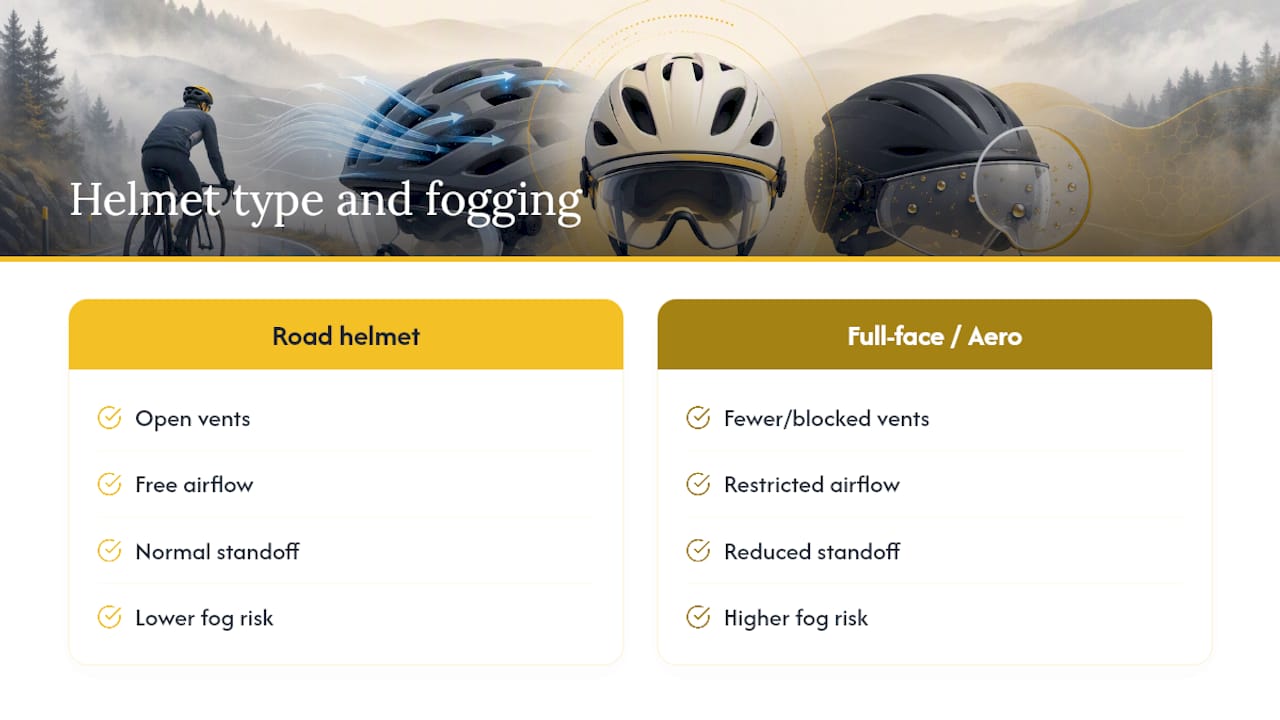
How your glasses sit relative to your helmet changes fogging risk more than most riders expect, because the helmet either supports airflow to your lenses or blocks it. A standard road helmet with open vents generally works well with most cycling glasses since air already moves freely around your face.
Full-face and aero helmets change the equation. These designs trap more air near your face by nature, which is why Thebeamofficial’s approach to helmet design treats vent placement and visor or eyewear compatibility as one connected system rather than two separate accessories. Temple pads and strap positioning on helmets also affect whether glasses sit at the right standoff distance or get pushed too close to your face.
For colder rides, a winter gear setup that layers correctly around your neck and lower face keeps warm breath from escaping upward into your helmet’s interior, which is often the real source of visor and glasses fog on winter commutes.
A Rider’s Note on What Actually Works
I’ve watched more riders chase a “miracle” anti-fog spray than fix the actual airflow problem sitting right in front of them. The habit that’s saved me the most grief on cold rides is boring: open every vent wider than feels necessary before you even clip in, and leave it there longer than instinct tells you to.
— Sophie
Gear That Helps You Ride Fog-Free
Some helmet and eyewear designs are built around the idea that ventilation should be engineered into the system from the start, not patched on later with a spray. That’s a real advantage over buying a helmet first and troubleshooting fog after the fact.

If you’re commuting daily, the VIRGO and Roamee helmet collection includes full-face and open designs with vent systems built for exactly the breath-management problems covered above. Road riders chasing climbs and descents in variable weather get more out of a helmet with dynamic vent control, while urban commuters dealing with stop-and-go traffic benefit most from wide-opening front vents that clear fog fast at a red light. For riders who want add-on fit and breath-management accessories rather than a new helmet, the accessories collection covers smaller fixes that pair with gear you already own.
Browse the helmet collection to compare vent placement and visor design before your next cold-weather ride.
Sources
- Anti Fog Cycling Glasses: 5 Solutions That Work
- Bicycles StackExchange - prevent glasses fogging when cycling in the cold
- How to Stop Your Glasses from Fogging Up Inside a Helmet - Revv Rider
- Leecadie
- Anti‑Fog Strategies for Glasses and Visors - Charge and GoBike
FAQ
What Is the 75% Rule in Cycling?
The 75% rule generally refers to pacing your effort at roughly three-quarters of maximum intensity during endurance training, not a fogging-specific guideline. It matters here indirectly: riding below max effort produces less breath and sweat, which lowers fogging risk on long rides.
What Is the 80% Rule in Cycling?
Like the 75% rule, this refers to a training intensity guideline where most endurance riding happens at a moderate, sustainable effort rather than near-maximum output. Lower sustained effort means less heat and moisture production, which indirectly reduces how often your lenses fog.
Does Spitting in Goggles Prevent Fogging?
Spit can work as a short-term emergency fix because saliva contains compounds that briefly reduce surface tension, spreading moisture into a thinner film. It’s not reliable long-term and can leave residue that affects factory coatings, so treat it as a last resort, not a routine.
How Do Pro Cyclists Keep Sweat Out of Their Eyes?
Most rely on moisture-wicking headbands or caps under their helmets to intercept sweat before it reaches their eyes or glasses. Combined with helmets that ventilate well, like the designs in Thebeamofficial’s helmet collection, this keeps both sweat and fog under control during hard efforts.
How Often Should I Reapply Anti-Fog Spray?
Reapplication depends on humidity, sweat, and how often you clean your lenses, but most sprays hold up for several rides before losing effectiveness. Higher humidity and heavy sweat shorten that window considerably.


