

A lightweight full-face cycling helmet protects your jaw, chin, and temples the way a road helmet never can, without piling on neck fatigue. Most sit between 550 and 750 grams in a medium shell, close to some heavier road-only helmets. If you ride gravel descents, urban traffic, or an e-bike at speed and want that facial coverage without a weight penalty, a high-end full-face helmet is worth serious consideration.
TL;DR:
- Lightweight full-face helmets usually weigh between 550 and 750 grams, with some high-end models falling below 600 grams due to advanced shell and liner engineering.
- MIPS technology significantly reduces rotational forces in low-impact crashes, especially at lower speeds common in urban, gravel, and e-bike riding.
- Proper fit, adjusted with a retention dial and removable pads, is more critical for safety and comfort than slight differences in weight or internal mitigation features.
- Ventilation effectiveness depends on internal channels and vent placement, with noise levels influenced by chin bar seals and ear pad adjustments.
- Certification standards like EN 1078 and NTA-8776 indicate the helmet’s tested impact scenarios and suitability for different riding speeds, especially for e-bikes.
Table of Contents
- What Makes a Casque Intégral Léger Actually Lightweight?
- Does MIPS Actually Reduce Concussion Risk?
- Getting Fit Right on a Full-Coverage Helmet
- Ventilation and Noise: The Real Trade-Off of Full Coverage
- Choosing a Lightweight Full-Face Helmet for Your Riding Style
- What EN 1078 and NTA-8776 Actually Guarantee
- How to Keep a Lightweight Full-Face Helmet Working Like New
- How Lightweight Full-Face Helmets Compare
- Does Helmet Shape Actually Affect Your Speed?
- Why THE BEAM Designs This Way
- Getting Your Hands on the VIRGO Integral
- Sources
What Makes a Casque Intégral Léger Actually Lightweight?
A casque intégral léger earns that label through shell material and internal engineering, not by skipping protection. Full carbon fiber shells save weight over polycarbonate but cost more to produce, so most brands blend a thinner polycarbonate outer shell with strategic carbon or fiberglass reinforcement at stress points like the chin bar and temple zones. The reinforcement carries load where a crash is statistically likely to hit, letting the rest of the shell run thinner.
The bigger weight savings usually come from the liner. Instead of one uniform block of EPS foam, engineers map multiple foam densities across the shell. Firmer, denser foam goes where impact energy is highest; softer, lighter foam fills lower-risk zones like the crown extension or rear coverage. This multi-density approach can shave 50 to 80 grams off a helmet without giving up energy absorption where it matters.
Some designs go further with what’s essentially an exoskeleton: internal ribs or a lattice frame that distributes force across the shell, similar to how a bike frame uses tube shaping instead of solid mass for strength. This lets manufacturers cut foam thickness in secondary zones because the frame itself does structural work.
Weight also shifts with certification. A shell built only to meet EN 1078 can run lighter than one also certified for e-bike speeds, since higher-speed compliance typically demands thicker impact zones. The Dainese Linea 01 MIPS lists 570 grams for a size medium, combining MIPS with structural reinforcement while still clearing multiple international standards. That figure is a useful benchmark: anything advertised well below it in the full-face category deserves a second look at what got left out.
Does MIPS Actually Reduce Concussion Risk?
Rotational force, not straight-line impact, is what most modern helmet research treats as the bigger threat to your brain. A direct hit compresses foam and slows linear acceleration. A glancing hit, the kind you get sliding across pavement or gravel, twists the skull and stretches brain tissue, which is what rotational damping systems are built to reduce.
A 2021 peer-reviewed review in Frontiers in Bioengineering and Biotechnology compared bicycle helmet technologies using kinematic injury metrics like peak rotational acceleration (PRA) and GAMBIT, a combined injury-risk score. The findings were consistent across systems:
- MIPS-equipped helmets showed lower PRA and significantly reduced GAMBIT at low impact velocities compared to conventional EPS-only helmets.
- WaveCel-style collapsible liners performed even better in the same low-velocity tests, with substantially lower peak linear acceleration, PRA, and GAMBIT.
- Airbag-style systems such as Hövding produced large reductions in lab metrics too, though they work through an entirely different deployment mechanism rather than a slip layer.
MIPS cuts GAMBIT injury-risk scores significantly at low impact speeds compared to conventional foam-only helmets, according to the same review.
MIPS itself works as a low-friction layer inside the shell that lets the helmet rotate slightly around your head on impact, absorbing rotational energy before it reaches your skull. For everyday collisions, an e-bike rider clipped by a car mirror, a gravel rider tumbling on loose rock, low-velocity glancing impacts are far more common than a dead-center high-speed hit, which is exactly the scenario where these systems show their biggest gains. The trade-off is minor: a MIPS layer adds a small amount of weight and cost, but the addition rarely pushes a well-engineered helmet out of the lightweight category.
Getting Fit Right on a Full-Coverage Helmet
Fit determines whether a helmet does its job, arguably more than the mitigation tech inside it. Industry testing and reviewer commentary consistently point out that comfort and adjustability influence whether people wear a helmet consistently more than small weight differences do. A perfectly engineered helmet that sits crooked or gets left at home protects nobody.
Work through fit in this order:
- Measure your head circumference an inch above your eyebrows and match it against the brand’s size chart rather than guessing from a past helmet.
- Put the shell on unbuckled and shake your head side to side; it should stay put without sliding, and cheek pads should touch your face without pinching.
- Buckle the strap and check chin bar clearance: you should be able to fit two fingers between the strap and your jaw, no more.
- Put on your sunglasses or riding glasses and check that the vents and eyeport don’t force an awkward angle or block your peripheral vision.
- Wear it for ten minutes indoors and note any pressure points near the temples or the base of the skull, since discomfort that seems minor at minute two often becomes unbearable at hour two.
- Check whether the fit affects hearing traffic and other riders; a chin bar that runs too close to the ears can muffle sound more than an open-face helmet would.
Pro Tip: Try the helmet on at the end of a workout, not first thing in the morning. Head shape shifts slightly with blood flow and sweat, and a helmet that feels snug when you’re fresh can feel tight after twenty minutes of riding.
If cheek pads feel loose or tight, ask about swappable pad thickness before assuming the whole helmet is the wrong size. Most brands sell replacement pad sets, and a return or exchange policy on a first-time full-face purchase is worth confirming before checkout.
Ventilation and Noise: The Real Trade-Off of Full Coverage
Full-face coverage traps heat that an open-face helmet vents freely, so airflow design matters more here than on any other helmet style. Vent count and channeling inside the EPS liner determine how much of that trapped heat actually escapes. A helmet with vents cut into the shell but no internal channel just moves air across the surface; one with molded channels through the foam pulls air across your scalp, which is where the cooling actually happens.
Perforated liner foam is one of the newer tricks for keeping weight down while preserving airflow: tiny air channels punched through multi-density foam sections cool the head without adding a separate ducting structure. Vent placement also matters by riding position. Road and gravel riders lean forward, so front and crown vents catch the most air; upright urban and e-bike riders benefit more from side and rear vents that catch cross-breeze at slower speeds.
Noise is the other trade-off nobody mentions on the spec sheet. A tighter chin bar seal cuts wind noise but can also muffle traffic sounds, which matters on city streets. Removable ear pads let you dial that balance yourself: pull them for better hearing on commutes, keep them in for descents where wind noise dominates. Gravel and road riders should prioritize crown and front ventilation for sustained climbing effort; urban and e-bike riders should weigh hearing and low-speed airflow over maximum vent count.
Choosing a Lightweight Full-Face Helmet for Your Riding Style
Run through this checklist before you buy, whether you’re standing in a shop or scrolling a product page:
- Weight target: sub-750 grams for size M is a reasonable ceiling for a genuinely lightweight full-face helmet; anything heavier should offer a clear trade-off, like extra ventilation or a lower price.
- Mitigation technology: confirm whether the helmet uses MIPS, a collapsible liner, or another rotational system, and check if independent kinematic testing backs the claim.
- Certification: look for EN 1078 as the baseline European standard, with NTA-8776 as an added marker if you ride a fast e-bike.
- Ventilation: count vents and ask whether the liner has internal channeling, not just surface cutouts.
- Fit adjustability: a retention dial and swappable cheek pads matter more long term than a slightly lower weight figure.
- Visibility and lighting compatibility: check whether the helmet has integrated rear lighting or mounting points, especially for urban and e-bike use.
- Price expectations: budget models often skip mitigation tech entirely; mid-range sits around basic MIPS integration; premium models add reinforced shells and integrated electronics.
Ask the seller directly about weight by size, since marketing copy often quotes the smallest shell size, not the one you’ll actually buy. Confirm the return policy before ordering online, particularly for a first full-face purchase where sizing surprises are common.
Treat a few claims as warning signs: a helmet with no declared safety standard listed anywhere on the page, a single “one-size-fits-most” claim with no size chart, or a return policy that excludes worn or tried-on helmets. Full-face helmets in the sub-$150 range typically skip rotational mitigation tech entirely; the $150 to $300 band is where MIPS and similar systems become standard; above that, you’re usually paying for lower weight, better ventilation engineering, and integrated features like lighting.
What EN 1078 and NTA-8776 Actually Guarantee
Certification tells you what a helmet was tested against, not how it will feel on your head, and the two standards you’ll see most on cycling full-face helmets cover different scenarios. EN 1078 is the baseline European standard for bicycle helmets, testing shock absorption, retention system strength, and field of vision under standardized drop conditions. It’s the floor, not the ceiling, and any legitimate cycling helmet sold in Europe should list it.
NTA-8776 goes further, developed specifically for helmets used on faster e-bikes. It typically requires thicker impact zones and stronger retention hardware to handle higher-speed collision energy. If you ride a Class 3 or speed-pedelec e-bike regularly, a helmet listing only EN 1078 compliance may not have been tested for your actual riding speed.
ASTM standards, common in North American motorsports and some skate categories, rarely appear on cycling-specific full-face helmets and shouldn’t be treated as a substitute for EN 1078 or NTA-8776 on a bike helmet. When a product page lists no standard at all, or vaguely claims to “exceed safety requirements” without naming one, that’s a gap worth asking about directly rather than assuming the best. A well-documented helmet will state its certification plainly, usually right next to the weight and size chart.
How to Keep a Lightweight Full-Face Helmet Working Like New
Multi-density foam and reinforced shells still degrade with sun, sweat, and impact, and a little maintenance extends both comfort and protective life. Clean the shell with mild soap and water; avoid solvents or household cleaners, since some can break down the polycarbonate or carbon coating over time. Wipe the EPS liner with a damp cloth rather than soaking it, since foam absorbs moisture and can take days to dry out fully, which invites odor and mildew.
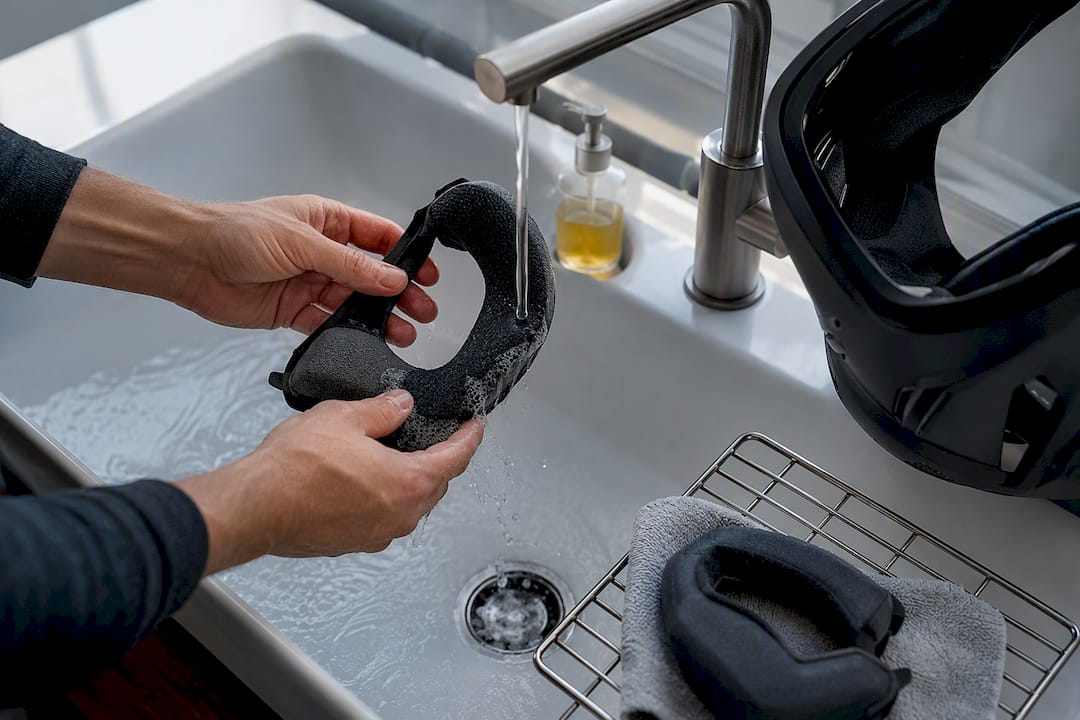
Cheek pads and comfort liners are usually removable and machine washable on a gentle cycle, or hand washable if the manual says so. Replace them once they’ve compressed and no longer hold a snug fit, typically after a season or two of regular sweat exposure. A loose pad undermines the whole retention system even if the shell itself is fine.
Check the strap and buckle every few months for fraying or a buckle that no longer clicks solidly. UV exposure weakens webbing over years of outdoor storage, so a strap that looks fine but feels stretchy under tension should be replaced, not ignored.
Store the helmet away from direct sun and away from car dashboards, where heat buildup can warp foam density over time. And treat any real impact as a replacement trigger: EPS foam compresses permanently on a hard hit even if the shell shows no visible crack, so a helmet that’s taken a real fall has already used up its one shot at protecting you.
How Lightweight Full-Face Helmets Compare
Full-face cycling helmets in the premium lightweight category tend to split along a few clear lines rather than one single “best” option. Carbon-reinforced shells with full exoskeleton framing hit the lowest weights, often under 600 grams, but usually cost the most and sometimes trade off ventilation for structural rigidity. Polycarbonate shells with multi-density foam and MIPS sit in the middle weight band, generally 650 to 750 grams, and tend to balance cost, coverage, and airflow better for riders who don’t need race-level minimalism.
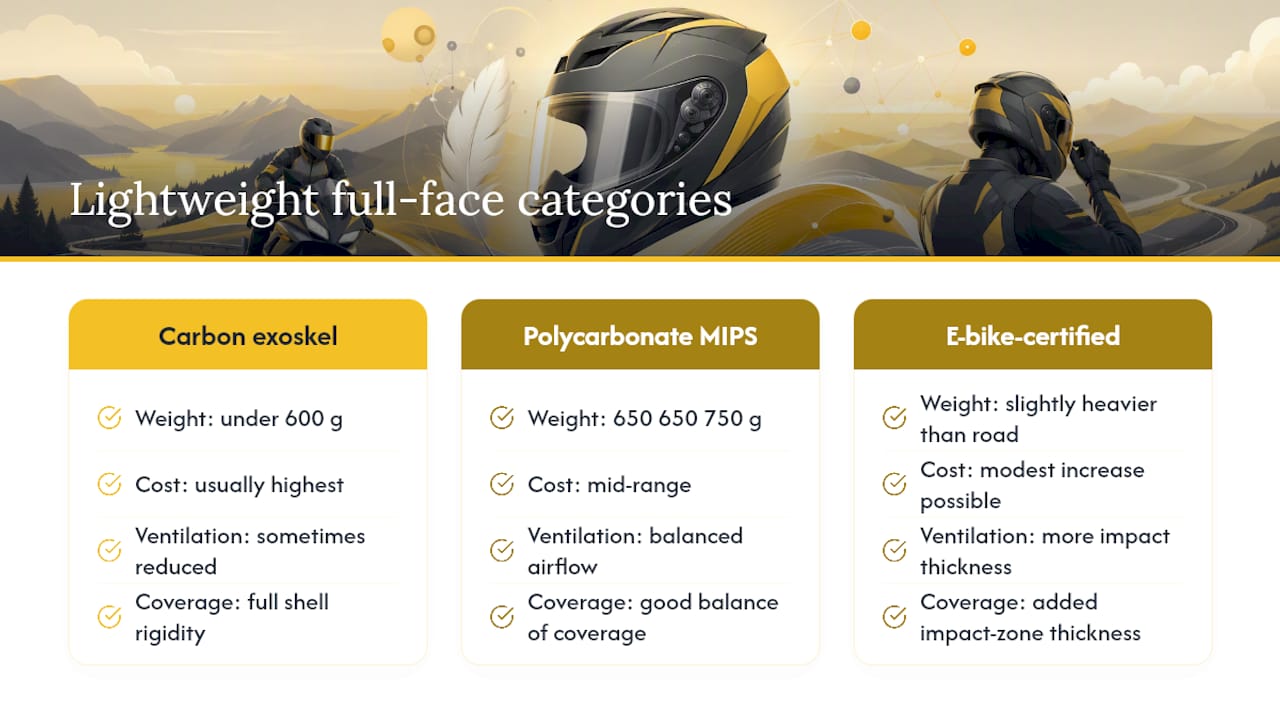
Helmets built specifically for e-bike speed compliance, meeting NTA-8776 alongside EN 1078, usually run slightly heavier than road-only full-face designs because of the added impact-zone thickness. That’s a reasonable trade if you’re riding a fast pedelec regularly; it’s unnecessary bulk if your riding is mostly weekend gravel.
THE BEAM’s VIRGO Integral sits in that middle to upper band, with a claimed weight range of roughly 650 to 700 grams depending on size, MIPS integration, a removable visor, and integrated rear lighting built into the shell rather than bolted on. The trade-off across the category is consistent: the lightest shells ask for the highest price, and helmets that add e-bike certification or integrated electronics add a modest amount of weight in exchange for real functional gain, not just marketing gloss.
Does Helmet Shape Actually Affect Your Speed?
Aerodynamics matters differently depending on what you ride, and full-face coverage changes the calculation more than most riders expect. A smooth, low-profile shell with a tapered rear reduces drag at road-racing speeds, where every watt saved compounds over hours in the saddle. For gravel and endurance riders holding a steady moderate pace, aerodynamic gains matter less than sustained ventilation, since overheating costs more energy over a long ride than a slightly draggier shell shape.
Full-face coverage itself changes airflow around the head compared to an open-face design; the chin bar and lower coverage can actually smooth some turbulence around the jawline that an open helmet leaves rough, though the effect is modest at typical road and gravel speeds rather than at time-trial velocities. Urban riders rarely benefit from aero shaping at all, since stop-and-go city speeds don’t generate enough sustained airflow for shell shape to matter; ventilation and visibility should outrank aerodynamics in that context every time.
E-bike riders sit in an interesting middle ground: motor-assisted speeds can approach the range where aerodynamics starts to matter, but the added mass and battery weight of the bike itself usually outweigh what a helmet shape can offset. For most riders outside dedicated road racing, prioritizing ventilation, fit, and weight over aero shaping is the more useful trade-off.
Why THE BEAM Designs This Way
THE BEAM is a French brand built specifically around high-end cycling safety equipment, and that focus shapes every material and weight decision behind the VIRGO Integral. The helmet integrates MIPS technology, a removable visor, and integrated rear lighting, aimed at riders who want facial coverage without carrying it around as dead weight all day.
Internal design data at THE BEAM puts facial trauma reduction from full-face coverage at roughly 39% compared to open-face helmets in equivalent crash scenarios, a figure that drives the case for integral protection over a traditional road shell whenever facial risk is part of the equation, gravel descents, mixed traffic, or high-speed e-bike commuting. Full specs, official photos, and current sizing details typically appear on the product page alongside certification information referenced throughout this guide.
— Sophie
Getting Your Hands on the VIRGO Integral
If the weight, ventilation, and certification checklist above sounds like what you need, the VIRGO Integral with MIPS is built to match it: MIPS rotational protection, a removable visor, and integrated rear lighting in a shell designed to stay light without cutting corners on coverage.

The product page lists full specs, size charts, and official photos so you can check weight by size before ordering. Pair it with a high-visibility bike reflector if you ride in low light or mixed urban traffic; visibility gear and head protection work best as a set, not separately. Measure your head circumference against the size chart first, and if the fit still feels off once it arrives, check the return policy on the product page before your test ride window closes. Order from THE BEAM’s official store to make sure sizing, warranty, and returns all track back to one place.
Sources
- Comparative analysis of bicycle helmet technologies and kinematic-based head injury metrics (Frontiers in Bioengineering and Biotechnology)
- MIPS bike helmets explained (The Strategist / NYMag)


