

Full-face cycling helmets earn their keep for one main reason: they protect your jaw, chin, and face in ways a standard helmet simply cannot, and when paired with rotational-mitigation tech like MIPS, they cut modeled brain strain in oblique impacts too. The trade-off is real: more weight, less airflow, and a narrower field of view. This guide breaks down the evidence, the drawbacks, and how to know if one fits your riding.
TL;DR:
- Full-face helmets provide superior face, chin, and jaw protection, especially in forward crashes and low-speed impacts common in commuting and cargo biking.
- Helmets with rotational mitigation systems like MIPS, WaveCel, and SPIN can measurably reduce brain strain during oblique impacts in laboratory tests.
- The main trade-offs include reduced ventilation, increased weight, narrower field of view, and potential perception issues, which can often be mitigated through proper fit and helmet design choices.
- Certification standards like EN 1078 and NTA 8776 ensure helmets are rated for typical impacts and higher-energy crashes at higher speeds, especially on fast e-bikes.
- The ideal full-face helmet for daily commuting offers a balance of protection, ventilation, comfort, and visibility, with features like adjustable visors, integrated taillights, and proper fit testing.
Table of Contents
- What Are the Real Full Face Helmet Pros?
- Does the Research Actually Back This Up?
- What Are the Trade-Offs, and How Do You Fix Them?
- When Should You Actually Choose a Full-Face Helmet?
- How Do You Check Fit, Ventilation, and Certification Before Buying?
- What’s the Quick Buying Checklist Before You Commit?
- Why Does THE BEAM Build Full-Face Helmets This Way?
- See the VIRGO Integral Helmet’s Full Specs
- Sources
What Are the Real Full Face Helmet Pros?
The biggest argument for a full-face cycling helmet isn’t abstract. It’s the chin bar sitting between your face and the pavement, the curb, or a car bumper. Traditional open-face helmets stop above the eyebrows. A crash that pitches you forward, which happens constantly in commuter traffic when a car door opens or a pothole grabs your front wheel, sends your face into the fall zone that open-face designs never touch.
Full-face integral helmets close that gap. Here’s what they add over a standard helmet:
- Face, chin, and jaw coverage against direct trauma from falls, low-speed collisions, and road debris.
- Better protection in forward-over-the-bars crashes, the most common failure mode for e-bikes and heavy cargo bikes.
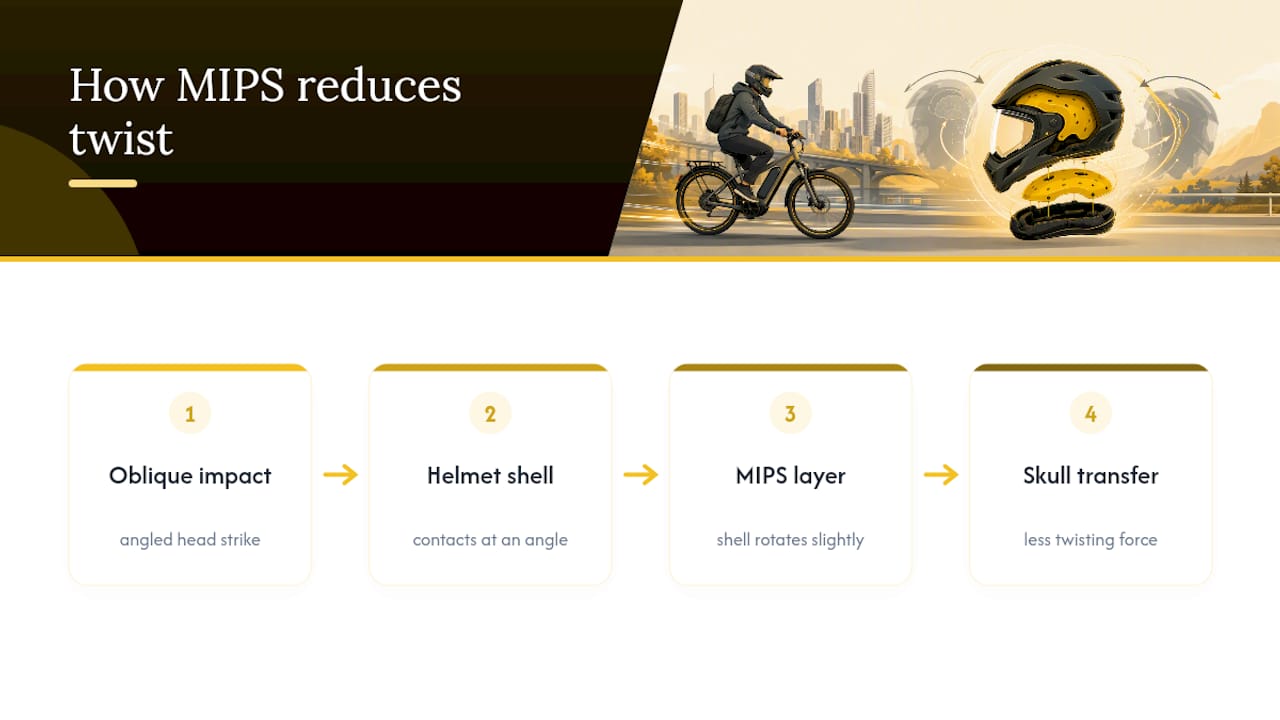
- Rotational protection when the helmet includes a slip-layer system such as MIPS, which reduces twisting forces on the brain during angled impacts.
- Weather and insect defense, since a chin bar and visor block wind, rain, and bugs that open designs leave you exposed to.
- Integrated visibility features, including built-in taillights on some models, which matter more at dusk than most riders assume.
None of this makes a full-face helmet a requirement for every ride. It makes it a meaningful upgrade for anyone who spends real time in mixed traffic or riding a fast e-bike.
Does the Research Actually Back This Up?
Marketing claims are cheap. Lab data is not, and this is where full-face and MIPS-equipped helmets separate from the pack.
A peer-reviewed study out of Chalmers University measured how helmets performed in oblique-impact testing across multiple kinematic metrics, including peak rotational acceleration and modeled brain strain. The finding: helmets fitted with rotational-mitigation systems like MIPS, WaveCel, and SPIN showed measurable reductions in these metrics compared with conventional foam-only designs. Oblique impacts, where the head strikes at an angle rather than straight down, mimic real crashes far better than a simple vertical drop test. That’s exactly the kind of impact you get sliding off a curb or getting clipped by a mirror.
MIPS in practical terms: the system inserts a low-friction layer between your head and the helmet shell, letting the shell rotate slightly on impact instead of transferring that twisting force straight into your skull. Thebeamofficial breaks down the mechanics in its MIPS technology explainer if you want the full technical picture.
A separate review of rotational-mitigation systems found MIPS and WaveCel currently deliver the most consistent biomechanical reductions across test configurations, though it also flagged that standardized real-world clinical outcome data is still thin. Lab results are strong. They’re not the same as tracking outcomes across thousands of real crashes yet.
Certifications matter here too. EN 1078 is the baseline European standard most bike helmets meet. NTA 8776 goes further, addressing the higher-energy impacts common on faster speed-pedelecs. If you’re riding an e-bike that assists past 25 km/h, an NTA 8776 rating tells you the helmet was built with that extra kinetic energy in mind, not just retrofitted from a road-helmet mold.
One caveat worth repeating: lab tests model impacts under controlled conditions. Fit, retention strap tension, and wearing the helmet correctly still decide whether any of this protection reaches your head in a real fall.
What Are the Trade-Offs, and How Do You Fix Them?
No one designs a full-face cycling helmet pretending it’s free of downsides. The honest list:
- Ventilation drops compared to open designs, since a chin bar and visor block some airflow.
- Weight increases, typically by a modest margin over an equivalent open-face helmet, enough to notice on a long climb but rarely enough to matter on a flat commute.
- Field of view narrows slightly, and hearing can feel muffled depending on visor and cheek pad design.
- Perception shifts, some riders report feeling less “seen” as a person in traffic while wearing a full-coverage helmet, according to trade coverage on commuter full-face adoption.
Every one of these has a practical fix. Test ventilation on a short local ride before committing to long ones. Look for models with internal vent channels rather than a sealed shell. If you ride in cold weather, a thin base layer under the helmet does more for warmth than a lack of vents does for you.
For field of view, ride slowly around a parking lot and check your peripheral vision at a shoulder check. Choose a visor design that sits far enough from your face to avoid tunnel vision.
Pro Tip: Counter the “less visible in traffic” effect with a bright shell color and an integrated or clip-on taillight. It does more for your actual safety than an open face ever did.
When Should You Actually Choose a Full-Face Helmet?
Not every ride calls for full-coverage protection. Some clearly do.
- Fast e-bike commuting. Once your bike assists past 25 to 32 km/h, crash energy climbs fast, and NTA 8776-rated protection starts to matter.
- Dense mixed traffic. If your commute means dodging car doors, delivery trucks, and distracted drivers daily, extra face and jaw coverage is a rational bet, not overkill.
- Riding with kids on board. Cargo bikes and family e-bikes carry more weight, brake differently, and forgive fewer mistakes. That’s exactly when chin protection earns its place.
- Long, hot climbs or aero road racing tip the other way. Ventilation and minimal weight matter more here than chin coverage, and open designs still win.
If you split your riding across disciplines, the honest answer is often a hybrid setup: one full-face integral for the commute and one lightweight open helmet for weekend road miles. Thebeamofficial’s breakdown of helmet types walks through exactly this kind of decision if you’re still weighing open versus full coverage.
How Do You Check Fit, Ventilation, and Certification Before Buying?
A helmet that looks right on a shelf can still fail you on the road. Run through this before you trust it with your head.
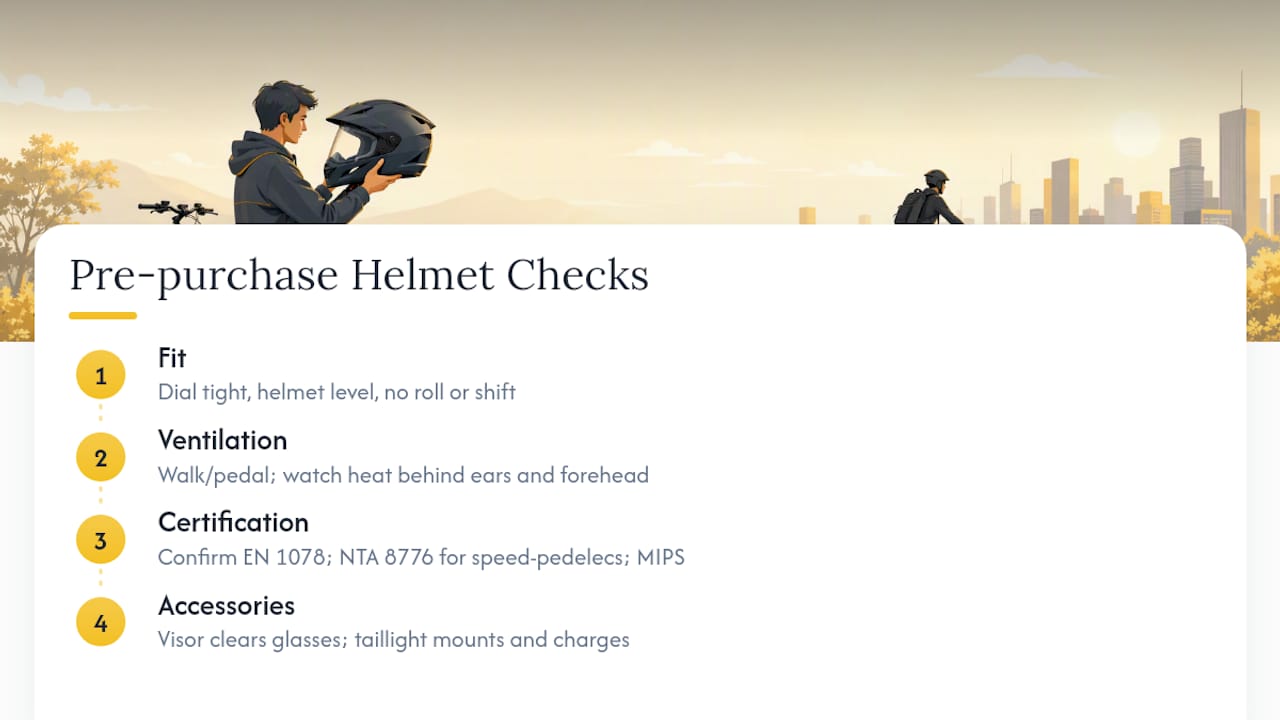
Fit checks: tighten the retention dial until the helmet sits level and doesn’t shift when you shake your head side to side. Cheek pads should press snugly without pinching. If the helmet rolls forward or back with a firm push, it’s the wrong size, full stop.
Ventilation checks: walk briskly or pedal at low effort for a few minutes and pay attention to how quickly heat builds behind your ears and forehead. A proper ventilation design uses internal channels to move air, not just surface vents that look good in photos.
Certification checks: confirm EN 1078 labeling on the inside shell, and for speed-pedelecs, look specifically for NTA 8776. Check for a MIPS label if rotational protection matters to you, since not every “safety helmet” includes it.
Accessory checks: test the visor’s range of motion, confirm it clears glasses or goggles, and check whether the taillight (if included) charges easily and mounts securely.
What’s the Quick Buying Checklist Before You Commit?
Trying a helmet in a store or right after delivery takes ten minutes if you follow a set order.
- Confirm size and retention. Shake your head firmly; the helmet shouldn’t shift.
- Test ventilation on a short ride. Try the visor both up and down to compare airflow.
- Check for certification labeling, including MIPS and EN 1078, and NTA 8776 if you ride a fast e-bike.
- Evaluate accessories and support. Removable liners, taillights, and warranty terms all affect long-term value.
- Wear it on one real commute before deciding it’s your everyday helmet.
Pro Tip: Do the ventilation test with the visor down first, since that’s the worst-case airflow scenario. If it’s tolerable there, it’ll be fine everywhere else.
Why Does THE BEAM Build Full-Face Helmets This Way?
Thebeamofficial builds integral helmets around one core belief: commuters and e-bike riders shouldn’t have to choose between real protection and a helmet they’ll actually want to wear every day. That’s the reasoning behind pairing a full-face shell with MIPS rather than treating rotational protection as an upsell.
Independent testing backs the approach. A published review of the VIRGO Integral MIPS helmet noted usable ventilation and manageable weight alongside full-face coverage, which is the exact balance most riders assume they’ll have to sacrifice. Riders in that same coverage also reported feeling more confident navigating traffic, a benefit that’s easy to dismiss until you’ve ridden both ways.
Protection that gets left in a drawer protects no one. That’s the standard THE BEAM designs against.
— Sophie
See the VIRGO Integral Helmet’s Full Specs
If the case for full-face protection makes sense for your commute, the VIRGO ACCESS MIPS is built around exactly the trade-offs this guide covers.
It combines a MIPS liner for rotational protection, ventilation channels tuned for everyday riding, and NTA 8776 credentials for riders on faster e-bikes. A removable visor and an integrated smart taillight round out the accessory checklist covered above, so you’re not hunting for add-ons after the fact. Thebeamofficial positioned VIRGO specifically for commuters and e-bike riders who want chin and jaw protection without giving up comfort on a daily ride. If you’re also weighing e-bike power output against helmet needs, AkkuPlus’s guide to e-bike battery upgrades is worth a look, since higher-assist setups are exactly where NTA 8776-rated protection earns its cost. Visit the VIRGO product page for full specs, sizing details, and to order one for your next commute.
Sources
- A New Assessment of Bicycle Helmets: The Brain Injury Mitigation Effects of New Technologies in Oblique Impacts
- Full face helmets have come to commuting - do they belong? | Cycling Weekly


