

Most cyclists believe their front and rear lights are enough to keep them safe after dark. Yet 77% of cyclist fatalities occur at night when visibility is lowest, and many of these tragedies happen because drivers simply don’t see riders soon enough. The overlooked hero in this equation? Bike reflectors. While lights grab attention, reflectors provide a fail-safe layer of visibility that works without batteries, meets legal standards, and can extend your detection distance from 100 feet to over 500 feet. This guide breaks down the science, legal requirements, and practical strategies to maximize reflector effectiveness for urban commuters.
Table of Contents
- Why visibility matters for urban cyclists
- The science behind bike reflectors
- Legal requirements for reflectors in the US and Europe
- Types of bike reflectors and optimal placement
- Reflectors versus lights and reflective clothing: The layered approach
- Common mistakes and overlooked tips for using bike reflectors
- Upgrade your visibility with advanced reflector solutions
- Frequently asked questions
Key Takeaways
| Point | Details |
|---|---|
| Reflectors boost detection | Reflectors increase night visibility up to 500 feet, making cyclists more noticeable to drivers. |
| Legal requirements vary | Both US and European laws stipulate specific types and placements of bike reflectors for nighttime riding. |
| Biomotion is key | Pedal and wheel reflectors use movement to help drivers quickly recognize cyclists. |
| Layered visibility works | A combination of reflectors, lights, and reflective clothing provides the best all-around safety. |
| Routine maintenance matters | Regularly cleaning and adjusting your reflectors ensures they perform optimally when needed most. |
Why visibility matters for urban cyclists
Night riding carries inherent risks that many cyclists underestimate. Research confirms that 77% of cyclist and pedestrian fatalities happen after dark, when fluorescent colors become invisible and detection distances shrink dramatically. The problem isn’t just darkness itself but the awareness gap among riders who invest in expensive lights while ignoring the reflectors already mounted on their bikes.
The difference in detection distance is staggering. A cyclist in dark clothing might be visible at 100 feet, giving drivers minimal reaction time at urban speeds. Add front and rear lights, and that distance improves significantly. But combine lights with properly positioned reflectors, and you can be detected from over 500 feet away, providing drivers with crucial extra seconds to slow down or change lanes.
“Retroreflective materials work by bouncing light directly back to its source, making cyclists visible to drivers whose headlights illuminate them, even when active lights fail or batteries die.”
Urban environments present unique challenges:
- Intersection conflicts where turning vehicles cross cyclist paths
- Parked car door zones requiring side visibility
- Multi-lane roads where drivers merge without checking blind spots
- Variable lighting from streetlights that create shadows and glare
For practical guidance on comprehensive urban safety strategies, check our urban cyclist safety checklist.
The science behind bike reflectors
Reflectors use retroreflective technology, which sounds complex but works on a simple principle. Tiny glass beads or prismatic structures embedded in the reflector surface bounce incoming light directly back toward its source. When a car’s headlights hit your reflector, the driver sees a bright spot that stands out against the dark background.
The real breakthrough comes from understanding detection distances. Studies show that reflectors increase detection from around 100 feet to over 500 feet compared to dark clothing alone. But not all reflectors perform equally.
Reflector Performance by Type
| Reflector Type | Detection Distance | Key Advantage |
|---|---|---|
| Static rear reflector | 300-400 feet | Always visible from behind |
| Pedal reflectors | 400-500 feet | Biomotion effect enhances recognition |
| Wheel/spoke reflectors | 450-550 feet | 360° side visibility plus motion |
| Reflective tape | 200-350 feet | Customizable placement |
The biomotion effect deserves special attention. When reflectors move with your pedaling or wheel rotation, they create a distinctive pattern that human brains recognize instantly as a cyclist. Research demonstrates that adding pedal or wheel reflectors can reduce collisions by up to 38% because drivers process the movement pattern faster than static lights alone.
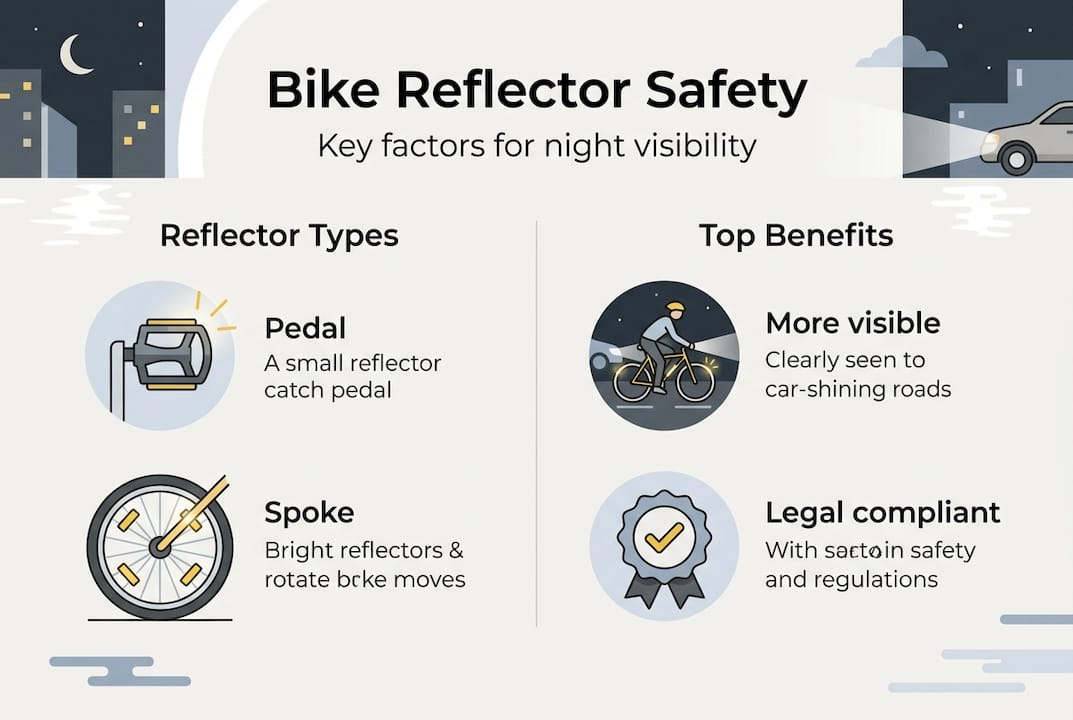
Pro Tip: Mount spoke reflectors at 90-degree intervals around your wheel to create continuous visibility as the wheel rotates, maximizing the biomotion effect even at slow speeds.
For deeper insights into how safety equipment works together, explore our cycling safety gear explained guide.
Legal requirements for reflectors in the US and Europe
Understanding legal requirements helps you stay compliant and safe. Both continents mandate specific reflector positions, but the details vary.
US vs. Europe Reflector Requirements
| Requirement | United States (CPSC) | Europe (RVLR/EN) |
|---|---|---|
| Front reflector | White, visible 500 feet | White, visible 100 meters |
| Rear reflector | Red, visible 600 feet | Red, visible 100 meters |
| Pedal reflectors | Amber, front/rear visible | Amber, required since 1985 |
| Side reflectors | Amber or white on wheels | Amber on wheels or frame |
| Visibility standard | CPSC 16 CFR Part 1512 | BS 6102/2, RVLR 1989 |
The US CPSC 16 CFR Part 1512 outlines mandatory reflector positions and visibility distances for bikes sold in America. European standards require rear red reflectors, white front reflectors, and amber pedal reflectors that have been mandatory since 1985.
Compliance checklist:
- Verify your rear reflector is red and mounted at seat height or on the rear rack
- Check that front reflector is white and visible from straight ahead
- Confirm pedal reflectors are amber and visible from front and rear
- Add wheel or spoke reflectors for side visibility (required in most jurisdictions)
- Clean all reflectors monthly and replace any that are cracked or faded
Penalties for non-compliance vary by region. Some US states issue warnings, while others impose fines ranging from $25 to $200. European enforcement tends to be stricter during nighttime police checks, particularly in Germany and the Netherlands.
For comprehensive protection strategies beyond reflectors, visit our urban cycling protection guide.
Types of bike reflectors and optimal placement
Choosing the right reflectors and positioning them correctly makes the difference between adequate and exceptional visibility.
Reflector types and their roles:
- Front reflectors (white): Alert oncoming traffic and are legally required in most regions
- Rear reflectors (red): Provide critical visibility to following vehicles, especially at intersections
- Pedal reflectors (amber): Create the biomotion effect that helps drivers recognize cyclists faster
- Wheel/spoke reflectors: Offer 360-degree side visibility and work well in urban cross-traffic scenarios
- Reflective tape: Allows custom placement on frame, fenders, or panniers for additional coverage
Integrated reflectors built into bike components offer durability and clean aesthetics, while clip-on options provide flexibility for different bikes or riding conditions. Front, rear, pedal, and wheel reflectors each play a unique role, and 360-degree placement maximizes protection.
Optimal mounting strategies:
Position rear reflectors at seat height or higher to align with driver eye level. Mount front reflectors on the fork or handlebars where they won’t be blocked by bags or water bottles. For pedals, ensure reflectors face both forward and backward. Spoke reflectors should be evenly distributed around the wheel, while frame-mounted options work best on seat stays and chain stays.
Maintenance matters more than most cyclists realize. Dirt reduces reflectivity by up to 50%, and misaligned reflectors may not catch headlight beams at the correct angle. Check reflectors every few weeks, wipe them with a damp cloth, and verify they’re securely fastened and properly angled.

Pro Tip: Add reflective tape to your helmet, backpack straps, and ankle bands to create multiple reflection points at different heights, making your silhouette more recognizable to drivers.
Learn more about comprehensive safety approaches in our road cycling safety concepts article.
Reflectors versus lights and reflective clothing: The layered approach
Reflectors, lights, and reflective clothing each serve distinct purposes, and understanding their strengths helps you build a complete visibility system.
Reflectors function as your fail-safe layer. They require no batteries, never run out of power mid-ride, and remain legal even when lights malfunction. However, they only work when illuminated by external light sources like car headlights. In total darkness without approaching vehicles, reflectors provide no visibility.
Lights offer active visibility, making you seen rather than waiting to be illuminated. Front lights help you see the road ahead while alerting oncoming traffic. Rear lights create a bright point that drivers notice from far away. Most jurisdictions require lights for night riding, making them legally essential.
Reflective clothing adds moveable highlight points that complement fixed reflectors. Vests, ankle bands, and backpack covers create additional reflection surfaces that move with your body, enhancing the biomotion effect. Experts advocate reflectors as a passive safety backup and highlight the need for both reflectors and active lighting in urban environments.
Layering strategies for different conditions:
- Urban commuting: Bright front/rear lights plus reflectors on all required positions, reflective ankle bands for biomotion
- Rural roads: High-lumen lights for road illumination, maximum reflector coverage including frame tape, reflective vest
- All-weather riding: Waterproof lights, sealed reflectors, reflective rain gear that remains visible when wet
The most effective approach combines all three elements. Lights make you actively visible, reflectors provide backup when lights fail or batteries die, and reflective clothing adds dynamic movement cues that help drivers judge your speed and distance.
For detailed equipment recommendations, check our cycling safety gear explained resource.
Common mistakes and overlooked tips for using bike reflectors
Even safety-conscious cyclists make preventable errors that reduce reflector effectiveness.
Mistakes to avoid:
- Neglecting pedal reflectors: These are the most effective type due to biomotion but often get removed or ignored
- Allowing dirt buildup: Reflectors need regular cleaning, as dirt and grime can reduce detection distances by half
- Mounting reflectors at wrong angles: Reflectors must face approaching traffic squarely to bounce light back effectively
- Blocking reflectors with gear: Panniers, bags, and fenders can obstruct reflectors if not positioned carefully
- Using faded or cracked reflectors: UV exposure degrades reflective materials over time, requiring periodic replacement
Pedal reflectors deserve special attention because they’re the most overlooked yet most effective option. Many cyclists remove them for aesthetic reasons or replace pedals without adding new reflectors. This eliminates the crucial biomotion effect that helps drivers recognize cyclists from greater distances.
“The movement pattern created by pedal reflectors triggers faster recognition in driver brains compared to static reflectors, potentially providing an extra second or two of reaction time that prevents collisions.”
DIY upgrades that actually work include adding reflective tape to frame tubes, attaching clip-on spoke reflectors for temporary visibility boosts, and using reflective zip ties on brake cables. These simple additions cost little but significantly expand your reflective surface area.
Riding posture affects reflector visibility more than most realize. Leaning forward on drop bars can angle your rear reflector downward, reducing its effectiveness. Loaded panniers may block side reflectors. Periodically check your setup from a driver’s perspective by having someone photograph your bike from various angles with headlights illuminating it.
For a complete safety review, consult our urban cyclist safety checklist.
Upgrade your visibility with advanced reflector solutions
Applying these insights becomes easier when you have access to high-quality, thoughtfully designed reflector systems that meet legal standards while enhancing your bike’s appearance.
Modern reflector technology has evolved beyond basic plastic rectangles. Minimalist designs integrate seamlessly with contemporary bike aesthetics, while advanced materials offer superior retroreflectivity in smaller packages. Motion-powered options combine reflectors with kinetic elements that create eye-catching patterns as you ride.

The Beam’s FRAME FLASH bike reflectors exemplify this evolution, offering legal compliance without compromising your bike’s clean lines. Paired with our adults’ helmets featuring integrated reflective elements and helmet add ons that expand your visibility profile, you can build a comprehensive safety system that works in any urban environment. These solutions recognize that serious cyclists want protection without sacrificing style or performance.
Frequently asked questions
Are bike reflectors required by law at night in my country?
Yes, most US states and European countries require reflectors in specific positions for legal compliance. European regulations make similar requirements for front, rear, pedal, and side reflectors.
Do bike reflectors work without any lights?
Reflectors enhance visibility when illuminated by car headlights but are not visible in total darkness without an external light source. Retroreflectors need lights to work and can extend visibility up to 500 feet when properly positioned.
How often should I check or clean my bike reflectors?
Check and clean reflectors every few weeks or after dirty rides to ensure maximum visibility. Dirt and misalignment reduce reflector effectiveness significantly, sometimes cutting detection distances in half.
Which is more important: reflectors or bicycle lights?
Both are important; reflectors serve as a backup when lights fail, while lights are more visible and active for oncoming traffic. Experts recommend a layered approach using both lights and reflectors for maximum safety.
Are pedal reflectors really necessary?
Yes, pedal reflectors boost biomotion recognition and reduce crashes by up to 38% because their movement pattern helps drivers identify cyclists faster than static reflectors alone.


