

TL;DR:
- Adaptive helmet padding uses impact-responsive liners that stiffen upon collision to better absorb energy during crashes. Systems like Rheon™ and MIPS Evolve Pro address both linear and rotational forces, significantly reducing brain injury risks in angled impacts. Optimal protection depends on pairing advanced liners with proper fit and regular maintenance, with future innovations integrating AI and 3D printing for personalized safety.
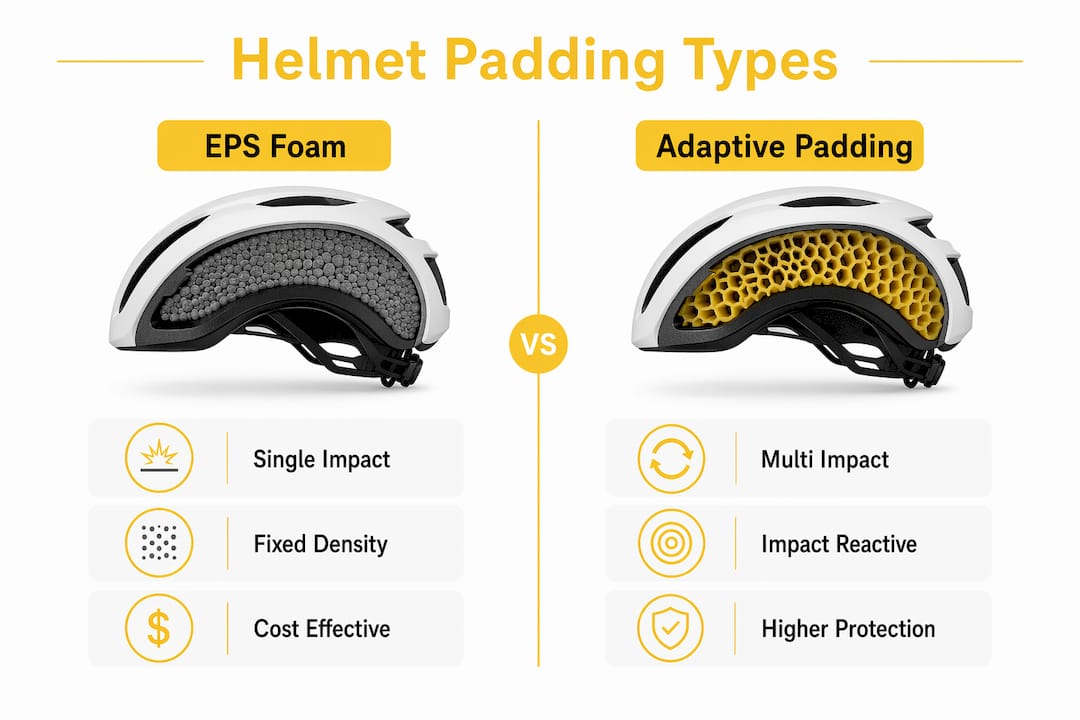
Adaptive helmet padding is defined as impact-responsive liner technology that stiffens under collision forces to absorb energy while remaining soft and comfortable during normal riding. Unlike traditional expanded polystyrene foam, which offers a fixed response regardless of impact severity, adaptive padding systems adjust their mechanical behavior based on the speed and angle of a hit. Technologies like Ruroc’s Rheon™ liner and MIPS Evolve Pro represent the leading edge of this category in 2026, addressing both linear and rotational force management. For cyclists, this dual capability is the critical difference between a helmet that meets minimum certification standards and one that genuinely reduces brain injury risk.
What is adaptive helmet padding and how does it work?
Adaptive helmet padding, also called impact-reactive liner technology in engineering literature, describes any cushioning system that changes its physical properties in response to an applied force. The standard industry term for the broader category is “multi-response impact liner,” though most cyclists encounter it through branded systems. The core principle is straightforward: the padding material behaves differently at low forces than at high ones, giving you comfort on a normal ride and maximum protection in a crash.
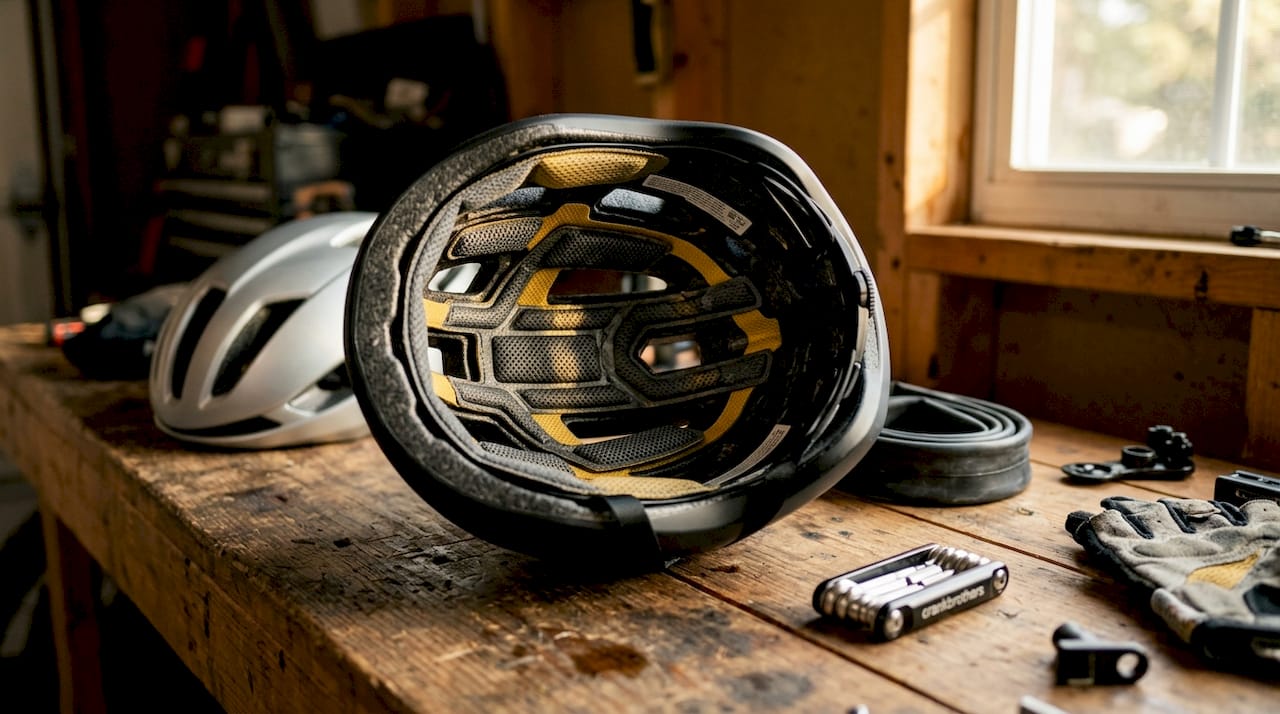
Traditional helmets rely on EPS foam as the primary liner. EPS is effective for single, high-energy impacts but offers no dynamic response. Adaptive materials sit on top of or integrate within the EPS layer to handle the full spectrum of impact energies that real crashes produce.
Core materials behind adaptive padding
The most discussed material in this space is Rheon™, a non-Newtonian substance that stays pliable and comfortable under everyday conditions but firms instantly when struck. This behavior mirrors the physics of cornstarch in water: slow pressure passes through easily, rapid force meets resistance. Rheon™ pads are integrated directly into the liner, allowing movement between the skull and the liner itself. This is mechanically distinct from MIPS, which creates movement between the outer shell and the liner.
The MIPS Evolve Pro system uses a low-friction slip layer that allows 10 to 15 mm of helmet movement relative to the head during angled impacts. That controlled slip redirects rotational forces away from the brain. The MIPS approach is passive: the slip layer functions the same way regardless of impact severity. Rheon™, by contrast, responds dynamically to both the magnitude and angle of force.
Pro Tip: When shopping for a helmet, look for both an impact-reactive liner (Rheon™ or equivalent) and a rotational management system (MIPS or similar). These technologies address different injury mechanisms and work best together.
A third category worth understanding is adjustable retention systems. The BOA FS2 fit system uses a micro-adjustable dial with 40% finer resolution than previous generations, delivering submillimeter precision in fit. BOA FS2 distributes pressure evenly and eliminates peak pressure points. It does not, however, change impact absorption. Fit systems and adaptive liners solve different problems and should not be confused.
How does adaptive padding reduce brain injury risk?
The biomechanical case for adaptive padding centers on rotational acceleration, not just linear force. Most cycling crashes involve an angled impact that causes the brain to rotate inside the skull. This rotational motion is the primary driver of diffuse axonal injury and concussion. Standard EPS foam manages linear compression well but does little to redirect rotational energy.
Research published in Nature demonstrates that pad material optimization can reduce peak rotational acceleration by 5% to 60% compared with traditional EPS foam liners. That range reflects the enormous variability in pad design, material stiffness, and impact angle. Even the lower end of that range represents a meaningful reduction in injury probability across a population of cyclists.
“Simulation studies show that impact energy and pad mechanical properties strongly influence rotational kinematics after hits.” — Nature Communications Engineering, 2025
The practical implication is that the material properties of your helmet’s liner directly determine how much rotational force reaches your brain in a crash. Choosing a helmet with an adaptive liner is not a marginal upgrade. It is a structural change in how your head protection performs.
| Impact type | EPS foam response | Adaptive liner response |
|---|---|---|
| Low-speed linear | Partial absorption | Soft, comfortable, minimal activation |
| High-speed linear | Full compression, single use | Firms instantly, spreads energy across surface |
| Angled rotational | Limited redirection | Dynamic response to angle and magnitude |
| Repeated low impacts | Degradation over time | Maintains flexibility between impacts |
Understanding rotational force management is the single most important concept for any cyclist evaluating helmet safety claims.
Comparing leading adaptive helmet padding systems
Not all adaptive padding systems are equal, and the differences matter depending on your riding style, budget, and the types of crashes you are most likely to experience.
Rheon™ (Ruroc) integrates the adaptive material directly into the liner foam. Because the Rheon™ pads sit between the skull and the liner, they respond to both the speed and angle of impact. This makes Rheon™ particularly effective for the complex, multi-directional forces common in road cycling crashes. The material also provides genuine comfort benefits during normal riding because it remains soft until activated.
MIPS Evolve Pro takes a different approach. The low-friction layer is passive, meaning it does not change its behavior based on impact severity. It simply allows the helmet to move relative to the head, which is highly effective for angled impacts. MIPS Evolve Pro also incorporates Coolmax® fabric for moisture wicking and airflow, addressing the thermal comfort gap that many cyclists notice with older liner designs.
BOA FS2 is not an impact technology. It is a fit technology. The micro-adjustment system improves helmet stability on the head, which indirectly supports safety by keeping the helmet correctly positioned during a crash. A helmet that shifts before impact delivers less protection than one that stays centered.
The strongest helmets in 2026 combine all three approaches: an adaptive impact liner for energy absorption, a rotational management layer for angled impacts, and a precision fit system for stability. These technologies address different aspects of head protection and do not compete with each other.
- Rheon™ is best for riders who want dynamic, force-responsive protection across impact types
- MIPS Evolve Pro suits riders prioritizing rotational force reduction with added comfort features
- BOA FS2 benefits riders who struggle with fit consistency across seasons or headgear changes
- Combining systems offers the broadest protection profile for serious road and gravel cyclists
For a deeper look at how helmet liner technology affects both safety and ride comfort, the differences between these systems become even clearer in real-world testing.
How to optimize your helmet fit with adaptive padding
Getting the most from adaptive padding starts with fit. A helmet that sits too high, tilts back, or shifts under braking delivers less protection regardless of how advanced its liner is. Adaptive padding cannot compensate for a poorly fitted shell.
- Set the baseline position. The helmet should sit two finger-widths above your eyebrows with the front edge parallel to the ground. Adjust the rear retention dial before tightening the chin strap.
- Dial in the retention system. If your helmet uses BOA FS2 or a similar micro-adjust system, tighten until the helmet feels snug without pressure points. You should feel even contact around the circumference of your head, not concentrated pressure at the temples or forehead.
- Check for seasonal variation. Adaptive fitting is a continuous process. Wearing a cycling cap in winter, going bald, or having thick hair all change the effective fit. Readjust every time your headgear changes.
- Inspect the adaptive pads. Rheon™ and similar materials maintain their properties across many impacts, but the surrounding foam and fabric can compress or wear. Check pad condition every six months and replace if you notice uneven compression or thinning.
- Test ventilation. Adaptive padding materials affect airflow differently than EPS foam. If you notice hotspots or reduced airflow after fitting, reposition the pads or check whether the helmet’s vent channels are blocked.
Pro Tip: Riders with bald heads often need to size down one shell size when switching to helmets with thicker adaptive liners. The liner adds measurable volume to the interior fit.
Moisture management also matters for long rides. MIPS Evolve Pro’s Coolmax® integration addresses sweat buildup directly. If your helmet uses a different liner system, look for removable, washable pad covers to maintain hygiene and consistent fit over time.
What’s next for adaptive helmet padding technology?
The next generation of adaptive helmet padding moves beyond reactive materials into predictive design. Research published in Nature shows that deep learning models can now optimize pad material properties by predicting impact kinematics before a helmet is manufactured. This means future helmets will be designed with material profiles tuned to specific crash scenarios, not just general impact absorption.
Several directions are gaining traction in 2026:
- 3D printed suspension liners, such as the KAV Rhoan’s Air Fit Suspension system, replace traditional foam with printed lattice structures that can be tuned for stiffness, density, and airflow simultaneously
- AI-driven material selection uses simulation data to identify pad compositions that minimize traumatic axonal injury risk across a range of impact energies and angles
- Integrated smart features connect adaptive padding to sensors that log impact data, alerting riders and medical contacts when a significant hit occurs
- Ventilation-optimized liner geometry uses computational fluid dynamics to design pad shapes that improve airflow without sacrificing impact performance
For cyclists tracking helmet technology trends in 2026, the convergence of materials science, AI, and connected hardware represents the most significant shift in head protection since the introduction of EPS foam.
Key takeaways
Adaptive helmet padding delivers measurably better protection than standard EPS foam by responding dynamically to impact force, angle, and severity rather than offering a fixed mechanical response.
| Point | Details |
|---|---|
| Core definition | Adaptive padding changes its physical properties under impact, unlike static EPS foam. |
| Rotational protection | Optimized pad materials reduce peak rotational acceleration by 5% to 60% versus EPS. |
| Technology differences | Rheon™ reacts dynamically; MIPS slips passively; BOA FS2 improves fit stability. |
| Fit is foundational | No adaptive liner performs correctly in a helmet that does not fit properly. |
| Future direction | AI-driven design and 3D printed lattice liners will define the next generation of helmets. |
Why I think most cyclists are still underestimating adaptive padding
I have tested helmets across every major liner category, from basic EPS road helmets to full-face options with Rheon™ integration, and the gap in real-world feel is larger than most reviews communicate. The comfort difference alone is noticeable within the first 20 minutes of a ride. Adaptive materials conform to head shape in a way that rigid foam never does.
What surprises me most is how few cyclists ask about liner technology when buying a helmet. Most conversations focus on aerodynamics, weight, and color. Liner technology rarely comes up unless the rider has already experienced a concussion. That needs to change.
The research on rotational acceleration reduction is not abstract. It translates directly to lower concussion probability in the crashes that cyclists actually have, which are almost always angled, not perfectly perpendicular. A helmet with a passive EPS liner and a helmet with Rheon™ plus MIPS are not equivalent products. They are different tools.
My advice for serious cyclists is to treat the liner as the primary purchase criterion, not an afterthought. Fit systems and ventilation matter, but they are secondary to what happens to your brain in a crash. The technology exists to do significantly better than the minimum standard. Use it.
— Sophie
Upgrade your protection with Thebeamofficial

Thebeamofficial designs helmets built around the same principles covered in this article: advanced liner technology, precise fit systems, and real-world usability for road, gravel, urban, and e-bike cyclists. The VIRGO integral helmet with MIPS technology is the flagship example, combining rotational force management with a fit system engineered for daily use. If you are ready to move beyond basic EPS protection, explore the full range of adult cycling helmets at Thebeamofficial, where adaptive safety gear meets considered design for riders who take head protection seriously.
FAQ
What is adaptive helmet padding?
Adaptive helmet padding is an impact-reactive liner technology that changes its mechanical properties under collision forces to absorb and redirect both linear and rotational energy. Systems like Ruroc’s Rheon™ stay soft during normal use and firm instantly on impact.
How does adaptive padding differ from standard EPS foam?
Standard EPS foam offers a fixed mechanical response regardless of impact severity, while adaptive padding adjusts its stiffness based on the speed and angle of the hit. This dynamic response is particularly effective for the angled impacts common in cycling crashes.
Does MIPS count as adaptive helmet padding?
MIPS is a rotational management system, not an adaptive impact liner. Its low-friction slip layer is passive and does not change behavior based on impact force. Adaptive padding, like Rheon™, actively responds to the magnitude and direction of impact energy.
How much does adaptive padding improve safety?
Research shows that optimized pad materials can reduce peak rotational acceleration by 5% to 60% compared with traditional EPS foam, depending on material properties and impact conditions.
How often should adaptive helmet pads be replaced?
Inspect adaptive pads every six months for signs of compression, thinning, or fabric wear. Replace the helmet or pads if you notice uneven contact, reduced cushioning, or after any significant impact, since internal damage is not always visible.


