

Heavy traffic and unpredictable city streets can make cycling in France and Germany feel risky, even for the most experienced riders. Prioritizing head protection means looking for the best advances in helmet design. MIPS technology offers a unique layer inside the helmet that slides upon impact, reducing rotational forces transmitted to your brain. This introduction cuts through the noise to explain how MIPS works and why it has become a key consideration for urban cyclists focused on safety.
Table of Contents
- Defining MIPS Technology In Cycling Helmets
- How MIPS Works To Prevent Injuries
- Types Of Helmets Featuring MIPS Technology
- Comparing MIPS With Traditional Helmet Designs
- Choosing The Right MIPS Helmet For Urban Cyclists
Key Takeaways
| Point | Details |
|---|---|
| MIPS Technology Enhances Safety | MIPS introduces a low-friction layer to helmets, reducing rotational forces during impacts and potentially lowering the risk of brain injury. |
| Helmet Types with MIPS | Various cycling helmets, including road, mountain, and urban models, now incorporate MIPS technology to address different impact scenarios. |
| Comparison with Traditional Helmets | Unlike traditional helmets, which primarily absorb linear impacts, MIPS helmets focus on managing both rotational and linear forces for better protection. |
| Urban Cyclist Considerations | When selecting a MIPS helmet for urban cycling, prioritize comfort, fit, and additional safety features like visibility, alongside the protective technology. |
Defining MIPS Technology in Cycling Helmets
Cycling safety technology continues to evolve, with MIPS (Multi-directional Impact Protection System) emerging as a significant breakthrough in helmet protection. Developed by researchers at the KTH Royal Institute of Technology, this innovative system addresses a critical safety challenge: reducing rotational motion during impact.
At its core, MIPS technology introduces a low-friction layer inside helmets that allows a sliding movement during angled impacts. This design is scientifically engineered to minimize rotational forces transmitted to the brain, potentially mitigating the risk of serious head injuries.
The key components of MIPS technology include:
- A thin, movable layer inside the helmet
- A low-friction interface between the helmet’s shell and inner liner
- Ability to redirect rotational motion during oblique impacts
- Designed to reduce strain on the brain during collision scenarios
While MIPS has gained significant attention, researchers continue to debate its comprehensive effectiveness. Some helmet testing studies suggest that the outer helmet shape and overall sliding capability might play equally important roles in impact performance.
Pro tip: When selecting a cycling helmet, look beyond marketing claims and request independent safety testing documentation to understand the true protective capabilities of MIPS technology.
How MIPS Works to Prevent Injuries
The MIPS technology represents a sophisticated approach to reducing brain injury risks during cycling accidents. By mimicking the brain’s natural protection mechanism, this innovative system addresses the complex biomechanics of rotational forces during impact.
At the core of MIPS functionality is a low-friction slip plane that allows the helmet to move independently from the head during angled collisions. This design creates a critical buffer zone that helps dissipate rotational energy before it can cause severe brain tissue damage. When a cyclist experiences an oblique impact, the MIPS layer enables a slight sliding motion, effectively reducing the shearing and stretching forces that can lead to traumatic brain injuries.
The key injury prevention mechanisms of MIPS include:
- Redirecting rotational motion away from the brain
- Creating a dynamic separation between helmet shell and inner liner
- Absorbing and dispersing impact energy more effectively
- Minimizing direct force transmission during angular impacts
MIPS technology aims to replicate the brain’s natural protective mechanisms, providing an additional layer of safety beyond traditional helmet designs.
However, it’s important to note that independent testing has shown mixed results regarding the technology’s comprehensive effectiveness. While the concept is scientifically sound, some studies have not found statistically significant differences in injury prevention between MIPS and traditional helmet designs.
Pro tip: Always complement MIPS technology with proper helmet fit and regular safety inspections to maximize your protection during cycling.
Types of Helmets Featuring MIPS Technology
MIPS Technology has revolutionized safety across multiple cycling disciplines, expanding into diverse helmet categories since its commercial introduction around 2010. This innovative protection system now appears in helmets designed for various cycling environments and riding styles.
The most common helmet types featuring MIPS technology include:
- Road cycling helmets
- Mountain biking helmets
- Urban commuter helmets
- E-bike protective gear
- Full-face downhill helmets
- Recreational cycling helmets
Each helmet category integrates MIPS slightly differently, tailoring the technology to specific impact risks and riding conditions. Road cyclists benefit from lightweight designs that minimize rotational forces during crashes, while mountain bikers require more robust protection against angular impacts on uneven terrain.
Here is a summary of MIPS helmet categories and their ideal users:
| Helmet Type | Ideal User | Key Benefit |
|---|---|---|
| Road Cycling | Performance cyclists | Lightweight, aerodynamic protection |
| Mountain Biking | Off-road riders | Enhanced oblique impact safety |
| Urban Commuter | City cyclists | Comfort, visibility, everyday use |
| Full-Face Downhill | Extreme sports athletes | Maximum coverage for high-risk rides |
| E-Bike Helmets | E-bike commuters | Reinforced for higher speeds |
MIPS technology adapts to different cycling disciplines, providing customized protection for various riding environments.
Comprehensive helmet ratings demonstrate that top manufacturers like Giro, Specialized, and Trek have widely adopted MIPS across their product lines. The technology’s versatility allows it to be incorporated into helmets ranging from budget-friendly options to high-end professional gear.
Pro tip: When selecting a MIPS helmet, prioritize fit and comfort alongside impact protection technology to ensure maximum safety and wearability.
Comparing MIPS With Traditional Helmet Designs
Traditional helmet designs have long relied on foam liners to absorb linear impacts, but MIPS introduces a revolutionary approach to managing rotational forces during cycling accidents. The key difference lies in how these technologies address brain protection during complex impact scenarios.
Key comparison points between MIPS and traditional helmet designs include:
- Linear impact absorption method
- Rotational force management
- Biomechanical protection strategy
- Overall injury mitigation capabilities
- Manufacturing complexity
- Cost considerations
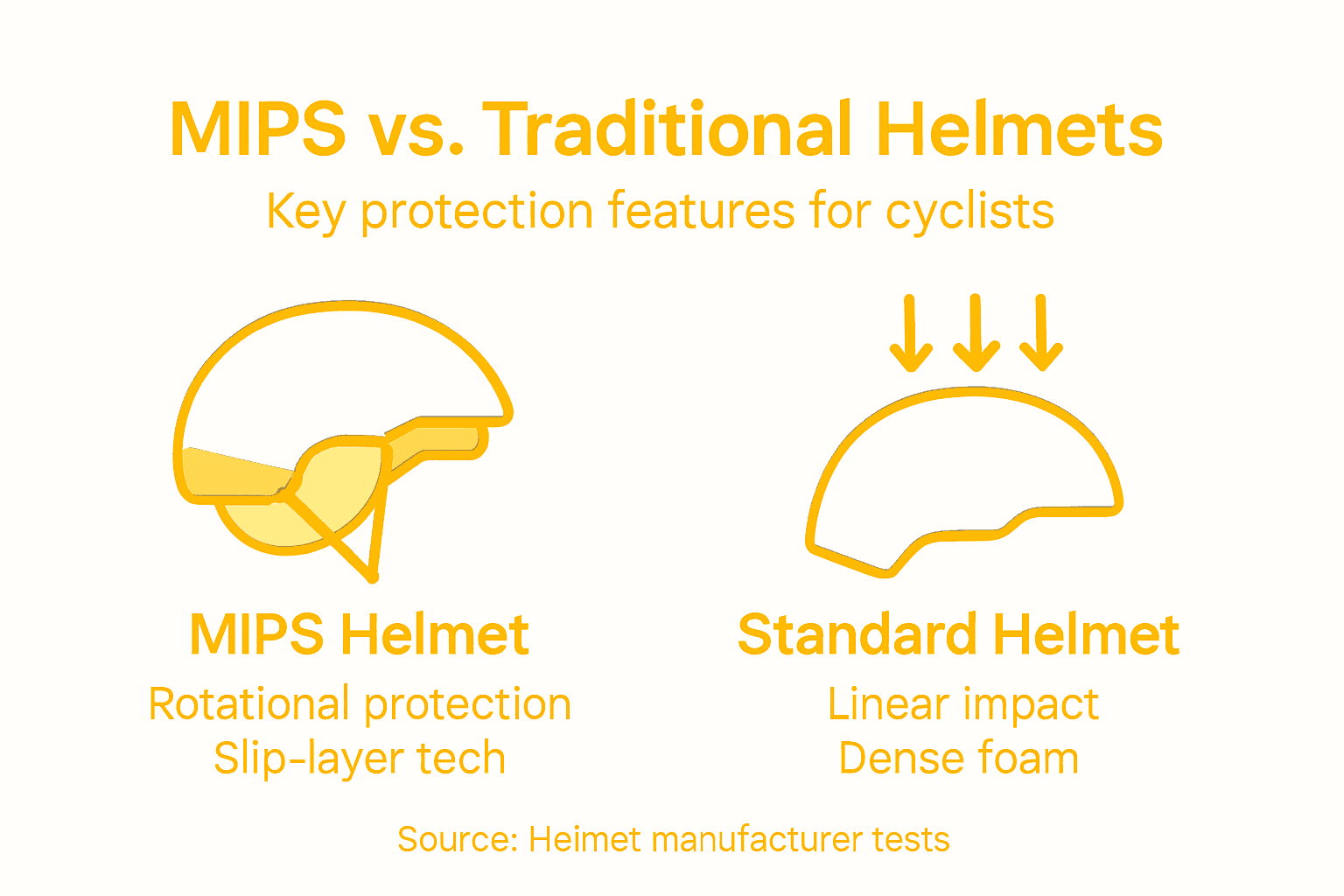
Traditional helmets focus primarily on direct, linear impact reduction by using dense foam materials that compress and distribute force. In contrast, MIPS integrates a low-friction slip plane that allows the helmet to move slightly independent of the head, potentially reducing the rotational energy transmitted during angled impacts.
Here’s a quick comparison of MIPS and traditional helmet technologies:
| Aspect | MIPS Helmets | Traditional Helmets |
|---|---|---|
| Impact Type Focus | Rotational and linear forces | Primarily linear forces |
| Protective Mechanism | Low-friction slip plane | Dense foam liner |
| Injury Protection | Reduces rotational brain strain | Disperses direct impact energy |
| Design Complexity | More engineering required | Simple structure |
| Common Use Cases | Performance and urban cycling | General cycling, budget helmets |
| Cost Range | Moderate to high | Lower to moderate |
While MIPS offers an innovative approach, helmet shape and outer shell design remain critically important in overall safety performance.
Comprehensive safety testing suggests that the benefits of MIPS are not universally conclusive. Some studies indicate that traditional helmet designs can perform equally well, depending on specific engineering and manufacturing techniques.
Pro tip: Always prioritize overall helmet fit, construction quality, and certified safety ratings over any single technological feature.
Choosing the Right MIPS Helmet for Urban Cyclists
Urban cycling demands specialized safety considerations, and selecting the right MIPS helmet requires careful evaluation of multiple factors. Comprehensive safety ratings provide critical insights into protecting yourself during city riding scenarios.
Key selection criteria for urban MIPS helmets include:
- Smooth, rounded exterior to minimize snag points
- Lightweight construction
- Excellent ventilation
- Adjustable fit system
- Enhanced rear coverage
- Visibility features
- Compliance with safety standards
Urban cyclists should prioritize helmets that balance protection with practical usability. Look for models with four or five-star safety ratings, which demonstrate superior performance in managing both linear and rotational impact scenarios. The MIPS technology adds an extra layer of protection by reducing rotational forces during potential accidents.
Urban helmet selection goes beyond technology - fit, comfort, and personal riding style are equally crucial for comprehensive safety.
Consider your specific urban cycling environment when making a selection. Commuters navigating dense traffic might prioritize different features compared to cyclists riding in more open urban spaces. Some MIPS helmets offer additional visibility elements like reflective details or integrated light mounting points.
Pro tip: Try on multiple MIPS helmets and perform a simple rotation test to ensure the slip-plane technology feels comfortable and moves naturally with your head.
Discover Advanced Protection with THE BEAM’s MIPS-Equipped Helmets
Cycling safety is more than just a priority it is a necessity. This article highlights the critical challenge of protecting against rotational brain injuries during impacts using innovative MIPS technology. If you seek a helmet that goes beyond traditional linear impact absorption and actively reduces rotational forces you need solutions designed with this cutting-edge approach in mind.

At THE BEAM we specialize in high-end cycling helmets that integrate MIPS technology to enhance real-world protection. Our flagship VIRGO integral helmet is engineered to offer superior fit comfort and the latest in rotational impact reduction. Whether you are an urban commuter or a road cyclist our products address your safety goals with thoughtfully designed features to mitigate injury risks during angled impacts. Explore our collection now at THE BEAM official website and equip yourself with gear trusted by cyclists across Europe and the United States. Don’t wait until an accident happens protect yourself today and ride with confidence.
Frequently Asked Questions
What is MIPS technology in cycling helmets?
MIPS, or Multi-directional Impact Protection System, is a safety technology designed to reduce rotational forces during angled impacts. It features a low-friction layer inside the helmet that allows for a sliding motion, potentially mitigating the risk of serious head injuries.
How does MIPS technology work to prevent brain injuries?
MIPS technology mimics the brain’s natural protection by providing a slipping interface that allows the helmet to move independently from the head during oblique impacts. This movement helps dissipate rotational energy, reducing the risk of traumatic brain injuries.
What types of cycling helmets typically incorporate MIPS technology?
MIPS technology is found in various helmet types, including road cycling helmets, mountain biking helmets, urban commuter helmets, e-bike helmets, and full-face downhill helmets. Each type is designed to address specific impact risks associated with different riding styles.
How does MIPS compare to traditional helmet designs?
Unlike traditional helmets that focus primarily on absorbing linear impacts with dense foam, MIPS provides a dual focus by managing both rotational and linear forces. MIPS helmets incorporate a low-friction slip plane that reduces the force transmitted to the brain during angled impacts, enhancing overall safety performance.


