

TL;DR:
- Reflective paint enhances cyclist visibility by bouncing light back to drivers in low-light conditions. Applying it to moving parts and bike surfaces creates effective signals that improve safety, especially when combined with active lights and reflective gear. This passive, durable coating offers a reliable safety layer for night riding and reduces crash risk.
Reflective paint is a specialized coating that bounces light directly back to its source, making cyclists visible to drivers during low-light and nighttime rides. Unlike bright colors that rely on ambient light, retroreflective coatings use micro glass beads or prismatic elements to send headlight beams straight back to the driver’s eyes. This is why reflective paint for bikes delivers a visibility advantage that fluorescent yellows and neon greens simply cannot match after dark. Brands like Life Paint have built entire product lines around this principle, and the science behind it is well established.
Why reflective paint for bikes outperforms other visibility methods
Retroreflection is the core mechanism that sets reflective paint apart. Standard bright paint scatters light in all directions. Retroreflective coatings direct light back along the exact path it came from, which means a driver’s headlights illuminate the cyclist directly in the driver’s line of sight. The result is visibility from hundreds of feet away under normal headlight conditions.
Fluorescent materials reflect daylight effectively but become nearly invisible in full darkness. A neon yellow jersey looks great at dusk but offers almost no protection at 10 PM on an unlit road. Retroreflective materials remain visible at night precisely because they need only a small amount of directed light to work.
The biomotion effect adds another layer of protection. Retroreflective materials on moving bike parts create dynamic signals that help drivers identify cyclists faster and from greater distances. Studies show drivers detect cyclists with biomotion reflectors up to twice as fast compared to chest-only reflectors. That speed of recognition is the difference between a driver braking in time and a collision.
Standard plastic reflectors meet legal minimums but fall short in real conditions. Nearly half of fatal bicycle crashes happen between 6 PM and midnight, when visibility is at its worst. A small plastic reflector on the rear dropout does not cover side angles, moving parts, or the front of the bike.
Key advantages of reflective paint over other methods:
- Passive operation. Reflective paint requires no batteries, charging, or switching on. It works every second of every ride.
- 360-degree potential. Paint can be applied to every surface of the bike, including sides and front, which standard reflectors never cover.
- Biomotion placement. Paint on rims, pedals, and crank arms creates moving reflective signals that drivers recognize faster.
- Aesthetic integration. Clear reflective sprays like Life Paint are invisible in daylight, preserving the bike’s original look.
Pro Tip: Test your reflective paint at night by standing 30 feet from your bike and shining a flashlight at it. If the coated areas glow brightly, the application is working. If they look dull, reapply or switch products.
What types of reflective paint and coatings are available for bikes?
Reflective bike coatings fall into two broad categories: clear sprays and pigmented paints. Each serves a different purpose, and the right choice depends on your priorities.
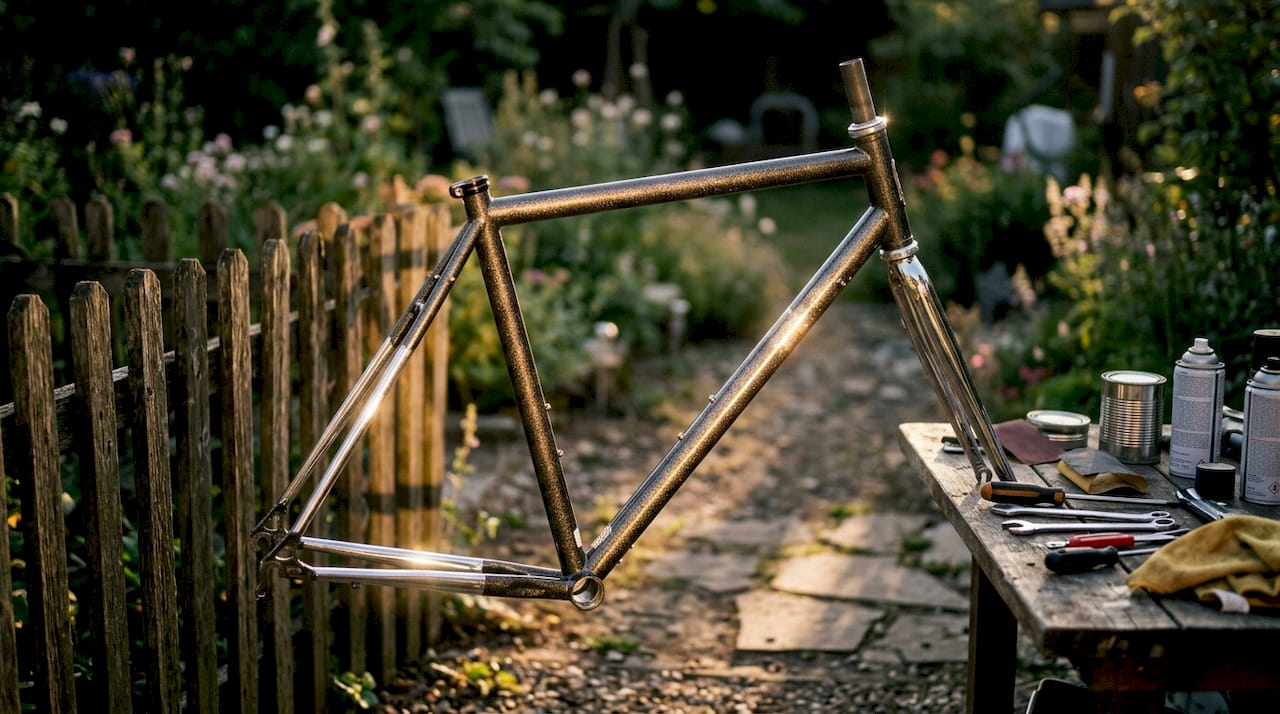
Clear reflective sprays are the most popular option among cyclists who want safety without changing their bike’s appearance. Life Paint uses micro glass bead technology similar to road signs to create effective night reflectivity while remaining invisible in daylight. You spray it on, let it dry, and the bike looks exactly the same until a headlight hits it. The trade-off is durability. Clear sprays typically last a few weeks before washing or wearing off, especially on high-contact areas like the frame and rims.
Pigmented reflective paints add visible color along with reflectivity. These are common in fluorescent silver, white, and yellow. They are more durable than clear sprays and work well on frames and forks where wear is lower. The downside is that they change the bike’s appearance permanently or semi-permanently.
| Feature | Clear reflective spray | Pigmented reflective paint | Reflective tape |
|---|---|---|---|
| Daytime appearance | Invisible | Visible color change | Visible strip |
| Night reflectivity | High | High | Very high |
| Durability | Low (weeks) | Medium (months) | High (years) |
| Application ease | Very easy (spray) | Moderate (brush or spray) | Easy (peel and stick) |
| Coverage flexibility | Full surface | Full surface | Limited to flat areas |
| Cost | Low | Low to medium | Low to medium |
Reflective tape generally exceeds plastic reflectors in both reflectivity and longevity, but it can peel on curved surfaces. Paint offers smoother integration on complex shapes like fork blades and chainstays. Combining both maximizes coverage and durability across the whole bike.
Surface preparation matters more than most cyclists realize. Clean the bike thoroughly before applying any reflective coating. Grease, dirt, or old wax will prevent adhesion and cause the paint to peel within days. A quick wipe with isopropyl alcohol on the target areas is enough for most applications.
How to apply reflective paint for maximum safety on your bike
Placement determines how much protection you actually get. Applying reflective paint randomly across the frame is better than nothing, but a targeted approach delivers significantly better results.
-
Start with the moving parts. Rims, pedals, and crank arms are the highest-priority surfaces. Application on moving parts creates the biomotion effect that doubles driver detection speed. These surfaces rotate and move in patterns that the human brain recognizes as a person on a bike, triggering faster reactions from drivers.
-
Cover the frame tubes for side visibility. Intersections are where cyclists face the highest risk from cross traffic. Painting the down tube, seat tube, and chainstays makes you visible from the side, where standard rear reflectors offer zero protection.
-
Apply to the fork and front of the bike. Front visibility is often neglected. A reflective coating on the fork blades and front wheel ensures oncoming traffic and pedestrians can see you.
-
Add reflective elements to the helmet. The head is the highest point on a cyclist and one of the first things a driver’s headlights reach. Reflective surfaces on a helmet extend your visible profile significantly.
-
Test your setup before riding. Walk 50 feet from your bike at night and check which surfaces reflect back. Adjust coverage based on what you find.
-
Reapply on schedule. Clear sprays need reapplication every few weeks. Set a reminder and treat it like checking tire pressure.
Pro Tip: Apply reflective paint in thin, even coats rather than one heavy layer. Multiple thin coats bond better to the surface and reflect more uniformly than a single thick application.
Combining reflective paint with active lighting provides the best overall safety. Active lights emit their own beam, while reflective paint bounces ambient light. Together, they create layered visibility that covers situations where one method alone would fail, such as when a light battery dies mid-ride.
For a complete approach to low-light riding, the night riding best practices guide from Thebeamofficial covers how to combine all these elements effectively.
Reflective paint vs. other visibility gear: which works best?
No single visibility method covers every scenario. Understanding the strengths and limits of each option helps you build a system that actually protects you.
| Method | Passive or active | Durability | Coverage | Maintenance |
|---|---|---|---|---|
| Reflective paint | Passive | Low to medium | Full bike surface | Reapply every few weeks |
| Reflective tape | Passive | High | Flat surfaces | Inspect for peeling |
| Bike lights | Active | High (hardware) | Front and rear | Charge regularly |
| Reflective clothing | Passive | Medium | Rider’s body | Wash and inspect |
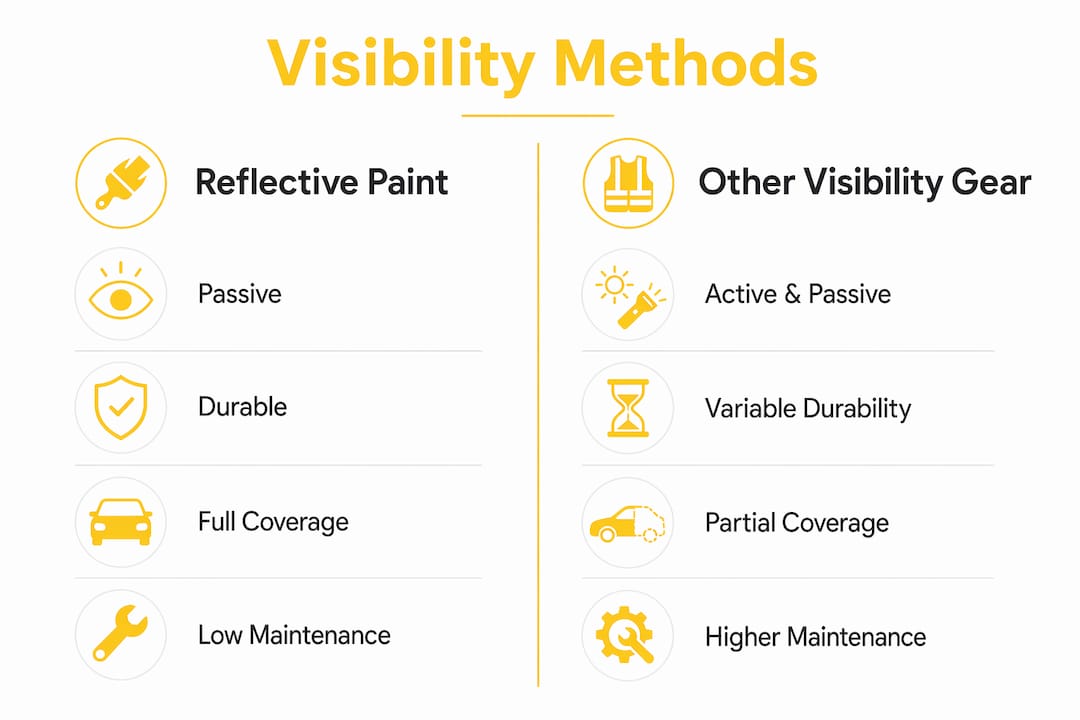
Driver detection distances double when retroreflective material is on ankles, knees, wrists, and elbows compared to torso-only reflectors. This finding applies directly to bikes. Reflective paint on pedals and crank arms mimics the ankle and knee movement that triggers faster driver recognition.
Bike lights are the most visible active option, but they depend entirely on charged batteries. A rider who forgets to charge their rear light is invisible from behind, regardless of how bright their front light is. Reflective products require no charging and work passively throughout the ride. That reliability is the core advantage of reflective paint over lights alone.
Reflective clothing enhances the rider’s visibility but requires the rider to wear it every time. Many cyclists skip their reflective vest on short rides or warm evenings. Reflective paint on the bike works regardless of what the rider is wearing.
The strongest safety setup combines all four methods. Paint and tape cover the bike passively. Lights add active illumination. Reflective clothing covers the rider. Each layer compensates for the weaknesses of the others. For guidance on selecting the right materials, the best reflective materials guide from Thebeamofficial breaks down the options clearly.
Key Takeaways
Reflective paint improves cyclist safety by using retroreflection to send light back to drivers, and its effectiveness multiplies when applied to moving parts and combined with active lighting and reflective gear.
| Point | Details |
|---|---|
| Retroreflection beats bright color | Fluorescent gear fails in full darkness; retroreflective paint works under any headlight. |
| Moving parts are the priority | Rims, pedals, and crank arms create biomotion signals that double driver detection speed. |
| Passive reliability matters | Reflective paint works without batteries, making it more dependable than lights alone. |
| Layered visibility is the goal | Combining paint, tape, lights, and reflective clothing covers every failure point. |
| Surface prep determines longevity | Cleaning with isopropyl alcohol before application prevents peeling and extends coating life. |
What I’ve learned from riding with reflective paint in real conditions
Most cyclists underestimate how invisible they are at night. I learned this the hard way on a rural road outside Lyon, where a car came within a meter of me before the driver reacted. I was wearing a bright jacket and had a rear light. What I did not have was any reflective material on my bike’s moving parts.
After that ride, I started applying clear reflective spray to my rims and pedals on every bike I own. The difference in driver behavior was immediate and obvious. Cars gave me more space and reacted earlier. The biomotion effect is not a theory. You feel it in how traffic responds to you.
The misconception I hear most often is that a bright color is enough. Cyclists show up to group rides in neon yellow kits and assume they are covered. They are covered in daylight. After dark, that neon does nothing. Retroreflective materials are the only solution that works when the sun goes down.
My honest recommendation is to treat reflective paint as a baseline, not an upgrade. Apply it to the rims and pedals at minimum. Add a clear spray to the frame if you ride in urban areas where side visibility matters. Then add lights and reflective clothing on top of that foundation. The cost is minimal. The protection is real.
— Sophie
Gear that works alongside your reflective setup
Reflective paint handles the bike. Your helmet handles your head, which is the most visible and most vulnerable part of you on the road.

Thebeamofficial designs helmets built for cyclists who take visibility seriously. The VIRGO integral helmet with MIPS technology combines real protection with features that complement a full reflective safety setup. The full helmet collection covers road, gravel, urban, and e-bike riders. For cyclists who want to extend their setup further, the helmet add-ons collection includes accessories that increase visibility directly from the helmet. Reflective paint on the bike and a well-designed helmet on your head is the combination that actually keeps you safe.
FAQ
What is reflective paint for bikes?
Reflective bike paint is a coating containing micro glass beads or prismatic elements that bounce light directly back to its source. It makes cyclists visible to drivers from hundreds of feet away under headlights, even in complete darkness.
Does reflective paint work better than bike lights?
Reflective paint and bike lights serve different functions. Lights emit their own beam while reflective paint bounces ambient light passively. The safest setup combines both, since reflective paint works even when a light battery dies.
Where should I apply reflective paint on my bike?
Apply reflective paint first to moving parts like rims, pedals, and crank arms for the biomotion effect. Then cover frame tubes for side visibility and the fork for front visibility.
How long does reflective bike paint last?
Clear reflective sprays like Life Paint typically last a few weeks before wearing off, especially in wet conditions. Pigmented reflective paints last longer, and reflective tape can last years with proper application.
Is reflective paint enough on its own for night riding?
Reflective paint is a strong passive safety layer but works best as part of a complete system. Combining it with active front and rear lights, reflective clothing, and a visible helmet provides the most reliable protection in all conditions.


