

The Hafny Bar End Bike Mirror is the best rear-view mirror for most cyclists. It mounts cleanly to flat or drop bars, holds its position under vibration, and delivers a wide convex field of view without adding noticeable weight. For riders who want something more integrated, THE BEAM rear-view mirror is the standout choice for safety-focused commuters who already ride with THE BEAM’s helmet ecosystem.
Quick shortlist:
- Best overall: Hafny Bar End Bike Mirror — stable, wide-angle, works on flat and drop bars
- Best for commuters: Mirrycle (Mountain or Road variant) — easy clamp mount, large mirror face
- Best helmet/eyewear option: Selle Italia Eyelink — minimal footprint, fast to glance
- Best budget bar-end: Zéfal Spin 15 — lightweight, adjustable, widely available in the US
- Best integrated safety pick: THE BEAM rear-view mirror — designed alongside THE BEAM’s helmet and accessories for riders who treat safety gear as a system
Key Takeaways
The Hafny Bar End Bike Mirror is the most reliable all-around pick for most cyclists, while THE BEAM rear-view mirror is the strongest choice for riders building an integrated safety setup.
| Point | Details |
|---|---|
| Best overall pick | The Hafny Bar End Bike Mirror offers stable hex-bolt tightening, scratch-resistant glass, and fits flat and drop bars. |
| Best for commuters | The Mirrycle clamp mount works on most bar types and gives one of the largest mirror faces in the category. |
| Mount compatibility first | Match your mirror to your bar type before comparing features: bar-end, clamp, hood, helmet, or eyewear. |
| Dominant eye placement | Mount on your dominant-eye side for faster, more accurate rear-view processing on every ride. |
| Mirrors supplement, not replace | Always shoulder-check before lane changes; no U.S. state requires a mirror, but using one improves awareness. |
| Thebeamofficial integrated option | THE BEAM rear-view mirror is built for safety-focused cyclists who want a mirror designed as part of a complete safety system. |
Table of Contents
- How do the best cycling rear-view mirrors compare?
- Hands-on reviews of the top cycling mirrors
- How to pick the right mirror for your bike and riding style
- How to install, aim, and maintain your mirror
- Why eye dominance and convex distortion actually change how you ride
- THE BEAM’s approach to mirror design and testing
- THE BEAM rear-view mirror: a direct recommendation
- Sources
How do the best cycling rear-view mirrors compare?
According to Cycling Weekly’s group test findings, pairing a handlebar mirror with a helmet mirror gives you the most complete rear view: a steady wide-angle image from the bar plus a fast-glance option from the helmet.
Key trade-offs to watch:
- Convex mirrors widen your field of view but compress distance, so vehicles look farther away than they are
- Bar-end mirrors are discrete but give a smaller image; hood-mounted mirrors give a larger view but sit exposed to knocks
- Helmet and eyewear mirrors are light and portable but take time to aim reliably
Hands-on reviews of the top cycling mirrors
How these were evaluated: Each mirror type was assessed across three scenarios: urban commuting (potholes, stop-and-go, frequent handlebar contact), loaded touring (panniers, rough pavement), and road riding (sustained speed, vibration from chip-seal). Stability was judged by how much the mirror drifted between adjustments. Field of view was compared by counting how many car lengths of following traffic were visible at a glance.
THE BEAM rear-view mirror
Designed as part of THE BEAM’s safety ecosystem, this mirror is built for riders who want their gear to work together rather than cobbled from different brands. The handlebar clamp mount is solid, the ball joint holds its position through sustained road vibration, and the convex glass gives a wide rear arc. It suits commuters and urban riders who already use THE BEAM helmet and want a mirror that matches the same design and safety standards. The one caveat: it’s optimized for THE BEAM’s own setup, so riders running a different helmet system may not get the full benefit of the integrated design.
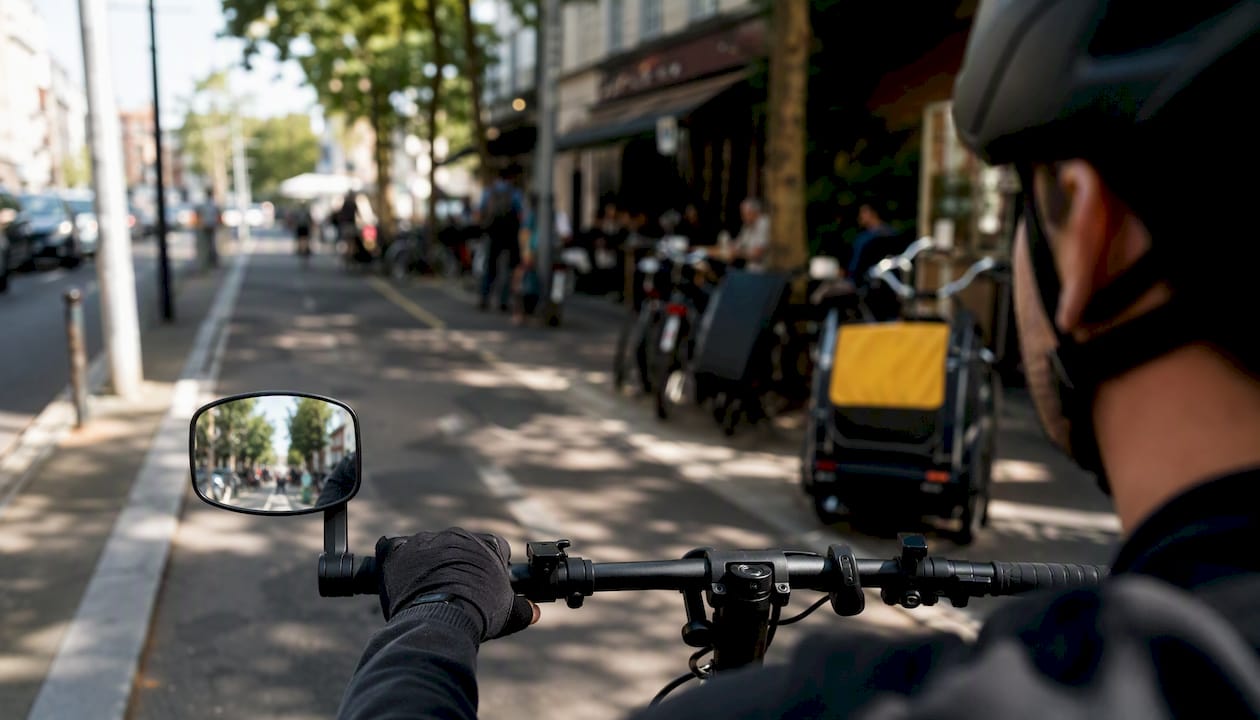
Reasons to buy: Durable build, wide convex field, designed for safety-first riders Reasons to avoid: Best value when paired with THE BEAM’s broader accessory lineup
Hafny bar end bike mirror
The Hafny is the mirror most testers reach for first on a new build. The stainless-steel glass resists scratching better than plastic mirrors, the ball joint locks firmly with a hex bolt, and the convex shape gives a genuinely wide rear view. It fits both flat bars and drop bars. The only real knock: the arm extends a few centimeters past the bar end, which can catch on bags in tight spaces.
Reasons to buy: Scratch-resistant glass, rock-solid hex-bolt tightening, flat and drop bar compatible Reasons to avoid: Arm protrusion can snag on panniers or bags
Cateye BM45 / BM-500
A long-running bar-end design that fits a wide range of handlebar diameters. The convex mirror is compact, the mount is reliable, and Cateye’s parts availability in the US is excellent. Adjustment range is narrower than the Hafny’s ball joint, so getting the exact angle can take a few tries. Solid for road commuters who want a no-fuss, proven option.
Reasons to buy: Proven reliability, widely available, compact profile Reasons to avoid: Limited adjustment range compared to full ball-joint designs
Zéfal Spin / Spin 15
At its price point, the Spin 15 punches above its weight. The ball-joint stem gives decent adjustability, and the convex mirror face is large enough for a useful rear view. Under heavy vibration on chip-seal roads it can drift slightly, so plan on a quick re-aim every few rides. CyclingSavvy’s mirror guide notes that any mirror with a plastic tightening mechanism will need more frequent attention than hex-bolt designs.
Reasons to buy: Lightweight, affordable, ball-joint adjustability Reasons to avoid: Plastic tightening can drift under sustained vibration
Mirrycle Mountain / Road mirror
The Mirrycle’s clamp mount wraps around the handlebar rather than inserting into the bar end, which means it works on grips, ergonomic bars, and setups where the bar end is already occupied. The mirror face is one of the largest in this category, giving a wide, easy-to-read rear view. Cycling West’s handlebar compatibility guide highlights clamp-style mounts as the better choice when you need to clear panniers on a loaded touring bike.
Reasons to buy: Large mirror face, clamp mount works on most bar types, good for touring Reasons to avoid: Sits exposed on the bar and can take knocks in traffic
Blackburn Road Mirror
Designed for drop bars, the Blackburn Road Mirror clips to the brake hood rather than the bar end. That placement puts the mirror close to your natural hand position, which makes glancing feel natural. The mirror face is convex and reasonably wide. The brake-hood clip is snug on most hoods but can loosen on older or worn rubber.
Reasons to buy: Natural placement for drop-bar riders, no bar-end modification needed Reasons to avoid: Hood clip can loosen on worn brake hoods
Selle Italia Eyelink
A helmet-mounted option that clips to the helmet strap or brim with minimal bulk. The mirror face is small, which keeps it out of your sightline when you’re not using it. Bicycling’s helmet mirror coverage notes that helmet mirrors take a few rides to aim reliably, but once dialed in they allow fast rear checks without moving your hands. Best for riders who swap helmets often and want a mirror that travels with the helmet rather than the bike.
Reasons to buy: Minimal weight, easy to transfer between helmets, unobtrusive Reasons to avoid: Small mirror face; takes time to aim correctly
Zefal Z-Eye and Blackburn Helmet Cycling Mirror
Both follow the same basic helmet-mount formula: a small convex mirror on a short arm that clips to the helmet. The Z-Eye is slightly lighter; the Blackburn has a marginally wider mirror face. Either works for casual commuters who want an always-on option without modifying the bike. Neither is the right tool for riders who need a large, stable rear image at speed.
Take-A-Look (Bike Peddler)
The Take-A-Look clips to eyeglass frames rather than the helmet or handlebar. The flat mirror gives an undistorted image, which is useful for judging vehicle distance accurately. The trade-off is a narrow field of view compared to convex designs. It’s the right pick for riders who wear the same glasses on every ride and change helmets frequently.
Reasons to buy: Flat mirror for accurate distance judgment, transfers with your glasses Reasons to avoid: Narrow field of view; only works if you always wear the same eyewear
Hindsight eyewear
Rather than a clip-on mirror, Hindsight integrates mirrored segments directly into the lens. There’s nothing to mount or adjust. The rear view is passive and always present. The limitation is that the mirrored area is fixed, so you can’t re-aim it for different riding positions. Best for riders who want rear awareness without any mechanical hardware.
How to pick the right mirror for your bike and riding style
Mount compatibility is the first filter. Cycling West’s compatibility breakdown lays this out clearly:
- Flat bars: bar-end or clamp mirrors both work; bar-end gives a cleaner look, clamp works when bar ends are occupied
- Drop bars: brake-hood clamp (Blackburn Road Mirror style) or bar-end; hood-mounted sits closer to your hands
- Helmet: any helmet-mount mirror; works regardless of bar type
- Eyewear: Take-A-Look or Hindsight; best when you wear the same glasses every ride
Once you’ve matched the mount, run through these selection checks:
- Field of view priority? Choose convex. If distance accuracy matters more, choose flat.
- Riding in traffic with frequent knocks? Prioritize hex-bolt tightening over plastic quick-release.
- Touring with panniers? A clamp-style mount with an extended arm clears bags better than a short bar-end.
- Switching bikes often? A helmet or eyewear mirror travels with you rather than staying on one bike.
- Want radar-level detection? The Garmin Varia RCT715 detects vehicles up to around 140 meters out and pairs with compatible devices — a complement to mirrors, not a replacement.
Pro Tip: If your mirror vibrates loose on rough roads, switch to a hex-bolt bar-end design and apply a small wrap of electrical tape inside the bar before inserting the mount. The friction fit tightens the whole assembly.
For a broader look at visibility gear that works alongside mirrors, the bike commuter visibility guide from Thebeamofficial covers reflectors, lighting, and positioning strategies for urban riders.
How to install, aim, and maintain your mirror
Installation and aiming:
- Choose your mount side based on dominant eye (see the expert section below for why this matters).
- Insert a bar-end mirror into the open end of the handlebar; for clamp mounts, position the clamp just inside the grip.
- Tighten finger-tight first, then sit on the bike in your normal riding position before final tightening.
- Aim the mirror so you can see the road behind you with a slight downward tilt — you want to see approaching vehicles, not sky.
- Tighten the ball joint or hex bolt fully. For hex-bolt designs, use a 4mm or 5mm Allen key rather than hand-tightening.
- Take a short test ride of 10–15 minutes on your normal surface. Re-aim after the first ride; mirrors settle into position.
Maintenance checklist:
- Check tightness every 2–3 weeks; vibration loosens plastic tightening devices faster than hex bolts
- For helmet mirrors, a small dab of hot-melt glue at the clip base reduces micro-movement without permanent attachment
- Clean mirror glass with a soft cloth and water; avoid abrasive cleaners on plastic-backed mirrors
- Inspect the ball joint for grit after wet rides; rinse and dry before re-tightening
- If the arm bends after a knock, check whether it can be re-bent cold before replacing the whole unit
- Store the bike away from direct sun if the mirror has a plastic housing; UV degrades plastic mounts over time
For detailed placement steps, Thebeamofficial’s mirror adjustment guide covers handlebar, helmet, and eyewear setups with specific aiming cues.
Safety note: A mirror gives you a fast rear glance without turning your head, but it doesn’t replace a shoulder check before lane changes or turns. Use both.
Why eye dominance and convex distortion actually change how you ride
Mount your mirror on the same side as your dominant eye. Your brain processes the image faster when it comes from the dominant side, which means a quicker, more accurate read of what’s behind you. To find your dominant eye: point at a distant object with both eyes open, then close each eye alternately. The eye that keeps your finger on target is dominant.
Convex mirrors are the default on most cycling mirrors because they widen the field of view significantly compared to flat glass. The catch is distance compression: a car that looks 30 meters back in a convex mirror may actually be 15 meters away. CyclingSavvy’s rear-view mirror guide explains this directly: convex mirrors tell you something is there and roughly how fast it’s closing, but they’re not reliable for precise gap judgment. Use them to decide whether to check further, not to decide whether to move.
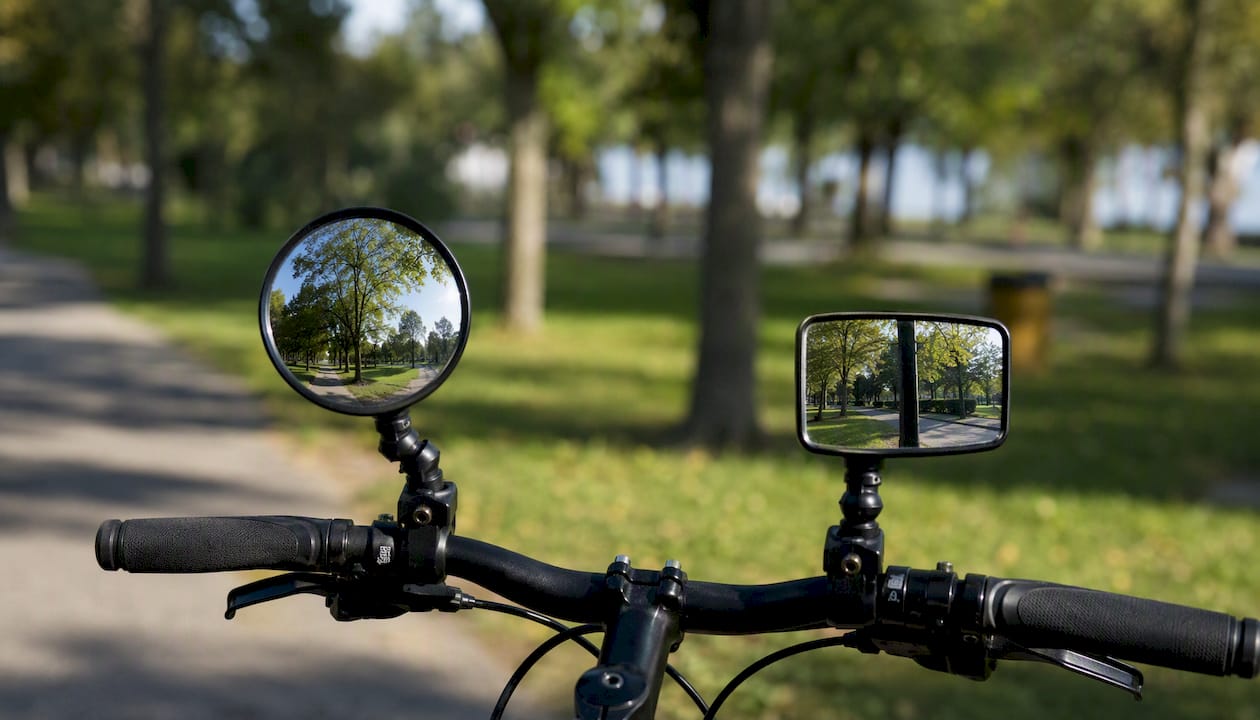
Flat mirrors (Take-A-Look, some helmet options) give accurate distance but a narrower field. They’re better for riders who need to judge whether a gap is safe before a lane change, and worse for riders who just want broad situational awareness.
Pro Tip: After mounting a new convex mirror, spend one ride consciously comparing what you see in the mirror to what you see when you shoulder-check. After a few sessions, your brain calibrates to the distortion and your distance judgments become more reliable.
No U.S. state requires cyclists to use a rear-view mirror. They’re a voluntary safety tool, and the CyclingSavvy guide is clear that mirrors supplement rather than replace active traffic awareness.
THE BEAM’s approach to mirror design and testing
At Thebeamofficial, mirrors go through the same real-world evaluation as helmets: commute routes, loaded touring, and sustained road riding across different surfaces. The metrics that matter are stability under vibration, field-of-view width, and how quickly a rider can re-aim after a knock. THE BEAM’s rear-view mirror is built to meet those standards as part of a complete safety setup rather than as a standalone accessory. For riders who want installation depth beyond what fits in a short review, Thebeamofficial publishes a full rear-view mirror setup guide covering placement, aiming, and compatibility across bar types.
THE BEAM rear-view mirror: a direct recommendation
THE BEAM rear-view mirror is the clearest choice for riders who want a mirror that was designed alongside the rest of their safety gear rather than sourced separately.
It’s built for commuters and safety-focused cyclists who ride with THE BEAM’s helmet and accessory ecosystem. The convex glass gives a wide rear arc, the ball-joint mount holds under road vibration, and the build quality matches what you’d expect from a brand that treats mirrors as safety equipment rather than afterthoughts. If you want a mirror that integrates with a broader safety setup, explore THE BEAM’s rear-view mirror and the full accessory lineup directly on the site.
Sources
- What kinds of rear-view mirrors work for bicyclists? - CyclingSavvy
- Bicycle Mirrors: What You Need to Know - Cycling West
- Best mirrors for bicycles 2026: a guide to the handy accessory | Cycling Weekly
- Bike Helmet Mirror | Cycling Safety - Bicycling
- Garmin Varia22 RCT715 | Rearview Bike Radar with Camera


