

TL;DR:
- Mirrors provide continuous rear visibility, reducing blind spots and enabling earlier vehicle detection.
- Handlebar, bar-end, and helmet-mounted mirrors each suit different riding styles and provide varying views.
- Regular mirror checks create habits that improve rider awareness and safety without replacing attentive riding.
Blind spots kill confidence. Every time you swing your head around to check traffic, you briefly lose control of your steering, shift your weight, and take your eyes off the road ahead. Most cyclists do this dozens of times per ride without a second thought, treating the shoulder check as the gold standard of rear awareness. But it is not always enough. Rear view mirrors provide continuous rear visibility without requiring a head turn, reducing blind spots and enabling earlier detection of approaching vehicles. This guide breaks down why mirrors matter, which types suit different riders, how to interpret what you see, and how to build smart mirror habits into every ride.
Table of Contents
- Why rear view mirrors matter for cyclists
- Comparing types of rear view mirrors
- Field of view: How much can you actually see?
- Limitations and best practices: Getting the most out of your mirror
- Integrating mirrors into everyday rides
- The cycling safety secret: Why rear view mirrors are underused but invaluable
Key Takeaways
| Point | Details |
|---|---|
| Constant rear awareness | Mirrors let you see approaching traffic without turning your head, reducing blind spots for safer cycling. |
| Choose the right type | Bar-end, handlebar, and helmet mirrors each offer specific advantages—pick what suits your riding style. |
| Understand mirror limitations | Mirrors supplement but do not replace shoulder checks and work best when used consistently with other safety habits. |
| Field of view matters | Convex mirrors provide a wider rear view, critical for spotting vehicles early, though distances may appear shorter. |
| Integrate for maximum safety | Combine mirrors with radar, lights, and defensive riding for the most effective protection on any road. |
Why rear view mirrors matter for cyclists
A shoulder check takes roughly one to two seconds. During that time, your front wheel can drift, your speed can change, and you lose situational awareness of everything in front of you. In heavy urban traffic, one second is all it takes for the situation ahead to change dramatically. Mirrors eliminate that trade-off by giving you a constant, passive view of what is coming from behind.
The specific problem mirrors solve is blind spot exposure. When cars pass cyclists, they often close the gap faster than riders expect. Without a mirror, you only catch that information when you happen to glance back. With a mirror, you catch it the moment the vehicle enters your field of view, giving you more time to position defensively, signal, or brake.
Situations where this matters most:
- Merging at roundabouts where traffic approaches fast from your left or right rear
- Narrow urban lanes where drivers squeeze past with minimal clearance
- Long descents where your speed is high and head turns are risky
- Group rides where you need to communicate overtaking maneuvers without losing your line
- Commutes with bus lanes where you share space with large, fast vehicles
“The ability to monitor rear traffic continuously without diverting attention from the road ahead is the single most underrated safety advantage a cyclist can have.”
Research into urban cycling mirror safety consistently shows that riders using mirrors make earlier and more deliberate responses to approaching vehicles. That early detection window, even if it is just two or three extra seconds, translates directly into better decisions and fewer near-misses. Mirrors do not replace attentive riding, but they add a layer of awareness that no head turn can match continuously.
Comparing types of rear view mirrors
Not all mirrors are built the same, and the wrong choice for your bike or riding style can make a mirror feel awkward or useless. The three main categories each come with real trade-offs.
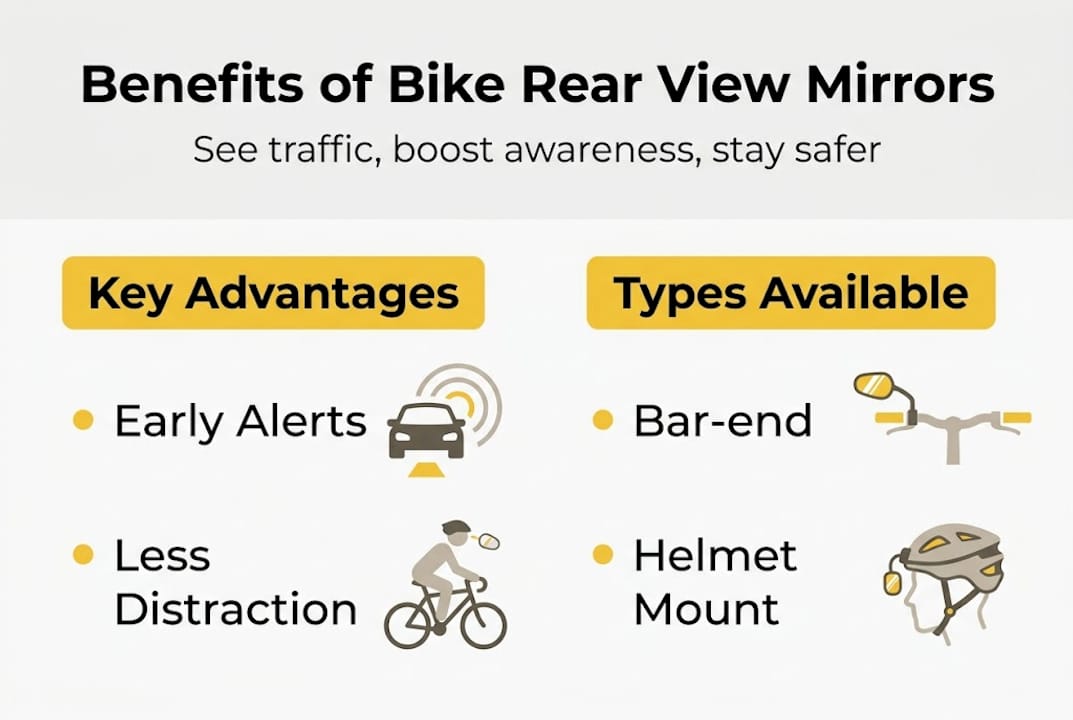
Mirror types for cyclists break down across three key designs:
| Mirror type | Best for | Field of view | Stability | Portability |
|---|---|---|---|---|
| Bar-end | Road and gravel bikes | Moderate | High | Low |
| Handlebar | Commuters and tourers | Wide | High | Medium |
| Helmet or glasses | Dynamic scanning, all bikes | Narrow but directional | Medium | High |
Bar-end mirrors attach inside the hollow end of drop bars or flat bars. They sit discreetly and do not interfere with hand position. The trade-off is a smaller mirror face and a view that is fixed relative to the bar angle. They work extremely well for road cyclists who maintain a consistent riding position.
Handlebar-mounted mirrors clamp onto the bar and typically offer the largest mirror face of any type. This means the widest view of what is behind you. They are easy to adjust, easy to clean, and ideal for commuters or tourers who carry gear and need maximum awareness. The downside is that they add visual bulk to the cockpit.
Helmet and glasses-mounted mirrors are small, angled mirrors that attach to your eyewear or helmet brim. They move with your head, which makes them excellent for dynamic scanning across multiple angles. The drawback is that the mirror face is tiny, and they require practice to use confidently. The best bike mirrors guide covers these options in more depth if you want side-by-side comparisons.
According to testing from Cycling Weekly, bar-end designs offer stability and a discreet profile ideal for drop bars, handlebar types deliver the largest field of view with sturdy mounting, and helmet or glasses-mounted mirrors provide a portable, dynamic view that travels with you between bikes.
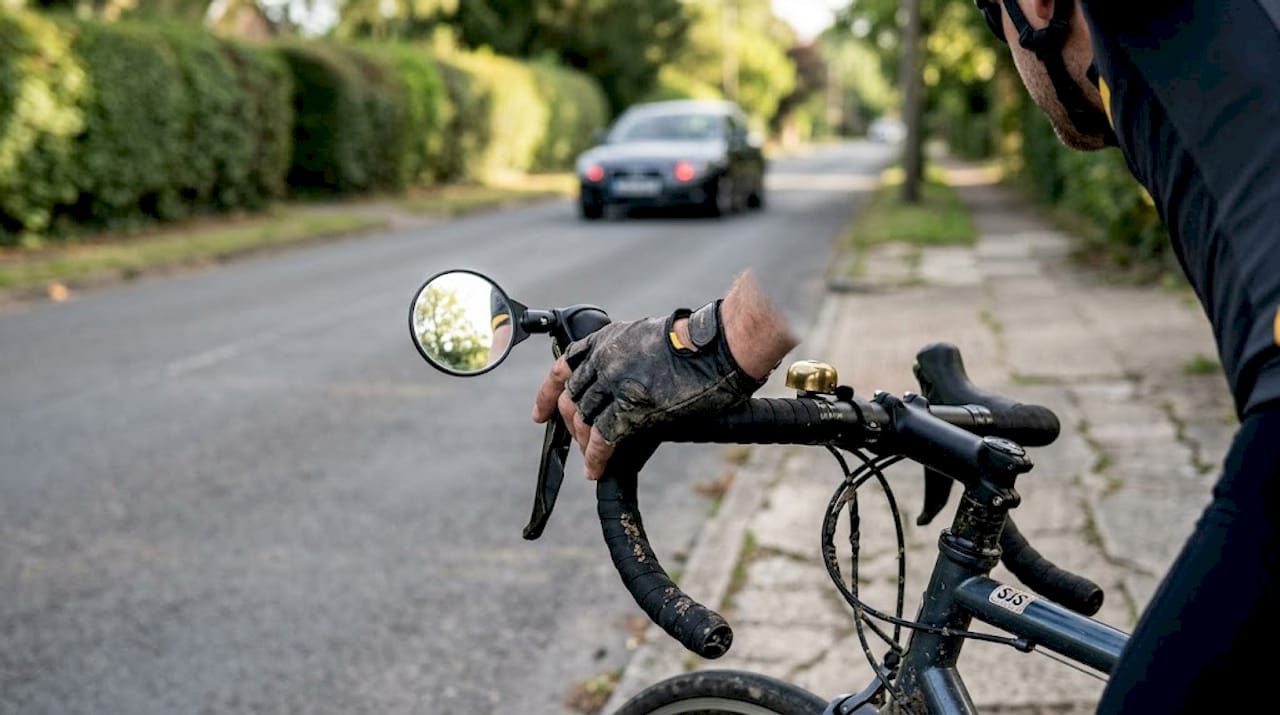
Pro Tip: If you switch between multiple bikes, a glasses-mounted mirror is the most practical option since it requires zero installation and moves with you every ride.
Field of view: How much can you actually see?
Buying a mirror without understanding what it shows you is like buying sunglasses without knowing the lens tint. The two key variables are mirror shape (convex vs. flat) and mirror size. Together they determine how much of the road behind you is visible and how accurately you can judge distances.
Convex vs. flat mirrors at a glance:
| Mirror shape | Field of view | Distance accuracy | Best use |
|---|---|---|---|
| Convex | Wide (70 to 100 meters) | Slight distortion | Urban and mixed roads |
| Flat | Narrow | Accurate | Quiet lanes, slower roads |
Convex mirrors deliver 70 to 100 meters of rear visibility compared to flat mirrors, though with some distance distortion. In practical terms, 70 meters at 30 mph gives you roughly five seconds of awareness before a vehicle reaches you. On a busy urban road, that is the difference between a reactive move and a planned one.
The distortion issue is real but manageable. Objects in a convex mirror appear slightly farther away than they actually are. This means you need to build a mental calibration habit. If something looks close in a convex mirror, assume it is closer than it appears.
Here is how to read your mirror effectively during a ride:
- Glance, do not stare. A quick half-second check every 10 to 15 seconds is enough to maintain awareness without fixating.
- Check before intersections. Make your mirror check a standard part of your intersection approach routine, not an afterthought.
- Use size to judge speed. If a vehicle appears to be growing quickly in your mirror, it is closing fast. React early.
- Combine with a shoulder check before lane changes. The mirror gives you context; the shoulder check gives you confirmation.
Exploring features in high-end bike mirrors can help you identify which optical quality and coatings matter most for low-light or wet conditions.
Limitations and best practices: Getting the most out of your mirror
Mirrors are powerful, but they are not perfect. Knowing their limitations is what separates riders who use mirrors well from those who feel let down by them.
Key limitations to understand:
- Vibration blurs the image. On rough roads, gravel, or cobblestones, mirror vibration can make the view useless. Rigid mounts significantly reduce this problem compared to flexible stems.
- Small mirrors limit situational awareness. The temptation to buy the most compact mirror for aesthetics is understandable, but you pay for it in blind spots. Always choose the largest mirror that fits your setup.
- Cargo and trailers block the view. If you ride with panniers or a trailer, a handlebar mirror may be partially blocked. Test your setup before relying on it.
- Mirrors do not replace shoulder checks. Ever. Before any lane change, turn, or merge, a direct look is still required.
“Mirrors are a supplement to defensive riding, not a replacement for active situational awareness.”
Vibration on rough roads blurs the view, which is why rigid mounts are preferred over flexible ones for mixed-surface riding. And while mirrors are highly effective, they work best as part of a layered safety system.
The smartest upgrade pairing a mirror with radar technology like a Garmin Varia creates an audio alert system that warns you of approaching vehicles before they even appear in your mirror. You hear the alert, glance at the mirror for confirmation, and have maximum time to respond. That layered approach is how serious cyclists build genuine urban bike mirror advice into their safety system.
Pro Tip: After installing a new mirror, spend your first three rides in a quiet area practicing glances. You need to train your eye to interpret the mirror view quickly and accurately before trusting it in traffic.
Integrating mirrors into everyday rides
Knowledge without habit does not protect you. The goal is to make mirror use automatic, not something you think about. That takes intentional repetition over a few weeks of riding.
Here is a simple framework to build the habit:
- Adjust before every ride. Make mirror alignment the first thing you do when you mount your bike. A mirror that is slightly off will be ignored. One that is perfectly aligned gets used constantly.
- Set a glance rhythm. Aim to check your mirror every 10 to 15 seconds during sustained riding. Set a mental timer until it becomes instinctive.
- Attach checks to events. Every time you approach a junction, every time a vehicle passes, every time you prepare to signal, check the mirror first. Event-based habit building is faster than time-based.
- Layer your gear. Combine your mirror with front and rear lights, reflective clothing, and if possible, a radar device. Each element covers what the others miss.
- Revisit your setup after every significant ride. Did the mirror stay aligned? Was the view clear enough? Small adjustments early prevent big frustrations later.
As road.cc’s review of rear view mirrors confirms, behavioral improvements from consistent mirror use are clear and measurable, even when crash statistics are harder to isolate. The rider who checks their mirror regularly is simply a more aware rider. When choosing your mirror, think of it as the first step in a layered safety upgrade, not a standalone fix.
The cycling safety secret: Why rear view mirrors are underused but invaluable
Here is an uncomfortable truth: the main reason rear view mirrors are not standard kit on most bikes is not practicality. It is image. Somewhere along the way, cycling culture decided that mirrors look


