

TL;DR:
- High-end bike mirrors feature superior optics, durable materials, and stable mounting systems for improved safety.
- They provide wide-angle, distortion-free views with anti-glare coatings, enhancing visibility in all lighting conditions.
- Choosing premium mirrors ensures reliable performance, reducing risks and increasing rider confidence in traffic.
Choosing a bike mirror sounds simple until you’re standing in front of dozens of options, each claiming to be the safest, clearest, and most durable. The reality is that most riders underestimate how much a mirror’s quality directly shapes their safety in traffic. A blurry reflection or a mount that vibrates loose at speed isn’t just annoying — it’s a genuine hazard. This article walks you through the exact criteria that separate truly premium bike mirrors from average ones, covering optics, mounting systems, materials, and real-world performance so you can make a confident, informed choice.
Table of Contents
- How to evaluate high-end bike mirrors: key criteria
- Clarity and field of view: why premium optics matter
- Mounting systems and adjustability: stability on the move
- Material quality and design: durability meets minimalist style
- Real-world advantages: what premium mirrors add to your ride
- Why most cyclists underestimate their bike mirror — and how to choose smarter
- Upgrade your safety: shop trusted bike accessories
- Frequently asked questions
Key Takeaways
| Point | Details |
|---|---|
| Premium optics are crucial | A high-end bike mirror offers wide, distortion-free views for safer riding in traffic. |
| Stability sets great mirrors apart | Secure, vibration-resistant mounting makes a huge difference in real-world performance. |
| Durability meets style | Premium materials ensure both a long lifespan and a sleek, modern look. |
| Choose based on your ride | Maintenance, field of view, and adjustability should fit your typical riding environment and style. |
How to evaluate high-end bike mirrors: key criteria
Not all mirrors are built the same, and the gap between a budget model and a high-end one goes far beyond price. Mirror quality directly impacts a cyclist’s ability to react to traffic, which means every feature on a premium mirror has a purpose rooted in real safety outcomes. Knowing what to look for saves you from wasting money on something that fails when it matters most.
Here are the core criteria to evaluate before buying:
- Optical clarity: The reflection should be sharp and distortion-free, even at the edges of the lens.
- Anti-glare performance: A quality mirror handles direct sunlight and headlights without washing out the image.
- Field of view: Convex or aspheric lens designs expand your visible range well beyond what a flat mirror can offer.
- Vibration resistance: The mirror should hold a steady image on rough pavement, not blur every time you hit a crack.
- Mounting stability: A secure, universal clamp system keeps the mirror locked at your chosen angle without creeping.
- Weather tolerance: Premium mirrors use sealed, weatherproofed construction that survives rain, mud, and UV exposure.
- Weight and profile: Aerodynamic, minimalist builds add almost nothing to your bike’s weight or drag.
For a broader look at how these factors compare across models, the rear-view mirror options available today show how much the market has evolved.
Pro Tip: Before purchasing, hold the mirror at arm’s length and look at your reflection. If you see any wavy distortion or color shift, the optics won’t perform well in traffic conditions.
With these criteria in mind, let’s break down the most essential features that set high-end mirrors apart.
Clarity and field of view: why premium optics matter
Once you know how to judge overall quality, consider how optics and field of vision elevate your ride. The lens is the heart of any mirror, and in a premium model, it does a lot more than just reflect light.
Distortion-free optics mean you see vehicles exactly where they are, not slightly offset or warped by a cheap lens curve. That accuracy matters when you’re deciding whether to hold your line or move right with a truck approaching at speed. Even a small distortion can cause you to misjudge distance.
“A 160-degree field of view gives cyclists dramatically more reaction time compared to narrow flat mirrors, turning a passive glance into an active safety tool.”
Anti-glare coatings are equally important. Morning sun low on the horizon or oncoming headlights at dusk can completely blind a standard mirror. High-end lenses use multi-layer coatings that cut reflected glare while keeping the image bright and readable. This is especially valuable for urban commuters riding in varied lighting throughout the day.
Convex and aspheric designs are the standard in quality mirrors because they physically bend the reflected image to cover a wider angle. A 160-degree field of view dramatically increases reaction time, giving you a much earlier warning when a vehicle is closing in from behind.
Key optical features to prioritize:
- Multi-layer anti-glare coating for consistent visibility in sun and artificial light
- Aspheric or convex lens shape for wide-angle coverage without blind spots
- High-contrast reflection that distinguishes vehicles from background easily
- Edge-to-edge sharpness so peripheral details stay readable
For a curated breakdown of models that deliver on these optical standards, the best bike mirrors guide offers a practical comparison across riding styles.
Mounting systems and adjustability: stability on the move
Optics matter, but how your mirror stays put under real-world conditions is just as important. A mirror that shifts angle every few kilometers, or vibrates into a blur on cobblestones, defeats its own purpose.
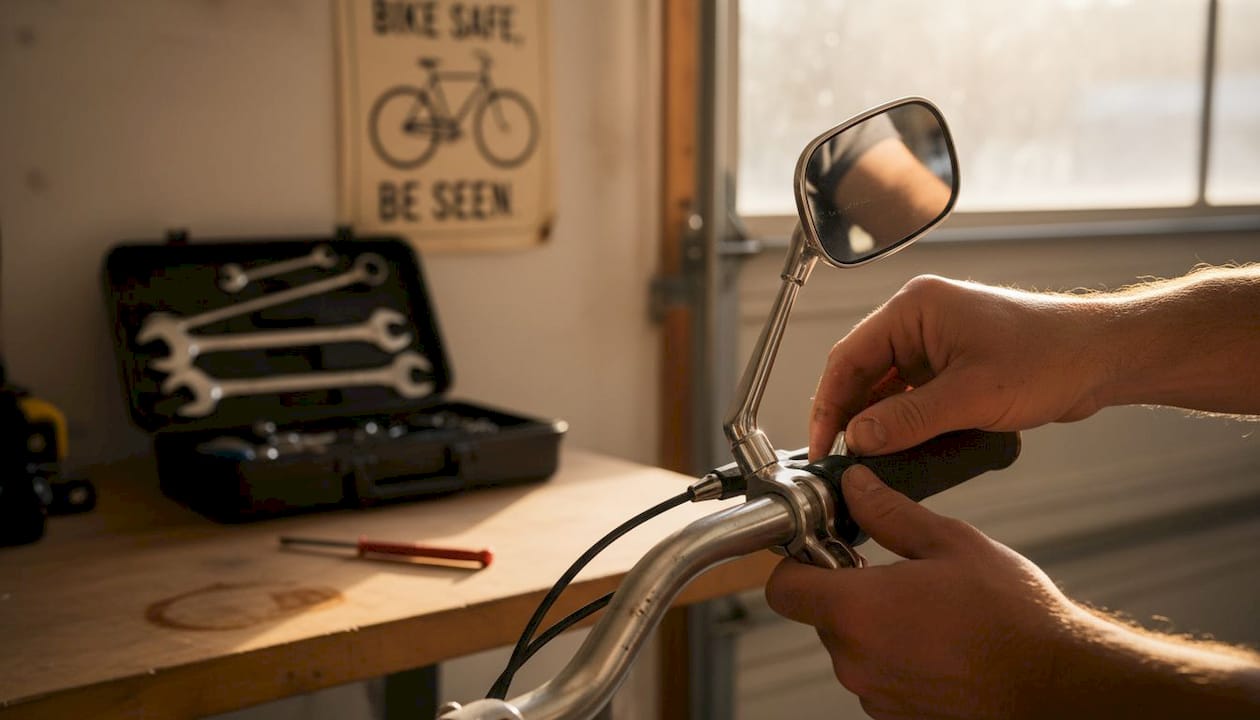
A well-mounted mirror remains steady even over rough pavement and bumps, which is the baseline expectation for any premium model. The mount design is what makes or breaks that promise.
Here’s what a quality mounting system delivers:
- Universal fit: Premium mounts are designed to fit a wide range of handlebar diameters, from narrow road bars to wider urban bars, without requiring adapters.
- Tool-free installation: Lever-based or twist-lock mechanisms let you install, remove, or reposition the mirror in seconds without a wrench.
- Vibration dampening: Rubber inserts or tension-based clamps absorb road chatter before it reaches the mirror head, keeping your view stable.
- Multi-angle adjustability: A ball-joint or pivot system allows fine-tuning in multiple directions so every rider can dial in the exact view they need.
- Secure lock-in: Once set, the mirror should hold its position firmly, even under the lateral forces of hard cornering or sudden braking.
Rigid clamp systems without any dampening tend to transmit every vibration directly to the lens, which turns a clear image into a blur at anything above a slow roll. Premium mounts solve this by isolating the mirror head from the bar.
Pro Tip: After installation, tap the mirror head firmly with your finger. If it springs back to position without wobbling, the mount tension is correct. If it drifts, tighten the clamp incrementally until it holds.
For more detail on how mounting quality connects to overall bike mirror safety, the differences become clear when you compare field performance across budget and premium tiers.
Material quality and design: durability meets minimalist style
With security accounted for, let’s examine what makes some mirrors outlast and outshine others in terms of material and design. The construction of a mirror determines not just how long it lasts, but how it performs in the conditions you actually ride in.
Premium mirrors use shatterproof materials and weatherproofing for longevity, which matters when you consider that a mirror takes the occasional knock in a bike rack or gets left out in the rain. Budget models use thin plastics that crack on impact or fog up after a few wet rides.
| Feature | Budget mirrors | Premium mirrors |
|---|---|---|
| Lens material | Standard plastic | Shatterproof polycarbonate |
| Frame construction | Thin ABS plastic | Reinforced alloy or composite |
| Weather resistance | Minimal | Sealed, UV-resistant |
| Weight | Often heavier | Lightweight, optimized |
| Aerodynamic profile | Bulky | Slim, low-drag design |
Beyond durability, design plays a real role in rider adoption. A mirror that looks sleek and integrates with your bike’s aesthetic is one you’ll actually use every day. Minimalist profiles also reduce wind resistance and avoid snagging on obstacles in tight urban spaces.
Key material advantages in high-end models:
- Impact-resistant polycarbonate lenses that survive drops and minor collisions
- Alloy or composite frames that resist corrosion from rain and sweat
- UV-stabilized coatings that prevent yellowing and lens degradation over time
- Low-profile aerodynamic shape that adds minimal drag at road speeds
If you ride in all weather, pairing a quality mirror with cycling sunglasses that also handle glare and wind gives you a complete front-and-rear visibility system. The bike mirror safety benefits of premium construction become obvious after just one season of regular riding.
Real-world advantages: what premium mirrors add to your ride
Bringing these features together, here’s how top-tier mirrors transform your daily ride. The technical specs only tell part of the story. What really counts is how those specs translate into actual riding experience.
The right mirror reduces collisions and increases rider confidence, which is the clearest summary of why the upgrade is worth making. Riders who switch from basic to premium mirrors consistently report fewer near-miss moments and a noticeably calmer experience in heavy traffic.
| Riding style | Key mirror benefit | What to prioritize |
|---|---|---|
| Urban commuter | Wide field of view in dense traffic | 160-degree convex lens, anti-glare |
| Road cyclist | Aerodynamic profile, vibration stability | Slim mount, shatterproof lens |
| Gravel rider | Durability on rough terrain | Alloy frame, vibration dampening |
| Night rider | Visibility in low light | Anti-glare coating, high contrast |
The confidence factor is real and measurable. When you can glance at a clear, stable mirror and immediately identify a vehicle’s speed and distance, you make better decisions. You hold your line with more certainty. You merge, turn, and signal with less hesitation.
Premium mirrors also reduce the mental load of riding in traffic. Instead of constantly turning your head to check behind you, a well-positioned mirror with a wide field lets you process rear traffic in a fraction of a second. That’s cognitive bandwidth you can redirect to what’s in front of you.
For bike mirrors for safer rides, the practical difference between a $15 mirror and a quality premium model isn’t marginal. It’s the difference between a tool you trust and one you second-guess every time you use it.
Why most cyclists underestimate their bike mirror — and how to choose smarter
Now that you know what to look for, here’s a fresh take on why the right mirror is far more than a simple accessory. Most cyclists treat a mirror as an afterthought, something to bolt on after the important purchases are done. That thinking is backwards.
A helmet protects you after a crash. A mirror helps you avoid one entirely. Yet riders routinely spend significant money on helmets, lights, and apparel while grabbing the cheapest mirror available. The result is a safety tool that fails at its primary job: giving you reliable, real-time awareness of what’s behind you.
We hear consistently from cyclists who upgraded to a high-end mirror that the change felt immediate. Not subtle. The clarity, the stable view, the wider angle — it reframes how you interact with traffic. One rider described it as “finally being able to trust what I see.” That trust is what makes the upgrade worth every cent.
Budget mirrors are often fine for casual paths or low-traffic routes. But if you ride in urban traffic, on roads shared with cars and trucks, or in varying light conditions, a basic mirror is genuinely not enough. The bike rear-view mirror safety case for going premium isn’t about luxury. It’s about using a tool that actually performs when the stakes are real.
Choose deliberately. Match the mirror’s optics, mount, and build quality to the conditions you actually ride in. That’s the smarter approach.
Upgrade your safety: shop trusted bike accessories
Ready to elevate your ride’s safety profile? At THE BEAM, we design safety gear that performs in real conditions, not just on spec sheets. Our bike accessories selection includes premium rear-view mirrors built with the optical clarity, vibration-resistant mounts, and durable construction covered throughout this article.
If you’re building a complete safety setup, our premium bike helmets pair naturally with our mirror range to give you front-to-rear protection designed with the same attention to detail. Every product we make is tested for real-world usability, because safety gear only works if you actually use it every day.
Frequently asked questions
What makes a bike mirror high-end compared to standard models?
High-end bike mirrors feature advanced optics, durable materials, superior adjustability, and weather-resistant construction. Premium mirrors use shatterproof materials and advanced lenses that standard models simply cannot match for safety and longevity.
Can premium mirrors fit all bike types?
Most high-end mirrors offer universal mounting and angle adjustment to fit a range of handlebars and bikes. Premium mirrors feature tool-free universal installation systems that work across road, urban, and gravel setups.
How do I clean and maintain a high-end bike mirror?
Use a soft, damp cloth to wipe the lens and periodically check the mounting clamp for tightness. Avoid abrasive cleaners that can scratch anti-glare coatings.
Are there bike mirrors that reduce glare for night riding?
Yes, many high-quality bike mirrors include anti-glare coatings to maintain clear visibility in low-light or direct sunlight conditions. Advanced mirrors use anti-glare coatings that make them effective from dawn commutes through evening rides.
Do high-end mirrors really improve cycling safety?
User reports and rider feedback consistently show that premium mirrors significantly increase rearward awareness and reduce accident risk. The right mirror reduces collisions and builds the kind of riding confidence that budget models rarely deliver.


