

TL;DR:
- Crash sensors in cycling detect impact events using advanced hardware and algorithms to alert emergency contacts quickly. They achieve high accuracy and fast response times but depend on proper calibration and reliable network connections for optimal performance. These sensors are essential for solo riders and should be combined with other safety gear for comprehensive protection.
Crash sensors in cycling are devices that detect impact events using motion-tracking hardware and algorithms, then automatically alert emergency contacts or services to get help to a rider faster. The role of crash sensors in cycling has grown from a niche concept into a practical safety layer for road, gravel, urban, and e-bike riders. These systems rely on inertial measurement units, sensor fusion algorithms, and GPS modules to distinguish a real crash from a pothole or a hard stop. For any cyclist who rides alone or in low-traffic areas, understanding this technology is no longer optional. It is the difference between waiting for help and getting it.
How do crash sensors work in cycling helmets and gear?
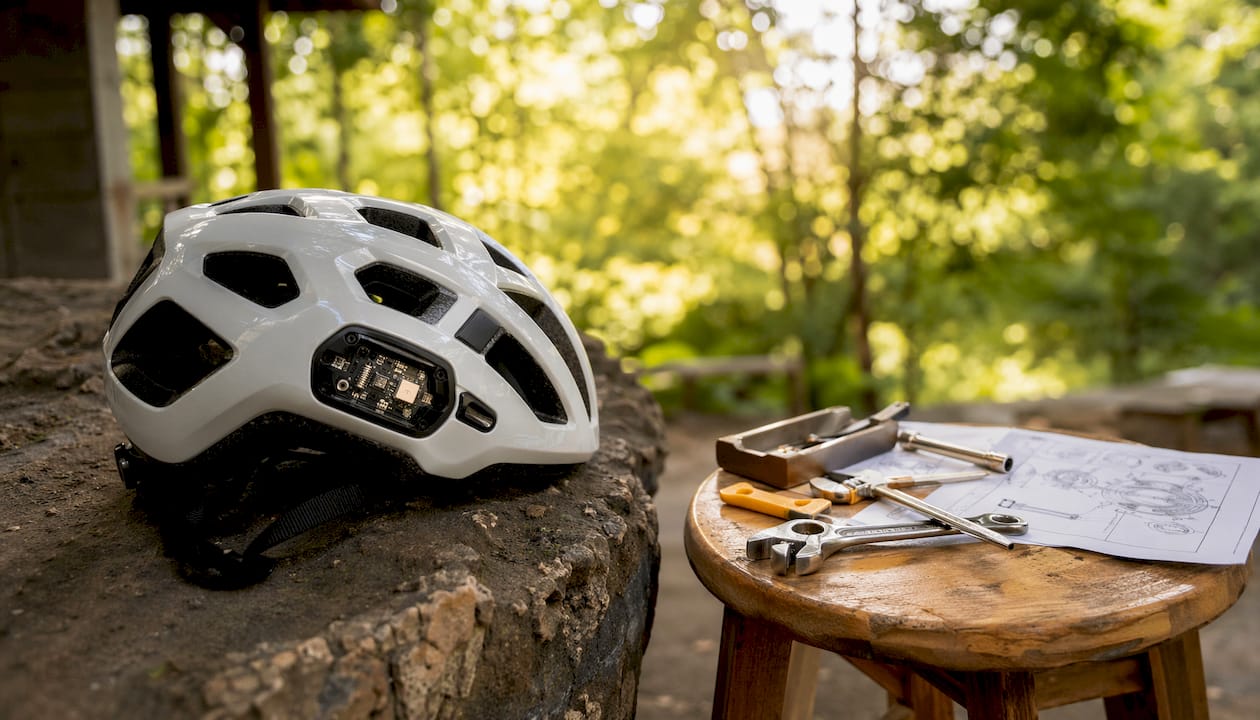
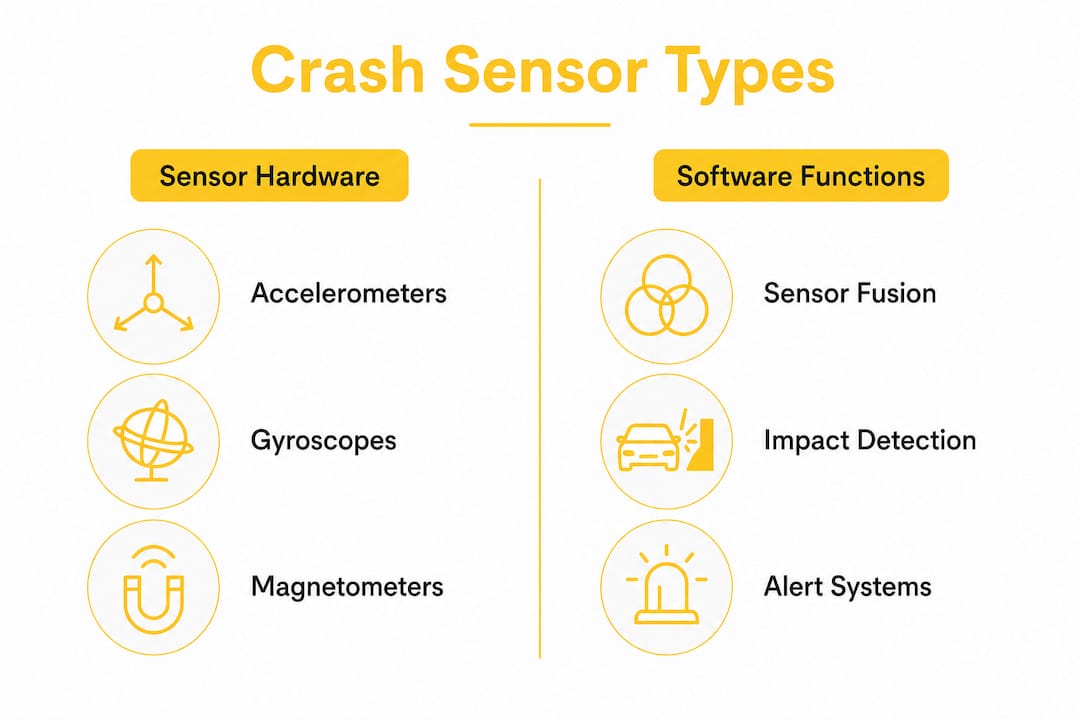
Crash detection technology is built around a combination of hardware sensors and software intelligence working together in real time. The core hardware is a tri-axial inertial measurement unit, or IMU, which tracks acceleration and rotation across three axes simultaneously. Most systems also include a gyroscope to capture angular velocity and a GPS module to confirm speed and location at the moment of impact.
Sensor fusion is the process that ties these data streams together. Rather than relying on a single accelerometer reading, the system cross-references acceleration, rotation, and GPS speed to confirm whether an event is a genuine crash. Modern crash detection systems achieve 97.5% average accuracy in simulated impacts with detection latency under 200 ms. That sub-200 ms window is fast enough to trigger an alert before a rider even regains consciousness.
Machine learning plays a direct role in reducing false positives. Algorithms trained on thousands of impact signatures learn to separate a crash from a hard bump on a gravel path. Crash detection technology uses sensor fusion and machine learning to filter out noise and false triggers caused by normal riding. This matters because a system that cries wolf too often loses the rider’s trust and gets disabled.
Key sensor types used in crash detection
- Tri-axial accelerometer: Measures linear acceleration in three directions to capture the force of an impact.
- Gyroscope: Tracks rotational movement, helping the algorithm identify the sudden tumble pattern of a real crash.
- GPS module: Confirms riding speed before impact and provides location data for emergency alerts.
- GSM communication module: Sends the alert, including GPS coordinates, via SMS or a connected app.
Calibration is not a one-time setup. Sensor performance degrades if the helmet fits poorly or if the sensor module shifts during a ride. Proper sensor calibration and fit are essential to minimize false alarms caused by helmet movement and normal riding bumps. A loose helmet is not just a protection problem. It is a sensor accuracy problem.
Pro Tip: Before every long ride, check that your helmet sits level on your head and that any integrated sensor module is firmly seated. A two-finger gap above the eyebrows and a snug chin strap are the baseline for both protection and accurate crash detection.
What are the benefits of crash sensors for cyclist safety?
The most direct benefit of crash detection technology is faster emergency response. When a rider goes down alone on a rural road or a quiet bike path, no one may witness the crash. Without an automatic alert, help could take hours. With a crash sensor, emergency GPS location alerts reach designated contacts or services within seconds of impact.
Speed of response is not just a comfort factor. It is a medical one.
“The ‘Golden Hour’ concept in trauma medicine holds that the first 60 minutes after a serious injury are the most critical window for intervention. Crash sensors that trigger alerts within seconds of impact directly support faster access to care during this window, improving survival rates and reducing long-term injury severity.”
The benefits of cycling sensors extend beyond emergency response. Solo riders gain genuine peace of mind, knowing that a crash will not go unnoticed. Families of cyclists, especially those with older or younger riders, gain a layer of reassurance that no amount of reflective gear can provide. Crash sensors improve emergency response during the critical Golden Hour post-accident, significantly increasing survival chances and reducing injury severity.
Limitations worth knowing
No technology is without trade-offs. Current crash detection systems face real-world challenges that riders should understand before relying on them:
- Battery life: Integrated sensors draw power continuously. In low-power modes, detection sensitivity can drop.
- False alarms: Even well-calibrated systems occasionally misread a hard stop or a dropped helmet as a crash event.
- Network dependency: Current crash detection helmets face performance lapses in low-network or extreme conditions, which limits alert delivery in remote areas.
- Smartphone pairing: Many consumer systems require a paired phone to complete the alert chain, adding a point of failure.
Understanding these limits does not undermine the technology. It helps you use it correctly and pair it with other smart cycling gear for a complete safety setup.
How do crash sensors differ from concussion sensors in helmets?
Crash sensors and concussion sensors are not the same thing, and the distinction matters for how you interpret the data each provides. A crash sensor detects a high-magnitude impact event and triggers an emergency alert. A concussion sensor attempts to measure the forces experienced by the helmet shell and estimate whether a brain injury may have occurred.
The problem with concussion sensors is a fundamental physics one. Helmet sensors record shell impacts, not necessarily the forces transmitted to the brain. The skull, cerebrospinal fluid, and brain tissue all absorb and redirect energy in ways that a surface-mounted accelerometer cannot fully capture. This means a sensor reading a high shell impact does not confirm a concussion, and a lower reading does not rule one out.
Regulatory bodies are working to address this gap. ASTM F08.53, the Helmet and Headgear subcommittee, is actively developing performance standards for head impact sensors to improve consumer confidence and product safety. Until those standards are finalized, no helmet-mounted sensor can legally or medically diagnose a concussion.
| Feature | Crash sensor | Concussion sensor |
|---|---|---|
| Primary function | Detects crash events, triggers alerts | Records shell impact forces |
| Data output | GPS location, emergency notification | Impact magnitude reading |
| Medical diagnosis | Not applicable | Cannot diagnose concussion |
| Regulatory standard | Emerging (ASTM F08.53) | Emerging (ASTM F08.53) |
| Requires medical follow-up | Yes, after any serious crash | Yes, always |
The practical takeaway is clear. Crash sensors are tools for emergency response. Concussion sensors are data-logging tools. Neither replaces a medical evaluation after a significant impact. If you want to learn more about impact sensors in helmets, the distinction between these two technologies is the most important concept to understand first.
Pro Tip: After any crash that triggers your sensor, seek medical evaluation regardless of how you feel. Concussion symptoms can be delayed by hours, and no sensor reading clears you to keep riding.
How to choose, use, and maintain crash sensors effectively
Choosing the right crash detection setup starts with deciding between an integrated helmet and an add-on sensor module. Integrated helmets combine the sensor, GPS, and GSM hardware into a single unit. Standalone smart helmets send GPS location via SMS autonomously with a mean alert latency of 2.8 seconds, without relying on a paired smartphone. Add-on modules offer flexibility but depend on Bluetooth connectivity to a phone, which adds latency and a potential point of failure.
Here is a practical framework for selecting and maintaining your crash detection setup:
- Prioritize integration. A helmet with built-in crash detection removes the smartphone dependency. Look for systems that use tri-axial IMUs and onboard GPS rather than relying entirely on your phone’s sensors.
- Check sensitivity settings. Most systems let you adjust the impact threshold. Set it too low and you get false alarms on rough roads. Set it too high and a real crash may not trigger. Start at the manufacturer’s recommended default and adjust based on your terrain.
- Register your emergency contacts before you ride. The alert system is only as useful as the contact list behind it. Add at least two contacts and confirm they know what an alert message looks like.
- Charge before every ride. Battery exhaustion is one of the most common reasons crash detection fails in the field. Build helmet charging into your pre-ride routine the same way you check tire pressure.
- Inspect the sensor module monthly. Look for physical damage, loose connections, or firmware updates. A sensor that has taken a hard knock may need recalibration or replacement.
- Combine with other safety gear. Crash sensors work best as part of a layered approach. Pair them with high-visibility reflectors, rear-view mirrors, and MIPS-equipped helmets for full-spectrum protection. Thebeamofficial designs its helmets and accessories with exactly this layered philosophy in mind.
For cyclists upgrading their setup, proven steps for helmet safety in 2026 include evaluating crash detection integration as a primary selection criterion, not an afterthought.
Key Takeaways
Crash sensors in cycling are the most direct technology available for reducing the time between a crash and emergency response, and their effectiveness depends on sensor quality, calibration, and correct use.
| Point | Details |
|---|---|
| Detection accuracy | Modern IMU-based systems achieve 97.5% accuracy with under 200 ms latency in simulated impacts. |
| Emergency response | Crash sensors trigger GPS alerts within seconds, supporting faster care during the critical Golden Hour. |
| Sensor vs. concussion | Crash sensors detect impact events for alerts; concussion sensors log shell forces but cannot diagnose brain injury. |
| Calibration matters | Proper helmet fit and sensor calibration directly reduce false alarms and improve detection reliability. |
| Layered safety | Crash sensors work best combined with MIPS helmets, reflectors, and mirrors for complete cyclist protection. |
Why I think most cyclists underestimate crash sensor technology
I have followed cycling safety technology for years, and the pattern I keep seeing is the same. Riders spend serious money on carbon frames and aerodynamic gear, then treat crash detection as a novelty feature they will “look into later.” That gap in priorities is a real problem.
The technology has crossed a threshold. A 97.5% detection accuracy rate is not a prototype number. It is a performance figure that belongs in the same conversation as helmet certification standards. The fact that ASTM is now formalizing sensor performance requirements tells you this is no longer fringe tech. It is becoming infrastructure.
What I find most underappreciated is the standalone capability. A helmet that sends your GPS coordinates via SMS without needing your phone is a fundamentally different safety proposition than one that depends on Bluetooth staying connected. That distinction rarely makes it into buying decisions because most riders do not know to ask the question.
The concussion sensor confusion also frustrates me. Riders assume that a sensor reading after a crash tells them whether they are okay to continue. It does not. The sensor tells you an impact happened. A doctor tells you what it means. Conflating the two creates a false sense of clearance that can lead to serious long-term harm.
The future of connected safety for cyclists will bring better battery life, tighter machine learning models, and eventually standardized alert protocols that connect directly to emergency services. We are not there yet. But the riders who adopt this technology now are building habits and expectations that will define what “safe cycling” means in the next decade.
— Sophie
Thebeamofficial helmets built for crash detection
Thebeamofficial designs helmets and safety accessories for cyclists who take protection seriously, from daily commuters to long-distance road riders. Every product in the lineup reflects a commitment to real-world usability, not just certification checkboxes.

The adults’ helmet collection includes options built with advanced safety integration, combining structural protection with the features that matter most for incident response. The VIRGO integral helmet with MIPS technology is the flagship, offering certified impact absorption alongside a design built for riders who want both performance and protection. For cyclists looking to add crash detection capability to an existing setup, the helmet add-ons range offers compatible accessories to extend your safety system without replacing your current helmet.
FAQ
What is the role of crash sensors in cycling?
Crash sensors detect high-magnitude impact events using accelerometers, gyroscopes, and GPS, then automatically alert emergency contacts with the rider’s location. Their primary role is to reduce the time between a crash and emergency response, especially for solo riders.
How accurate are crash sensors in cycling helmets?
Modern systems using tri-axial IMUs and sensor fusion achieve 97.5% detection accuracy with under 200 ms latency in simulated impacts. Accuracy in real-world conditions depends on proper fit, calibration, and network availability.
Can crash sensors diagnose a concussion?
No. Helmet-mounted sensors record shell acceleration, not brain forces, and cannot diagnose a concussion. Medical evaluation is always required after any significant impact, regardless of what the sensor data shows.
Why do crash sensors give false alarms?
False alarms most often result from improper helmet fit, sensor misplacement, or insufficient calibration. Sensor fusion algorithms reduce false triggers by cross-referencing multiple data streams, but no system eliminates them entirely.
Do crash sensors work without a smartphone?
Some integrated helmet systems include onboard GPS and GSM modules that send alerts autonomously. Standalone smart helmets can transmit GPS location via SMS with a mean latency of 2.8 seconds, without requiring a paired phone.


