

TL;DR:
- Traditional safety gear alone cannot address the persistent stagnation in cyclist safety despite technological advances.Connected safety devices like V2X systems, radar taillights, and AI cameras significantly improve situational awareness but face limitations such as weather, adoption rates, and infrastructure dependence. Ultimately, layered safety strategies combining smart technology, route planning, and better infrastructure are essential for meaningful safety improvements.
Reflective vests and bright lights were once enough to feel safe on a bike. They’re not anymore. Despite decades of road safety campaigns across Europe and the United States, EU cyclist fatalities have remained stubbornly flat at roughly 1,900 to 2,000 deaths annually between 2013 and 2023, a decline of only 8% compared to a 26% drop for motorized road users over the same period. The gap is stark, and it demands a smarter answer than simply wearing a brighter jacket. This guide breaks down the connected technologies now available to cyclists, what they can actually do, where they fall short, and how to build a layered safety strategy that works in the real world.
Table of Contents
- Why connected safety matters: the reality for cyclists
- Core technologies powering connected safety
- Limitations, edge cases, and what most guides miss
- Practical steps for upgrading your cycling safety
- The uncomfortable truth about cycling safety no gadget can solve
- Gear up for safer rides with connected and high-visibility equipment
- Frequently asked questions
Key Takeaways
| Point | Details |
|---|---|
| Collision risk remains high | Despite new gear, most cycling fatalities still involve motor vehicles and require more than just visibility. |
| Tech boosts real-time awareness | Connected devices like V2X, radar, and AI cameras alert both cyclists and vehicles, helping to reduce blind spots. |
| Each device has limits | No device is perfect—weather, adoption rates, and infrastructure gaps can undermine protective tech. |
| Layer solutions for best results | Combining connected tech, reflective equipment, and smart route choices delivers the highest safety gains. |
| Advocate for better streets | Pushing for dedicated bike lanes and calm traffic zones is essential for long-term cyclist safety. |
Why connected safety matters: the reality for cyclists
The numbers behind cycling fatalities reveal a pattern that traditional safety gear simply cannot fix. In Europe, 65% of cyclist deaths involve a collision with a motor vehicle. In the United States, the National Highway Traffic Safety Administration reports a similar trend, with motor vehicles involved in the vast majority of fatal cycling crashes. These aren’t accidents caused by cyclists failing to be seen in the dark. Most happen in daylight, at intersections, or during overtaking maneuvers on roads where the cyclist was perfectly visible.
So what is actually going wrong? A significant part of the problem lies in the perception gap between cyclists and drivers. Drivers often underestimate a cyclist’s speed or misjudge closing distances. Cyclists, meanwhile, tend to overestimate their own safety after a vehicle has passed them, entering a false “relief period” where they feel danger has passed when another vehicle may already be approaching. This psychological mismatch creates a window of real risk that no reflector can close.
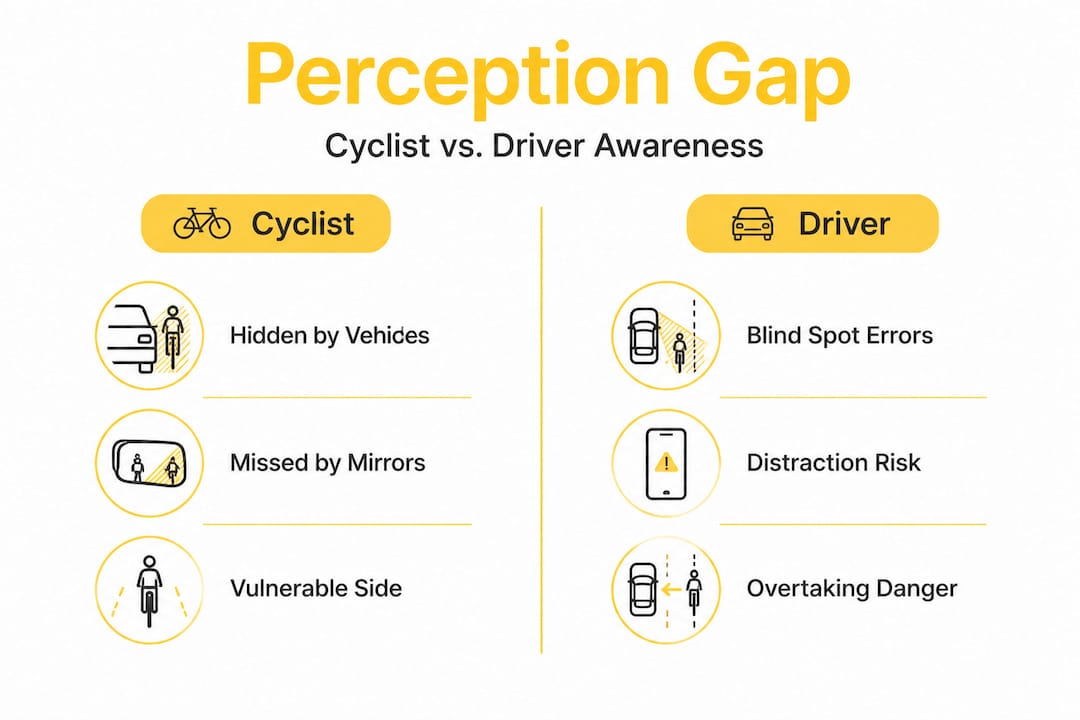
Infrastructure has made meaningful progress. Protected bike lanes and 30 km/h speed limit zones do work. Research shows they reduce cyclist injury risk by 34 to 60% compared to riding in mixed traffic. That is a substantial improvement. But here is the uncomfortable truth: most cyclists spend a significant portion of their commutes and rides outside of those protected corridors. You transition between a protected lane and a busy arterial road in seconds. That transition point is where connected technology becomes critical.
Consider what traditional approaches miss:
- Rear visibility depends on a driver’s attention. A taillight is passive. It emits, but it cannot alert.
- High-visibility clothing helps only when a driver is looking directly at you. Distracted drivers miss cyclists regardless of what they wear.
- Bells and horns address the rider in front of you, not the two-ton vehicle closing at 60 km/h from behind.
- Route knowledge reduces but never eliminates the moment you share road space with fast-moving vehicles.
For deeper context on urban cycling safety strategies that combine infrastructure awareness with practical gear choices, the data makes a compelling case for upgrading beyond passive protection.
“Cyclists often feel safer after a car has passed, precisely when a second vehicle may already be within collision range. That false confidence is one of the most dangerous moments on any busy road.”
Use this urban cyclist safety checklist to audit your current setup before adding connected devices to the mix.
Core technologies powering connected safety
The field of connected cycling safety has matured rapidly since 2020. Three distinct technology categories now offer meaningful, real-world protection, each with different mechanisms and ideal use cases.
The three core technologies at a glance
| Technology | How it works | Range | Key strength | Key limitation |
|---|---|---|---|---|
| V2X communication | Broadcasts position via radio | Up to 300m | Alerts vehicles directly | Requires vehicle adoption |
| Doppler radar | Detects approaching vehicles | Up to 175m | Real-time alerts on head unit | Performance drops in rain |
| AI camera systems | Analyzes video in real time | Variable | Close-pass alerts, incident recording | Higher cost, battery demands |
V2X (vehicle-to-everything) is arguably the most forward-looking of the three. Using lightweight onboard units, a cyclist can broadcast position, speed, and direction to compatible vehicles, which can then issue driver alerts or even trigger emergency braking systems autonomously. Commsignia’s OBU Lite is a practical example of this technology arriving in a compact, cyclist-friendly format. When it works as intended, the car essentially sees you before the driver does.
Doppler radar taillights are the most immediately accessible connected safety tool available today. The Garmin Varia series, for example, uses Doppler radar to detect vehicles up to 175 meters away, track their approach speed, identify whether they are changing lanes, and relay all of this to a head unit or paired smartphone. You get a visual and haptic alert seconds before a vehicle reaches you. That extra awareness window is the difference between a controlled response and a panicked swerve.
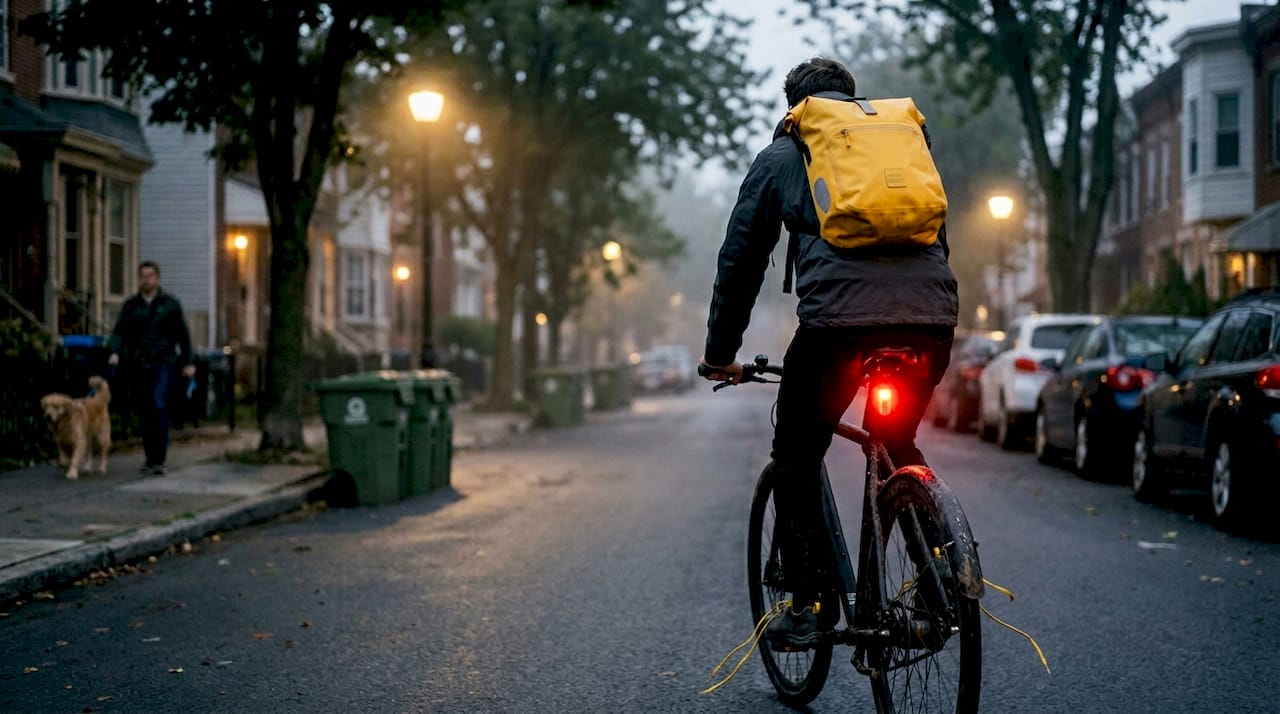
AI camera systems bring a third layer of intelligence. Luna Systems, a startup that recently secured €1.5 million in funding to scale its product, offers a rear-mounted camera with onboard AI that detects close-pass events in real time, maps dangerous road blackspots over time, and provides continuous video recording for incident documentation. This matters enormously for insurance claims, legal proceedings, and personal advocacy following a collision.
Here is a practical framework for building your connected safety stack, from essential to advanced:
- Start with Doppler radar. It works independently, requires no infrastructure, and delivers immediate benefits on any road in any country. It is the foundation.
- Add a front-facing or rear AI camera. Incident recording is valuable on its own, and close-pass alerts compound your situational awareness.
- Integrate a connected head unit or smartphone app. This ties radar and camera alerts into a single display you can glance at without losing focus on the road.
- Explore V2X hardware if you ride in areas where municipal or highway V2X infrastructure is being deployed, particularly in Germany, France, or certain U.S. metro corridors.
- Review your connected cycling equipment guide regularly as new devices enter the market each season.
Pro Tip: Do not assume that more alerts equal more safety. Calibrate your devices carefully during low-traffic rides first, so you learn to distinguish genuine threat alerts from background noise. Alert fatigue is a real risk, and a cyclist who stops reacting to warnings is more vulnerable than one with no device at all.
For anyone starting the upgrade process, read about improving urban cycling security with a focus on layering these devices intelligently rather than stacking every gadget available.
Limitations, edge cases, and what most guides miss
Honest reviews of connected cycling technology are rare. Most product roundups lead with headline features and bury the caveats. Here is what you actually need to know before you spend several hundred dollars on these devices.
Radar performance degrades in bad weather. Rain and standing water on the road cause radar signals to scatter and reflect unpredictably. Tests of the Garmin Varia have confirmed that wet conditions can lead to misclassification of approaching vehicles, meaning a vehicle might not register on your display until it is significantly closer than 175 meters. On a rainy commute at night, that closes your response window dramatically.
V2X is only as good as adoption rates. This is the technology’s fundamental challenge. A V2X unit broadcasting your position provides exactly zero benefit if the approaching vehicle is not equipped to receive the signal. Simulations show significant promise, but real-world deployments are complicated by channel congestion: when multiple V2X devices compete for airspace in dense urban environments, awareness gaps can occur. You may be broadcasting while the receiving vehicle’s system is busy processing a dozen other signals.
The practical limitations extend beyond weather and adoption:
- Battery life on AI camera systems is often 2 to 4 hours of continuous recording, which may not cover a full day commute plus the return trip.
- Mount compatibility varies significantly. Some radar units are designed for drop handlebars and do not sit cleanly on urban commuter bikes with rear racks.
- Alert distraction is underreported. A radar alert that interrupts your focus at a complex intersection can briefly shift your gaze at precisely the wrong moment.
- Legal gray areas exist around continuous video recording of other road users in several European countries. Check local regulations before activating a camera’s public-facing recording mode.
“No device compensates for a driver who is texting. Situational awareness remains your first line of defense, and connected tech is your second, not the other way around.”
Pro Tip: Build in redundancy by default. Use at least two different detection technologies simultaneously. If your radar device gives a false negative in the rain, your camera’s close-pass alert may still fire. Overlapping coverage is not paranoia. It is engineering logic applied to personal safety.
For a broader look at cycling safety gear and strategies that account for these real-world variables, prioritize sources that discuss edge cases alongside performance specs.
Practical steps for upgrading your cycling safety
Understanding the technology landscape is one thing. Putting it into practice on your specific commute or route is another. Here is a straightforward process for making meaningful upgrades without overcomplicating your setup.
-
Audit your most dangerous segments. Review your regular routes and identify where you transition from protected infrastructure to mixed traffic, where overtaking happens frequently, and where visibility is reduced. These segments define your highest-risk exposure and should guide what you buy first.
-
Match technology to your primary threat. If your biggest risk is fast-moving overtaking vehicles on a rural or suburban road, a Doppler radar taillight is your most impactful first purchase. If you ride heavily in urban stop-and-go traffic, an AI camera with close-pass detection addresses your most common near-miss scenario.
-
Set up and calibrate before riding in live traffic. Most connected devices require a brief learning period. Spend time in a quiet environment understanding what normal alerts feel like versus urgent ones before you depend on the system in real conditions.
-
Layer a physical visibility upgrade alongside any connected device. Connected tech improves how vehicles react to you. High-quality reflectors and a powerful taillight improve whether they notice you at all. Both matter. Neither replaces the other.
-
Reassess every six months. This market moves fast. A device that was best-in-class 18 months ago may now have a superior option available. Check the complete list of connected cycling devices periodically to stay current.
-
Combine technology with route optimization. The Monash research that found protected lanes reduce injury risk by 34 to 60% underscores that even a small detour through better infrastructure significantly changes your risk profile. Connected tech is most effective when paired with smart routing decisions.
The uncomfortable truth about cycling safety no gadget can solve
We work deeply in this space, and we want to be direct about something that most gear reviews will not say plainly: technology is not winning the war on cycling fatalities. The data is clear. EU cyclist deaths have barely budged over a decade despite the arrival of radar lights, connected cameras, and ever-brighter LEDs. That is not a failure of the products. It is a signal that the products are being asked to solve a problem that requires a larger solution.
Garmin’s radar detection is genuinely impressive. Luna Systems’ AI close-pass alerts are a meaningful step forward. V2X, once adoption reaches critical mass, could fundamentally change how vehicles and cyclists coexist. We believe in these tools, and we design our products around the same principles of real-world usability. But no device creates safe infrastructure. No algorithm slows a driver who is distracted, aggressive, or simply unaware that the road was also built for you.
The most honest advice we can give is this: buy the best connected technology you can afford, and then use the visibility it gives you to ride with sharper attention, not less. Your radar taillight bought you an extra 4 seconds of warning. Use that time actively. Check your mirror. Adjust your position. Make eye contact where possible.
And beyond your personal setup, advocate for better streets. Separated lanes, reduced speed limits on mixed roads, and V2X-ready infrastructure are not cycling luxuries. They are the difference between the 8% improvement Europe recorded over a decade and the transformative reduction that is actually achievable. The security tips for urban cycling that matter most combine smart gear with the recognition that no individual solution is complete.
Connected tech is essential. It is also not enough on its own. Holding both of those truths at once is where real cycling safety starts.
Gear up for safer rides with connected and high-visibility equipment
At THE BEAM, we build safety equipment for cyclists who refuse to compromise on protection or design. Our flagship VIRGO integral helmet with MIPS technology delivers full-face protection engineered for urban commuters and road riders who understand that the right helmet is their most critical safety investment.
Beyond the helmet, our range includes high-visibility reflectors, rear-view mirrors, and connected accessories designed to complement the radar and AI safety systems covered in this article. We do not believe in selling single-product solutions. Every piece of THE BEAM equipment is designed to work as part of a layered safety strategy, the same approach this article recommends. Whether you are building your first connected safety stack or upgrading an existing setup, explore our full range at thebeamofficial.com and find equipment that matches how you actually ride.
Frequently asked questions
What is V2X and how does it help cyclists stay safe?
V2X allows your bike to broadcast your position to connected vehicles, enabling drivers and automated systems to detect and respond to your presence before a collision can occur.
How reliable are radar taillights in bad weather?
Radar taillights are highly effective in clear conditions, but rain and wet roads can cause vehicle misclassification, so you should treat alerts as one signal among several rather than a definitive warning.
Do these systems work everywhere or just in cities?
Radar and AI camera systems function on any road regardless of infrastructure, but V2X capabilities depend on widespread vehicle-side adoption, which currently limits its effectiveness outside of V2X-enabled corridors.
Is connected safety equipment a replacement for infrastructure?
No. Protected bike lanes reduce injury risk by 34 to 60%, a magnitude no single device currently matches, making connected tech a powerful supplement rather than a structural solution.


