

Most cyclists still think of a helmet as a passive shield, something that absorbs impact and does nothing else. That assumption is now outdated. A connected helmet is a smart bicycle helmet equipped with integrated electronics such as LED lights, Bluetooth, crash detection, and communication features that actively respond to your environment before and after an incident. This guide breaks down how these helmets work, how leading models compare, and exactly what to look for when you’re ready to invest in genuinely advanced protection.
Table of Contents
- What is a connected helmet? Breaking the basics
- Inside the tech: Sensors, signals, and connectivity
- Comparing high-end connected helmets: Features, weights, and value
- Limits, edge cases, and expert safety tips
- How to choose the right connected helmet for your ride
- Explore The Beam’s cycling safety solutions
- Frequently asked questions
Key Takeaways
| Point | Details |
|---|---|
| Smart safety features | Connected helmets actively enhance cyclist visibility and crash response well beyond traditional models. |
| Sensor-driven protection | IMU sensors and Bluetooth integrate for app-controlled alerts and efficient accident detection. |
| Choosing wisely | Prioritize certified helmets with MIPS or Quin tech and balance safety features with ventilation and comfort. |
| User trade-offs | Expect some battery management and possible venting drawbacks with high-tech helmet models. |
| Explore advanced gear | Pair connected helmets with other cycling safety accessories for maximum protection and visibility. |
What is a connected helmet? Breaking the basics
A connected helmet is not just a regular helmet with a light bolted on. It’s a system. The shell, sensors, and software work together to give you real-time feedback, visibility, and emergency response that no traditional helmet can offer.
The core difference is active safety versus passive protection. A conventional helmet absorbs energy on impact. A connected helmet detects, signals, and communicates, often before you even hit the ground. That shift from reactive to proactive is what makes this category worth understanding.
Connected helmets offer LED lights, app pairing via Bluetooth, crash detection, and sometimes built-in speakers and microphones for hands-free communication. Here’s what you’ll typically find inside a high-end model:
- Integrated LED lighting: Front and rear lights, often with turn signals controlled by a handlebar remote
- Bluetooth connectivity: Pairs with your smartphone for navigation alerts, music, and call handling
- Crash detection: Sensors identify sudden impacts and trigger emergency alerts automatically
- Auto-brightness: Ambient light sensors adjust LED intensity based on conditions
- App integration: Customize alert contacts, light patterns, and ride data through a companion app
Pro Tip: Before buying, check whether the helmet’s app is compatible with both iOS and Android. Some brands restrict full functionality to one platform, which can limit how useful the smart features actually are.
“The real value of a connected helmet isn’t any single feature. It’s the combination of visibility, communication, and crash response working simultaneously.”
If you want to understand how integrated helmet design affects both aerodynamics and tech placement, that context matters when comparing models at different price points.
Inside the tech: Sensors, signals, and connectivity
The intelligence inside a connected helmet comes from a small but powerful set of components. Understanding them helps you evaluate what’s worth paying for and what’s marketing noise.
IMU sensors (Inertial Measurement Units) are the backbone of most smart helmets. IMU sensors use accelerometers and gyroscopes for brake light activation and crash detection. When you decelerate sharply, the accelerometer triggers the rear LED to flash as a brake light. When a crash-level impact occurs, the gyroscope data confirms the event and initiates an emergency alert.
Here’s how the main technologies interact in a typical connected helmet:
- IMU sensor detects motion change (braking, impact, or fall)
- Onboard processor filters the data to reduce false positives
- Bluetooth module sends the signal to your paired smartphone
- Companion app triggers the appropriate response: brake light, crash alert, or navigation cue
- LED array executes the visual output in real time
Battery life is one of the most practical specs to evaluate. Most connected helmets run between 3 and 16 hours depending on how many features are active. Running LEDs, Bluetooth, and crash detection simultaneously drains power faster than using lights alone.
“Sensor fusion, combining data from multiple sensors simultaneously, is what separates accurate crash detection from systems that trigger on every pothole.”
For deeper context on how smart helmet accident detection algorithms are built and validated, the engineering behind it is more sophisticated than most riders realize.
Connected helmets also benefit from MIPS protection, which adds a low-friction layer inside the shell to reduce rotational forces during angled impacts. Pairing MIPS with smart sensors gives you both passive and active protection in one system.
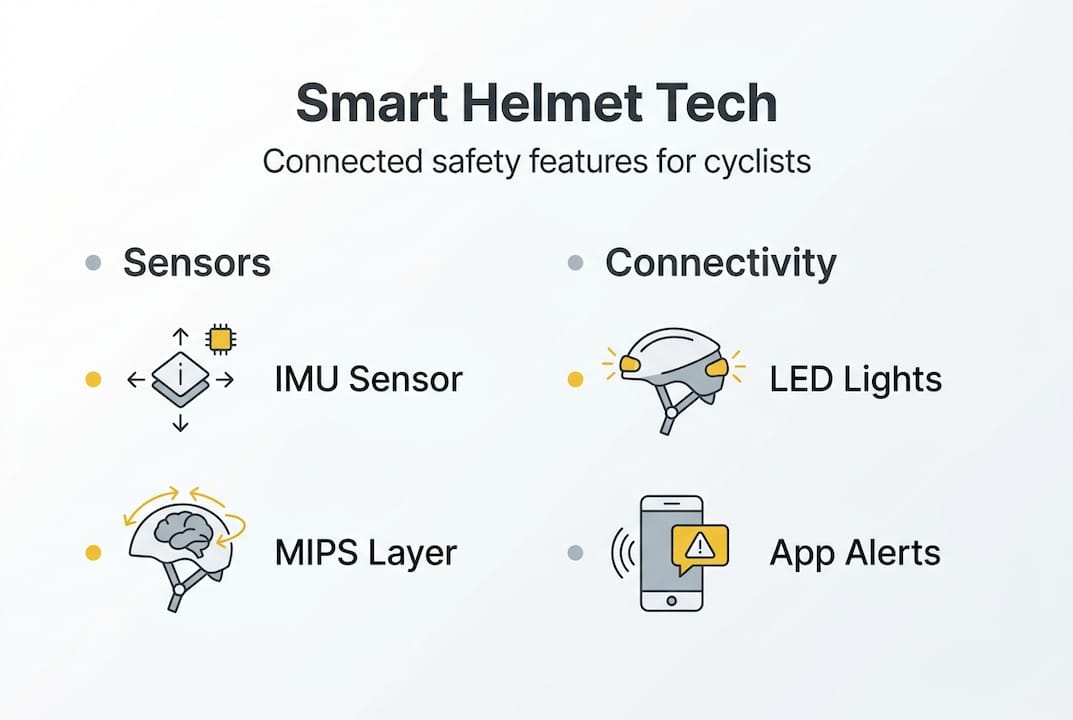
| Feature | Basic connected helmet | High-end connected helmet |
|---|---|---|
| LED lighting | Rear only | 360° front and rear |
| Crash detection | Basic impact sensor | IMU sensor fusion |
| Bluetooth | Audio only | Full app integration |
| Battery life | 3 to 6 hours | Up to 16 hours |
| MIPS | Not included | Standard |
| Emergency alerts | Manual | Automatic via app |
Comparing high-end connected helmets: Features, weights, and value
Not all connected helmets are built for the same rider. Here’s how three leading models stack up across the specs that matter most.
| Model | Certification | Key tech | Price range | Best for |
|---|---|---|---|---|
| Lumos Nyxel | CPSC + MIPS + Quin | 360° LEDs, crash detection | $200 to $300 | Road and urban |
| TENWAYS EH20 | CPSC | Speakers, mic, auto lights | $169 | Urban commuting |
| Unit 1 Aura | NTA 8776 + CPSC | Crash detection, LEDs | $200 to $250 | E-bike riders |
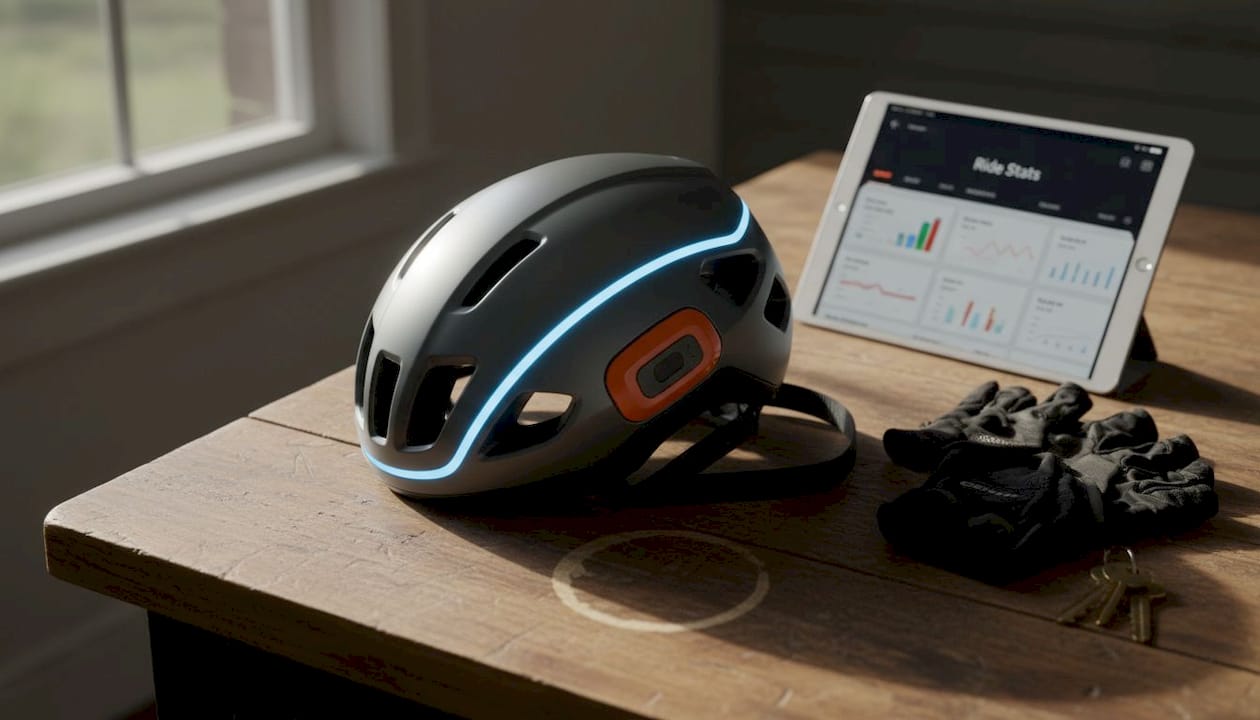
The Lumos Nyxel stands out for its combination of MIPS and Quin crash detection, plus 360-degree LED coverage. It’s the most complete safety package for road cyclists who want maximum visibility and protection. The TENWAYS EH20 leans into communication, with built-in speakers and a microphone that make it ideal for urban commuters who take calls on the go.
The Unit 1 Aura is the standout choice for e-bike riders. Its NTA 8776 certification means it’s tested for higher-speed impacts, which standard cycling certifications don’t cover. If you ride an e-bike regularly, that certification is not optional.
Key considerations when comparing models:
- Weight: Electronics add mass. Most connected helmets weigh between 350g and 500g, heavier than a standard road helmet
- Ventilation: More electronics often mean fewer vents, which matters on long summer rides
- App ecosystem: Some apps are polished and reliable; others are buggy and rarely updated
- Replacement policy: Check whether the brand offers post-crash replacement programs
For a broader look at helmet types explained across road, urban, and e-bike categories, that context helps you understand where connected helmets fit in the wider market.
Limits, edge cases, and expert safety tips
Connected helmets are impressive, but they’re not perfect. Knowing where they fall short helps you use them more effectively and avoid over-relying on features that have real-world limitations.
Crash detection accuracy is the most discussed limitation. False positives in crash detection are mitigated via sensor fusion and time-windowing, but they still happen. Dropping your helmet on the floor or hitting a particularly rough patch of road can occasionally trigger an alert. Most systems give you a 30-second cancellation window before contacting emergency contacts.
App dependency is another real constraint. If your phone battery dies or you lose signal, crash alerts and navigation features stop working. The helmet’s LEDs and basic sensors still function, but the smart layer goes dark.
Ventilation trade-offs are significant for performance riders. Integrating electronics into the shell reduces the space available for air channels. If you ride hard in warm weather, a connected helmet may run noticeably warmer than a lightweight road helmet.
Pro Tip: Always test your crash detection settings before a long ride. Trigger a controlled alert at home, confirm your emergency contact receives it, and practice the cancellation process so you’re not fumbling with your phone mid-ride.
Here’s what experts consistently recommend for urban cyclists using connected helmets:
- Keep the companion app updated. Manufacturers push firmware fixes that improve sensor accuracy over time
- Charge the helmet the night before any ride longer than two hours
- Don’t rely solely on crash detection. Ride defensively and treat smart features as a backup layer
- Inspect the helmet after any significant impact, even if the crash detection didn’t trigger
- Store the helmet away from extreme heat, which degrades battery cells faster
For more on how helmet innovation is reshaping urban cyclist safety beyond just connected features, the design principles behind modern helmets are worth understanding.
How to choose the right connected helmet for your ride
Choosing a connected helmet is not just about picking the one with the most features. It’s about matching the technology to your actual riding habits, environment, and safety priorities.
Follow this step-by-step selection process:
- Define your primary use case. Urban commuting, e-bike riding, road cycling, and gravel riding each have different demands. An e-bike rider needs NTA 8776 certification. A road cyclist prioritizes weight and ventilation.
- Check certifications first. CPSC is the U.S. baseline. MIPS adds rotational protection. NTA 8776 is required for high-speed e-bikes. Don’t skip this step.
- Evaluate the app ecosystem. Download the companion app before buying. Check recent reviews for bugs, update frequency, and ease of use.
- Assess fit and ventilation. Try the helmet on if possible. Electronics can shift the fit profile compared to a standard shell. Ventilation matters more than most buyers expect.
- Calculate total battery needs. Add up your typical daily ride time and factor in all active features. Choose a model whose battery comfortably exceeds that total.
- Compare crash detection systems. Quin and similar third-party systems have established track records. Proprietary systems vary widely in reliability.
Prioritize MIPS and Quin for protection, and remember that ventilation is often reduced by electronics, so factor that into your decision if you ride in warm climates or push hard on climbs.
Pro Tip: If you’re torn between two models, choose the one with the better-reviewed app. The hardware is only as useful as the software managing it. A great sensor paired with a buggy app is a frustrating experience.
For a detailed breakdown of MIPS helmet technology and why it matters for both connected and standard helmets, that resource gives you the technical foundation to make a confident choice.
Explore The Beam’s cycling safety solutions
If this guide has shown you anything, it’s that serious cycling safety goes well beyond a basic shell. At THE BEAM, we design high-end helmets and accessories built specifically for riders who want real protection, real visibility, and real performance in every condition.
Browse our full range of cycling safety products, from our VIRGO integral helmet with MIPS technology to connected accessories built for urban and performance riding. If you’re focused on visibility, our high visibility bike reflectors are engineered to make you seen in traffic, low light, and everything in between. Every product we make is designed to work together as a complete safety system, not just a collection of gear.
Frequently asked questions
How does crash detection work in connected helmets?
IMU sensors detect high-g impacts and send an alert through the companion app to your designated emergency contacts, usually with a short cancellation window to prevent false alarms.
Do connected helmets require frequent charging?
Battery life ranges from 3 to 16 hours depending on the model and which features are active, so charging after every few rides is standard practice to keep all functions reliable.
Are connected helmets certified for e-bike use?
Unit 1 Aura is NTA 8776 certified for high-speed e-bike use; always verify the certification label on any helmet before purchasing for e-bike riding.
What are the main drawbacks of connected helmets?
Some models have limited ventilation due to electronics integration, rely on phone connectivity for smart alerts, and can weigh more than standard helmets when MIPS is included.
Can connected helmets improve visibility in urban areas?
Integrated LEDs and turn signals significantly boost your presence in traffic, with visibility up to 1,475 ft reported in real-world reviews of high-end models.


