

TL;DR:
- Smart sensors in bike safety monitor environments and rider health to provide real-time alerts and emergency responses. They integrate multiple technologies like IMUs, radar, cameras, and physiological monitors to enhance protection and reduce crash risks. However, sensors should complement, not replace, traditional safety practices like high-visibility gear and attentive riding.
Smart sensors in bike safety are electronic detection systems that monitor the rider’s environment and physical condition in real time, then trigger alerts or emergency responses before or after a crash occurs. The role of smart sensors in bike safety has expanded far beyond simple speedometers. Today, inertial measurement units (IMUs), radar arrays, biometric monitors, and GPS modules work together to create a layered protection system. Brands like Canyon and Wahoo have already deployed these technologies in production and prototype gear, and the smart bike accessories market reached $3.6 billion in 2026. That figure signals a fundamental shift in how cyclists think about protection.
What types of smart sensors are used in bike safety systems?
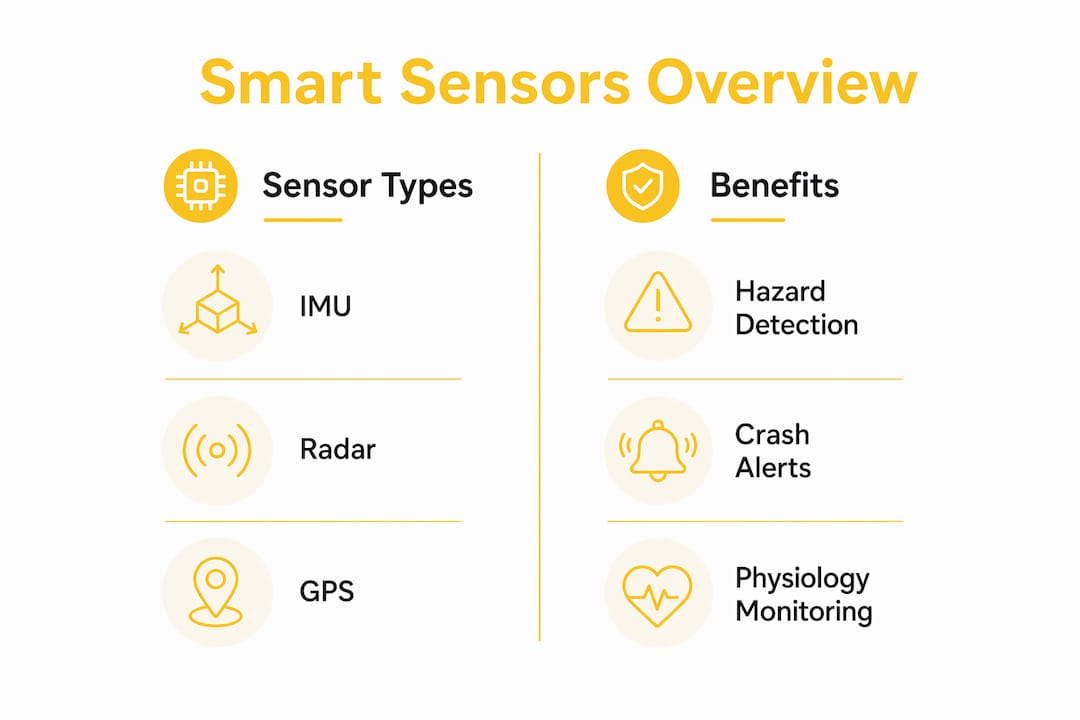
The sensor stack in modern cycling safety gear covers five distinct categories, each solving a different part of the safety problem.
-
Inertial Measurement Units (IMUs): An IMU combines accelerometers and gyroscopes to detect sudden changes in motion. Helmet systems use IMUs to identify crash signatures and distinguish them from normal riding vibration. Sensor fusion algorithms combining inertial and force-impact data over time windows achieve detection accuracies above 93% and false positive rates below 3%.
-
Proximity sensors (radar and LIDAR): Radar measures the speed and distance of objects approaching from behind or the sides. LIDAR builds a three-dimensional map of the immediate environment. Both give the rider advance warning of vehicles closing in at speed.
-
Cameras with computer vision: Onboard cameras feed video to edge processors that classify objects, read lane markings, and flag pedestrians. The Canyon Predict prototype uses a 360-degree camera array paired with on-device AI to assign hazard risk scores in real time.
-
Physiological sensors: Heart rate monitors, muscle oxygen saturation sensors, and thermal strain gauges track the rider’s physical state. These devices flag fatigue and heat stress before they impair judgment.
-
GPS and connectivity modules: GPS tracks location for route logging and anti-theft alerts. GSM modules transmit crash location data to emergency contacts automatically.
Pro Tip: When choosing bicycle safety gadgets, check whether the device uses sensor fusion rather than a single sensor type. A system that cross-references IMU data with GPS speed is far less likely to trigger a false alarm on a rough gravel descent.
How are smart sensors integrated into modern bicycles and helmets?
Sensor integration follows two main paths: on-bike arrays and wearable helmet systems. Each has distinct strengths.
On-bike sensor arrays
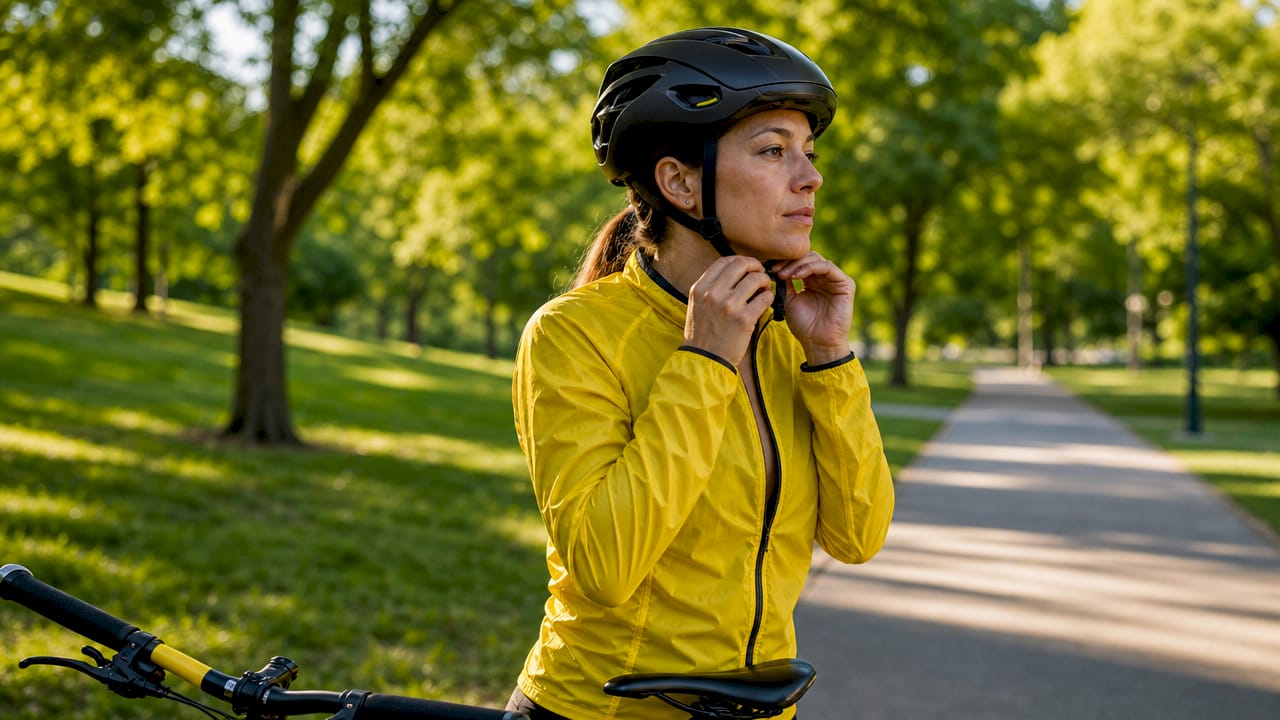
The Canyon Predict prototype is the clearest example of what full on-bike integration looks like. It mounts radar, cameras, and motion sensors directly to the frame and fork. The onboard processor computes a continuous hazard risk score and delivers haptic and visual feedback to the rider’s handlebars and display. The system anticipates road hazards before the rider’s eyes register them. That predictive gap, even fractions of a second, is where serious accidents are prevented.
Smart helmet systems
Smart helmets embed IMUs and GSM modules directly into the shell. When a crash is detected, the helmet automatically sends the rider’s GPS coordinates to a pre-set emergency contact. Thebeamofficial covers the full mechanics of this in their guide on how smart helmets detect crashes. The advantage of helmet-based systems is that they stay with the rider even if the bike is separated from them in a crash.
Proprietary vs. open ecosystems
| Feature | Proprietary ecosystem | Open standards (ANT+, BLE) |
|---|---|---|
| Device compatibility | Limited to one brand | Works across multiple brands |
| Setup complexity | Simpler, plug-and-play | Requires manual pairing |
| Future-proofing | Dependent on vendor | Broad long-term support |
| Cost | Often bundled | Mix-and-match pricing |
ANT+ and Bluetooth Low Energy enable broad compatibility across brands for sensors including radar, heart rate monitors, and power meters. Wahoo’s ELEMNT GPS cycling computers use these open standards to pair with sensors from dozens of manufacturers. Choosing gear that supports open standards protects your investment as the technology evolves.
Pro Tip: Before buying any connected cycling device, confirm it supports ANT+ or Bluetooth Low Energy. Proprietary protocols can leave you locked out of future upgrades or unable to pair with your preferred bike computer.
What benefits do smart sensors provide for real-time hazard detection?
The core benefit is time. Smart sensors give cyclists warning before a hazard becomes a collision.
-
Predictive alerts: AI running on the bike’s edge processor analyzes the trajectories of surrounding objects and the rider’s own dynamics. It calculates a risk score and delivers a warning via haptic buzz, audio tone, or visual indicator. The rider reacts to a computed prediction, not a visual stimulus they may have missed.
-
Crash detection with low latency: Inertial-based accident detection systems achieve 97.5% accuracy with under 200ms latency. That speed matters because emergency services response time depends on how quickly a crash notification is sent.
-
Automatic emergency notification: GPS and GSM modules in smart helmets transmit crash coordinates to emergency contacts within seconds of impact. Riders who are unconscious or disoriented after a crash cannot call for help themselves. The sensor does it for them.
-
False positive reduction: Sensor fusion algorithms cross-reference multiple data streams before triggering an alert. A pothole hit registers differently from a true crash because the IMU, GPS speed, and force sensors tell different stories. This keeps alert fatigue low.
“The safest riders combine smart sensors with high-visibility gear and attentive road behavior to avoid overreliance on devices.” — Cycling Technology 2026
GPS tracking does have a known limitation. GPS signal degrades in dense urban canyons, so location-based safety features should be treated as one layer of protection, not the only one. Pairing GPS with geofencing alerts and physical visibility gear gives the most complete coverage.
How do physiological sensors enhance cyclist safety and performance?
Physiological monitoring is the fastest-growing area of smart sensor technology for cycling. These sensors track what is happening inside the rider, not just around them.
-
Heart rate variability (HRV) monitoring: HRV sensors detect early signs of cardiovascular stress. A sudden drop in HRV during a ride can indicate dangerous fatigue levels before the rider consciously feels impaired.
-
Muscle oxygen saturation: Devices like near-infrared spectroscopy sensors measure oxygen levels in working muscles. Muscle oxygen monitors provide faster and more precise insight into rider fatigue than traditional heart rate metrics alone. When muscle oxygen drops below a threshold, the rider knows to reduce intensity before judgment is compromised.
-
Thermal strain gauges: Core temperature sensors detect heat stress. Overheating impairs reaction time and decision-making, two factors directly linked to crash risk. Thermal monitoring is especially relevant for urban commuters riding in summer traffic.
-
Respiratory monitoring: Breathing rate and depth sensors flag respiratory distress. Future systems will integrate this data with thermal and respiratory metrics to build a complete picture of rider alertness.
-
Integration with bike computers and wearables: Physiological data feeds into GPS units, smart glasses, and handlebar displays for real-time feedback. Wahoo ELEMNT computers already support heart rate and power meter pairing via open standards, making it straightforward to add biometric layers to an existing setup.
The practical safety benefit is clear. A rider who knows their muscle oxygen is critically low will ease off the pace and stay alert. A rider who does not have that data may push through fatigue and make a poor decision at a busy intersection. You can read more about how connected safety gear brings these layers together in a real-world riding context.
Key takeaways
Smart sensors improve bike safety most when they combine environmental detection, crash response, and physiological monitoring into a single, interoperable system.
| Point | Details |
|---|---|
| Sensor fusion beats single sensors | Systems combining IMU, radar, and GPS data cut false positives and improve crash detection reliability above 93%. |
| Open standards protect your investment | Gear supporting ANT+ and Bluetooth Low Energy pairs across brands and stays compatible as technology advances. |
| Physiological monitoring prevents crashes | Muscle oxygen and HRV sensors flag fatigue before it impairs judgment, reducing accident risk at the source. |
| GPS has urban limitations | Signal degradation in city canyons means GPS should be paired with geofencing and high-visibility gear, not used alone. |
| Predictive systems change the equation | Canyon Predict-style AI computes hazard risk scores before the rider’s eyes register a threat, buying critical reaction time. |
Why sensors alone won’t save you: a rider’s honest view
The technology is genuinely impressive. A helmet that detects a crash and texts your emergency contact in under 200 milliseconds is not a gimmick. It is a real safety net. But after years of watching how cyclists actually ride with this gear, I have noticed a pattern worth naming.
Riders who trust their radar tail light to handle traffic awareness tend to check their mirrors less. Riders who rely on HRV alerts to manage fatigue sometimes ignore the obvious physical signals their body was already sending. The sensor becomes a permission slip to stop paying attention. That is the wrong relationship to have with this technology.
The best use of smart sensor technology for cycling is as a backup layer, not a primary one. Wear high-visibility gear. Check your mirrors. Ride predictably. Let the sensors catch what you miss, not replace what you should be doing. The impact sensors in helmets guide from Thebeamofficial makes this point well: the sensor detects the crash, but your behavior determines whether the crash happens at all.
Battery life and interoperability are also real-world friction points that marketing rarely addresses. A radar sensor that dies 40 minutes into a two-hour commute is worse than no sensor, because you may have already adjusted your riding behavior around it. Test your gear in real conditions before you depend on it.
The future I am genuinely excited about is integrated physiological monitoring. Knowing your thermal strain and muscle oxygen in real time, displayed on a handlebar unit, gives you information that no amount of experience or intuition can replicate. That is where advanced sensors for bicycle safety will deliver their biggest return.
— Sophie
Thebeamofficial’s smart helmets and cycling safety gear
Thebeamofficial designs helmets and accessories built around the same sensor principles covered in this article: impact detection, emergency response, and real-world visibility.

The VIRGO integral helmet with MIPS technology integrates impact protection with a design built for road, gravel, urban, and e-bike riders. Thebeamofficial’s accessory range includes high-visibility reflectors and connected products that complement sensor ecosystems without requiring a full tech overhaul. If you are ready to add a hardware layer to your safety setup, browse the full smart helmet collection or explore the cycling accessories range to find gear that fits your riding style and safety priorities.
FAQ
What is the role of smart sensors in bike safety?
Smart sensors detect environmental hazards, monitor rider physiology, and trigger emergency alerts after crashes. They work as a real-time backup layer alongside traditional safety practices like high-visibility gear and attentive riding.
How accurate are smart helmet crash detection systems?
Inertial-based smart helmet systems achieve 97.5% detection accuracy with under 200ms latency. Sensor fusion algorithms keep false positive rates below 3% by cross-referencing multiple data streams before triggering an alert.
What connectivity standards should I look for in cycling sensors?
Choose devices that support ANT+ or Bluetooth Low Energy. These open standards allow sensors from different brands to pair with GPS computers like the Wahoo ELEMNT, keeping your setup flexible and future-proof.
Can GPS sensors reliably track my bike in a city?
GPS accuracy degrades in dense urban areas due to signal interference from buildings. Use GPS as one part of a broader security setup that includes geofencing alerts and physical deterrents for reliable urban bike protection.
How do physiological sensors reduce crash risk?
Muscle oxygen and heart rate variability sensors detect fatigue and heat stress before they impair the rider’s judgment. Acting on that data, by slowing down or resting, directly reduces the likelihood of a crash caused by physical stress.


