

TL;DR:
- Rear-view mirrors vary by type, mounting style, and suitability for different riding environments.
- Combining mirrors with radar systems enhances cyclist safety by providing both visual and electronic awareness.
- The most important factor is choosing a mirror that stays in place and becomes an automatic safety habit.
Staying aware of what’s happening behind you is one of the most underrated challenges in cycling. You can’t turn your head every few seconds without losing focus on what’s ahead, especially in fast-moving urban traffic or on open roads where vehicles approach at speed. Rear-view mirrors solve this problem, but picking the right one is harder than it looks. Bar-end, handlebar-mounted, helmet-based, and glasses-clipped designs all compete for your attention, each with real strengths and real trade-offs. This guide walks you through the key criteria, the top options, and how to match the right mirror to your riding style.
Table of Contents
- How to choose the right rear-view mirror: Key criteria for cyclists
- Bar-end rear-view mirrors: Discreet yet powerful for drop-bar and urban bikes
- Handlebar-mounted rear-view mirrors: Maximum versatility for commuters and tourers
- Helmet and glasses-mounted mirrors: Always-on awareness with trade-offs
- Mirrors, radar, or both? Comparing modern cycling safety tech
- Why the best rear-view mirror is the one you’ll actually use
- Next steps: Ride safer with advanced mirror options from The Beam
- Frequently asked questions
Key Takeaways
| Point | Details |
|---|---|
| Know your mounting style | Bar-end, handlebar, and helmet/glasses-mounted mirrors each suit different bikes and riding habits. |
| Field of view matters | Look for convex designs and wide adjustability to maximize the area you can see behind you. |
| Mirror plus radar is best | Combining rear-view mirrors with radar tech provides both visual and early warning safety layers. |
| Legal advice for travel | Legal requirements vary, so check local rules before riding abroad. |
How to choose the right rear-view mirror: Key criteria for cyclists
Before you buy, it helps to know what actually separates a great mirror from a frustrating one. The main types of cyclist rear-view mirrors are bar-end, handlebar-mounted, and helmet or glasses-mounted, and each one suits a different rider and environment. Choosing without a framework often leads to a mirror that rattles loose, fogs up, or sits at the wrong angle after your first pothole.
Here are the core criteria worth evaluating before committing to any model:
- Field of view: A wider mirror gives you more context, but too wide creates distortion. Look for convex glass with a useful, undistorted rear zone.
- Ease of adjustment: Can you fine-tune the angle with gloves on? A mirror you can’t quickly reposition is one you’ll stop trusting.
- Vibration resistance: Cobblestones, gravel, and rough pavement will shake a poorly mounted mirror into uselessness. Check how the mount locks.
- Mounting method: Compatibility with your bar diameter or helmet type matters more than most riders realize before they buy.
- Weight: Lighter is better, especially for road cyclists. Most quality mirrors stay under 20 grams.
- Visibility range: How far back can you actually see? This varies widely between models.
On the regulatory side, requirements differ across regions. Germany strongly recommends rear-view mirrors for cyclists, while France treats them as optional. In the U.S., there is no federal law requiring mirrors on bicycles, though urban bike mirror safety is increasingly discussed in city cycling guidelines.
Pro Tip: Match your mirror type to your riding environment first. Urban commuters benefit most from handlebar or bar-end mirrors that stay fixed to the bike. Road cyclists who frequently change bikes may prefer helmet-mounted options for portability.
Bar-end rear-view mirrors: Discreet yet powerful for drop-bar and urban bikes
Bar-end mirrors are ideal for drop-bar road bikes and urban setups, offering a low-profile design that doesn’t interrupt your cockpit. They insert into the open end of your handlebar using an expandable plug system, typically compatible with bars measuring 21 to 23mm in inner diameter. Once locked in, they stay put and rotate to your preferred angle.
Notable models in this category include the Hafny bar-end mirror, the CatEye BM-45, and The Beam’s own CORKY rearview mirror, which is engineered specifically for road and urban cyclists who want a clean, aerodynamic look without sacrificing rear visibility. Mirror sizes for bar-end types range from 30 to 80mm, and weights from 6 to 20 grams, making them among the lightest options available.
Pros and cons at a glance:
- ✓ Sleek, aerodynamic profile
- ✓ Excellent vibration resistance when properly installed
- ✓ Wide rotation range for angle customization
- ✓ Compatible with most road and urban drop bars
- ✗ Not compatible with flat bars that have bar-end plugs already installed
- ✗ Smaller mirror surface than handlebar-mounted options
- ✗ Installation requires removing existing bar-end caps
| Feature | Bar-end mirrors |
|---|---|
| Bar compatibility | 21 to 23mm inner diameter |
| Typical mirror size | 30 to 80mm |
| Weight range | 6 to 20 grams |
| Best for | Road, gravel, urban drop-bar bikes |
| Vibration resistance | High (plug-lock system) |
Pro Tip: If you ride in heavy city traffic, a bar-end mirror gives you a quick glance without shifting your grip. Position it so you can see the lane behind you with just a downward eye movement, not a full head turn.
Handlebar-mounted rear-view mirrors: Maximum versatility for commuters and tourers
If bar-end mirrors aren’t an ideal fit, handlebar-mounted options may hold the answer for everyday commuting. These mirrors clamp directly onto the handlebar using friction-based mounts and are compatible with a much wider range of bar diameters. Handlebar-mounted mirrors fit 22 to 35mm bars, offer larger reflective surfaces, and use friction clamps for secure installation across flat, riser, and touring bars.
Popular models include the Mirrycle, the Zefal Spin, and the LX LERMX. These mirrors typically feature ball-joint adjustability, letting you dial in the exact angle you need. The larger mirror surface also means a broader field of view, which is especially valuable when riding alongside parked cars or navigating busy intersections.
“For urban commuters carrying panniers and navigating stop-and-go traffic, a handlebar mirror is often the most practical choice. The larger view and easy repositioning outweigh the slight bulk.” — Experienced urban cycling instructor
Convex mirrors offer 70 to 100 meters of rear visibility and an enhanced field of view, making them a strong choice for riders who need to monitor multiple lanes or fast-approaching vehicles.
Pros and cons:
- ✓ Wide bar compatibility (22 to 35mm)
- ✓ Larger mirror surface for broader visibility
- ✓ Easy to install and reposition without tools
- ✓ Works on most commuter, touring, and e-bike setups
- ✗ Slightly bulkier profile than bar-end designs
- ✗ Can vibrate more on rough terrain if clamp loosens
- ✗ May interfere with bar bags or accessories
| Feature | Bar-end | Handlebar-mounted |
|---|---|---|
| Installation | Plug-in, tool-free | Clamp-on, tool-free |
| Bar compatibility | 21 to 23mm inner | 22 to 35mm outer |
| Mirror size | Smaller | Larger |
| Best use case | Road, urban drop-bar | Commuter, touring, e-bike |
| Visibility range | Good | Excellent |
The CORKY Urban mirror from The Beam is a strong example of this category, designed for riders who prioritize wide visibility and easy daily adjustments.
Helmet and glasses-mounted mirrors: Always-on awareness with trade-offs
Beyond your bike’s frame, some mirrors travel with you. Helmet and glasses-mounted mirrors clip directly to your helmet brim or eyewear frame, keeping the reflective surface within your peripheral vision at all times. Helmet and glasses-mounted mirrors are universal fit and maintain your line of sight without requiring any handlebar movement.
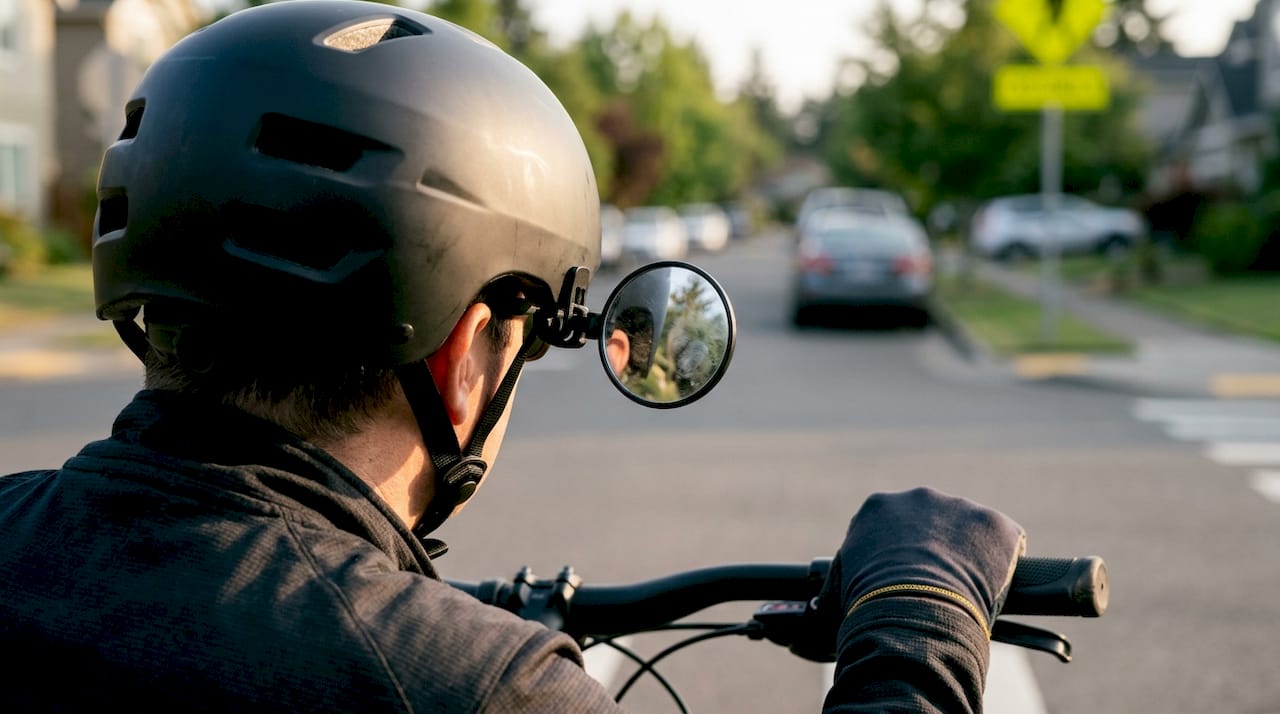
Well-known products include the Blackburn Mirror, Take-a-Look, and HubBub. These are especially popular among long-distance road cyclists and tourers who switch bikes frequently and don’t want to reinstall a mirror every time.
How to set up a helmet or glasses-mounted mirror correctly:
- Attach the mirror clip firmly to your helmet brim or glasses arm before you ride.
- Position the mirror so it sits just inside your left peripheral vision without blocking your forward view.
- Adjust the angle while stationary so you can see the road behind you with a slight eye movement.
- Test at low speed before entering traffic to confirm the angle holds under movement.
- Re-check alignment after any fall or contact, as these mirrors can shift easily.
At just 6 to 10 grams for most models, the weight penalty is essentially zero. The real trade-off is durability. These mirrors are more fragile than bike-mounted options and can be knocked out of alignment during fast descents or rough terrain.
“Helmet mirrors are brilliant for long rides where you’re changing position constantly. But if you crash or even brush against a tree branch, you’ll need to reset the angle. They reward careful riders.” — Road cycling coach
For urban cyclists interested in how mirror placement affects overall urban cyclist mirror safety, the choice of mounting point matters as much as the mirror itself.
Mirrors, radar, or both? Comparing modern cycling safety tech
With the foundation of mirror choices clear, it’s time to see how new tech fits into modern cyclist safety. Radar systems like the Garmin Varia represent a fundamentally different approach to rear awareness. Instead of showing you what’s behind you, they detect it and alert you before it’s visible. Garmin Varia radar detects vehicles up to 175 meters but lacks the visual confirmation that mirrors provide, and experts recommend combining both for full situational awareness.
| Feature | Rear-view mirror | Radar system |
|---|---|---|
| Type | Passive, visual | Active, electronic |
| Detection range | 30 to 100 meters | Up to 175 meters |
| Visual confirmation | Yes | No |
| Cost | $10 to $60 | $150 to $250 |
| Battery required | No | Yes |
| Best for | All cyclists | Road and performance cyclists |
“No single tool gives you complete rear awareness. Mirrors show you what’s there. Radar tells you something is coming. Together, they cover what neither can do alone.” — Cycling safety researcher
Who should consider using both?
- Road cyclists riding on fast, open roads with limited shoulder space
- Commuters navigating high-traffic corridors where vehicles approach quickly
- Cyclists with hearing impairments who benefit from visual radar alerts
- Tourers covering long daily distances in mixed traffic conditions
For riders exploring the CORKY mirror safety options, pairing a reliable mirror with a radar unit creates a layered safety system that covers both immediate visual confirmation and early-warning detection.
Why the best rear-view mirror is the one you’ll actually use
Here’s the part most gear guides skip: specs don’t keep you safe. Habits do. We’ve seen riders invest in technically superior mirrors, only to stop using them within two weeks because the angle kept slipping or the mount felt awkward with their grip style. The mirror that stays on your bike, stays adjusted, and gets checked instinctively on every ride is worth more than a premium model collecting dust in a drawer.
The real-world difference between a good mirror and a great one isn’t the glass quality or the weight. It’s whether checking it becomes automatic. That only happens when the mirror is intuitive to use and stays exactly where you put it. Riders who experiment with two or three types before settling on one almost always end up more consistent mirror users than those who buy once and hope for the best.
Our honest advice: start with the mirror type that matches your current bike and riding environment, use it for four weeks, and pay attention to whether you’re actually looking at it. If you’re not, the mount or position needs to change. Explore your real-world mirror use options with that mindset, and you’ll find the right fit faster than any spec sheet will tell you.
Next steps: Ride safer with advanced mirror options from The Beam
Ready to boost your on-road confidence? At The Beam, we’ve built our mirror range around one principle: safety equipment only works when riders actually use it. That means intuitive mounting, reliable adjustment, and designs that fit naturally into your riding style, whether you’re commuting through city streets or pushing pace on open roads.
Explore our full range of all cycling safety products to find the mirror that fits your setup. Pair it with one of our modern cycling helmets for a complete safety system, or browse our helmet add-ons to customize your protection. Every product is designed for real riders in real conditions.
Frequently asked questions
Do I need a rear-view mirror to cycle legally in Europe and the US?
EU and US laws on rear-view mirrors vary by country: Germany strongly recommends them, France treats them as optional, and no U.S. federal law requires them on bicycles. Always check your local regulations.
Are helmet or glasses-mounted mirrors safe for high-speed road cycling?
Helmet and glasses-mounted mirrors offer continuous visibility, but prone to damage at speed or in rough conditions, meaning they can shift out of alignment when you need them most.
How much weight do cycling mirrors add to my setup?
Cycling mirror weights range from 6g to 20g, so the impact on your total bike or helmet weight is negligible for virtually all riders.
Is a mirror or radar safer for urban riding?
Experts recommend using both radar and mirror for maximum safety: mirrors give you instant visual confirmation, while radar alerts you to approaching vehicles before they’re in your field of view.


