

TL;DR:
- Urban helmets provide superior side, face, and rotational impact protection tailored for city hazards.
- Features like MIPS or WaveCel significantly reduce brain injury risks in angled impacts common in urban crashes.
- Comfort, fit, visibility, and proper certification are critical for ensuring consistent helmet use and safety.
Helmeted cyclists are 60% less likely to suffer serious head injuries, yet most commuters grab whatever helmet is on sale without thinking twice about whether it was designed for city riding. That’s a problem. Urban cycling throws hazards at you that road or mountain bike helmets were never built to handle: car doors swinging open, tight intersections, low-speed tumbles onto concrete curbs, and constant stop-and-go traffic. This guide cuts through the noise and gives you an evidence-backed framework for choosing an urban helmet that actually fits your commute, covering safety features, certifications, comfort, visibility, and the trade-offs worth knowing before you buy.
Table of Contents
- What makes an urban helmet different?
- The science behind urban helmet safety
- Comfort, ventilation, and visibility for city commuting
- Weighing trade-offs: Finding your perfect urban helmet
- A practical perspective on urban helmet choice
- Next steps: Gear up safely for your city rides
- Frequently asked questions
Key Takeaways
| Point | Details |
|---|---|
| Urban design advantage | Urban helmets are engineered for side, face, and jaw protection during city accidents. |
| Rotational impact protection | MIPS and similar techs lower brain injury risk in angled urban crashes. |
| Certification matters | Choose helmets with CPSC, EN 1078, or STAR ratings for trustworthy safety. |
| Comfort means consistency | Fit, ventilation, and style encourage daily helmet use on every commute. |
| Balance features wisely | Weigh protection, comfort, and budget to find the best helmet for your needs. |
What makes an urban helmet different?
Most cyclists assume a helmet is a helmet. It isn’t. Road helmets are optimized for aerodynamics and ventilation at high speeds. Mountain bike helmets prioritize rear head coverage for trail falls. Urban helmets solve a completely different puzzle: protecting you in the messy, unpredictable environment of city streets.
The biggest distinction is coverage. Integral helmet safety research confirms that full-face and integral designs prioritize superior protection against common city hazards like dooring and side impacts. An integral helmet wraps around your chin and jaw, areas left completely exposed by a standard road helmet. For urban riders, that coverage isn’t overkill. It’s practical.
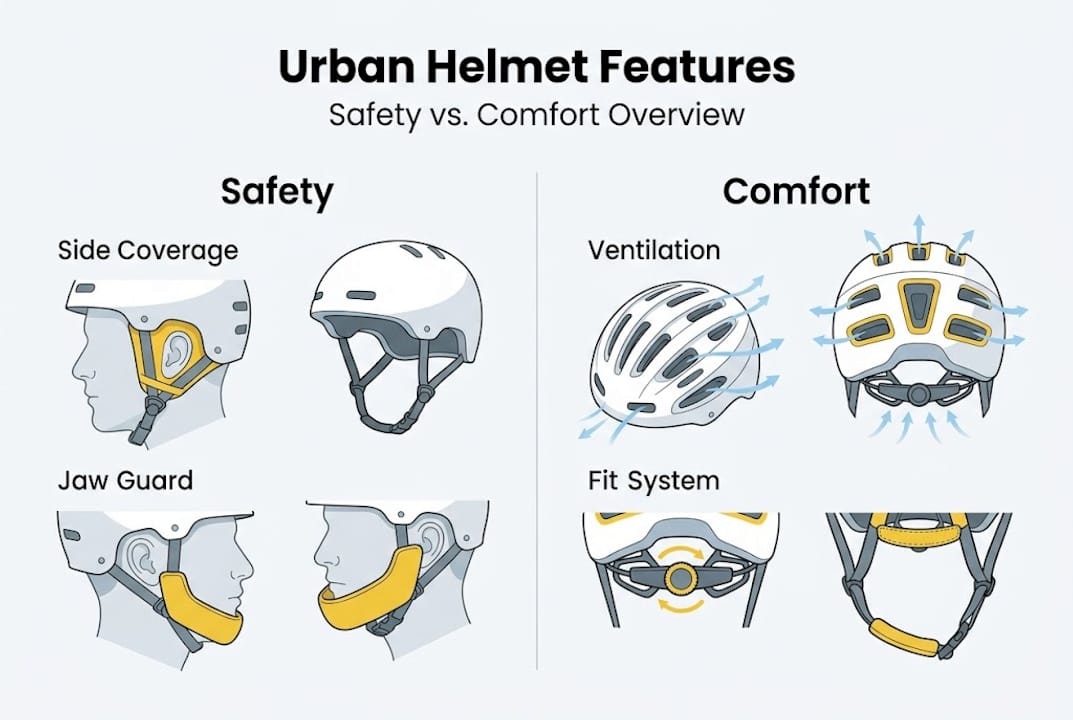
Here’s a quick comparison of the two main styles:
| Feature | Open-face helmet | Integral (full-face) helmet |
|---|---|---|
| Chin/jaw protection | None | Full coverage |
| Weight | Lighter | Heavier |
| Ventilation | Higher | Moderate |
| City crash protection | Basic | Superior |
| Visibility integration | Varies | Often built-in |
Beyond coverage, urban helmets are built with city life in mind. Many include integrated LED lights, reflective panels, and a lower profile that fits under a bike storage hook or in a bag. The helmet types for urban safety vary widely, but the best urban models share a few non-negotiable traits.
City-specific hazards that urban helmets address:
- Dooring: A car door opens suddenly; you hit it at an angle, not head-on.
- Side impacts: Intersections create lateral collision risks that road helmets ignore.
- Low-speed falls: Tipping over at a red light sends your temple straight into the curb.
- Debris and pedestrian contact: Urban environments mean unpredictable obstacles at close range.
Pro Tip: If you commute through dense traffic or ride an e-bike, always check for integral chin and jaw coverage. That single feature can be the difference between a bruised ego and a serious facial injury.
Think about the scenarios where you actually need protection on your commute: squeezing through a bus lane, navigating a roundabout, or locking your bike in a tight rack. Urban helmets are engineered for exactly those moments.
The science behind urban helmet safety
Understanding those differences, let’s look at the science behind urban helmet protection.
Most city crashes don’t happen straight-on. They happen at angles. When your head hits a surface at an angle, it doesn’t just compress. It rotates. That rotational force is what tears brain tissue and causes concussions. Standard foam helmets absorb linear impact reasonably well but do almost nothing to manage rotation.
That’s where MIPS (Multi-directional Impact Protection System) and WaveCel come in. Helmets with MIPS reduce rotational brain forces by 20 to 50% in angled impacts. WaveCel, a collapsible cellular structure inside the helmet, works similarly by allowing the liner to flex and absorb energy before it reaches your skull.
| Technology | Mechanism | Benefit |
|---|---|---|
| Standard EPS foam | Linear compression | Basic impact absorption |
| MIPS | Slip-plane layer | Reduces rotational force |
| WaveCel | Flexible cell structure | Absorbs and redirects energy |
For urban riders, this matters more than for road cyclists. City crashes tend to be lower speed but involve harder, irregular surfaces like curbs, parked cars, and pavement edges. The angled nature of those impacts makes rotational protection critical, not optional.
Certifications tell you the minimum standard a helmet meets. Here’s what to look for:
- CPSC: Required for all helmets sold in the United States.
- EN 1078: The European standard, mandatory in the EU.
- Virginia Tech STAR rating: An independent benchmark that goes beyond legal minimums. Virginia Tech ratings show real-world performance differences, with top models like the Specialized Mode ranking 13th overall in 2025 testing.
A helmet can pass CPSC or EN 1078 and still perform poorly in Virginia Tech’s more rigorous protocol. Always cross-reference both the legal certification and the independent rating before buying.
What to look for on a helmet’s safety label:
- CPSC or EN 1078 stamp (mandatory)
- MIPS or WaveCel badge (strongly recommended)
- Virginia Tech STAR rating of 4 or 5 stars
- No visible cracks or manufacturing defects on the liner
- Manufacture date (within the last 5 years)
The urban helmet innovation driving these improvements is moving fast, and the gap between a certified helmet and a genuinely protective one has never been wider.
Comfort, ventilation, and visibility for city commuting
Safety is key, but urban helmets excel at comfort and liveability too.
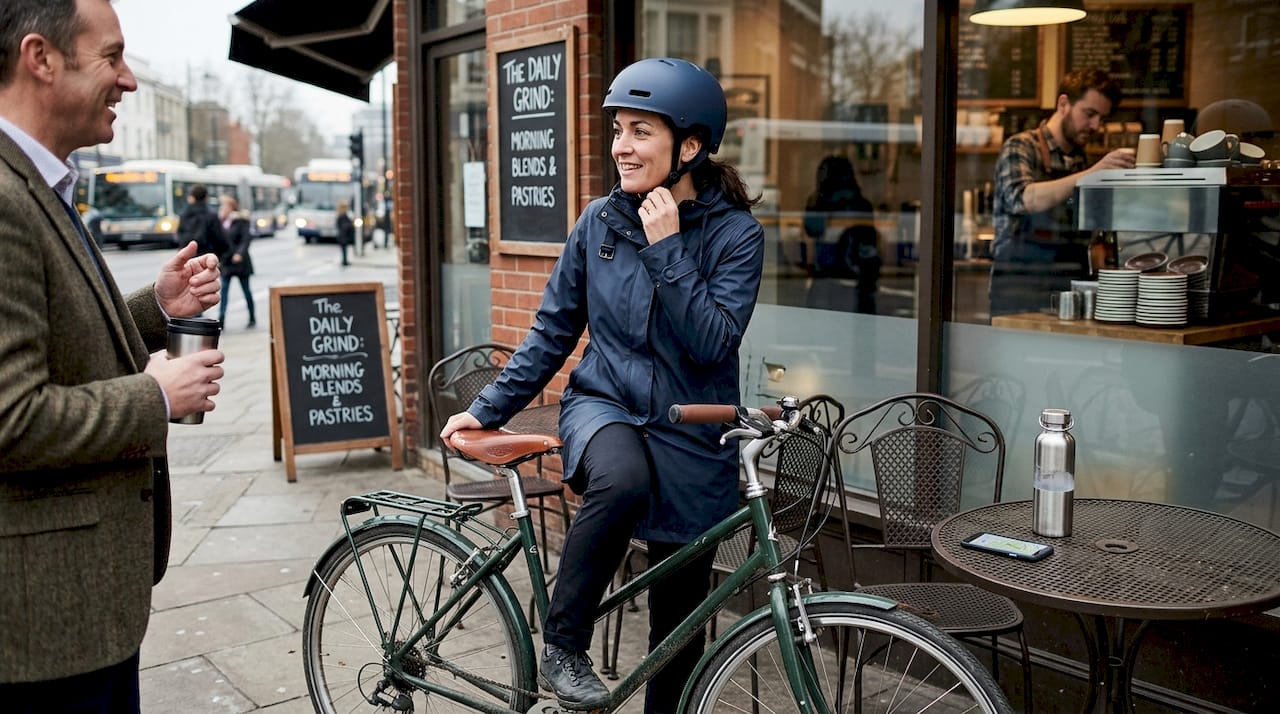
Here’s a truth most helmet reviews skip: the safest helmet in the world does nothing if you find it so uncomfortable that you leave it at home. Comfort isn’t a luxury feature. It’s a safety feature.
Ventilation matters enormously for commuters. You’re not gliding at 30 mph with wind cooling your head. You’re grinding through stop-and-go traffic, sweating even in mild weather. Urban helmets typically offer 12 to 21 vents, with internal channeling that moves air across your scalp. Enhanced ventilation and visibility features, including reflectors and LED lights, are now standard on quality urban models.
Features to prioritize for urban commuters:
- Adjustable retention system: A dial or strap system that lets you fine-tune the fit in seconds.
- Moisture-wicking padding: Removable, washable pads keep the interior fresh on daily rides.
- Integrated LED lights: Rear or side lights built into the helmet improve your visibility at dusk and night without extra accessories.
- Reflective panels: 360-degree reflectivity makes you visible from every angle in low light.
- Low-profile shell: Fits under a bag strap, through a bike lock loop, or in a locker without drama.
Visibility is where urban helmets genuinely outshine road models. A road helmet designed for daylight group rides has no need for integrated lighting. Your city commute, often starting before sunrise or ending after dark, absolutely does. Reflectors and LEDs built directly into the helmet mean you’re never unprotected just because you forgot to attach a separate light.
Pro Tip: Fit and comfort should come before any tech feature on your checklist. A helmet that fits perfectly and feels good is one you’ll wear every single ride. A helmet with every feature but a poor fit is just expensive shelf decoration.
For a deeper look at how to balance gear choices for city riding, the urban cycling protection guide covers the full picture from helmet to accessories.
Weighing trade-offs: Finding your perfect urban helmet
Once you know your options, how do you find the best helmet for you?
Every helmet involves trade-offs. The goal isn’t to find the perfect helmet. It’s to find the right helmet for your specific commute, climate, and comfort threshold.
Integral helmets offer maximum protection but come with real costs. They’re heavier, typically 100 to 200 grams more than open-face models, and ventilation is more limited. On a hot summer commute, that matters. Integral helmets are heavier but more protective, and MIPS technology adds roughly $20 to $50 to the price but is consistently justified by independent safety benchmarks. That’s a worthwhile investment when you consider what it protects.
Open-face helmets are lighter and cooler, making them easier to wear on longer or warmer commutes. The trade-off is less coverage at the chin and jaw, which matters most in the exact city crash scenarios described above.
“The best helmet is the one you wear consistently. Prioritize fit over features every time.” This is the single most repeated finding across independent helmet safety research, and it’s the one most buyers ignore.
Here’s a step-by-step framework for choosing your urban helmet:
- Define your commute: Distance, terrain, traffic density, and typical weather conditions.
- Set your protection priority: High-traffic urban routes favor integral designs. Quieter paths allow open-face.
- Check certifications first: CPSC (US) or EN 1078 (EU) is the baseline. Virginia Tech STAR rating is your upgrade filter.
- Evaluate MIPS or WaveCel: If your budget allows, this is the single most impactful safety upgrade.
- Try before you buy: Fit varies significantly between brands. A helmet should sit level, feel snug without pressure points, and not shift when you shake your head.
- Consider visibility needs: If you ride at night or in low light, integrated lighting or reflectors are essential, not optional.
For a detailed breakdown of how different designs compare, the integrated helmet design guide goes deeper on construction and performance differences.
A practical perspective on urban helmet choice
After years of working with urban cyclists across France, the U.S., and Germany, one pattern stands out clearly: the riders who upgrade their helmet tech the most are often not the safest riders on the road.
The uncomfortable truth is that obsessing over MIPS ratings and Virginia Tech scores while ignoring fit, comfort, and personal style leads to helmets that sit on shelves. We’ve seen it repeatedly. A rider invests in a technically superior helmet, finds it slightly uncomfortable, and starts skipping it on shorter rides. Then on most rides. Then all rides.
The helmet you actually wear is infinitely safer than the one you don’t. That means choosing a design you genuinely like the look of matters. It means comfort is not a compromise. It means following the step-by-step helmet guide to nail your fit before spending a cent on tech upgrades.
One more thing most riders ignore: replace your helmet every 3 to 5 years, even without a crash. EPS foam degrades silently. A helmet that looks fine on the outside may have lost significant protective capacity. That’s not a marketing claim. It’s physics.
Next steps: Gear up safely for your city rides
You now have a clear framework for evaluating urban helmets based on real safety science, not marketing claims. The next step is putting it into practice.
At THE BEAM, we design helmets and accessories specifically for the demands of city cycling. Our VIRGO integral helmet with MIPS technology is built for riders who refuse to compromise between protection and style. Beyond helmets, discover all helmets and gear in our collection, including safety accessories designed for urban commuters. For riders looking to maximize visibility without adding bulk, our bike reflectors for added visibility are a simple, effective upgrade that works alongside any helmet choice. Ride smart, ride protected.
Frequently asked questions
Are urban helmets safer than road helmets for city commuting?
Urban helmets offer more side and face protection, making them better suited to city risks like dooring and side impacts. Full-face and integral designs are specifically built to handle the angled, low-speed impacts most common in urban environments.
How important is MIPS or WaveCel in an urban helmet?
Very important for city riders. MIPS reduces rotational forces by 20 to 50% in angled impacts, which are the most common type in urban crashes, making it one of the highest-value safety upgrades available.
What certifications should I look for in an urban helmet?
Start with CPSC (US) or EN 1078 (EU) as the legal baseline, then use Virginia Tech STAR ratings to compare real-world performance beyond the minimum standard.
How do I know if an urban helmet fits correctly?
A properly fitting helmet sits level on your head, feels snug without creating pressure points, and does not shift or rock when you shake your head side to side. The chin strap should allow only two fingers between the strap and your chin.
How often should I replace my urban helmet?
Replace your helmet every 3 to 5 years or immediately after any crash. Fit matters more than tech, and a degraded helmet, even one that looks intact, may no longer provide adequate protection.


