

What is cycling infrastructure, and why does it matter?
Cycling infrastructure is the collection of facilities, street design elements, and supporting amenities built specifically for people on bikes. That covers everything from a painted lane on a city arterial to a fully separated cycle track, a neighborhood greenway, secure bike parking, and signal timing that gives cyclists a head start at intersections. The goal is not just to mark space on a road. It’s to make cycling safe, comfortable, and genuinely usable for a broad range of people, including kids, older adults, and anyone who would never ride in mixed traffic with fast-moving cars.
Organizations like PeopleForBikes and the U.S. Department of Transportation (USDOT) have spent years building the policy and research case for investing in these networks. The core argument is straightforward: when streets are designed only for cars, cycling stays a niche activity. When streets include protected space for cyclists, ridership grows, crashes fall, and cities become more livable.
The key functions cycling infrastructure serves:
- Safety: Physically separating cyclists from fast motor traffic reduces crash exposure.
- Accessibility: Low-stress routes let people of all ages and abilities ride without fear.
- Modal shift: Better infrastructure pulls trips away from cars, cutting congestion and emissions.
- Public health: More cycling means more daily physical activity at the population level.
- Economic value: Cycling networks cost far less to build and maintain than road expansions.
- Community quality: Quieter, calmer streets benefit pedestrians, residents, and local businesses.
No single design fits every street. The right facility depends on how fast and how much motor traffic a road carries, which is the foundational principle behind every serious planning framework in use today.
The main types of cycling infrastructure you’ll encounter
Cycling infrastructure covers a wider range of facility types than most people realize. A painted stripe and a fully separated path are both “bike infrastructure,” but they serve very different riders under very different conditions.
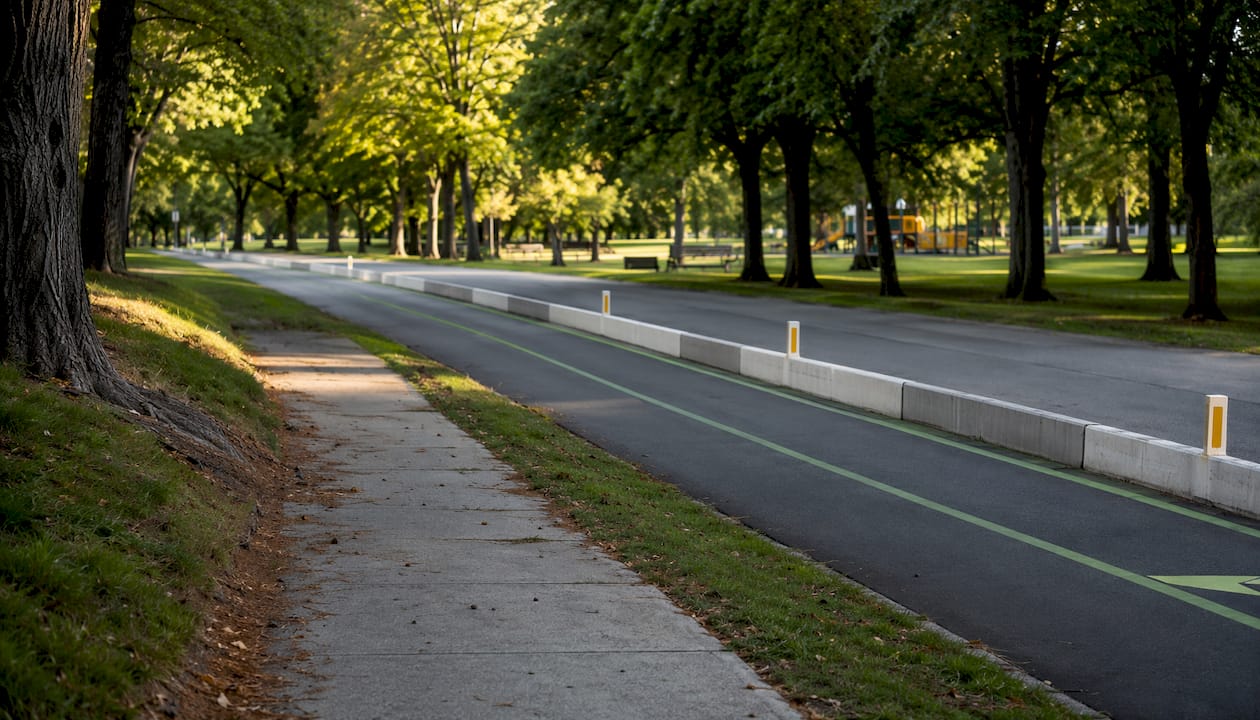
Protected cycle tracks (separated bike lanes) These are on-street lanes physically separated from moving traffic by a concrete barrier, raised buffer, or a row of parked cars placed between the lane and the travel lanes. They’re the gold standard on high-volume arterials. Chicago’s network uses concrete barriers, plastic curbs, and bollards to create this separation, and the city explicitly designs them for streets where motor vehicle volumes make shared or painted-only lanes inadequate.
Standard and buffered bike lanes A standard bike lane is a dedicated on-street space marked with striping, signs, and pavement markings. A buffered bike lane adds extra painted space between the cyclist and moving traffic or the door zone of parked cars. Both are appropriate on lower-volume roads where speeds are moderate, but neither provides the physical protection a cycle track does.
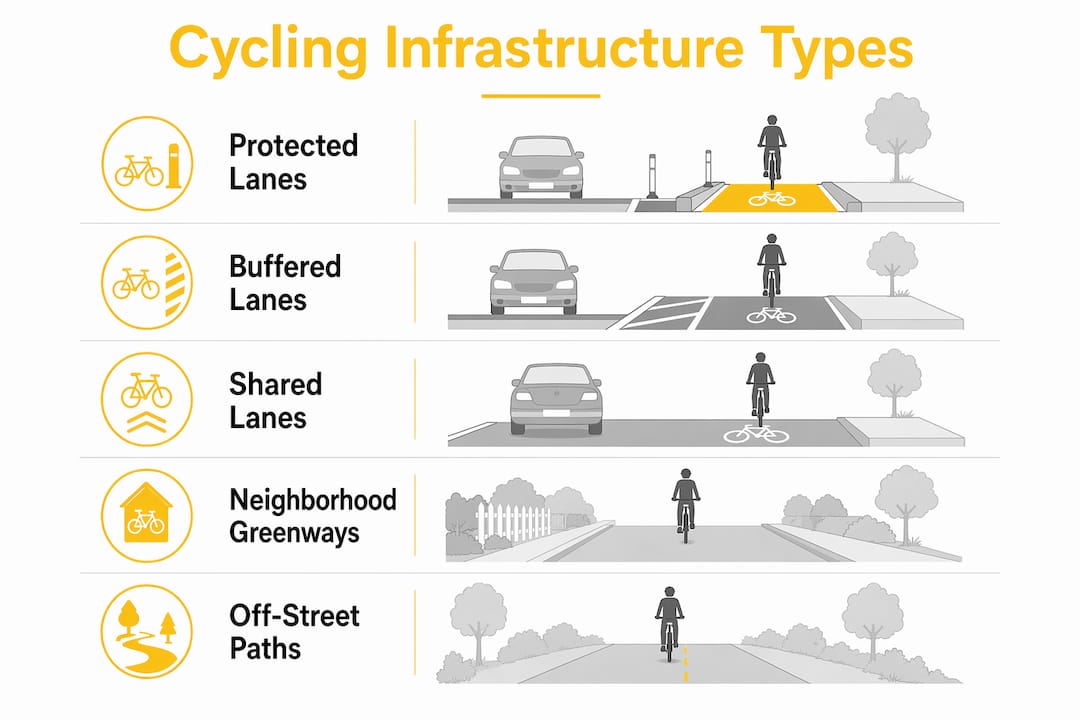
Shared lanes (sharrows) Marked shared lanes use pavement markings and signs to signal that cyclists have the right to use the full travel lane. They work on low-speed streets where traffic volumes are light, but they offer no physical protection and are not a substitute for separated infrastructure on busy roads.
Neighborhood greenways Residential streets can be converted into low-stress cycling corridors through traffic calming: speed humps, raised crosswalks, curb extensions, neighborhood traffic circles, and turn restrictions that discourage through motor traffic. Chicago’s greenway program uses these tools to create two-way bike travel on one-way streets and to give cyclists priority at intersections, turning ordinary side streets into practical alternatives to arterials.
Off-street trails and multi-use paths Car-free paths through parks, along waterfronts, or in rail corridors provide the highest level of separation from traffic. Chicago has an extensive network of off-street trails, including the well-known Lakefront Trail. These paths attract the widest range of riders but require careful design at road crossings, where conflict risk spikes.
Contraflow bike lanes On one-way streets, contraflow lanes let cyclists travel against the direction of motor traffic. Signs and signals alert drivers at intersections. The result is more direct routing through grid networks without forcing cyclists onto longer detours.
Bicycle highways and express networks These are high-capacity cycling corridors connecting major destinations across a metro area, typically built to higher design standards with fewer stops, better surfaces, and consistent separation. They form the backbone of a regional network, with local streets feeding into them.
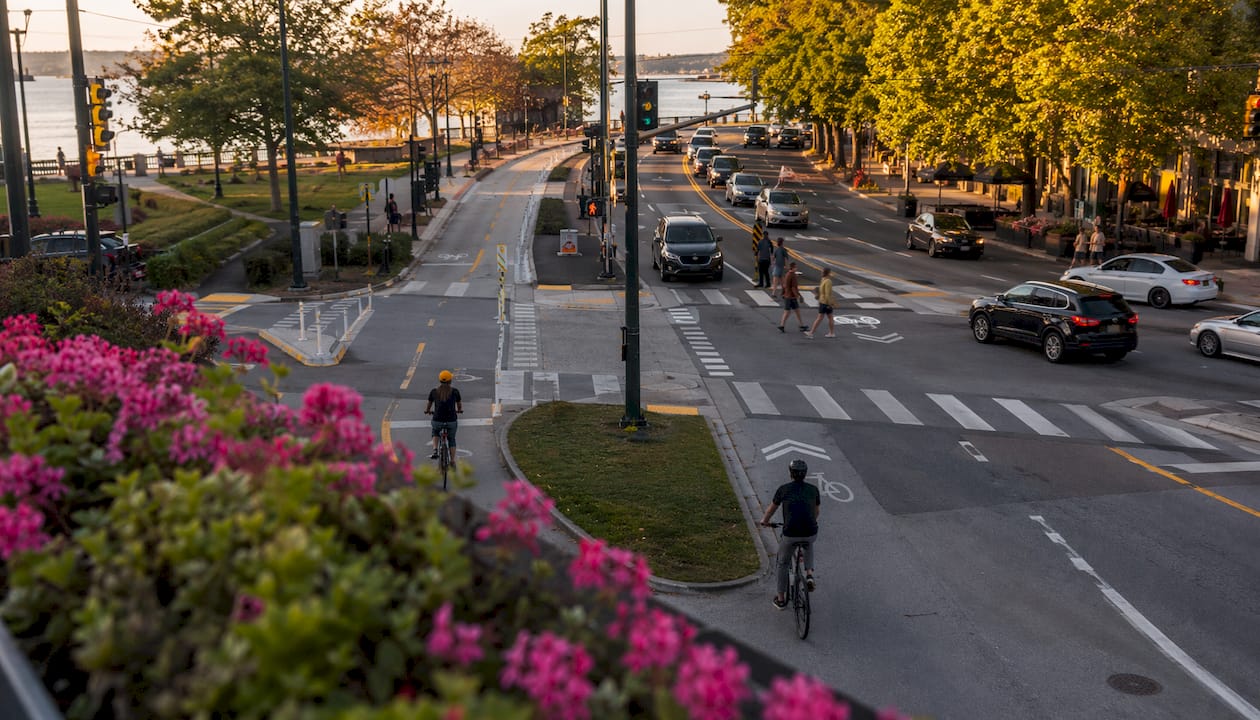
End-of-trip facilities and intersection treatments Secure bike parking, bike boxes at traffic signals, signal priority timing, and dashed conflict markings at intersections are not glamorous, but intersection safety and amenities often determine whether cyclists actually use a route more than the mid-block lane quality does. A bike box positions cyclists ahead of waiting cars at a red light, improving visibility and reducing right-hook crashes.
Shared paths deserve a specific note: they work only where combined pedestrian and cyclist volumes stay low enough to avoid frequent conflict. Where those volumes rise, separation becomes necessary for both safety and comfort.
Safety and design principles that make cycling infrastructure work
The concept of a “low-stress network” is the most useful frame for understanding what good cycling infrastructure actually achieves. A low-stress network is designed so that riders of all ages and abilities feel comfortable, not just experienced cyclists willing to mix with traffic. Signal timing and secure parking critically influence whether a network functions in practice, which means infrastructure design goes well beyond painting lines on pavement.
Physical separation is the single most effective safety intervention on high-speed, high-volume roads. Painted lanes alone do not protect cyclists from errant vehicles. A concrete buffer or raised cycle track changes the geometry of a potential crash, not just the legal designation of the space. Copenhagen data shows that constructing cycle lanes that physically separate cyclists from higher-speed vehicles is associated with reduced rates of fatalities and injuries, and the Crash Modification Factor framework quantifies this: a CMF below 1 means fewer crashes after the facility is installed.
On local streets where speeds are already low, physical separation is often unnecessary. Traffic calming tools, including speed humps, raised crosswalks, and curb extensions, can bring vehicle speeds down to levels where cyclists and drivers mix safely. The threshold most transportation experts use is 20 mph: streets at or below that speed can typically accommodate mixed traffic cycling without dedicated lanes.
Intersections are where most cycling crashes happen, and they deserve specific design attention. Bike boxes, protected intersection geometry, and dashed conflict markings all reduce the number of points where cyclists and turning vehicles can collide. Protected intersections show real promise for reducing conflict even though they remain understudied compared to mid-block treatments.
Core safety design elements worth knowing:
- Physical separation on roads with speeds above 20 mph or high vehicle volumes
- Traffic calming on local streets to reduce speed differentials
- Bike boxes at signalized intersections for visibility and positioning
- Protected intersection geometry to separate turning conflicts
- Midblock crossing treatments (raised crossings, flashing beacons) for off-street path connections
- Secure, covered bike parking at destinations to complete the trip
Pro Tip: When designing or advocating for cycling infrastructure in your community, prioritize routes that connect schools, transit stops, and neighborhood centers first. Children and older adults are the most sensitive indicators of whether a network is truly low-stress. If an 8-year-old and a 70-year-old would both use a route, the design is working.
How cycling infrastructure benefits communities
Protected cycling infrastructure delivers safety, health, environmental, and economic returns that consistently outpace its construction costs. The evidence base across more than 200 studies points to wide-ranging societal benefits from active transportation interventions, with the strongest effects seen when infrastructure and supporting programs are combined.
Safety gains are direct and measurable. Separating cyclists from motor traffic reduces crash exposure in two ways: it protects existing cyclists who previously rode in mixed traffic, and it shifts some car trips to cycling, which reduces the total number of motorized vehicle crashes. Protected and segregated cycle lanes reduce the likelihood of crashes involving cyclists and motor vehicles, and they encourage more predictable interactions between all road users.
Environmental benefits flow from mode shift. Every car trip replaced by a bike trip cuts greenhouse gas emissions, reduces air pollution, and lowers noise levels. The World Health Organization’s Health Economic Assessment Tool (HEAT) calculates these reductions across operational emissions, energy supply emissions, and vehicle lifecycle emissions, giving planners a monetized figure to put in front of decision-makers.
Public health improvements are population-wide. Cycling is moderate-intensity aerobic exercise. Networks that make cycling accessible to everyday riders, not just enthusiasts, increase physical activity at scale, reducing mortality and lowering the burden on healthcare systems. The health benefit from reduced mortality is one of the four core benefit categories in the ITDP/World Bank CyclingMax cost-benefit tool.
Economic returns extend beyond construction. Capital costs of cycling infrastructure are offset by long-term societal benefits including reduced road maintenance, improved public health outcomes, and less traffic congestion. Planners increasingly evaluate these co-benefits alongside traditional cost-benefit ratios, which reframes cycling investment as a high-return public expenditure rather than a discretionary amenity.
Key benefit categories at a glance:
- Fewer cyclist fatalities and injuries on roads with physical separation
- Reduced greenhouse gas emissions and air pollution from mode shift
- Lower cardiovascular disease risk and mortality from increased physical activity
- Reduced road maintenance costs compared to motor vehicle infrastructure
- Increased retail spending near protected bike lanes in urban commercial corridors
- Improved air quality and noise reduction in residential neighborhoods
How US cycling infrastructure evolved to where it is today
American cycling infrastructure has a longer history than most people expect, and its trajectory is not a straight line. The story moves from near-total neglect to a period of painted-lane experimentation, and then toward the protected networks that major cities are building today.
The earliest dedicated cycling facilities in the US appeared in the late 19th century, when the Good Roads Movement, driven largely by cyclists, pushed for paved surfaces. That momentum collapsed when the automobile took over road policy in the early 20th century. For most of the following decades, cyclists were treated as slow vehicles sharing lanes with cars, with no dedicated space.
The 1970s oil crisis and environmental movement sparked renewed interest in cycling as transportation. Cities began painting bike lanes on existing roads, and the Federal Highway Administration started developing guidance for bicycle facilities. These early lanes were minimal: a stripe and a sign, with no physical protection. They served confident adult cyclists but did little to broaden ridership.
Key milestones in US cycling infrastructure development:
- 1970s: First modern bike lanes appear in US cities; federal bicycle program funding established.
- 1991: The Intermodal Surface Transportation Efficiency Act (ISTEA) created dedicated federal funding streams for bicycle and pedestrian infrastructure.
- 2000s: NACTO (National Association of City Transportation Officials) begins developing urban street design guides that include protected lanes and intersection treatments.
- 2010s: New York City, Chicago, San Francisco, and Portland build the first generation of protected cycle tracks, drawing on European models. PeopleForBikes launches national advocacy campaigns for connected networks.
- 2015 onward: FHWA publishes the Bikeway Selection Guide, giving transportation agencies a structured decision tool for choosing facility types based on street context.
- 2020s: Federal infrastructure investment through the Bipartisan Infrastructure Law channels billions toward active transportation, and USDOT formally prioritizes expanding and improving bicycle and pedestrian infrastructure as a health and equity goal.
The ITDP and World Bank document this global shift: historic cycling infrastructure evolved from minimal lane markings to sophisticated protected networks as policy support and community demand grew together. The US followed a similar arc, just later and more unevenly than peer countries.
| Era | Dominant facility type | Key policy driver |
|---|---|---|
| Pre-1970s | None (mixed traffic) | No dedicated bicycle policy |
| 1970s–1980s | Painted bike lanes | Federal environmental and transportation acts |
| 2000s–2010s | Buffered lanes, first protected tracks | NACTO urban design guides, city-level advocacy |
| 2010s–present | Protected cycle tracks, greenways, express networks | FHWA Bikeway Selection Guide, Bipartisan Infrastructure Law |
How to choose the right cycling infrastructure for any street
Selecting the right facility type is not guesswork. The FHWA Bikeway Selection Guide gives transportation practitioners a structured process for weighing trade-offs based on real-world street conditions. The central question is always the same: what type of bikeway fits this particular street given its traffic volume, speed, land use, and the riders it needs to serve?
Street context drives everything. A high-volume arterial carrying thousands of vehicles per day at 35 mph needs physical separation. A residential street with low volumes and speeds under 20 mph can often accommodate cycling through traffic calming alone, without any dedicated lane. Forcing a one-size solution onto every street wastes money and produces infrastructure that either over-engineers quiet streets or under-protects busy ones.
The Roads and Streets Framework and Quality of Service tools help planners check whether a proposed facility actually meets the needs of the street environment. These frameworks assess factors like vehicle speed, volume, parking configuration, and intersection complexity to determine whether a given design will feel safe to a broad range of riders, not just the most confident ones.
Factors that determine facility selection:
- Vehicle volume: High daily traffic counts push toward physical separation.
- Vehicle speed: Roads above 20 mph require more protection; traffic calming is the tool for local streets.
- User mix: Networks serving children, older adults, and people with disabilities need lower stress levels throughout.
- Land use: Commercial corridors need end-of-trip amenities; residential streets need calming and wayfinding.
- Network connectivity: A facility that dead-ends or forces cyclists into high-stress conditions at intersections fails regardless of mid-block quality.
- Intersection treatment: Bike boxes, signal priority, and protected intersection geometry must be planned alongside the lane itself.
| Street type | Recommended facility | Key design tool |
|---|---|---|
| High-volume arterial (35+ mph) | Protected cycle track with physical barrier | FHWA Bikeway Selection Guide |
| Collector street (moderate volume) | Buffered or protected bike lane | NACTO Urban Street Design Guide |
| Low-volume residential street | Neighborhood greenway with traffic calming | Local network design standards |
| Off-street corridor | Multi-use path or dedicated cycle track | Quality of Service assessment |
| One-way urban street | Contraflow bike lane | Intersection signal coordination |
Best practices for planning and maintenance:
- Audit the full route, not just individual segments, for stress levels and connectivity gaps.
- Design intersections and crossings with the same care as mid-block segments.
- Provide secure bike parking and wayfinding at key destinations.
- Plan maintenance schedules that keep surfaces, markings, and barriers in good condition year-round.
- Engage residents and cyclists in the design process to surface local knowledge about conflict points.
How cycling infrastructure gets funded and maintained
Funding cycling infrastructure in the US draws from a mix of federal, state, and local sources, and the mix matters because each source comes with different eligibility rules and timelines. The Bipartisan Infrastructure Law, signed in 2021, significantly expanded federal funding for bicycle and pedestrian infrastructure, channeling money through programs like the Transportation Alternatives Program (TAP) and the Safe Routes to School program. USDOT also directs funding through the Congestion Mitigation and Air Quality (CMAQ) program, which cycling projects can access when they demonstrate emissions reduction benefits.
State departments of transportation pass federal funds down to municipalities and metropolitan planning organizations (MPOs), which prioritize projects through long-range transportation plans. Local governments often supplement federal dollars with general fund allocations, bond measures, or developer impact fees tied to new construction near cycling corridors.
Maintenance is where many US cities fall short. Building a protected lane is a one-time capital expense; keeping it functional requires ongoing budgets for resurfacing, repainting markings, replacing damaged bollards, and clearing debris from protected channels. Cities that treat cycling infrastructure as a capital project without a maintenance line item find that facilities degrade within a few years, undermining both safety and rider confidence. Dedicated maintenance contracts and regular condition assessments are the standard practice in cities with mature cycling networks.
Why connecting cycling infrastructure to transit multiplies its value
Cycling and public transit are natural partners. A cyclist who can ride to a rail station, lock up securely, and board a train extends their effective range far beyond what either mode offers alone. This combination, often called bike-and-ride, is one of the most cost-effective ways to increase transit ridership and reduce car dependence simultaneously.
The infrastructure requirements for effective integration are specific. Secure, covered bike parking at transit stations is the baseline. Bike lockers, staffed parking facilities, and bike-share docking stations at station entrances all serve different rider needs. Without secure parking, cyclists face a real risk of theft that makes the combination impractical for daily commuting.
On-board bike accommodation matters for trips where the cycling leg is too long or hilly for a direct ride. Many US commuter rail systems allow bikes on trains during off-peak hours, and some bus rapid transit corridors include bike racks on vehicles. These policies directly affect whether cyclists can use transit as a flexible part of a longer trip.
The network design implications are significant. Cycling infrastructure that feeds transit hubs should be planned as part of the same corridor study, not as separate projects. A protected lane that ends two blocks from a rail station, forcing cyclists into a high-stress merge with bus traffic, breaks the chain. Cities like Minneapolis and Washington, D.C. have invested in continuous protected connections from residential neighborhoods to major transit nodes, and ridership data at those stations reflects it. For riders thinking about urban cycling safety in the context of multimodal commuting, the quality of the last mile of cycling infrastructure is often the deciding factor in whether they ride at all.
Key Takeaways
Well-designed cycling infrastructure, built to match street context and serving all ages and abilities, is the single most effective tool for making urban cycling safe and broadly accessible.
| Point | Details |
|---|---|
| Physical separation saves lives | Protected cycle tracks reduce fatalities and injuries by separating cyclists from motor traffic, confirmed by Copenhagen crash data and CMF analysis. |
| Street context drives facility choice | Vehicle speed and volume determine the right facility type; roads above 20 mph require physical separation, not just painted lanes. |
| End-of-trip amenities complete the network | Secure parking, bike boxes, and signal priority often influence route choice more than mid-block lane quality alone. |
| Co-benefits justify investment | Capital costs are offset by reduced road maintenance, public health gains, and lower congestion, shifting the economic case for cycling networks. |
| Transit integration multiplies impact | Secure bike parking at transit stations and continuous protected connections to transit hubs extend cycling’s reach and boost ridership on both modes. |
Ride safer on every type of infrastructure
Good infrastructure reduces risk, but it doesn’t eliminate it. Every road type, from a protected cycle track to a neighborhood greenway, still puts you in an environment where visibility and protection matter. Thebeamofficial designs helmets and safety accessories specifically for this reality: urban commuters, e-bike riders, and everyday cyclists who need gear that works as hard as the infrastructure around them.
The VIRGO integral helmet with MIPS technology is built for riders who take protection seriously without sacrificing comfort or style. Pair it with high-visibility bike reflectors and a rear-view mirror, and you’re covered for the gaps that even the best infrastructure can’t close, low-light intersections, blind corners, and the unpredictable moments that no bike box can prevent.

Browse Thebeamofficial’s full range of adults’ helmets and cycling safety accessories, built for the roads you actually ride.


