

TL;DR:
- Connected cycling safety relies on linking physical protected routes with real-time communication technology to create low-stress networks. V2X alerts and smart gear enhance hazard detection, but physical infrastructure remains essential for maximum safety. Combining connected infrastructure with safety gear offers the best protection for cyclists.
Connectivity is defined as the integration of communication technologies, physical networks, and real-time data sharing to reduce crash risk and improve rider visibility on the road. The role of connectivity in cycling safety goes far beyond GPS tracking. It covers how bike routes link to each other, how cyclists communicate with vehicles, and how smart gear alerts riders to hazards before they become emergencies. Connected bike networks increase cycling ridership 4.6 times more strongly than isolated cycling facility projects. That number tells you something critical: a single protected lane does far less than a fully linked network. Thebeamofficial builds its entire product line around this principle, designing helmets and accessories that work within connected systems, not in isolation.
How does connected cycling infrastructure improve safety?
Connected bike infrastructure is a network where routes, signals, and lanes are physically and digitally linked to create a continuous, low-stress riding environment. The difference between a connected network and a collection of isolated lanes is the difference between a highway system and a series of dead-end roads.
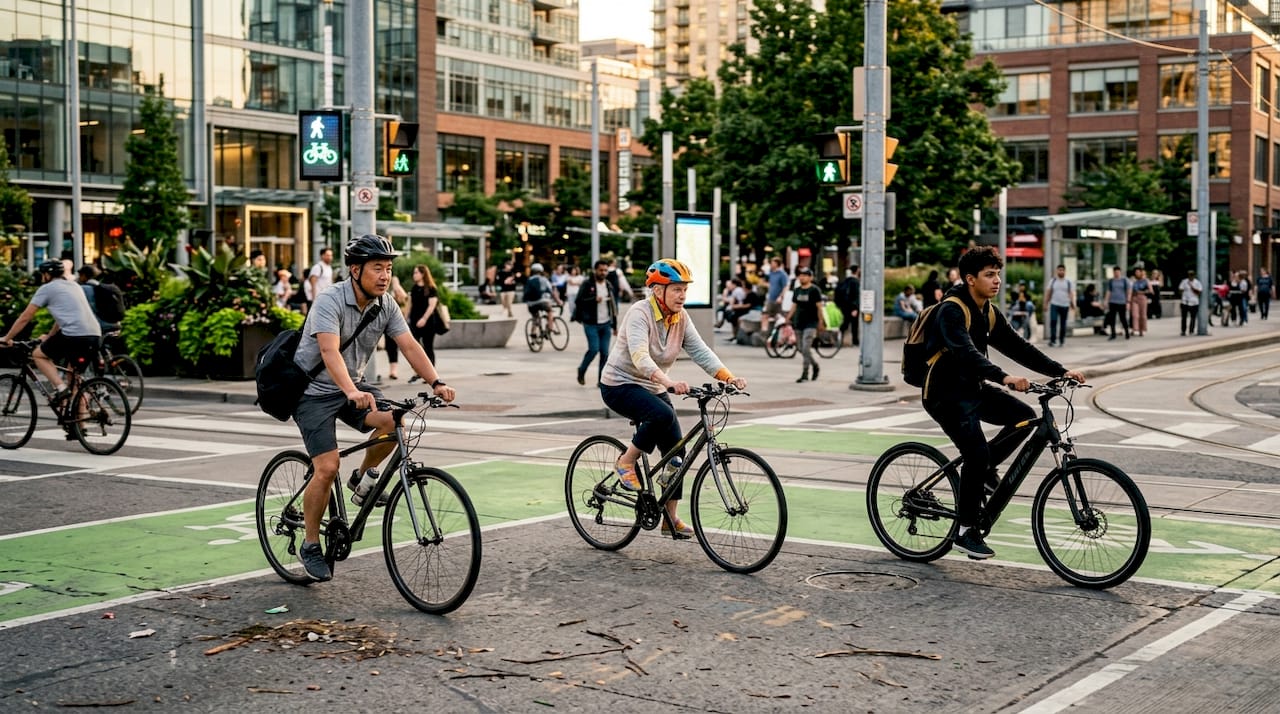
Protected bike lanes near new bikeshare stations caused an average 18% increase in trips, while painted lanes did not significantly affect ridership. That gap matters. Physical separation, not just paint, changes rider behavior and reduces exposure to vehicle traffic. When those protected lanes connect to each other across a city, the safety benefit compounds.
Low-stress routing is the technical term urban planners use for networks where cyclists rarely encounter high-speed traffic or complex intersections. The Federal Highway Administration (FHWA) recognizes network completeness as a core design standard for safe cycling environments. A route that forces a rider onto a six-lane arterial for two blocks destroys the safety value of every protected segment around it.
The table below shows how different infrastructure types compare on safety and ridership impact.
| Infrastructure type | Safety impact | Ridership impact |
|---|---|---|
| Painted bike lane | Low, no physical separation | Minimal increase |
| Protected bike lane | High, physical barrier from traffic | Significant increase |
| Connected network of protected lanes | Highest, continuous low-stress routing | 4.6x stronger than isolated projects |
| Shared road with signage only | Very low | No measurable increase |
The practical takeaway is straightforward. Riding on a connected, low-stress network is safer than riding on any single protected lane that dead-ends into unprotected roads. When you plan a route, network continuity matters as much as the quality of any individual segment.
Pro Tip: Use route-planning apps that filter for low-stress or protected infrastructure. A slightly longer route on a connected network is almost always safer than a direct route through high-traffic roads.
What does V2X technology add to cyclist safety?
Vehicle-to-Everything (V2X) technology is a communication standard that lets bikes and vehicles exchange real-time data directly, without relying on line-of-sight awareness. A driver who cannot see a cyclist around a corner can still receive a V2X alert that a cyclist is approaching. That is the core safety gain.
V2X enables bidirectional communication between bikes and vehicles, delivering early hazard notifications through haptic feedback in handlebars. Haptic alerts are physically felt vibrations, not visual warnings. That distinction matters because a rider’s eyes need to stay on the road.
Haptic feedback reduces rider distraction compared to visual alerts alone by lowering cognitive load. In fast urban environments, a buzz in the left handlebar telling you a car is approaching from that direction is far more useful than a screen notification you have to read.
The current limitations of V2X are real and worth understanding:
- Critical mass requirement. V2X systems need a critical mass of connected vehicles and cyclists to be effective. An isolated device on a road with no other connected vehicles offers limited protection.
- Cross-sector collaboration. Scaling V2X deployment requires alignment across automotive, telecom, and cycling industries. No single company can build this ecosystem alone.
- Regulatory gaps. Government mandates for V2X adoption in vehicles remain inconsistent across the U.S. and Europe, slowing the growth of the connected ecosystem.
- Design standards. The POLIS Network identifies the lack of standardized design guidelines for connected cycling products as a barrier to safe, distraction-free human-machine interaction.
Smart helmets that integrate connectivity features, like those in the Thebeamofficial lineup, are designed with these constraints in mind. The goal is to deliver useful alerts without creating new distractions.
Pro Tip: When using V2X or Bluetooth safety alerts, set your device to haptic-only mode in urban environments. Audio alerts compete with traffic noise and can mask other important sounds.
Is connectivity a substitute for physical cycling infrastructure?
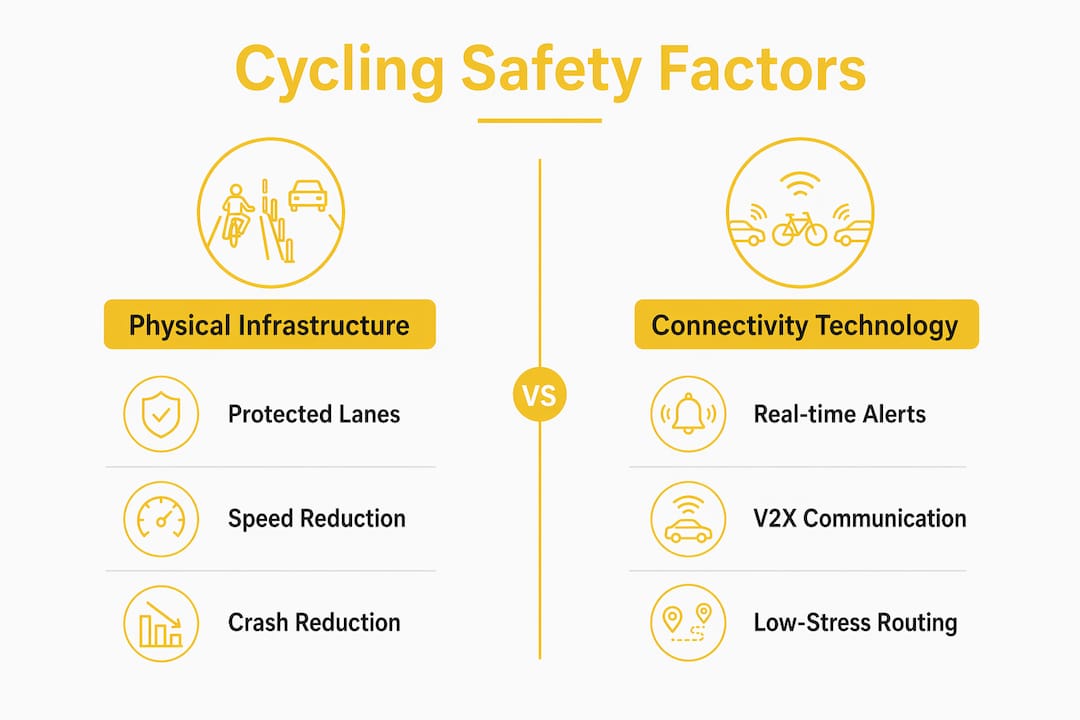
Connectivity is not a substitute for physical cycling infrastructure. Safety experts are direct on this point: separated bike lanes and speed reductions remain the most effective cycling safety measures available. Technology adds value on top of that foundation. It does not replace it.
The risk of treating connectivity as a substitute is well documented. Connected safety technology risks shifting responsibility for safety from public infrastructure to individual cyclists. When governments and city planners point to connected gear as a safety solution, they reduce pressure on themselves to build the protected lanes and traffic calming measures that actually prevent crashes at scale.
This is not a theoretical concern. Cities that have invested heavily in digital cycling programs while neglecting physical infrastructure have not seen the crash reduction rates of cities that built connected networks of protected lanes first.
| Approach | Strengths | Weaknesses |
|---|---|---|
| Physical infrastructure only | Proven crash reduction, benefits all riders | High cost, slow to build |
| Connectivity technology only | Real-time alerts, scalable | Requires adoption, shifts responsibility to individuals |
| Combined approach | Maximum safety benefit, supports all rider types | Requires coordinated investment and policy |
The combined approach is the only one that delivers consistent results across different rider types and urban conditions. A commuter on a connected network wearing a smart helmet with V2X alerts is safer than either option alone. Thebeamofficial’s product philosophy reflects this: gear that enhances visibility and communication, designed for riders who already prioritize safe routes.
Practical ways to use connectivity for safer riding
Cyclists can act on connectivity benefits today, even before V2X reaches critical mass in their city. The most effective steps combine smart gear choices with network-aware route planning.
- Choose connected routes over direct routes. Riding on a connected bike network reduces your exposure to high-risk intersections and unprotected road segments. The extra distance is almost always worth it.
- Use a connected helmet. Smart helmets that integrate Bluetooth, rear-view alerts, or integrated lighting give you information about your environment without requiring you to look away from the road.
- Add high-visibility accessories. Reflectors and integrated lights increase your detectability to both human drivers and vehicle sensors. Thebeamofficial’s FRAME FLASH reflectors are designed for this purpose.
- Use real-time traffic apps. Apps that integrate live hazard data help you avoid road closures, accident zones, and high-congestion segments before you encounter them.
- Join a local cycling club. Local cycling clubs build the community awareness that accelerates connected network adoption in your area. Group rides on connected routes also normalize safe cycling behavior for drivers.
The importance of bike paths and connected routes becomes most obvious when you compare your crash exposure on a protected network versus an unprotected arterial road. The data consistently favors the network. Your gear choices matter, but your route choices matter more.
Pro Tip: Before any ride, check whether your planned route has continuous protected infrastructure. A cycling event rest stop guide can also help you understand how physical infrastructure planning translates to real-world rider safety on longer routes.
Key Takeaways
Connectivity enhances cycling safety most when it combines real-time communication technology with physically connected, protected bike infrastructure, rather than replacing either one.
| Point | Details |
|---|---|
| Connected networks multiply safety | Linked protected routes increase ridership 4.6x more than isolated lanes. |
| Physical separation still leads | Protected lanes drove an 18% trip increase; painted lanes did not. |
| V2X adds real-time hazard alerts | Haptic feedback in handlebars warns riders of approaching vehicles without visual distraction. |
| Connectivity must not replace infrastructure | Shifting safety responsibility to individuals risks delaying critical public investment. |
| Combined approach wins | Smart gear on connected routes delivers the highest safety outcome for cyclists. |
What I’ve learned from watching connectivity and cycling safety evolve
I’ve followed connected cycling technology closely for years, and the honest truth is that the technology is moving faster than the infrastructure it depends on. V2X is genuinely impressive in controlled environments. But most cyclists I know ride in cities where connected vehicles are still rare and protected lanes still have gaps. The tech works best when the physical foundation is already there.
What concerns me most is the narrative that connected gear makes any road safe. It does not. A smart helmet on an unprotected arterial road is still a rider on an unprotected arterial road. The gear improves your odds. It does not change the fundamental physics of a car hitting a cyclist at 40 mph.
The most underrated safety factor I see is community. Cyclists who ride in groups, use connected routes, and advocate locally for better infrastructure create the conditions where both physical and digital safety measures actually work. Technology without that community context is just hardware. I’d encourage every cyclist to treat route choice and community engagement as seriously as gear selection. The connected cycling equipment guide from Thebeamofficial is a good starting point for understanding what gear actually does in real conditions.
— Sophie
Thebeamofficial’s connected safety gear for every rider
Thebeamofficial designs helmets and accessories built for the reality of modern cycling, where visibility, communication, and protection all need to work together on the same ride.

The VIRGO integral helmet with MIPS technology is Thebeamofficial’s flagship, engineered for road, gravel, urban, and e-bike riders who need serious protection without sacrificing real-world usability. Paired with high-visibility accessories like the FRAME FLASH reflectors, it gives you both passive and active visibility on any route. For cyclists who want to build out a full connected safety setup, the adults’ helmet collection and the helmet add-ons range cover every layer of protection from head to frame.
FAQ
What is the role of connectivity in cycling safety?
Connectivity improves cycling safety by linking bike routes into continuous low-stress networks, enabling real-time vehicle-to-cyclist communication through V2X technology, and providing hazard alerts through smart gear. It works best when combined with physical infrastructure like protected bike lanes.
How does V2X technology protect cyclists?
V2X sends real-time alerts between bikes and vehicles, warning both parties of hazards before they are visible. Haptic feedback in handlebars delivers these warnings without requiring the rider to look away from the road.
Do connected bike networks really increase ridership?
Connected bike networks increase cycling ridership 4.6 times more strongly than isolated cycling facility projects, based on analysis across 28 U.S. cities. Network continuity is the key driver of that difference.
Can connectivity replace protected bike lanes?
Connectivity cannot replace protected bike lanes. Safety experts confirm that separated infrastructure and speed reductions remain the most effective cycling safety measures, with connectivity serving as a complement, not a substitute.
What connected gear should cyclists use today?
Cyclists benefit most from smart helmets with integrated alerts, high-visibility reflectors, and Bluetooth safety accessories. Pairing this gear with route planning on connected, low-stress networks delivers the strongest safety outcome.


