

Microprismatic retroreflective film combined with integrated 360° behavioral lighting is the practical standard for cyclist visibility in 2026, and THE BEAM’s FRAME FLASH is a compliant, ready-to-mount option that delivers on both fronts. Three features separate a genuinely effective reflector from a box-checker:
- High-grade retroreflective material (microprismatic film, not standard molded plastic)
- 360° coverage or spoke/tire retroreflective elements for side visibility
- Regulatory compliance with 16 CFR §1512.16, the federal standard governing U.S. bicycle reflectors
If you only have time to act on one thing: verify your rear reflector is red, mounted below your seat surface by the legally specified clearance, and made from a material that passes CPSC abrasion and optical-axis tests.
Key Takeaways
Microprismatic retroreflective film combined with behavioral lighting modules is the most effective visibility upgrade a cyclist can make in 2026, and legal compliance with 16 CFR §1512.16 is the non-negotiable baseline.
| Point | Details |
|---|---|
| Material matters most | Microprismatic film outperforms molded plastic at distance and lasts longer through cleaning cycles. |
| Legal baseline is specific | Rear reflector must be red, mounted at least 76 mm below the seat surface, and aimed within ±5° optical axis. |
| Behavioral lighting adds active safety | Integrated brake-flash modules (4–18 hr runtime) signal deceleration automatically, reducing driver reaction lag. |
| Maintenance is simple but necessary | Monthly headlight check and post-ride wipe-down keep retroreflective performance high; replace on visible scratching. |
| FRAME FLASH by Thebeamofficial | A compliant, minimalist retroreflective reflector designed for road, gravel, urban, and e-bike frames. |
Table of Contents
- What changed in reflector design for 2026?
- What does U.S. law actually require for bicycle reflectors?
- How do you choose the right reflector in 2026?
- Mounting and alignment: how to get it right the first time
- How do you keep reflectors performing over time?
- THE BEAM’s FRAME FLASH: how it fits the 2026 checklist
- Where to find installation tutorials for new reflector designs
- What riders and experts say about 2026 reflector products
- Environmental impact of new reflector materials
- Why incremental reflector innovation matters more than you might think
- THE BEAM’s FRAME FLASH is ready when you are
- Sources
What changed in reflector design for 2026?
The two biggest shifts are material and intelligence. Microprismatic retroreflective film and integrated 360° behavioral lighting modules have moved from niche to mainstream, and the difference in real-world performance is significant.
Microprismatic film vs. molded plastic. Standard molded plastic reflectors scatter light broadly. Microprismatic film returns light back toward its source with far greater directionality, which is exactly what a driver’s headlight needs to trigger recognition at distance. Industry specialists consistently note that film-based reflectors outperform plastic in driver-detection scenarios, particularly at the oblique angles common in urban intersections.
Integrated behavioral lighting. The bigger conceptual shift is behavioral lighting: systems that communicate intent, not just presence. Spanninga’s 360° SmartLED, developed with Lazer, is the clearest production example. It integrates automatic brake-light activation on deceleration, capacitive touch mode control, and haptic feedback so riders confirm mode changes without looking down. Cycling Industry News reports front output up to 35 lumens and rear output of 10 lumens, with visibility claims reaching a significant distance. The manufacturer documentation lists runtimes of 4–18 hours depending on mode and magnetic charging at 5A/1V.
Statistic note: The ~500 m visibility figure is a manufacturer claim for the Spanninga 360° SmartLED under optimal conditions. Real-world range varies with ambient light, weather, and road surface.
Crowdfunded “AI bike light” projects promising automatic turn signals and sensor fusion are also circulating, but independent validation of those systems remains limited. Weigh novelty against the risk of false signals before committing.
Pro Tip: Place reflective elements at your ankles and wheel rims, not just your frame. Biomotion cues — the rhythmic movement of limbs — help drivers recognize a cyclist faster than a static rear reflector alone.

What does U.S. law actually require for bicycle reflectors?
16 CFR §1512.16 sets the federal floor. Here are the core specs:
| Reflector position | Required color | Key numeric requirement |
|---|---|---|
| Front | Colorless | Optical axis within ±5° of forward horizontal |
| Rear | Red | Top edge at least 76 mm below seat surface; optical axis within ±5° |
| Pedals (front and rear face) | Colorless or amber | Visible from front and rear |
| Sides | Colorless | Retroreflective tire sidewalls or spoke reflectors; ±10° vertical, ±50° horizontal |
The eCFR consolidated text also permits retroreflective tire sidewalls or rims as a substitute for spoke-mounted reflectors, provided they meet the minimum candlepower-per-foot-candle values in Part 1512 Tables 1–4.
Quick compliance checklist:
- Rear reflector is red and mounted below the seat surface by at least 76 mm
- Front reflector is colorless and faces forward within ±5°
- Pedal reflectors are present on both front and rear pedal faces
- Side visibility is covered by spoke reflectors or retroreflective tire sidewalls
- All reflectors pass the CPSC mount and alignment test per §1512.18(m)
Abrasion and moisture tests matter because a reflector that passes optical-axis checks on day one but degrades after a wet commute is not actually compliant in use.
How do you choose the right reflector in 2026?
Six criteria, in priority order:
- Material class — microprismatic film over molded plastic for distance detection
- Coverage — 360° module or spoke/tire retroreflective elements for side angles
- Mounting security — firm attachment that survives the CPSC mechanical impact test
- Compliance certification — look for explicit §1512.16 reference or CPSC test documentation
- Battery and auto modes (smart modules only) — minimum 4-hour runtime; auto-on via ambient light sensor
- Durability and IP rating — IPX5 or better for wet commutes; check abrasion resistance
By rider type:
- Commuter: Prioritize 360° coverage and auto-on modes; a rear module with brake sensing adds meaningful safety on busy streets.
- Road cyclist: Low-drag microprismatic film reflectors on frame and helmet; spoke or tire retroreflective elements for side visibility at speed.
- Gravel rider: Durability and IP rating matter most; mud and vibration degrade cheap plastic reflectors quickly.
- E-bike rider: Behavioral lighting (auto brake flash) is worth the investment given higher speeds and heavier braking distances.
On cost: microprismatic film products typically cost more upfront than molded plastic, but they last longer and maintain retroreflective performance through more cleaning cycles. A quality film reflector replaced every two to three years often costs less over time than cheap plastic units replaced annually.
Mounting and alignment: how to get it right the first time
Correct mounting is as important as reflector quality. A premium microprismatic reflector aimed at the wrong angle returns almost no light to a driver’s eyes.
- Set the bike on level ground. A kickstand or repair stand works; the frame must be upright and not leaning.
- Measure rear reflector height. The top edge must sit at least 76 mm below the lowest point of the seat surface. Use a tape measure and mark the seatpost with tape.
- Check optical axis. The reflector face should point directly rearward, within ±5° of vertical. A smartphone level app placed against the reflector face gives a fast reading.
- Tighten the mount. Hand-tight is not enough. The CPSC mechanical impact test applies force that a loose mount will fail. Use the torque spec in the reflector’s instructions.
- Verify spoke or tire side coverage. Spin each wheel slowly and confirm retroreflective elements are present and undamaged around the full circumference.
Pro Tip: After mounting, walk 30 feet behind your parked bike at night with a flashlight. If the rear reflector does not flash back brightly at that distance, recheck the optical axis before your next ride.
Common mistakes: mounting on a fender that vibrates loose, placing spoke reflectors unevenly so gaps appear at certain wheel positions, and ignoring pedal reflectors entirely because they seem minor. Pedal reflectors are a federal requirement, not optional.
For a full visual walkthrough, THE BEAM’s installation guide covers step-by-step alignment checks for common frame types.
How do you keep reflectors performing over time?
A simple monthly check takes under five minutes and catches most problems before they become safety issues.
Daily/weekly: Wipe reflectors with a damp cloth after wet rides. Grit embedded in the film surface scatters light and reduces retroreflective output faster than UV exposure does.
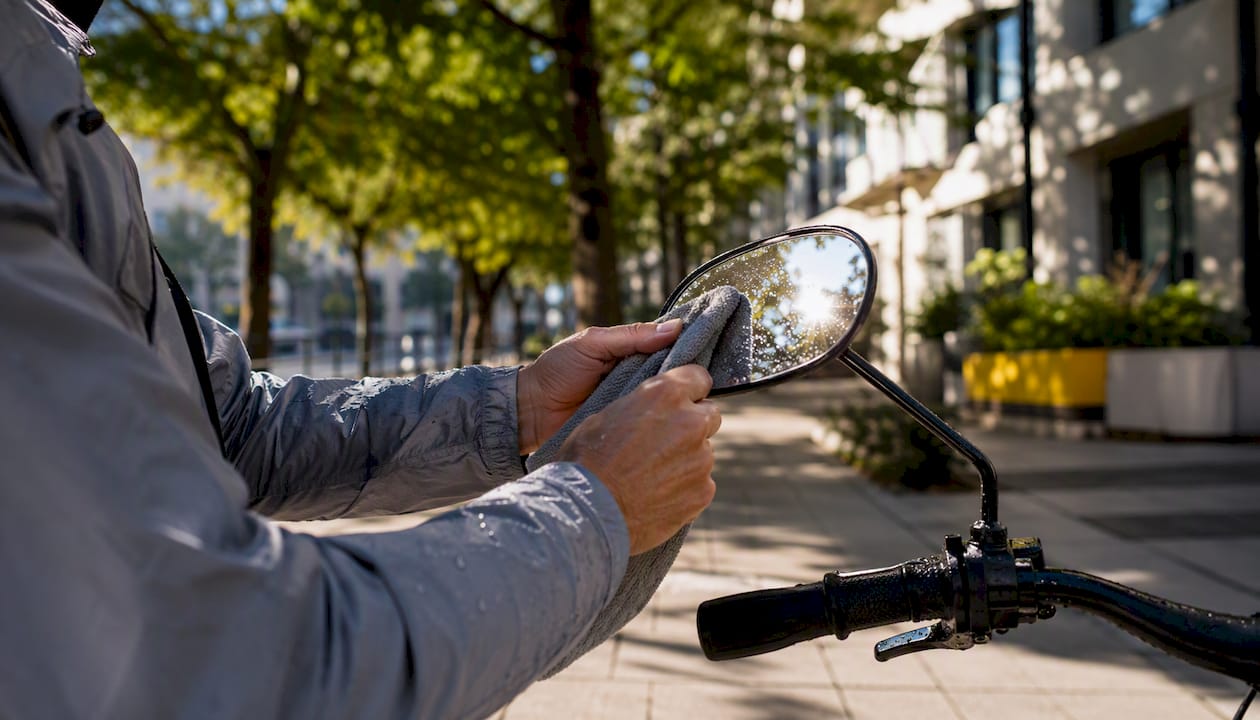
Monthly: Park your bike facing away from a car with headlights on low beam at roughly 50 feet. The rear reflector should be clearly visible. If it looks dim or patchy, inspect for scratches or film delamination.
For smart modules, the Spanninga 360° SmartLED system reports runtimes of 4–18 hours depending on mode. Check battery level before any ride longer than your module’s rated runtime in its current mode.
When to replace: Visible scratches across the retroreflective surface, loss of the bright “mirror” sheen, or any crack in the housing. Molded plastic reflectors degrade faster under UV than microprismatic film, so road cyclists who leave bikes outdoors should inspect plastic units every season.
Environmental note: Microprismatic films use less raw material per unit of retroreflective performance than thick molded plastic, and some manufacturers are moving toward recyclable film substrates. Molded plastic reflectors are generally not recyclable through standard curbside programs. If sustainability matters to you, ask the manufacturer directly about take-back or recycling options before buying.
THE BEAM’s FRAME FLASH: how it fits the 2026 checklist
FRAME FLASH is Thebeamofficial’s minimalist high-visibility reflector, designed to meet the material and mounting standards this guide covers.
- Visibility approach: High-visibility retroreflective construction optimized for driver detection at distance
- Mounting: Secure, low-drag frame attachment designed to stay aligned through road vibration and weather
- Design: Minimalist profile that works on road, gravel, urban, and e-bike frames without adding aerodynamic drag
- Durability: Built for real-world commuting conditions, including wet roads and repeated cleaning
- Compliance: Designed to satisfy 16 CFR §1512.16 requirements for rear reflector placement and optical-axis alignment
FRAME FLASH pairs naturally with Thebeamofficial’s broader safety accessories lineup, including rear lighting and helmet add-ons for riders who want to layer passive and active visibility. For riders interested in urban cyclist safety at night, THE BEAM’s blog covers the material science behind reflector performance in more depth.
Where to find installation tutorials for new reflector designs
Most reflector manufacturers now publish short video tutorials alongside written instructions. For microprismatic film products, the key steps are surface prep (clean, dry, grease-free frame section), peel-and-stick or bracket alignment, and a final optical-axis check. THE BEAM’s installation guide walks through bracket-mount alignment for common road and gravel frame geometries.
For integrated smart modules like the Spanninga 360° SmartLED, Lazer’s product pages include pairing and mode-setup videos. The critical installation step for any helmet-mounted module is verifying the module sits level on the helmet surface so the optical axis matches the rider’s forward direction, not the helmet’s tilt angle.
What riders and experts say about 2026 reflector products
Consumer feedback on microprismatic film reflectors consistently highlights two things: noticeably brighter return at distance compared to the plastic units they replaced, and better durability through wet seasons. Gravel riders in particular report that film-based reflectors hold up through mud and high-pressure washing where cheap plastic units crack or delaminate.
Expert commentary from the cycling safety community points to behavioral lighting as the most meaningful advance. Integrated brake-light detection reduces the gap between a cyclist’s deceleration and a following driver’s awareness, a benefit that passive reflectors simply cannot provide. The caveat, repeated by safety specialists, is that smart modules require charging discipline. A dead module on a dark commute is worse than a simple passive reflector that never needs power.
Environmental impact of new reflector materials
Microprismatic retroreflective films represent a genuine step forward on material efficiency. A thin film layer delivers retroreflective performance that previously required a much thicker molded plastic body, reducing the total polymer mass per reflector. Some film substrates are also moving toward recyclable or bio-based carriers, though this varies by manufacturer and is not yet an industry standard.
Molded plastic reflectors, by contrast, are typically made from polycarbonate or ABS, neither of which is accepted in standard municipal recycling streams. They also tend to be replaced more frequently due to UV degradation and cracking, which compounds the waste footprint over a bike’s lifetime.
The honest picture: no reflector is zero-impact. But choosing a durable, film-based product that lasts longer and uses less material per unit of performance is a meaningful step in the right direction.
Why incremental reflector innovation matters more than you might think
Most cyclists upgrade their helmet or drivetrain long before they think about their reflectors. That’s a mistake, and the 2026 material and behavioral lighting advances make it a more costly one than it used to be.
The gap between a worn molded plastic reflector and a current microprismatic film unit is not marginal. At the angles where drivers are most likely to spot a cyclist — oblique intersections, curved roads, parking lot exits — directional retroreflection makes a real difference. Behavioral lighting adds another layer: a brake flash that fires automatically means the driver behind you gets a signal even when you’re focused on the obstacle ahead and not thinking about your lights.
The crowdfunded AI-signal projects are worth watching but not worth betting your commute on yet. Independently validated, production-ready systems like the Spanninga 360° SmartLED are the practical choice for 2026. Pair one with a compliant passive reflector like FRAME FLASH and you have both bases covered: passive retroreflection that works with zero battery, and active behavioral lighting when you need it.
Pro Tip: If you’re an e-bike commuter, start with the behavioral lighting module first. Higher speeds mean longer stopping distances for following drivers, and an automatic brake flash closes that gap more reliably than any passive reflector.
THE BEAM’s FRAME FLASH is ready when you are
Thebeamofficial built FRAME FLASH for cyclists who want a compliant, low-maintenance reflector that actually performs at distance, without adding bulk to a clean frame setup. It fits road, gravel, urban, and e-bike builds, and it pairs with THE BEAM’s full range of helmet add-ons and rear lighting for riders who want a complete visibility system.
Browse the FRAME FLASH product page for specs, mounting compatibility, and official product photos. Installation guides and fit information are available directly on the site. If you’re building out a full visibility kit, the all accessories collection covers everything from mounts to smart lighting add-ons.
Sources
Official product photos used in this article are sourced from THE BEAM’s website and appear at the end of the article per publishing guidelines.


