

NTA 8776 is the Netherlands Technical Agreement covering helmets for S-EPACs, or speed pedelecs, e-bikes with pedal assistance up to 45 km/h. It’s not a universal legal mandate across Europe, but for anyone riding a vehicle in that speed class, it’s the standard built for the job. The reason: NTA 8776 puts helmets through tougher impact and weather testing than the rules covering conventional bicycle helmets.
TL;DR:
- Helmets for speed pedelecs must pass stricter impact tests, with a maximum head force threshold of 250 g, and undergo dual-anvil impacts to better simulate real-world crashes.
- Certification involves annual surveillance testing and requires manufacturers to maintain production samples, ensuring ongoing compliance and safety performance.
- NTA 8776 is a Netherlands-specific standard not legally mandated worldwide, but it is essential for legal riding of approved speed pedelecs in the Netherlands and some other regions.
- Buyers should verify certification by checking for the exact “NTA 8776:2016” marking and cross-referencing the certificate number with official certification bodies.
- Most helmets bought off-the-shelf are not certified to NTA 8776, so choosing a helmet specifically marked and tested for impacts at speeds up to 45 km/h significantly improves rider safety.
Table of Contents
- What Norme NTA 8776 Covers and Which Bikes It Applies To
- How NTA 8776 Testing Differs From Standard Bicycle Helmet Tests
- Who Certifies NTA 8776 Helmets and How Ongoing Compliance Works
- Is NTA 8776 Required Where You Ride?
- How to Verify a Helmet’s NTA 8776 Certification Before You Buy
- How Thebeamofficial Approaches Speed-Pedelec-Level Safety
- History and Development Background of NTA 8776
- Do NTA 8776 Helmets Actually Perform Better in Real Crashes?
- NTA 8776 Compared to Other Helmet Standards Around the World
- How to Choose the Right NTA 8776 Certified Helmet
- What’s Next for the NTA 8776 Standard
- Where to Verify the Standard Yourself
- Why This Standard Deserves More Attention Than It Gets
- Sources
What Norme NTA 8776 Covers and Which Bikes It Applies To
NTA stands for Netherlands Technical Agreement, a category of standard published through NEN, the Dutch national standardization body. The full document, NTA 8776:2016, was published in 2016 and lays out requirements for construction, field of vision, shock absorption, retention system strength, and marking on the helmet itself.
The vehicles it targets are S-EPACs, electrically power-assisted cycles that keep helping the rider up to 45 km/h rather than cutting off at 25 km/h like a standard e-bike. That gap matters more than it sounds: a crash at 45 km/h generates far more kinetic energy than one at 25 km/h, and a helmet built only for city-bike speeds isn’t engineered to absorb it.
A few things to keep straight when you’re shopping:
- NTA 8776 is a technical specification, not a Europe-wide law. Whether it’s mandatory depends on how your country classifies your bike.
- The standard applies specifically to helmets for speed pedelecs, not to every e-bike on the market.
- Regular pedal-assist bikes capped at 25 km/h generally fall under bicycle helmet rules like EN 1078, not NTA 8776.
How NTA 8776 Testing Differs From Standard Bicycle Helmet Tests
The test bench is where this standard earns its reputation. Helmets get struck against both a flat anvil and a curbstone-shaped anvil, simulating a flat road impact and a sharper edge hit, respectively. A triaxial accelerometer inside the test headform records exactly how much force reaches the head on both impacts.
Pro Tip: If a helmet’s spec sheet only mentions one impact test, ask which anvil shape it used. Dual-anvil testing catches injury risks a single flat-surface test can miss entirely.
The pass threshold is strict: maximum head force cannot exceed 250 g, a tighter ceiling than what many bicycle helmet certifications require. Force above that level correlates with a much higher risk of serious brain injury.
NTA 8776 also runs helmets through environmental conditioning before impact testing:
- Cold exposure, checking that the shell and foam don’t become brittle in winter conditions.
- Heat exposure, checking that materials haven’t softened or degraded.
- Simulated rain, checking that moisture hasn’t compromised the retention system or padding.
A helmet that performs well at room temperature can behave differently on a cold, wet commute. Testing under those conditions closes that gap rather than assuming lab conditions match the road.
Who Certifies NTA 8776 Helmets and How Ongoing Compliance Works
Certification runs through the NCS 8776 scheme, managed under NEN’s framework and carried out by accredited testing laboratories such as Kiwa. Getting certified isn’t a one-time lab visit. It’s an ongoing relationship between the manufacturer and the certifying body.
Here’s what that relationship actually requires:
- Manufacturers must use labs accredited specifically for NTA 8776 testing, not just any general safety lab.
- Certified production lines undergo yearly surveillance testing, meaning the lab pulls samples from actual retail stock, not just prototypes.
- Manufacturers must keep production samples available so the certifying body can re-test at any point.
- A certificate can be suspended or revoked if a helmet no longer meets spec, which means the model on the shelf today should match what was originally certified.
That surveillance layer is what separates a real NTA 8776 certificate from a helmet that simply resembles one. If a brand skips it, there’s no ongoing check that mass-produced units still perform the way the original test sample did.
Is NTA 8776 Required Where You Ride?
Legal status depends entirely on how your country classifies your bike, and that classification is not consistent across Europe. In the Netherlands, riders of approved speed pedelecs are required to wear an approved helmet, and NTA 8776 is the recognized standard for that vehicle class. Other countries draw the line differently, and some accept different homologations for similar vehicles.
A few practical notes if you ride across borders or just want clarity:
- Check the vehicle classification rules in the country you’re riding in, not just where you bought your bike.
- If you’re traveling with a speed pedelec, don’t assume a helmet approved at home automatically satisfies rules elsewhere.
- Riders on standard 25 km/h e-bikes are generally not legally required to wear an NTA 8776 helmet, since that standard targets faster S-EPACs specifically.
- Even where it’s not legally required, choosing a certified helmet built for higher-speed impacts is the safer call given the physics involved.
Laws lag behind the vehicles they’re supposed to regulate. Speed pedelecs blur the line between bicycle and moped, and legislation is still catching up in a lot of jurisdictions.
How to Verify a Helmet’s NTA 8776 Certification Before You Buy
A helmet that looks aerodynamic and aggressive isn’t automatically certified. The only way to know for sure is to check the documentation, not the shape of the shell.
- Look for the exact marking. Check the interior padding, the packaging, or the included manual for the text “NTA 8776:2016.” If it’s missing entirely, treat that as a red flag rather than an oversight.
- Ask for the certificate number. A legitimate retailer or manufacturer should be able to provide the certificate number and the name of the issuing body without hesitation.
- Cross-check with the certification body. NEN and accredited labs like Kiwa maintain records tied to certified models, so a certificate number should be traceable back to a real, active listing.
- Check coverage area. NTA 8776 helmets extend protection to the temples and back of the head, areas conventional bicycle helmets often leave more exposed, given the standard’s larger coverage requirements.
- Test the retention system and field of vision. A helmet built for 45 km/h needs a strap system that won’t shift under wind resistance, and a visor or brim that doesn’t cut into your peripheral vision at speed.
Pro Tip: Save the certificate number and seller confirmation in writing. If you ever need to file an insurance claim after a crash, proof that your helmet met the applicable safety standard at time of purchase can matter.
Buy from sellers who volunteer this documentation rather than making you dig for it. If a listing goes quiet on specifics, that’s usually the answer to whether the claim is real. For riders specifically shopping for a speed pedelec helmet, matching the certification to the actual vehicle class is the whole point of the exercise.
How Thebeamofficial Approaches Speed-Pedelec-Level Safety
Thebeamofficial is a brand focused on high-end cycling safety equipment, emphasizing helmet performance at real-world speeds in its design approach. The VIRGO full-face helmet integrates MIPS technology, engineered to manage the rotational forces that a straight impact test doesn’t fully capture.
We publish detailed breakdowns comparing NTA 8776 against EN 1078 and explain helmet certification terminology so buyers aren’t left guessing what a mark on a box actually guarantees. Beyond helmets, we sell rearview mirrors, high-visibility reflectors, and connected safety accessories aimed at closing the visibility gap that causes a lot of e-bike collisions before impact ever becomes a factor. Product photos and detailed spec pages are available on our site for readers who want to see the construction up close.
History and Development Background of NTA 8776
Speed pedelecs didn’t exist in meaningful numbers when most bicycle helmet standards were written decades ago, and that gap is exactly what prompted NTA 8776. As pedal-assist bikes capable of 45 km/h started showing up on Dutch cycle paths, regulators and safety engineers recognized that a helmet certified for casual cycling wasn’t built to handle impacts at moped-adjacent speeds.
NEN published NTA 8776 in 2016 as a Netherlands Technical Agreement, a designation used for standards developed faster than a full European harmonized standard but still built through structured technical committee input. The timing tracked closely with the Netherlands formally classifying speed pedelecs as a distinct vehicle category requiring approved helmets, since the country was already moving toward mandatory helmet use for that specific vehicle class.
What makes the standard’s development notable is its focus: rather than trying to create one helmet standard for every type of cycling, NEN scoped NTA 8776 narrowly to S-EPACs. That decision let the technical committee set stricter impact thresholds and add environmental testing without watering down requirements to cover slower, lower-risk bicycles too. It’s a standard built around a specific speed bracket and the injury patterns that come with it, not a general-purpose helmet rulebook stretched to fit a new category of vehicle.
Do NTA 8776 Helmets Actually Perform Better in Real Crashes?
The clearest evidence comes from the test bench itself rather than crash statistics, since real-world injury data broken down by helmet certification standard isn’t widely published. What is measurable is the gap between what NTA 8776 demands and what many conventional helmet standards allow through.
The 250 g maximum head force threshold is the headline figure, but the dual-anvil approach matters just as much. A curbstone impact concentrates force on a smaller area than a flat-surface hit, which is closer to what actually happens when a rider goes down at speed and their head catches a curb edge, a pothole rim, or a road marking. Testing against both surfaces means a certified helmet has proven it can spread that force rather than transmitting it directly to the skull.
Extended coverage across the temples and back of the head adds a second layer of real-world relevance. Higher speeds change the angle and force of typical falls, and a helmet that stops at the ears leaves exactly the regions most exposed in a sideways or backward tumble unprotected. Combined with environmental testing, a certified helmet’s performance profile holds up whether the crash happens on a dry summer commute or a freezing, rain-slicked evening ride home. That combination, tighter force limits, dual impact geometry, and weather resilience, is what separates the standard from a helmet that simply looks aggressive enough for higher speeds.
NTA 8776 Compared to Other Helmet Standards Around the World
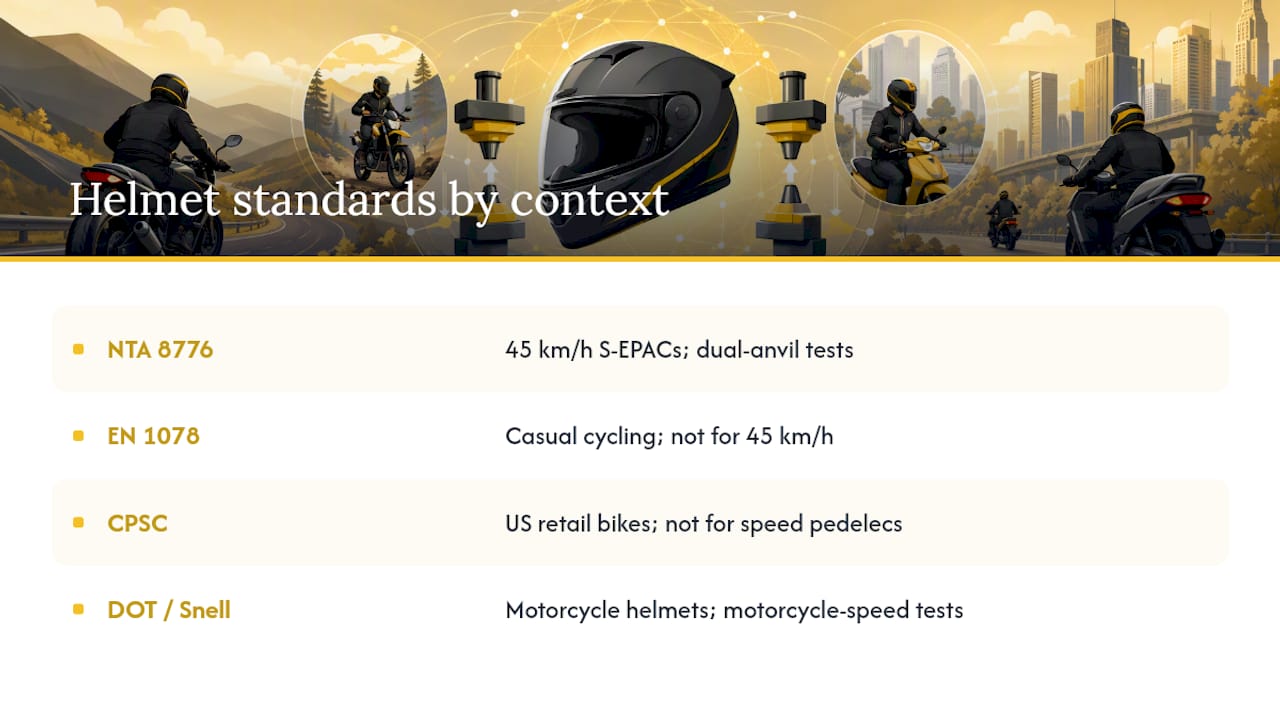
EN 1078 governs conventional bicycle helmets across Europe and remains the baseline most riders are familiar with, but it wasn’t written with 45 km/h impacts in mind. NTA 8776 sits above it specifically for S-EPACs, with the lower head force threshold and dual-anvil testing covered earlier doing the heavy lifting.
Outside Europe, the comparison looks different again. In the United States, the CPSC standard governs bicycle helmets sold at retail, and it wasn’t designed around speed pedelec risk profiles either. Some faster e-bikes in the US market get classified closer to mopeds, which can trigger motorcycle helmet requirements (typically DOT or Snell certified) instead of bicycle standards altogether. That’s a meaningfully different testing regime, built around motorcycle-speed impacts rather than the specific 45 km/h bracket NTA 8776 targets.
The practical takeaway for anyone comparing standards: certification names aren’t interchangeable just because they all say “helmet standard” on the label. EN 1078 tells you a helmet is built for casual cycling speeds. CPSC tells you it clears a similar bar for the US market. NTA 8776 tells you something more specific, that the helmet has been tested against the higher-speed impact profile and environmental stress that speed pedelecs actually produce. If you’re riding a vehicle that can hit 45 km/h under motor assistance, matching the certification to that speed bracket matters more than matching it to whatever standard happens to be most common in your country.
How to Choose the Right NTA 8776 Certified Helmet
Start with your actual riding profile before comparing specs. A speed pedelec commuter riding daily in mixed weather has different priorities than someone who rides a certified S-EPAC occasionally on dry weekend routes, and the environmental testing built into NTA 8776 matters more the more variable your riding conditions are.
Fit deserves as much attention as certification status. A helmet can carry a valid NTA 8776 mark and still fail you in practice if the retention system doesn’t hold steady at speed or the visor cuts into your field of vision during head checks. Try helmets on with the same layers you’d actually wear riding, since a helmet that fits over a bare head can sit differently over a beanie or winter liner.
Weigh coverage against ventilation honestly. The extended temple and back-of-head protection required by NTA 8776 sometimes means less airflow than a stripped-down road helmet, and that tradeoff is worth accepting for the speed bracket these helmets are built for. If a model advertises NTA 8776 compliance but looks nearly identical to a standard commuter helmet with minimal coverage, ask more questions before buying.
Finally, treat price as a signal but not the whole story. Accredited lab testing, yearly surveillance, and production sample retention all cost manufacturers money, and that cost tends to show up somewhere in the retail price. A certified helmet priced dramatically below comparable models is worth a closer look at the paperwork, not just the price tag.
What’s Next for the NTA 8776 Standard
NTA 8776 hasn’t seen a major public revision since its 2016 publication, but the standard exists in a category built for iteration. Netherlands Technical Agreements are designed to move faster than full harmonized European standards specifically so they can be updated as the vehicles they cover keep changing.
Speed pedelecs themselves have evolved since 2016. Battery capacity, motor torque, and top-assisted speeds have all shifted as manufacturers push the category further, and helmet designers have introduced features like integrated lighting and sensor systems that didn’t exist when the original test methods were drafted. Any future revision would likely need to account for those additions without loosening the core impact and environmental thresholds that make the standard meaningful in the first place.
Watch for movement at the European level too. As speed pedelec adoption grows across more countries, there’s ongoing pressure to harmonize vehicle classification and helmet requirements rather than leaving each country to draw its own lines. Whether that results in a European-wide standard absorbing NTA 8776’s requirements, or simply wider adoption of the existing standard as the reference point, is still an open question. For now, checking NEN’s official listing directly remains the most reliable way to confirm whether the current version is still 2016 or has been superseded.
Where to Verify the Standard Yourself
The NEN NTA 8776 listing is the primary source for the standard’s official scope and requirements. For technical breakdowns of the impact and environmental test procedures, ACT Lab’s testing overview walks through the dual-anvil methodology in detail. The Kiwa certification scheme document covers exactly how conformity and surveillance testing work. Thebeamofficial’s own helmet standard comparison offers a practical buyer’s angle on top of the formal documentation.
Why This Standard Deserves More Attention Than It Gets
Most riders shopping for an e-bike helmet default to whatever certification is most familiar, usually EN 1078, without checking whether their bike’s speed bracket actually calls for something stricter. That’s the gap NTA 8776 exists to close, and it’s the part conventional buying advice tends to skip entirely.

The overrated piece of conventional wisdom here is the assumption that “certified” means the same thing across every helmet on a shelf. It doesn’t. A helmet cleared for 25 km/h impacts and one cleared for 45 km/h impacts under NTA 8776 are answering fundamentally different questions about force and coverage, and a rider on a genuine speed pedelec wearing the wrong one is carrying real, measurable risk they probably don’t know about.
What actually matters, based on everything the testing data shows, is the verification step most buyers skip. Checking for the “NTA 8776:2016” marking and asking for a certificate number takes two minutes and separates a genuinely tested helmet from one that just looks the part. Prioritize that over brand reputation or visual styling. The 250 g force threshold and dual-anvil testing only protect you if the helmet in your hands actually earned that certification, not just borrowed its aesthetic.
— Sophie
Explore Thebeamofficial’s safety accessories, including the FRAME FLASH high-visibility reflectors, designed to pair with a properly certified helmet for full-coverage protection on speed pedelec rides. For riders assembling or upgrading their own e-bike power setup alongside safety gear, AkkuPlus’s e-bike battery packs are worth a look. And if you’re curious what a community of safety-focused riders looks like in action, check out The Beam’s ultracycling event.
Sources
- NTA 8776:2016-12 en — NEN
- NTA-8776 Standard & Testing - ACT LAB
- NCS 8776 certification scheme to NTA 8776 — Kiwa (RD_130_06)


